

Connect with us


Corporate Video


Top Use Cases of Agentic RAG Systems in eCommerce Development
.jpg)
The eCommerce landscape is evolving faster than ever. Companies that once competed on product selection and shipping speed now face a new reality: customers expect AI-powered personalization, instant support, and frictionless shopping experiences. Traditional approaches to customer engagement simply don't scale anymore.
Agentic RAG is reshaping how eCommerce businesses operate. Unlike conventional systems that retrieve and respond in a single step, agentic RAG empowers AI agents to reason, plan, and act autonomously across multiple data sources. For eCommerce, this means smarter product recommendations, faster customer support, optimized inventory management, and real-time decision-making that drives revenue growth.
For companies seeking to scale efficiently with eCommerce development services, understanding how agentic RAG can be applied across operations is crucial. This guide explores the top use cases, technical architecture, implementation roadmap, and strategic considerations for adopting agentic RAG in eCommerce.
Why eCommerce Companies Need Agentic RAG Systems
The challenge facing modern eCommerce businesses is multifaceted. You're managing thousands of products with variants, prices that fluctuate hourly, inventory that depletes in real-time, and customer expectations that grow by the day. Meanwhile, your legacy systems, order management platforms, CRM tools, knowledge bases, and pricing engines operate in silos.
A customer asks: "I want a blue winter jacket under $150 that's in stock in my size and ships today." Traditional eCommerce search fails here. Keyword matching returns generic results. Customers get frustrated. You lose sales.
This is where agentic RAG changes everything. Instead of a simple retrieval-and-response mechanism, agentic RAG deploys intelligent AI agents that can:
- Break down complex queries into logical steps
- Access multiple data sources simultaneously (product catalog, inventory, pricing, policies)
- Reason about constraints (size availability, shipping restrictions, budget limits)
- Adapt their approach if the initial information is incomplete
- Deliver contextual, accurate answers that convert browsers into buyers
The business impact is measurable. Companies implementing agentic RAG for product discovery report 25-45% increases in conversion rates. Customer support teams see 60-80% reduction in escalations. Inventory teams prevent stockouts through predictive analysis. For eCommerce, this isn't just an upgrade; it's a competitive advantage.
Agentic RAG vs. Traditional RAG: What eCommerce Teams Need to Know
Before diving into specific use cases, it's essential to understand why agentic RAG differs fundamentally from traditional RAG.
Traditional RAG follows a fixed, linear process:
- User asks a question
- System retrieves relevant documents
- LLM generates a response using that context
- Response is delivered
This works well for documentation search or simple FAQs. But eCommerce queries are rarely simple. They're multi-faceted, requiring context from inventory systems, pricing engines, CRM platforms, and policy documents simultaneously.
Agentic RAG introduces autonomous decision-making:
- Agent receives a query
- Agent analyzes the query and creates a plan
- Agent decides what to retrieve and from where
- Agent retrieves information from multiple sources
- Agent evaluates if it has enough context
- Agent refines and retrieves again
- Agent reasons about the complete picture
- Agent generates a response or triggers an action
For eCommerce, partnering with an AI agent development company allows a single intelligent agent to handle a customer return request like checking order history, verifying return policies, confirming inventory, and assessing warehouse capacity all in one seamless interaction, with no human intervention required.
The system doesn't just answer questions; it intelligently decides how to answer them, adapts when it doesn't have complete information, and sometimes takes action.
Best Agentic RAG Use Cases for eCommerce Businesses
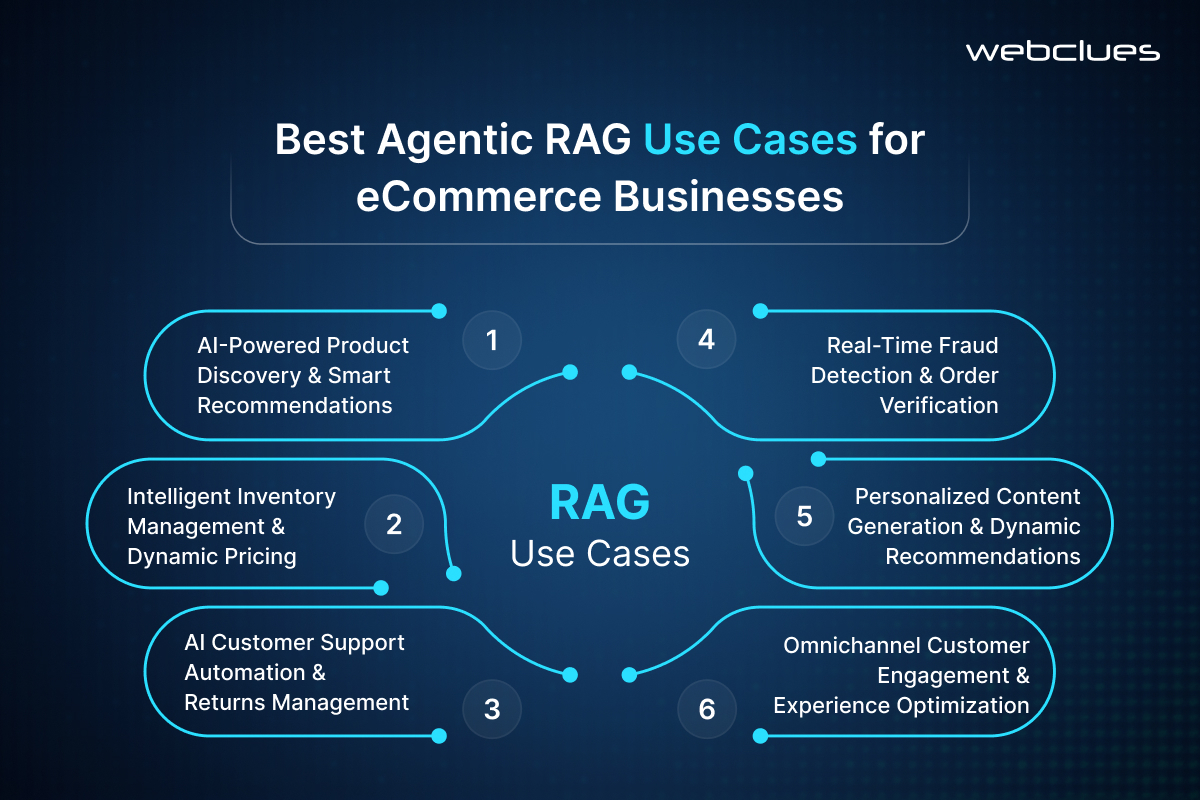
AI-Powered Product Discovery & Smart Recommendations
Product discovery is the heartbeat of eCommerce. When a customer can't find what they're looking for, you've lost them.
Traditional eCommerce search relies on keyword matching and basic filters. A customer searching for "sustainable running shoes for flat feet" gets bombarded with results that match some criteria but miss the mark on others. The experience is frustrating and conversion rates suffer.
Agentic RAG transforms this. An intelligent agent can:
- Understand the semantic meaning of "sustainable" and "flat feet"
- Search product descriptions, customer reviews, and technical specs
- Cross-reference with inventory and sizing data
- Rank results by availability in the customer's location
- Present personalized recommendations with context ("Based on similar customers' preferences, here's why we recommend these three options")
The impact is substantial. Customers spend less time searching and more time buying. Average order value increases because recommendations feel relevant, not random. Conversion rates improve by 25-40% in pilot implementations.
The technical challenge: eCommerce data is multimodal. Products have text descriptions, images showing actual colors and styles, structured metadata (size charts, weight, dimensions), and dynamic data (price, stock levels). Agentic RAG handles this by treating images, text, and metadata as distinct information sources that agents can query based on the customer's intent.
Intelligent Inventory Management & Dynamic Pricing
Behind every eCommerce operation is a complex inventory puzzle: stock levels, supplier lead times, demand forecasts, and margin targets all pulling in different directions. Most teams solve this through manual spreadsheet work and static rules. The result? Stockouts, overstock, and lost revenue.
Agentic RAG enables autonomous inventory management. Imagine an agent that answers: "Which suppliers can deliver 500 units of SKU-1234 within 5 days, considering current stock levels and demand forecasts?"
The agent can:
- Query warehouse inventory systems
- Access supplier lead time data
- Review demand forecasts from analytics platforms
- Check contractual terms and pricing
- Generate a data-backed recommendation in seconds
Dynamic pricing becomes possible, too. An agent continuously monitors:
- Competitor pricing (via web scraping and API feeds)
- Inventory levels and velocity
- Demand patterns and seasonality
- Margin targets and promotional calendars
When conditions change, a competitor drops their price, inventory spikes, and demand softens, the agent can recommend pricing adjustments in real-time. Early adopters report 15-25% margin improvements and 40% reduction in overstock situations.
The operational benefit extends beyond numbers. Supply chain teams spend less time digging through data and more time executing decisions. Manual research drops by 60%.
AI Customer Support Automation & Returns Management
Customer support is where many eCommerce operations leak revenue. A customer's simple question becomes a frustration when they're passed between departments, asked to repeat information, or given inconsistent answers.
Consider a complex customer inquiry: "I ordered item X as a gift but need to return it. I lost the receipt, and I'm outside the standard return window. Can I still return it? If not, can you exchange it for a different size?"
Traditional support systems fail here. A chatbot doesn't have context across order history, return policies, and current inventory. A human agent needs to log into multiple systems, check policies, and make judgment calls. It's slow and inconsistent.
Agentic RAG enables end-to-end resolution. An intelligent AI chatbot development can:
- Retrieve the customer's order history and gift purchase details
- Access return and exchange policies
- Check current inventory for alternative sizes
- Evaluate whether an exception is warranted based on customer history
- Generate a personalized solution that keeps the customer happy
Real implementations show 60-80% of customer queries resolved without human intervention. Support ticket volume drops significantly. CSAT scores improve because customers get accurate, personalized answers immediately.
The agent integrates seamlessly with CRM systems, order management platforms, and policy databases. When integrated properly, it handles returns, exchanges, warranty questions, shipping inquiries, and product questions—the bulk of support volume.
Real-Time Fraud Detection & Order Verification
Fraud is a persistent eCommerce challenge. Rule-based systems flag transactions based on rigid criteria: billing address doesn't match shipping address, card declined twice, order exceeds typical customer purchase. The problem? These rules create false positives that frustrate legitimate customers and false negatives that let fraud slip through.
Agentic RAG enables intelligent fraud detection. Instead of static rules, agents reason about the complete picture:
- A first-time customer orders a high-value item to a new address (red flag)
- But their email has been registered for 6 months, they've browsed the site extensively, and the device fingerprint is consistent (reassuring signals)
- Shipping address is in a known fraud hotspot, but payment method is from the same region and has been verified (mixed signals)
The agent weighs all these signals and makes a probabilistic decision: approve, flag for review, or deny. Machine learning improves these decisions over time as agents learn which patterns actually correlate with fraud.
The operational benefit is clear: false positive rates drop by 30-50%, reducing unnecessary order holds and customer frustration. Actual fraud detection rates improve by 20-30% because agents catch sophisticated patterns that rigid rules miss.
Personalized Content Generation & Dynamic Recommendations
Modern eCommerce is about more than transactions—it's about engagement. Email marketing, product recommendations, content creation, and post-purchase communication determine customer lifetime value.
Agentic RAG enables personalized content at scale. An agent can:
- Review a customer's purchase history and browsing behavior
- Access product knowledge bases, inventory status, and margin data
- Generate personalized product descriptions tailored to the customer segment
- Create buying guides specific to the current inventory
- Compose follow-up emails with context ("You purchased a coffee machine 3 weeks ago—here's how to descale it, plus these complementary products")
The impact is quantifiable: personalized email campaigns achieve 3-5x higher click rates than generic promotions. Repeat purchase rates increase by 20-35%. Customer lifetime value grows substantially because every touchpoint feels relevant, not automated.
How Agentic RAG Works: eCommerce Architecture Explained
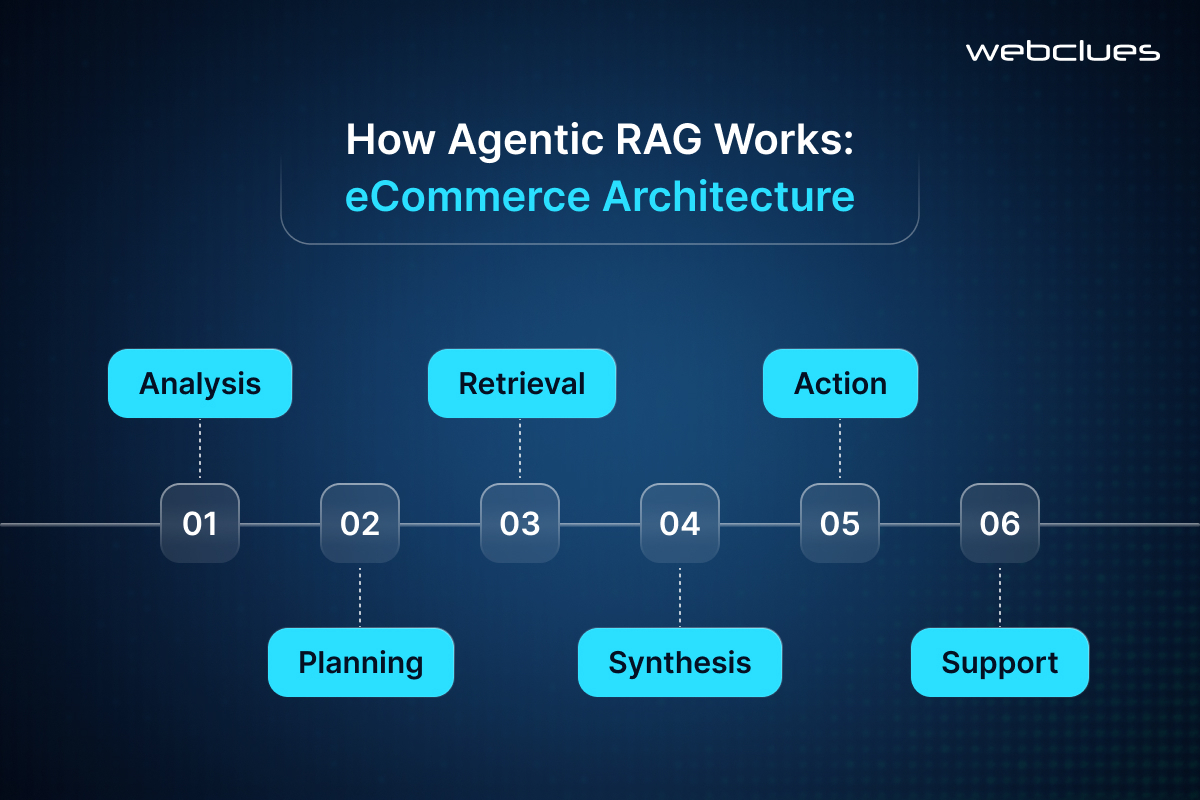
Understanding agentic RAG's technical architecture helps eCommerce leaders make informed decisions about implementation. The intelligent workflow operates as a continuous loop:
Query Analysis: When a customer submits a request, an agent first analyzes the query to understand the true intent. A question like "Show me black shoes" might reveal deeper intent: comfortable shoes for standing all day, work-appropriate, within a specific budget, in stock immediately.
Planning: The agent creates a multi-step plan. For the shoe example: First, retrieve products matching "black shoes"; second, filter for comfort ratings and work-appropriate styling; third, check inventory and pricing; fourth, rank by customer reviews and return rate.
Retrieval & Reasoning: The agent executes its plan, pulling data from product databases, inventory systems, pricing engines, and customer review platforms. It evaluates whether it has sufficient context. If not, it refines queries and retrieves additional information.
Synthesis & Response: Once confident it has complete information, the agent synthesizes findings into a personalized response with recommendations, explanations, and next steps.
Action Triggering: In some cases, agents can take action—updating a cart, initiating a return, adjusting pricing, or flagging a suspicious order.
The agent types supporting eCommerce operations include:
- Routing agents that decide which system to query (product catalog vs. inventory vs. pricing)
- Validation agents that verify information accuracy across systems
- Synthesis agents that combine data from multiple sources into coherent responses
- Action agents that execute decisions (applying discounts, processing returns, initiating shipments)
Data pipeline requirements are critical. Product data must be fresh, consistent across systems, and properly structured. This is why Change Data Capture (CDC) patterns matter—they automatically propagate inventory updates, price changes, and new products through the system without manual intervention.
eCommerce Agentic RAG Implementation Roadmap
Implementing agentic RAG is a journey, not a switch. Most successful deployments follow a phased approach with the help of an expert eCommerce development company.
Phase 1: Assessment & Foundation (Months 1-2)
Start by evaluating your current state. Document your eCommerce platform (Shopify, WooCommerce, custom build), identify critical business problems (customer support, product discovery, inventory management), and assess data readiness.
Data readiness is the biggest differentiator. If your product data is scattered across spreadsheets, APIs, and manual entries—with inconsistent formats and outdated information—you'll struggle. Invest in data quality first. Consolidate product information, establish single sources of truth for inventory and pricing, and implement real-time synchronization between systems.
Choose an appropriate agent framework. Popular options include LangChain (flexible, open-source), LlamaIndex (focused on data indexing), AWS AgentCore (enterprise-grade), and Databricks (for data-heavy operations). Your choice depends on platform preferences, in-house expertise, and budget constraints.
Identify your highest-impact use case. Don't try to solve everything at once. Customer support automation, product discovery, or inventory optimization—pick one where success is measurable and achievable within 6 months.
Phase 2: Development & Testing (Months 2-4)
With the foundation in place, begin development. Integrate your agent framework with critical systems: product catalogs, order management, CRM platforms, and knowledge bases.
Build robust data pipelines. This is where architecture decisions matter most. Implement CDC to synchronize inventory and pricing changes automatically. Set up proper logging and monitoring so you can track agent behavior, identify bottlenecks, and debug issues.
Test extensively against real-world scenarios. Generate thousands of customer queries, product discovery requests, or support tickets. Measure success metrics: resolution accuracy, latency, cost per interaction.
Iterate based on testing results. Agents might consistently struggle with certain query types (typos in product names, ambiguous size questions, edge cases). Refine agent behavior, improve training data, and strengthen data quality.
Phase 3: Launch & Continuous Improvement (Months 4-6)
Gradual rollout is critical. Start with internal teams or a small customer segment. Monitor performance closely. Measure KPIs: conversion rate improvements (for product discovery), support ticket reduction (for customer support), and inventory accuracy (for inventory management).
Gather feedback and iterate. Agents aren't set-and-forget. They improve over time as they process more queries, learn from failures, and adapt to new product categories or seasonal patterns.
Plan for scaling to additional use cases. Once you've proven value with one application, the infrastructure supports rapid expansion. Your next use case (fraud detection, dynamic pricing) can be deployed in 4-6 weeks instead of 4-6 months.
Common Challenges When Implementing Agentic RAG for eCommerce
Several obstacles trip up eCommerce teams implementing agentic RAG.
Data Quality Issues: eCommerce data is messy. Product descriptions vary in length and detail. Image quality differs. Inventory feeds occasionally malfunction. Size charts are inconsistent across categories. Agents struggle with poor data quality. Invest in data governance upfront.
Real-Time Synchronization: Pricing changes hourly. Inventory updates constantly. If your agent consults stale data, recommendations become wrong. CDC patterns and event-driven architectures are essential, not optional.
Integration Complexity: eCommerce platforms often use legacy systems for order management, separate tools for CRM, and different databases for inventory. Integrating agents with this ecosystem is non-trivial. API documentation might be outdated. Systems might not support real-time queries. Budget time for integration work.
Lack of Observability: When an agent makes a poor recommendation or takes a wrong action, can you trace why? Without proper logging, debugging becomes impossible. Implement comprehensive logging from day one.
Over-Engineering: Teams sometimes try to build perfect agents upfront. Start simple. Solve one problem well. Scale after proving value.
Why Hiring Experienced eCommerce Developers Matters
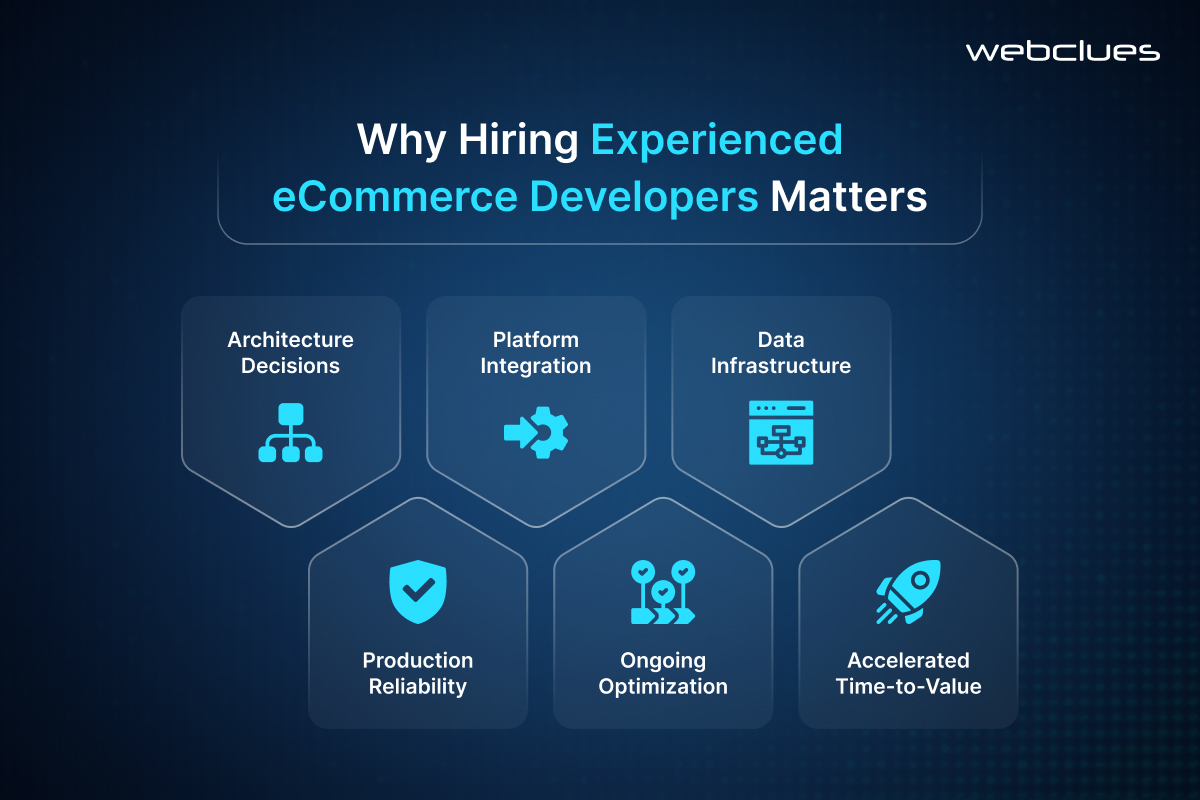
Implementing agentic RAG isn't a simple software deployment. It requires deep expertise across multiple domains.
Architecture Decisions: Should you start with a single intelligent agent or a multi-agent system? How do you handle agent failures? Where do you cache results to optimize latency? These decisions, made early, determine success or failure. Experienced eCommerce teams have learned these lessons through failures.
Platform Integration: Shopify's GraphQL API differs from WooCommerce's REST API, which differs from custom platforms. Experienced teams understand these nuances and avoid common pitfalls.
Data Infrastructure: Building robust data pipelines with CDC, event streaming, and real-time synchronization requires systems engineering expertise. Many startups underestimate this complexity.
Production Reliability: Once agents handle customer-facing operations—processing returns, flagging fraud, generating recommendations—failures have business impact. Experienced teams implement proper monitoring, alerting, and fallback mechanisms.
Ongoing Optimization: Agents improve over time as teams refine training data, tune parameters, and adapt to new business needs. This requires continuous attention, not a one-time implementation effort.
Partnering with an experienced eCommerce development services provider accelerates time-to-value, reduces costly mistakes, and ensures production reliability. The investment in expert guidance typically pays for itself within months through avoided missteps and faster deployment.
The Future of AI in eCommerce: What's Next Beyond Agentic RAG
Agentic RAG is transformative today, but the evolution continues.
Multimodal Agents: Future systems will seamlessly handle text, images, video, and audio. A customer asking "Do you have something like this?" (while pointing to an image) will get intelligent, context-aware responses.
Real-Time LLMs: Current LLMs process queries sequentially. Emerging real-time models will enable faster decision-making and more interactive agent-customer conversations.
Autonomous Workflows: Tomorrow's agents will manage complete end-to-end workflows—processing an order, verifying payment, triggering fulfillment, handling customer issues, and optimizing future recommendations—all autonomously.
Building for these futures requires eCommerce teams to invest in flexible, modular architectures today. Choose platforms and frameworks that support evolution. Prioritize data quality. Build observability and logging from the start.
How to Get Started with Agentic RAG for Your eCommerce Platform
Ready to implement agentic RAG? Here's your checklist
- Define Your Highest-Priority Use Case: Which business problem causes the most pain? Customer support volume, product discovery conversion, inventory management complexity? Start there.
- Set Measurable KPIs: Before building, define success. For product discovery: conversion rate improvement. For customer support: ticket reduction and CSAT improvement. For inventory: stockout prevention and overstock reduction.
- Assess Your Data Readiness: Audit product data quality, inventory system accuracy, and pricing feed consistency. Plan any necessary cleanup or consolidation.
- Start with a Pilot Program: Don't launch company-wide immediately. Test with a specific customer segment, product category, or business function. Learn before scaling.
- Partner with Experienced eCommerce Development Teams: Choose an eCommerce Development Agency with proven expertise in agentic AI, eCommerce platform integration, and data infrastructure. Their experience accelerates success and prevents costly mistakes.
- Plan for Long-Term Scaling: View agentic RAG as a capability you'll expand across multiple use cases over 12-24 months, not a one-off project. Build infrastructure and expertise with this trajectory in mind.
Get Competitive Advantage for an eCommerce Store with Agentic RAG Systems
Agentic RAG is no longer experimental technology. Leading eCommerce companies are deploying it today to improve product discovery, optimize customer support, manage inventory intelligently, detect fraud, and drive personalization at scale. The business impact is measurable: higher conversion rates, increased customer lifetime value, operational efficiency, and competitive advantage.
The companies winning in eCommerce today aren't those with the most products or the fastest shipping, they're those delivering the most intelligent, personalized customer experiences. Agentic RAG makes this possible.
Your eCommerce business can be next. Start by identifying your highest-impact use case, assessing data readiness, and partnering with an experienced eCommerce development company who understand both the technology and the unique demands of eCommerce operations.
The future of eCommerce is intelligent, autonomous, and agentic. The question isn't whether to adopt agentic RAG, but when and whether you'll lead or follow.
Ready to transform your eCommerce operations with agentic RAG? Contact us to get started with expert Agentic AI-driven solutions that boost conversions and streamline workflows.
Post Author

Vedansh Kanodia
Vedansh Kanodia, a dynamic Business Development Executive at WebClues Infotech, is a passionate technocrat who helps businesses embrace innovation, and unlock new possibilities with his valuable perspectives.


Build Your Agile Team
Hire Skilled Developer From Us
Unlock AI-Powered eCommerce Growth with Agentic RAG
Supercharge your online store with agentic RAG systems. Automate customer support, optimize inventory and pricing, and deliver hyper-personalized recommendations—all in real time. Partner with expert eCommerce developers to implement AI agents that convert browsers into buyers, reduce operational bottlenecks, and scale revenue effortlessly. Start your pilot today and lead the next wave of intelligent eCommerce innovation.
Connect Now!Frequently Asked Questions
Our Recent Blogs
Sharing knowledge helps us grow, stay motivated and stay on-track with frontier technological and design concepts. Developers and business innovators, customers and employees - our events are all about you.