
Connect with us


Corporate Video

AI Chatbot Development in 2026: Should Companies Build or Buy?
.png)
AI has now reached a turning point for use in business. 70% of enterprise customer interactions will be AI-driven in 2026, indicating a fundamental shift in how people will expect to engage with a brand. (Source: Gartner)
For businesses, the issue is no longer if AI chatbots will be used, but how to determine if a custom solution should be built or if a solution should be purchased. This issue is more pressing than ever given that conversational AI has transitioned from a support level cost to an operational revenue driver and customer experience differentiator.
Choosing the right model vs. the wrong model is a significant determinant of whether or not personalization, automated tasks at an accelerated rate, and operational intelligence is unlocked or whether costs continue to escalate with minimal changes to processes and numerous limitations in user adoption. Businesses are now evaluating build vs. buy in the following aspects: operations, ownership of data, pricing strategy (long term), level of security, complexity of automation, and strategy for customer experience (CX).
WebClues, an AI chatbot development company with over 50 custom deployments and over 3 million automated conversations, has experienced the effects of this more than other companies. The impact of the final decision surrounding support metrics is more significant than average in the areas of revenue, customer retention, product adoption, and overall customer satisfaction.
This guide provides an approach for making evaluations that take ROI, scalability, depth of integration, and long-term ownership into consideration, allowing company leadership to choose an AI chatbot model that helps enable sustainable business development.
How the Build vs Buy Decision Changed for 2026
The implications of AI chatbot strategy as of 2026 are a world apart from what companies evaluated 3 years prior. The first chatbot designs were rudimentary rule-based automations that focused on FAQs and interactions driven through menu selection.
Generative AI chatbots on the other hand, with LLM fine-tuning, autonomous workflows and real-time contextual retrieval, have shifted chatbots from being a rudimentary response reacting to user input to being an integral partner providing strategic intelligence throughout the customer life cycle.
Historically, purchasing a chatbot platform assumed faster, streamlined implementation and lower costs. This however, has shifted across five key areas.
AI has shifted to being a primary experience interface rather than a supporting human presence.
The conversation data that was primarily used for accurate response generation has become a proprietary asset used for recommendations, forecasting, and product insights.
AI model governance has become a key consideration to prevent loss of control. This includes domain expertise, preventative measures for controlled hallucination, and audit trails.
The gap between “AI that answers” and “AI that acts” has widened, resulting in the loss of basic automation capabilities as a strategic advantage.
Adoption maturity across different industries entails that the same platform will not be compatible with every organization's strategy.
The decision to buy or build is not simply a personal choice, it now impacts competitive positioning, automation efficiencies, trustworthiness, compliance risk, and differentiation in the marketplace. Leaders need to consider the decision as a potential technology investment with compounding ROI, and not simply as a mundane support tool purchase.
The AI Chatbot Development Models
As of 2026, companies can explore three methodologies for the development of conversational AI. These are: Platform (Buy), Hybrid (Co-Build), and Custom (Build). Each sits on a different segment of the spectrum of cost, control, and long-term ownership.
Platform (Buy) is subscription-based SaaS of very low cost, with basic workflows, generic templates, limited customization, and is best known for speed.
Hybrid (Co-Build) is when companies purchase a platform and customize it with additional proprietary features and a tuned model. This is the right balance of speed and domain intelligence with custom workflows.
Custom (Build) refers to the construction of tailored AI systems trained on exclusive datasets and aligned with brand values, logic, compliance rules, and systems infrastructure.
This is not a selection of three price tiers. The differences are grounded in priority levels. The key is to synchronize the chosen model to your automation ambitions, data strategy, and business maturity.
When Should Your Business Consider a Platform (Buy) AI Chatbot Development?
When your primary goal is time-to-value, ownership, and deep control of the IP is not necessary, which makes buying a platform a sensible option. This is the case for organizations that prefer predictability in their pricing, want more template and value-proven options, and want a more hands-off role in the technical aspects.
Where buying a platform is reasonable:
- AI support is not removing staff.
- The support conversation is limited to FAQs, bookings, or lead capture.
- No proprietary AI logic is needed and there is no stringent compliance.
- Your internal team lack the technical skills required to create AI.
- The cost of delay is more significant than technical obstacles.
For early-automation-mature businesses, platforms also provide a cost-effective way to assess use cases and prove value without engineering commitment.
However, the following limitations than become visible when the system is more complex:
- There are multiple systems that need complex, bi-directional data-synced.
- The workflow needs to perform logic-based decisions which are proprietary.
- Model bias, hallucination prevention, or explainability are important.
- The roadmaps are for voice, multimodal, or autonomous workflows.
The real problem is not buying is the problem but growing out of the platform.
The all-important question is: Are we sacrificing long-term leverage for short-term speed?
As we see it, is the development of Hybrid AI Chatbots the simplest, most feasible of the options available to us for the year 2026?
Given the ease of development, Hybrid AI has been the default consideration, especially for mid-market and enterprise firms, for it ties in seamlessly with the practical operator mindset of “build what we can differentiate, buy what we can’t.”
With the hybrid model, organizations license the core engine (NLP, workflow builder, analytics) and customize the following aspects:
- Business-specific datasets for model tuning.
- Augmented generation of retrieval for deeper contextualization.
- Logic of Integration into CRM, ERP, and legacy systems.
- Workflows of decision automation such as underwriting, compliance and eligibility.
- Task (refunds, reporting, and scheduling) AI agents for automation.
Hybrid model is most effective when:
- Integration of legacy technological environments requires specialization.
- Compulsory governance and compliance frameworks must be enforced.
- Customer journeys are non-linear and dependent on changing datasets.
- Cost management is a primary motivation, with autonomy being the secondary one.
- The company intends to progressively shift into automation for strategy rather than just support.
The hybrid model is not a “halfway solution,” and the primary nuance is, it is a scaling strategy to manage the cost curve while also providing flexibility.
If organizations that rush to customize are to be avoided, it is because they tend to overspend on engineering without achieving adoption. Hybrid, of course, mitigates that risk by validating assumptions while maintaining the optionality for future ownership.
When Are Custom Chatbot Development Solutions The Best Strategic Investment?
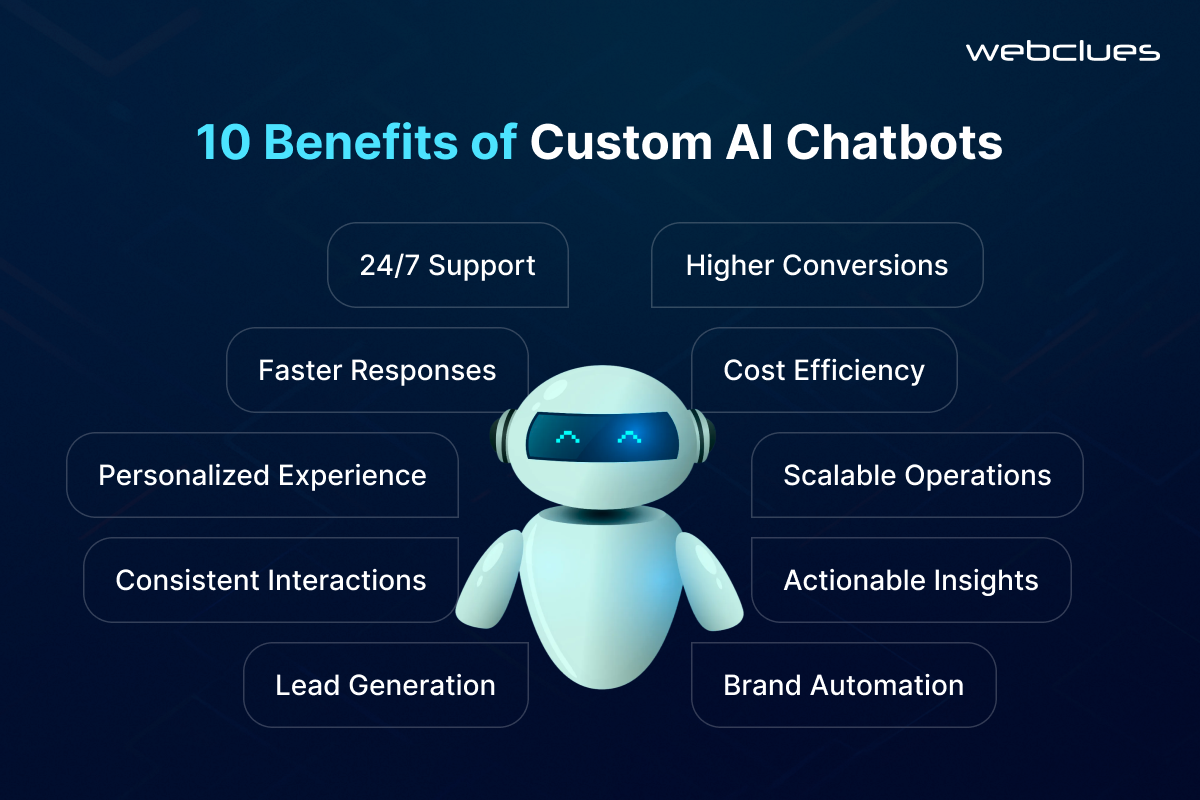
Investing in custom chatbot development should be seen as purchasing a new piece of intellectual property. When AI starts to be integrated into products, workflows, pricing structures, and user experience, the discussion evolves from simple chatbot automation to building a competitive moat.
Some of the reasons businesses opt for custom development include:
- When the logic integrated into the AI influences earned revenue (as opposed to just offering a service).
- When businesses need custom models or proprietary/standalone infrastructure.
- When businesses need to fulfill compliance frameworks that require complete control or air-gapped architecture.
- When businesses need to handle and protect sensitive data, e.g., financial, legal, healthcare, defense.
- When businesses need to execute in multiple languages, in multiple markets, or across several brands.
- When AI is crucial for a product or service to be a key differentiator or for a business to achieve a high pricing tier.
Examples include:
- A fintech model that detects credit risks from conversation.
- A healthcare agent that pre-diagnoses based on provided history and symptoms.
- A logistics AI that autonomously discovers delays, forecasts, and re-routes.
- A SaaS that integrates conversational UIs into its software.
Custom development is never the fastest way to go, but it becomes the most strategically valuable when the ability to predict, personalize, or automate becomes a business crucial priority.
The best indicator is, if your competition is utilizing the same features from a software platform as you, then your AI is not a differentiator, but a cost center.
Cost, Control ROI Comparison: Platform vs Hybrid vs Custom
| Factors | Platforms | Hybrids | Custom |
| Initial Cost | Subscription + onboarding; lowest upfront | Shared development + component-based build | Highest due to full engineering + infra setup |
| Time to Delivery | Fastest | 12–20 weeks | 6–12 months |
| Control & Customization | Limited; platform rules apply | Domain-specific + configurable | Full architectural freedom |
| Long-Term Cost Ratios | Scales with usage; can increase over time | Cost-plus model; predictable | Cost efficiency improves as usage grows |
| Data Ownership & Compliance | Vendor-controlled access | Balanced model; client retains partial control | Complete ownership + compliance alignment |
| Integration Potential | Standard APIs; minimal deviation | Connectors for wider ecosystem fit | Full orchestration across enterprise systems |
| Flexibility of AI Models | Fixed models + presets | Customizable, more sophisticated models | Proprietary adaptive AI tuned to business needs |
| Security & Governance | Dependent on platform policies | Joint governance model | Enterprise-grade governance, fully controlled |
| Timeline for ROI | Near-term ROI likely | Mid-term ROI achievable | Long-term ROI with highest upside |
| Marketplace Competitive Strength | Lower due to feature parity | Moderate differentiation | Highest differentiation + defensibility |
Build vs Buy Recommendations Based on Use Case Complexity
The decision to build, buy, or work with an AI chatbot development company to execute a hybrid strategy hinges on how mission-critical the use case is and how much control, compliance, and differentiation the business requires.
- Low Complexity (FAQs, appointments, lead capture) → Purchase (Platform): For these workflows, the efficiency and low costs from automations are more beneficial than the small value that would come from engineering a custom solution.
- Medium Complexity (CRM handoffs, ticket triage, retrieval based answers) → Hybrid: Co-building is a great solution when responses need context and to draw from internal knowledge, as the burden of model training, integrating, and scaling is not fully on one party.
- High Complexity (predictive operations, claims, underwriting, compliance enforcement) → Custom: Automation of these processes is proprietary, coupled to business logic, and critical to the company’s competitive advantage as these licensing platforms limit custom tuning, transparency, and data loops.
- Mission Critical (finance, healthcare, citizen services, defense) → Custom: Ownership allows for audit capabilities, custom encryption, on premises control in order to mitigate slope of failure, and full control when downtime, auditability, and explainability become concerns for governance.
- Multi Region, Multi Language, and Localization → Hybrid or Custom: Standard platform translation is not contextually aware; custom AI solutions are necessary for the culture, regulation, and trust.
How Does Each Model Impact ROI Over 12, 24, & 60 Months?
ROI diverges in the longer term because custom solutions depreciate while platform subscriptions accrue more costs.
- 12 months: For platform solutions, time to value is shorter as deployment is quicker, leading to less barriers to onboarding.
- 0 - 24 months - Hybrid surpassing due to automation scale.
- 0 - 60 months - Custom ownership leads to cost proficiency with superior competitive edge.
ROI Must Account:
- Agent hours either reduced or repurposed.
- Automation applied with removal of manual approvals.
- Automation of responses with contextual answers that increase conversion.
- Engagement personalization stream retention.
- New retention insights were product/service improvement enabling.
AI driven business ROI: Your business AI driven ROI is no longer solely measured upon support metrics; ROI is support metrics and driven operational and revenue evolution.
Technology Stacks Used Across Platform, Hybrid & Custom Approaches-
Modern Chatbot Stacks Includes:
- LLM Providers - OpenAI, Anthropic, Mistral, Cohere.
- Model Hosting & Fine Tuning - Azure, AWS, GCP, private clusters.
- Frameworks - LangChain, LlamaIndex, RAG pipelines.
- Vector Databases - Pinecone, Weaviate, Redis, Chroma.
- Messaging Channels - Web, WhatsApp, IVR, mobile, in-app chat.
- Orchestration - Airflow, Dagster, custom task agents.
For platform buyers, stack selection is pre-decided. For hybrid, it is negotiated. For custom, it is architected. Knowing the stack helps influence the foresight in flexibility.
Important Factors When Developing An Enterprise AI Chatbot: Data, Security, Scalability, & Ownership
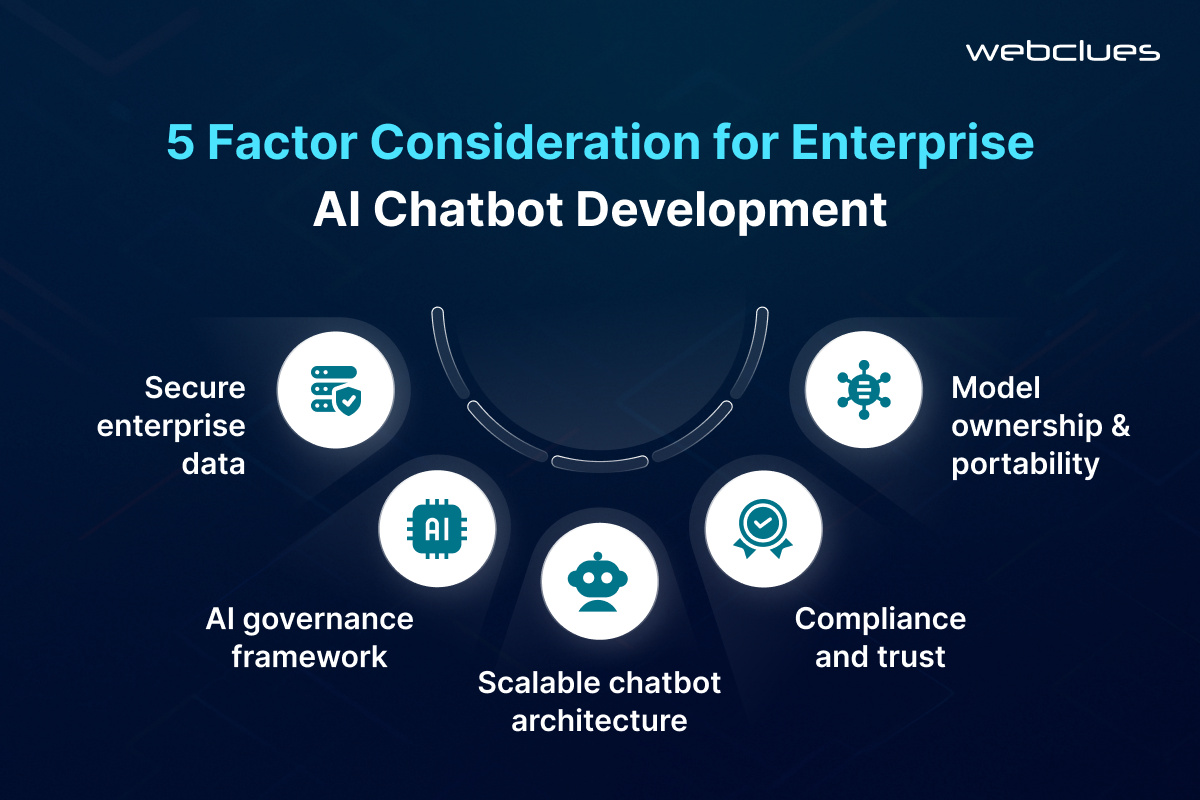
When evaluating building vs buying an enterprise AI Chatbot, the business organization must evaluate the building blocks of the response systems in the same way they would evaluate the response systems of the core systems of the enterprise:
1) Where is the data stored?
2) Are there any audits performed of the system for prompts, context, and responses?
3) What measures are in place to govern and mitigate hallucinations?
4) Is the technology model portable, or are we locked in with a vendor?
5) Are there mechanisms in place to manage usage costs at scale?
Security is no longer just infrastructure; it is driven by the behavior of AI systems. Compliance standards must consider:
1) Retention of data policies
2) Right to forget workflows
3) Defenses against prompt injection
4) Explainability and traceability of the model
AI adoption without frameworks and policies to govern the use of AI is the primary driver of trust within the organization.
Future Trends Impacting the Strategy for AI Chatbots Beyond 2026
Key influencers for building or buying AI Chatbots:
1) Transition of AI systems from texts to multimodal interactions (images, voice, and screen sharing
2) AI systems based on verticals outperforming general-purpose systems
3) Initiating policies from clarified regulation on the usage of black-box systems
4) Embedding of AI within product UI, removing the need for external widgets
5) Collaborating agent systems
Ownership becomes more important when integration of AI moves from a tool to an interface.
Partnering With the Right AI Chatbot Consulting Specialists
When assessing particular AI consulting firms, it is important to remember that the success (or failure) of an AI implementation is not dictated solely by the technology involved. More important are the strategies around the movement of information through various touchpoints, the design of the user experience, and the optimization of operations surrounding the new AI automation.
When there are considerations around product thinking, compliance, depth of integration, and behavioral modeling, the expertise of AI consulting firms increases greatly and the likelihood of the chatbot being functional, and subsequently, being adopted, scaled, and monetized, increases greatly.
Pre-packaged, customized, automated AI chatbot tools, such as Chatwit, from WebClues Technology, fulfill the needs of such firms while also providing efficient, automated, standardized deployment.
For those organizations that are seeking AI chatbot development services, can connect with us. We provide fully customized automation coupled with a hybrid model that will allow the construction of unique automation systems that will more closely align with the organization's data ownership and competitive strategies.
Post Author

Vedansh Kanodia
Vedansh Kanodia, a dynamic Business Development Executive at WebClues Infotech, is a passionate technocrat who helps businesses embrace innovation, and unlock new possibilities with his valuable perspectives.


Build Your Agile Team
Hire Skilled Developer From Us
Accelerate AI Adoption with Trusted AI Chatbot Development Services
With WebClues, you gain AI chatbot development services that exceed the minimum thresholds of automation. While most organizations build basic chatbot automations, we design personalized conversational AI that embeds into workflows, provides tailored engagement, and scales to diverse teams and global markets. We help you achieve operational, customer, and revenue objectives aligned with AI, custom development, and hybrid deployment from building strategy and tuning models to deployment.
Connect Now!Frequently Asked Questions
Our Recent Blogs
Sharing knowledge helps us grow, stay motivated and stay on-track with frontier technological and design concepts. Developers and business innovators, customers and employees - our events are all about you.