AI in
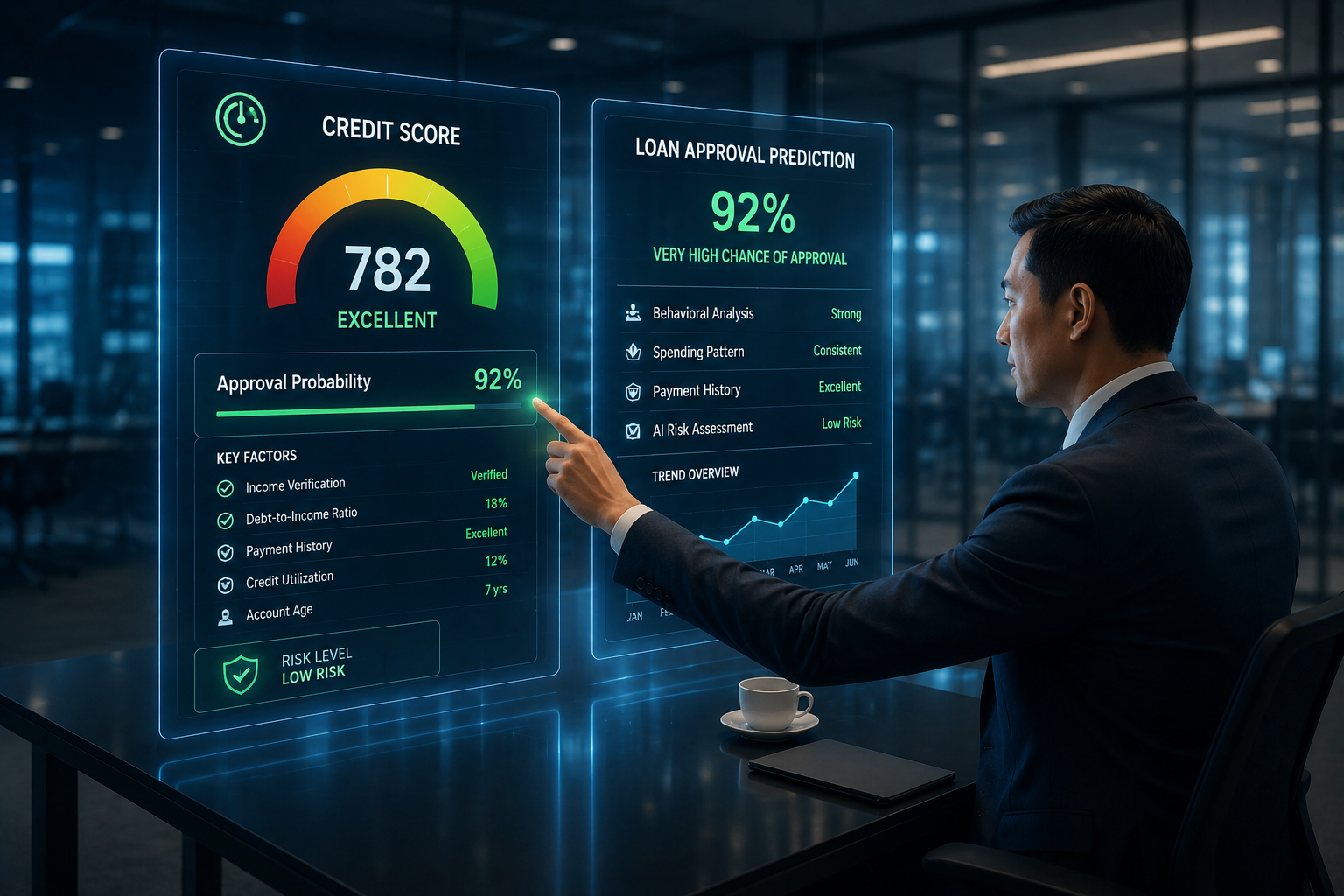
Why Traditional Credit Scoring Models Are Becoming Ineffective
Traditional credit scoring relies on limited data and manual underwriting, making it less effective for modern lending that demands speed, scale, and continuous risk evaluation.
How AI Modernizes Credit Scoring and Lending Operations
AI transforms credit scoring from a static evaluation process into a continuously learning risk intelligence system.
Dynamic Risk Evaluation:
AI continuously analyzes borrower behavior, transactions, and repayment patterns to assess real-time creditworthiness.
Predictive Default Forecasting
Machine learning models detect early signs of default using historical and behavioral data.
Automated Underwriting
AI streamlines borrower assessment, eligibility checks, and risk classification.
Alternative Data Analysis
Uses utility payments, digital transactions, and wallet activity to evaluate thin-file borrowers.
Fraud Detection
Identifies anomalies, identity inconsistencies, and suspicious application behavior before approval.
Continuous Compliance Monitoring
Enables real-time reporting, audit readiness, and explainable lending decisions.
AI Capabilities Driving Modern Credit Intelligence Systems
AI strengthens lending infrastructure through advanced analytics, adaptive modeling, and automated financial decision-making.
Machine Learning Credit Risk Models
Improve accuracy using repayment history, delinquency trends, and borrower behavior.
Behavioral Credit Scoring
Uses transaction patterns, payment timing, and spending behavior for profiling.
Explainable AI Frameworks
Ensures transparent and compliant lending decisions.
Automated Loan Eligibility Engines
Enable instant borrower assessment and risk-based decisions.
Portfolio Risk Monitoring
Tracks loan portfolios to detect early risk signals and delinquency trends.
Financial Fraud Intelligence
Detects identity anomalies, device patterns, and suspicious transactions.
Unified Lending Dashboards
Provides visibility into risk, underwriting performance, and compliance metrics.
Comparing AI Credit Scoring vs Traditional Lending Models
| Capability | Traditional Credit Scoring | AI-Based Credit Scoring |
|---|---|---|
1Borrower Assessment | Historical credit records | Behavioral and predictive analytics |
2Underwriting Speed | Manual and time-intensive | Automated decision intelligence |
3Risk Prediction | Static scoring formulas | Adaptive machine learning models |
4Financial Inclusion | Limited thin-file coverage | Alternative data-driven lending |
5Fraud Detection | Rule-based verification | Behavioral anomaly detection |
6Portfolio Monitoring | Periodic reviews | Continuous risk monitoring |
7Compliance Management | Manual documentation | Automated audit and reporting |
Key AI Use Cases Across Credit Scoring Operations
AI supports lending, underwriting, and financial risk management across modern ecosystems.
Alternative Credit Assessment
Uses broader financial signals beyond bureau data to serve thin-file and new-to-credit borrowers
Digital Loan Underwriting
Automates loan approvals for consumer and SME lending with reduced manual intervention.
Credit Limit Optimization
Dynamically adjusts credit limits based on behavior, repayment patterns, and risk profile.
Delinquency Prediction
Identifies early warning signals of repayment stress to prevent defaults.
Fraud Prevention
Detects synthetic identities, account abuse, and transaction anomalies.
Portfolio Risk Intelligence
Monitors loan portfolios and optimizes risk-based lending decisions.
Industry Use Cases of AI in Credit Scoring
AI-based lending intelligence is transforming risk assessment and financial accessibility across industries.
Banking and Financial Services
Banks use AI for underwriting automation, borrower segmentation, risk-based lending, and real-time fraud detection.
Fintech and Digital Lending Platforms
Fintech firms leverage AI for instant approvals, embedded finance, and scalable lending operations.
Microfinance and Financial Inclusion
AI expands credit access using alternative and behavioral data for underserved borrowers.
BNPL Platforms
Real-time risk models evaluate repayment probability instantly during checkout.
Insurance and Consumer Finance
AI improves risk profiling for credit-linked insurance and financing products.
E-Commerce and Marketplace Lending
Platforms use AI to assess merchant creditworthiness and customer lending eligibility.
Business Impact of AI on Credit Scoring Performance
Organizations implementing AI-powered credit scoring systems achieve measurable operational and financial improvements:
- 2–5x faster underwriting and loan approval cycles
- 30–50% improvement in default risk prediction accuracy
- 40%+ increase in approval rates for thin-file borrowers
- 25–40% reduction in underwriting operational costs
- Significant reduction in lending fraud and identity manipulation
- Faster compliance reporting and audit preparation processes
- Improved portfolio monitoring and borrower risk visibility
How AI Credit Scoring Systems Are Implemented
A structured implementation approach helps financial institutions deploy scalable and compliant AI lending infrastructure.
Lending Workflow Assessment
Analyze underwriting operations, borrower evaluation processes, fraud risks, and compliance requirements.
AI Opportunity Mapping
Identify high-impact applications such as alternative scoring, automated underwriting, or delinquency prediction.
Financial Data Integration
Connect banking systems, APIs, CRMs, transaction databases, and external financial datasets.
Model Training and Validation
Train machine learning models using historical lending, repayment, and fraud datasets.
Risk Testing and Simulation
Validate AI performance against real-world lending scenarios and regulatory requirements.
Enterprise Deployment
Deploy AI systems into live lending environments with secure infrastructure integration.
Continuous Model Optimization
Improve model accuracy using repayment outcomes, portfolio intelligence, and evolving borrower behavior patterns.
AI Credit Scoring Integration with Financial Ecosystems
AI-powered credit scoring systems integrate with existing enterprise financial infrastructure:
Core Banking Platforms: Finacle, Temenos, Oracle FLEXCUBE
Cloud Infrastructure: AWS, Microsoft Azure, Google Cloud Platform
CRM and Lending Systems: Salesforce Financial Services Cloud, HubSpot, Zoho
Fraud Management Platforms: Feedzai, NICE Actimize, SAS Fraud Management
Data & Analytics Platforms: Tableau, Power BI, Elastic Stack
Key Challenges in AI Credit Scoring Adoption
Financial institutions face several operational and regulatory challenges during AI adoption.

| Challenge | WebClues Solutions |
|---|---|
| Legacy banking architecture | API-first integration frameworks |
| Regulatory explainability requirements | Explainable AI model architecture |
| Data security and privacy concerns | Encryption and governance controls |
| Bias in lending models | Fairness testing and continuous audits |
| High implementation complexity | Phased deployment strategy |
| Internal adoption resistance | Workflow training & operational support |
Why Choose WebClues Infotech for AI Credit Scoring Solutions
WebClues Infotech develops enterprise-grade AI lending and credit intelligence systems designed for scalable, compliant, and data-driven financial operations.
AI-Based Credit Scoring Platforms
Automated Underwriting Systems
Predictive Risk Intelligence
Alternative Data Modeling
Fraud Detection Solutions
Explainable AI Compliance Frameworks
Enterprise Lending Integrations
The Future of AI-Powered Credit Scoring
AI in lending is evolving toward adaptive, transparent, and continuously learning financial intelligence ecosystems.
Key trends shaping the future of AI credit scoring:
Explainable Lending AI: Focus on transparent, auditable decision-making to improve regulatory compliance and borrower trust.
Expansion of Alternative Data: Digital transactions, mobile usage, utility payments, and behavioral signals will increasingly drive credit evaluation
Real-Time Adaptive Credit Models: Credit scoring will become dynamic, updating continuously based on borrower activity and financial behavior.
AI + Decentralized Finance (DeFi): Blockchain-based identity and transaction data will enhance future credit intelligence frameworks.
Autonomous Lending Operations: AI will automate underwriting, fraud detection, portfolio monitoring, and compliance workflows end-to-end.
Build Smarter Lending Systems with AI-Powered Credit Intelligence
AI is transforming credit scoring into a predictive, adaptive, and scalable lending intelligence system that improves underwriting speed, reduces financial risk, expands borrower access, and strengthens compliance operations.
Talk to Our AI ExpertsFrequently Asked Questions
Contact
Information
India
Ahmedabad
1007-1010, Signature-1,
S.G.Highway, Makarba,
Ahmedabad, Gujarat - 380051
Rajkot
1308 - The Spire, 150 Feet Ring Rd,
Manharpura 1, Madhapar,
Rajkot, Gujarat - 360007
UAE
Dubai
Dubai Silicon Oasis, DDP,
Building A1, Dubai, UAE
USA
Atlanta
6851 Roswell Rd 2nd Floor,
Atlanta, GA, USA 30328
New Jersey
513 Baldwin Ave, Jersey City,
NJ 07306, USA
California
4701 Patrick Henry Dr. Building
26 Santa Clara, California 95054
Australia
Queensland
120 Highgate Street,
Coopers Plains,
Brisbane, Queensland 4108
UK
London
85 Great Portland Street, First
Floor, London, W1W 7LT
Canada
Burlington
5096 South Service Rd,
ON Burlington, L7l 4X4
Let’s Transform Your Idea into
Reality. Get in Touch