

Connect with us


Corporate Video

AI PoC Development Explained: How to Reduce Risk Before Full-Scale AI Investment
.jpg)
Summary: Most AI initiatives fail not because AI doesn't work, but because companies invest at scale before validating the fundamentals. An AI Proof of Concept (PoC) is the structured, time-boxed experiment that separates well-informed AI investments from expensive guesses. This guide explains what AI PoC development services actually involve, why skipping it is the single biggest risk in enterprise AI, and how to build one that gives you a real decision not just a demo. Whether you're a startup testing a new AI idea or an enterprise evaluating intelligent automation, this is the framework you need before adding budget to full-scale AI development.
What Is AI PoC Development And Why Does It Matter in 2026?
An AI Proof of Concept (PoC) is a focused, time-bounded experiment designed to answer one fundamental question before you spend serious money:
Can this AI approach actually work with our data, in our environment, to solve our specific business problem?
It is not a product. It is not a polished demo for a board presentation. It is a structured test of a hypothesis that produces a clear, defensible go/no-go decision.
AI PoC development matters more than ever in 2026 because enterprise AI investments have grown dramatically while the failure rate has barely moved.
Gartner projects that organizations will abandon approximately 60% of AI projects through 2026 not because the underlying technology is broken, but because the projects weren't designed with a clear question and a clear success threshold from day one.
The practical value of running a proper AI PoC breaks down into four areas:
- Technical feasibility validation: Does the AI model perform at an acceptable level on your actual data, under your actual constraints? This isn't answerable theoretically. It requires a test.
- Data readiness assessment: Data is the most common killer of AI initiatives. Businesses routinely assume their data is clean, accessible, and sufficient, and discover mid-project that it's siloed, inconsistent, or legally restricted. An AI feasibility study surfaces this in week two, not month six.
- Business value confirmation: Technical feasibility and business value are separate questions. A model can be accurate and still fail to reduce costs, improve throughput, or meet the ROI threshold that justifies production investment.
- Stakeholder alignment: AI projects fail for organizational reasons as often as technical ones. A structured PoC gives leadership a concrete, evidence-backed result to evaluate rather than an abstract concept to approve on faith.
Done correctly, AI PoC development de-risks 90% of the decision before you've committed the budget that would make a wrong decision expensive.
AI PoC vs Prototype vs MVP: The Differences That Protect Your Budget
These three terms are used interchangeably in most organizations. That's a problem because each serves a distinct purpose, operates at a different level of investment, and answers a different question. Confusing them leads directly to misaligned expectations and avoidable project failures.
| Stage | Primary Question | Data Environment | Typical Duration | Success Metric |
| AI PoC | Can this technically work? | Sample or representative data | 3–8 weeks | Feasibility confirmed; go/no-go decision |
| AI Prototype | What will it look like and how will it flow? | Mock or limited data | 2–4 weeks | Stakeholder understanding; UX validation |
| AI MVP | Will users actually adopt this? | Production data, limited scope | 3–6 months | Usage, retention, measurable business impact |
AI PoC is the earliest and most critical stage. Its job is to validate the hypothesis before significant resources are committed. The output is evidence, not a product.
AI Prototype assumes technical feasibility is already established. It focuses on user experience, workflow design, and stakeholder visualization — not on whether the underlying model can perform.
AI MVP assumes both feasibility and stakeholder alignment are established. SaaS MVP partner provides solutions that deliver the minimum feature set to a real audience for real-world validation. An MVP built without a prior PoC is one of the most reliable ways to waste six months and damage organizational confidence in AI.
A useful rule: start at the stage that matches your level of uncertainty. High technical or data uncertainty means starting with a PoC.
If feasibility is known but the user experience is unclear, move straight to a prototype. If both are established, build the MVP.
The additional category worth understanding in 2026 is Generative AI PoC versus Traditional ML PoC. These are not the same experiment:
- A traditional ML PoC (classification, regression, prediction) typically takes 6–10 weeks, requires clean labeled data, and is evaluated on quantitative metrics like F1-score, precision, and recall.
- A generative AI PoC (LLM-powered tools, RAG pipelines, AI assistants) can often be built in 3–5 weeks using API-based foundation models, but requires qualitative evaluation — fluency, factuality, hallucination rate, user trust — alongside technical metrics.
The architecture, evaluation approach, and definition of success differ enough that treating them as the same type of project is itself a source of PoC failure.
Why AI Projects Fail Without a PoC (The Research Is Brutal)
According to the Research and Development Corporation's research, 80% of enterprise AI projects never make it past the prototype stage. Gartner puts the abandonment rate of AI initiatives through 2026 at around 60%. McKinsey data shows that most AI value concentrates in four business functions but that concentration doesn't protect projects that weren't structured to measure the right things.
The failure patterns are consistent and well-documented:
- Poor data quality and readiness — This is the single most cited reason AI implementations fail in production. Data that appears available and sufficient during planning turns out to be incomplete, inconsistent, or inaccessible when actual model training begins. A proper AI feasibility study surfaces these gaps before they become expensive.
- Undefined success criteria — When no one has agreed upfront on what success looks like, different stakeholders measure against different expectations. A result that would have been approved in week one gets rejected in week eight because the goalposts shifted. The PoC exists precisely to force this alignment before the build.
- Scope creep — A PoC that starts as "predict customer churn" and becomes "predict churn, recommend next best action, and generate personalized outreach" is no longer a PoC. It's a product. Time-boxing both the scope and the calendar is the only reliable defense.
- Misaligned business expectations — Executives who expect an AI deployment to immediately transform operations will be disappointed by a system that requires months of iteration before it delivers consistent value. A PoC sets realistic expectations by showing actual performance data rather than marketing projections.
- Overengineering before validation — Building a production-grade system before confirming feasibility is one of the costliest mistakes in AI development services. The PoC framework exists to answer the feasibility question cheaply and quickly, before production-grade engineering investment begins.
- Model drift and deployment mismatch — Even models that perform well during development fail in production when real-world data differs from training data. Validation during the PoC phase using data that reflects actual production conditions catches this before deployment.
The McDonald's AI drive-thru, cancelled in 2024 after failing at 100+ locations, illustrates what happens when operational conditions aren't properly tested before rollout. The system performed acceptably in controlled environments and then failed systematically in real-world drive-thrus with ambient noise, accent variation, and complex orders. Every one of those conditions was testable in a PoC. None of them was adequately tested before scale.
The AI PoC Development Process: 7 Stages That Actually Work
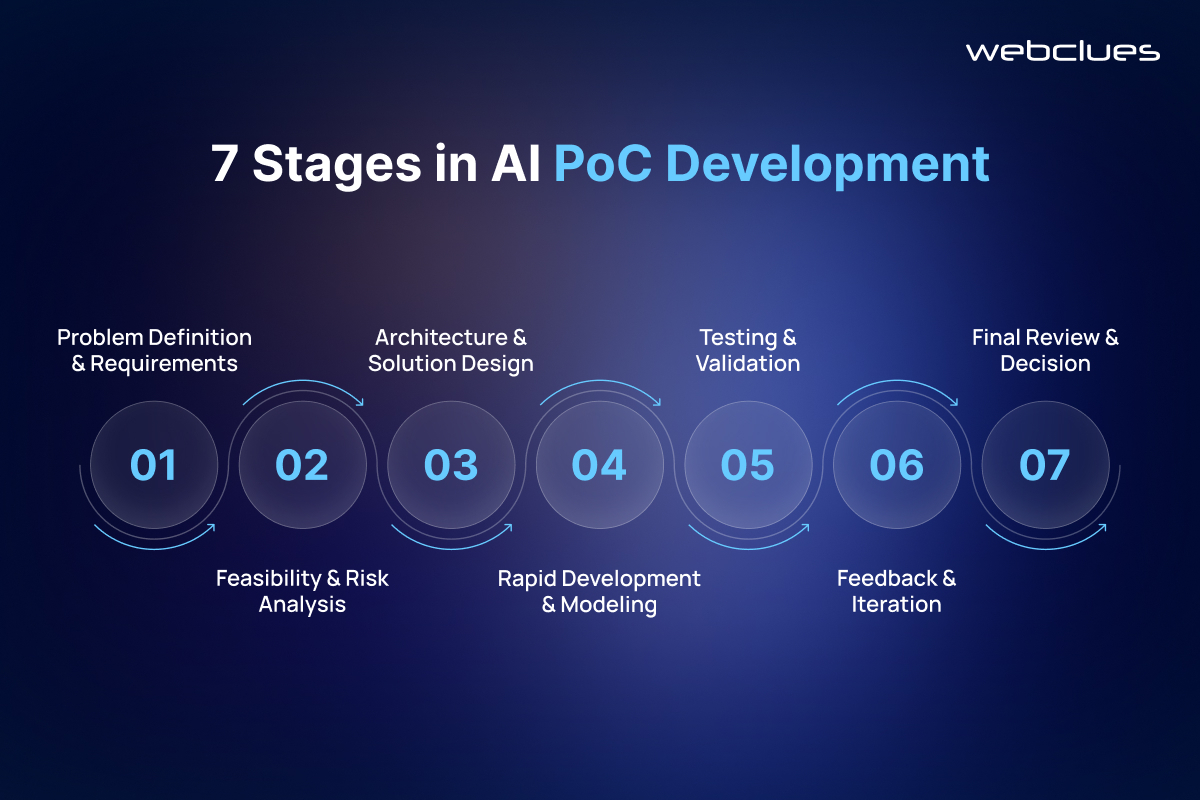
A structured AI PoC development process is the difference between an experiment that produces a real decision and one that produces an impressive demo with no clear next step. Here's how the best AI PoC development companies approach it.
Stage 1: Business Problem Definition and Requirement Gathering
Before any technical work begins, the business problem must be defined with enough precision to generate a testable hypothesis. This is harder than it sounds. "We want to use AI for customer support" is not a testable hypothesis. "We want to test whether an NLP-based triage system can categorize 70% of incoming tickets with greater than 88% accuracy" is.
This stage involves stakeholder interviews, requirement documentation, objective clarification, and explicit definition of what success and failure look like. The output is a scoping document that all stakeholders have agreed to before a single line of code is written.
Stage 2: AI Feasibility Study and Risk Assessment
This is the analytical core of the PoC process. A genuine AI feasibility assessment covers three dimensions:
- Technical feasibility — Can the available AI models, frameworks, and infrastructure support the proposed solution? What are the compute requirements? What third-party APIs or cloud services are involved?
- Data readiness — Is the relevant data accessible, sufficiently clean, adequately labeled, and large enough to produce meaningful results? Are there privacy, security, or compliance constraints that affect data use?
- Business feasibility — Does the expected ROI justify the investment in development, infrastructure, and maintenance? What is the cost of failure versus the cost of doing nothing?
The output is a feasibility report with explicit risk flags and mitigation recommendations. Organizations that skip this stage discover the blockers later — at a point where addressing them is significantly more expensive.
Stage 3: Conceptual Design and Architecture Planning
With feasibility established, this stage defines how the AI solution will actually work: the data pipeline, model architecture, integration points, and user touchpoints.
For a traditional ML PoC, this means model selection, feature engineering approach, and evaluation pipeline. For a generative AI PoC, it means foundation model selection, RAG pipeline design, prompt engineering strategy, and evaluation framework.
Conceptual design at the PoC stage should be simple enough to build quickly and representative enough to produce valid results. Over-engineering the PoC architecture is a common and costly mistake.
Stage 4: Rapid Development and Model Building
Development at the PoC stage focuses on core functionality, not completeness. The goal is to build the minimum implementation needed to test the hypothesis not to build a production-ready system.
For traditional ML, this means model training on representative data, basic evaluation pipeline setup, and feature selection validation. For generative AI, it typically means prompt engineering, RAG pipeline construction, and integration with a foundation model API. For computer vision use cases, it means data labeling, model selection, and inference testing.
Agile sprints work well here: short development cycles with frequent check-ins keep the PoC on scope and on timeline.
Stage 5: Testing, Validation, and Performance Evaluation
Testing during AI PoC development is not optional, and it's not the same as testing traditional software. AI models must be evaluated against the predefined success criteria established in Stage 1.
This means functional testing (does it work?), model performance testing (does it perform at threshold?), and business logic validation (does the output actually align with how the business works?). For generative AI development, human evaluation is a required part of the methodology qualitative assessment of output quality, factual accuracy, and usability cannot be replaced by automated metrics alone.
Critically, testing must use data that reflects production conditions. A model that performs beautifully on hand-selected, pre-cleaned data and then fails on actual production data has not been validated; it has been staged.
Stage 6: Feedback, Iteration, and Refinement
The first PoC result is rarely the final one. This stage involves collecting structured feedback from domain experts, business stakeholders, and technical reviewers, then implementing targeted improvements and retesting.
The key discipline here is staying within the original scope. Iteration should refine the solution against the original hypothesis, not expand the scope to test new hypotheses. Scope expansion at this stage is how PoCs become indefinite experiments without a decision at the end.
Stage 7: Final Readout and Next-Step Recommendation
The PoC concludes with a structured presentation of results against the predefined success criteria. This is a business presentation, not a technical debrief. The audience is decision-makers who need to allocate budget, not data scientists who want to discuss model architecture.
The readout should cover: what was tested, what the results were, what the identified limitations are, and a clear recommendation to proceed to MVP, iterate with a refined approach, or stop and reallocate resources. All three outcomes are valid. A PoC that recommends stopping has succeeded by preventing a larger failure.
How Long Does AI PoC Development Take?
Timeline expectations are one of the most common sources of misalignment between AI teams and business stakeholders. The honest answer is: it depends on the type of PoC, data readiness, and integration complexity. Here are industry-standard ranges:
| PoC Type | Typical Duration | Primary Timeline Driver |
| Generative AI / LLM PoC | 3–5 weeks | Prompt engineering, RAG pipeline setup, human evaluation |
| Traditional ML PoC (classification, regression) | 6–10 weeks | Data cleaning, feature engineering, model training |
| NLP PoC (sentiment analysis, text classification) | 4–8 weeks | Labeling requirements, model selection, domain adaptation |
| Computer Vision PoC | 8–12 weeks | Image labeling, model architecture, inference optimization |
| Agentic AI PoC | 8–14 weeks | Agent architecture, tool integration, multi-step reliability testing |
| Enterprise multi-system integration PoC | 10–16 weeks | Data access, security review, integration testing, stakeholder alignment |
At WebClues Infotech, our structured AI PoC development process delivers validated results in as few as 80 hours for well-scoped, data-ready use cases.
The most reliable way to shorten a PoC timeline is to resolve data access and governance before the PoC begins. Data access delays waiting for legal approval, IT provisioning, or data cleansing are the single most common reasons PoCs run over timeline. Address this in the feasibility stage, not mid-build.
Industry Use Cases: What AI PoC Looks Like Across Sectors
AI PoC in machine learning and generative AI applies across virtually every industry. The business problems differ; the logic is identical — validate before you commit. Here's what that looks like in practice.
AI PoC in Healthcare: Healthcare AI PoCs typically address clinical decision support, medical imaging analysis, and administrative automation. A computer vision PoC for radiology might test whether a model can flag specific anomalies with sensitivity above a clinical threshold on a held-out dataset. The success criteria are more stringent here: clinical accuracy, explainability to clinicians, and regulatory pathway assessment (HIPAA, FDA considerations) must all be addressed within the PoC scope.
AI PoC in Finance and Fraud Detection: Fraud detection PoCs in financial services test whether ML models can match or exceed analyst-level accuracy on historical transaction data while maintaining a false positive rate that's operationally workable. A PoC that flags too many legitimate transactions as fraudulent is technically accurate but operationally useless. The PoC must test both dimensions. NLP PoC development for document processing — KYC, loan underwriting, reconciliation — is another high-value area in this sector.
AI PoC for Retail Demand Forecasting: Retail AI PoCs focus heavily on demand forecasting, dynamic pricing, and personalization. Shadow mode testing — running the AI model in parallel with existing processes, recording its recommendations without acting on them, and comparing predicted versus actual outcomes — is the standard evaluation approach. This gives retailers real-world performance data without operational risk.
AI PoC in Manufacturing Predictive Maintenance: Manufacturing AI PoCs test whether sensor data can predict equipment failure with enough lead time to take preventive action. The key metrics are prediction accuracy on held-out data, false positive rate (unnecessary maintenance interventions have real cost), and lead time — how far in advance does the model flag issues? Edge deployment feasibility — can the model run on plant-floor hardware without cloud dependency — is a frequent PoC-stage question in manufacturing environments.
AI PoC in Logistics Optimization: Logistics AI PoCs address route optimization, warehouse efficiency, and demand-driven inventory positioning. The PoC must test not just prediction accuracy but operational integration — can model outputs be delivered to the right person, in the right format, at the point in the workflow where action can be taken?
Generative AI Proof of Concept: Generative AI PoCs LLM-powered knowledge assistants, AI-generated drafts, and conversational AI are the fastest-growing category in 2026. A well-structured GenAI PoC tests foundation model selection, RAG pipeline construction, prompt engineering quality, and hallucination rate on a representative document set. Human evaluation of output quality is non-negotiable at this stage. Generative AI PoCs can often be scoped and delivered in 3–5 weeks, which makes them an excellent entry point for organizations beginning their AI validation process.
AI PoC Success Criteria: What "It Worked" Actually Means
The most common reason AI PoCs fail to produce a clear decision is that no one agreed upfront on what success looked like. Defining success criteria must happen before development begins, not after results come in.
Success criteria should span three dimensions:
Technical performance criteria — These are quantitative thresholds tied directly to the use case. For a classification model: F1-score above a defined threshold on a held-out test set. For a generative AI system: hallucination rate below a defined percentage on a human-evaluated sample. For a real-time application: inference latency below a defined millisecond threshold at the 95th percentile.
Business impact criteria — Technical performance means nothing if it doesn't translate to operational improvement. Business criteria might include: processing time reduction by a defined percentage, error rate reduction by a measurable amount, cost per unit below a defined threshold, or throughput increase by a stated multiple.
Adoption and usability criteria — A technically accurate model that end users don't trust or don't use has failed. Usability criteria might include: percentage of users rating AI outputs as useful, override rate (how often human operators reject AI recommendations), and trust threshold (percentage of users willing to act on AI outputs without manual verification after a defined period).
Write these numbers down. Get stakeholder sign-off before the build begins. A PoC without pre-agreed success criteria is not an experiment, but a demonstration, and demonstrations don't reduce risk.
For model evaluation metrics in traditional ML PoCs, the standard suite includes precision, recall, F1-score, and AUC-ROC. For regression tasks: RMSE and MAE. For generative AI: BLEU score, ROUGE score, and human evaluation rubrics covering factual accuracy, fluency, and relevance. Understanding which metrics matter for your specific use case is part of the AI validation process that a qualified AI PoC development company will lead during the scoping stage.
Common Mistakes in Building AI Proof of Concept
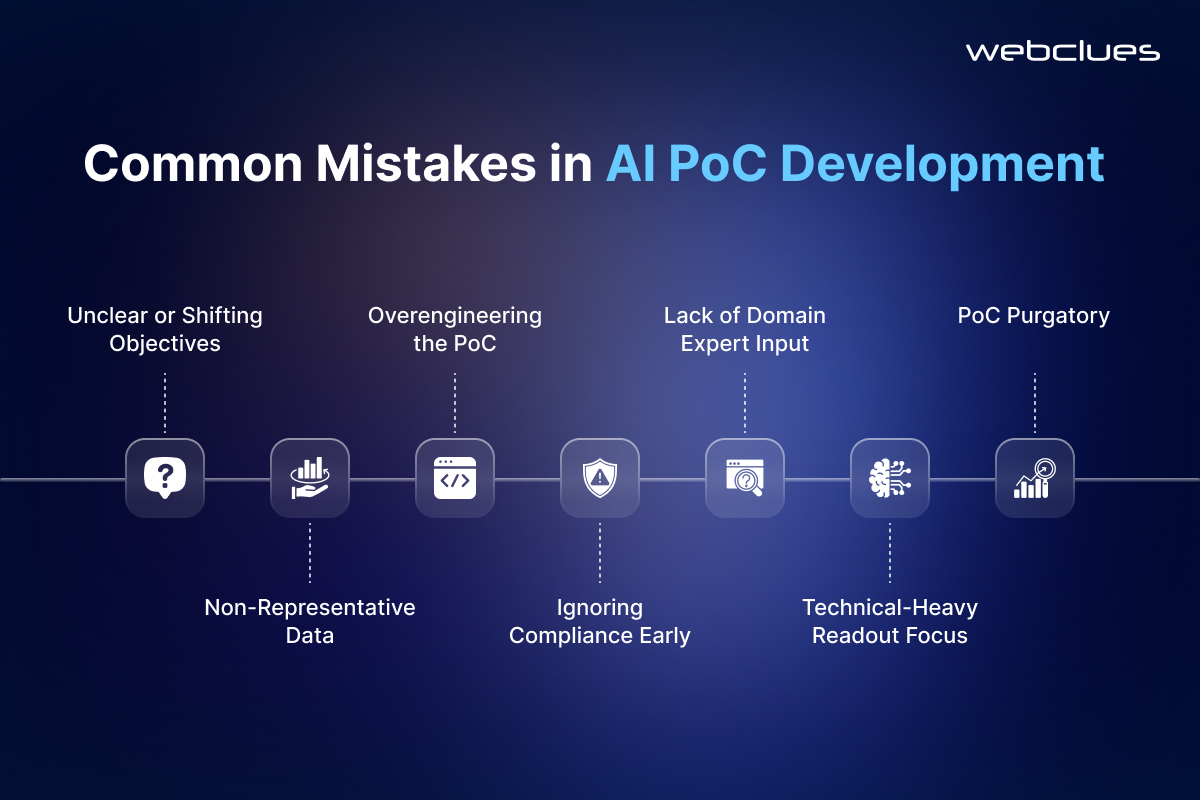
Understanding why AI models fail after deployment or fail to reach deployment is as important as understanding how to build them correctly.
Unclear or shifting objectives — The most reliable predictor of a failed AI PoC is starting without a specific, measurable hypothesis. "Let's see what AI can do for us" is not a PoC objective. It's an exploration that will produce interesting observations and no decision.
Non-representative data — Testing on idealized, pre-cleaned, hand-selected data and then deploying against messy production data is the fastest path to a failed rollout. If your production data has a 20% missing-value rate in a key field, your PoC data should too. Production-representative data is more valuable than perfectly curated data.
Overengineering the PoC — Building a production-grade system before validating the core hypothesis inflates costs, extends timelines, and obscures the answer to the question you actually need answered. A PoC should be simple enough to build quickly and rigorous enough to produce valid results. These are not in conflict.
Ignoring compliance from the start — Data privacy, regulatory compliance, and governance requirements affect PoC architecture. GDPR, HIPAA, and sector-specific frameworks are not items to address post-validation. They must be integrated from day one — particularly around data access, PII handling, and model explainability requirements.
No domain expert involvement — Data scientists working without access to people who understand the business problem will build technically correct models that solve the wrong problem. Domain expert input on which features matter, which edge cases are business-critical, and what "good output" looks like is worth more in week one than in the final review.
Treating the PoC readout as a technical presentation — The audience for a PoC conclusion is almost always a business decision-maker. Structure the readout around the business question, the business metrics, and a clear recommendation — not model architecture diagrams and loss curves.
PoC purgatory — The PoC that "kind of works" and never reaches a definitive go/no-go decision is arguably the most common failure mode. It consumes resources, delays better-directed investment, and creates organizational cynicism about AI. A hard end date and pre-agreed success thresholds are the only reliable defense.
How to Choose the Right AI PoC Development Company
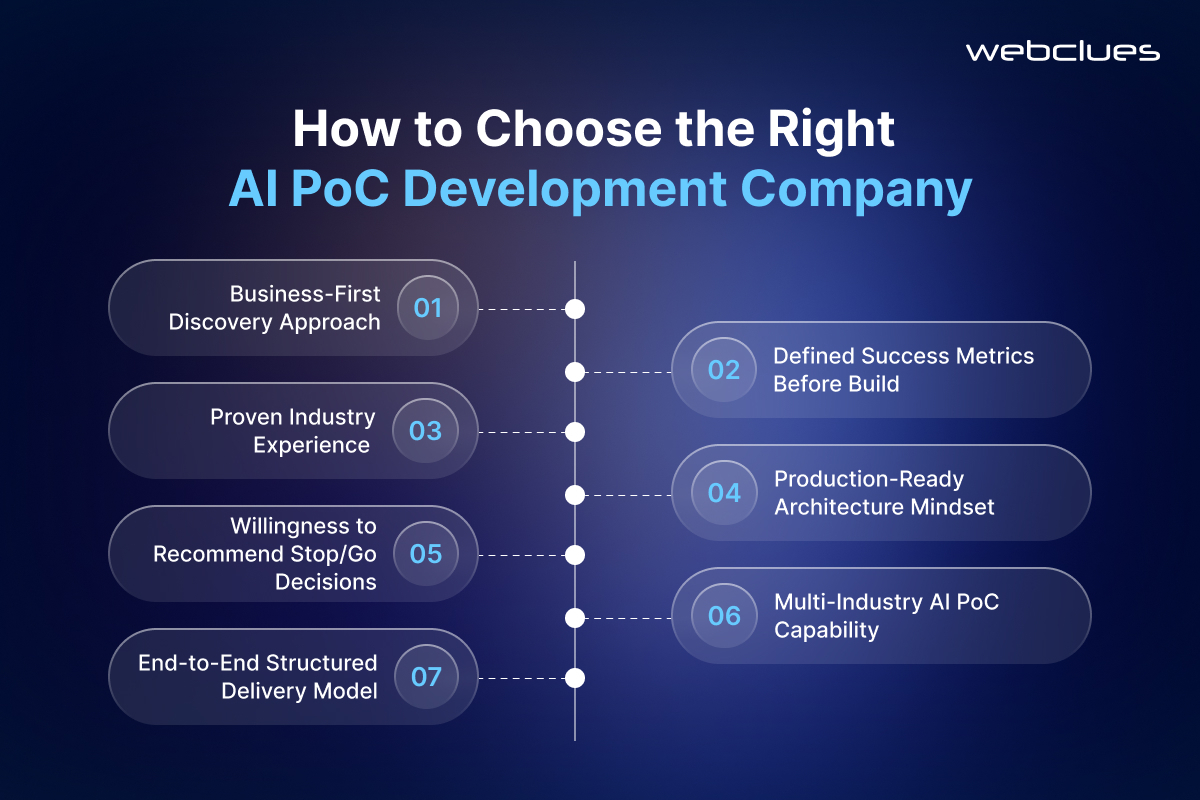
When you're ready to run a proper AI PoC, the choice of development partner significantly affects outcome quality. Here's what distinguishes a genuine AI PoC development company from one that will deliver a polished demo with no business decision at the end.
They start with your business problem, not their technology stack. The right partner will spend the first conversations on what you're trying to prove, what data you have, and what success looks like — not on which models or frameworks they prefer to use.
They define success criteria before the build begins. Any credible AI PoC services provider will insist on documented, stakeholder-agreed success metrics before development starts. If a potential partner is willing to begin building without this, that is a significant warning sign.
They have relevant industry experience. An AI proof of concept development company that has run PoCs in your industry will understand the data constraints, regulatory environment, and business metrics that matter in your context. Ask for case studies. Ask about failure cases, not just successes.
They build with production in mind from the start. The best PoC partners use reproducible environments (Infrastructure as Code), document assumptions and limitations, and design the PoC architecture in a way that can be hardened and scaled if the validation succeeds. A PoC built in a throwaway environment creates rework when it succeeds.
They give you a real answer, not an extended engagement. A trustworthy AI feasibility assessment services provider will tell you when a PoC should be stopped and resources redirected. If a partner is reluctant to ever recommend stopping, they're selling development hours, not validation.
They can build in your industry. Look for a partner with coverage across healthcare, finance, retail, manufacturing, and logistics — the industries where AI PoC in machine learning has the most validated use cases and the clearest evaluation benchmarks.
WebClues Infotech delivers end-to-end AI PoC development with a structured process that goes from discovery to validated prototype in as few as 80 hours. With 100+ AI PoCs delivered across 30+ industry use cases, we bring the feasibility assessment rigor, domain expertise, and development speed that turns AI ideas into evidence-backed investment decisions.
The Bottom Line: Test Smart, Scale Confidently!
AI is no longer experimental; it's an operational infrastructure for businesses that want to compete in the next decade. But the companies that capture the most value from AI are not the ones that invested the most, the fastest. They're the ones that validated before they scaled.
An AI PoC is not a delay in your AI journey. It's the mechanism that makes your AI journey succeed. It replaces assumptions with evidence, aligns stakeholders around shared success criteria, surfaces data problems before they become production failures, and gives you a concrete, defensible answer to the question every AI investment requires: Does this actually work for us?
Most AI projects fail because companies skip validation. Don't be one of them. Get AI PoC in 80 Hours with WebClues Infotech and know your AI is ready to scale before you invest.
Post Author

Ayush Kanodia
As one of the esteemed Directors of WebClues Infotech. Ayush Kanodia is passionate about delivering innovative IT services & solutions and has spearheaded numerous successful projects, cementing the company's position as a leader in the field.


Build Your Agile Team
Hire Skilled Developer From Us
Get a Working AI Proof of Concept in 80 Hours
Don't invest in AI development based on assumptions. Our AI PoC development services validate your idea with real data, measurable performance benchmarks, and a clear go/no-go decision before you commit to full-scale build. We've delivered 100+ AI PoCs across healthcare, finance, retail, manufacturing, logistics, and more. Talk to our team today and know whether your AI idea is ready to scale.
Connect Now!Frequently Asked Questions
Our Recent Blogs
Sharing knowledge helps us grow, stay motivated and stay on-track with frontier technological and design concepts. Developers and business innovators, customers and employees - our events are all about you.