

Connect with us


Corporate Video

Cloud & DevOps Consulting in 2026: Manage AI-Heavy Workloads
.png)
Heavy AI workloads are shattering standard cloud and DevOps models at a quicker pace than most teams can imagine. With rising GPU prices and increasingly complex deployment pipelines, scaling AI becomes more than a tool, it becomes an operational problem. In 2026, high-performing teams will gain an edge by reinventing DevOps around measurable results, platform engineering, and smart automation instead of headcount.
Cloud and DevOps consulting services address the reality that customers require to build the AI-ready approaches that require in-depth engineering resource investment to construct the AI protected sensitive workloads and to optimize the elastic cloud services to provide the optimal solution to governing multiple cloud service providers.
AI will continue to shift the focus of product engineering innovation, and in doing so, it elevates the role of DevOps from a traditional support function to an integral strategic role/restorative posture for the organization from a constraints standpoint, enabling faster deployments, less downtime, and better returns on the burgeoning costs of AI.
This blog will explain why AI-heavy workloads require new ways of thinking, how organizations mitigate these challenges with cloud and DevOps services, and what will be the defining strategies of high-performing teams in 2026.
What Makes AI-Heavy Workloads Different?
AI-heavy workloads behave differently in production than traditional applications, often exposing hidden cost, latency, and reliability issues at scale. Training cycles, real-time inference, and rapid experimentation create unpredictable demand that static infrastructure and legacy CI/CD pipelines cannot absorb. Without AI-optimized cloud architecture, teams face GPU underutilization, failed deployments, and runaway cloud spend.
AI focused applications also need a dynamically resource-allocated system, as they tend to have unpredictable workload spikes that are associated with the training cycles of the models, as well as, real-time inference and batch processing. Static systems are often unable to meet the demands of such static infrastructures, resulting in a variety of delays, errors, and overspend to meet the high demands of the load.
The extreme level of pipelining complexity is also something that stands out. Each of the individual data processing, engineering, models, training, evaluation, deployment, and monitoring phases encompasses a variety of individual segments. These segments each have their dependencies, and errors in one phase can cascade the entire process, resulting in deployment failures.
The facilitation of and compliance, are all the more difficult. AI models often use sensitive information and or data that is proprietary to the company, having secure streams, auditability and a cloud DevSecOps are all immensely critical. As without specialized clouds the DevOps organization is often a well-oiled machine and is also the loss of a lot of time and money.
In the case of AI workloads, constant need of experimentation is crucial. The traditional DevOps are not designed to keep models updated. This is why organizations now seek cloud experts and DevOps consulting services to ensure AI workloads scale efficiently, safely, and cost-effectively.
The New Role of Cloud & DevOps Consulting in an AI-First World
Cloud and DevOps consulting has moved from advisory support to a strategic function that determines whether AI systems scale or stall. Modern consulting focuses on building AI-ready platforms that balance performance, cost control, and security across complex cloud environments. The objective is predictable AI delivery at scale, not just faster pipelines.
Advisory consultants, in cloud and DevOps, assist businesses in the following areas:
- Designing architectures that increase AI scalability for vast data sets and compute-intensive GPUs.
- Implementing AI Ops supplemented with error predictive monitoring for proactive prevention of violations.
- Adopting platform engineering for the consolidation of disparate tools and pipelining systems.
- Establishing systems that are secure and compliant to the greater cloud with sensitive workload protections..
- Optimizing and cost saving cloud providers that utilize intelligent resource allocation and scaling strategies.
The collaboration of clients with cloud and DevOps engineers, eliminates the bottleneck limitation of infrastructure towering over AI initiatives. With the vast majority of service providers now offering AI-first products, the AI consulting services are now focused on providing the client with the trade- offs of execution, alignment, and outcomes for effective AI operationalizations.
Core Pillars of AI-Ready Cloud & DevOps Architecture
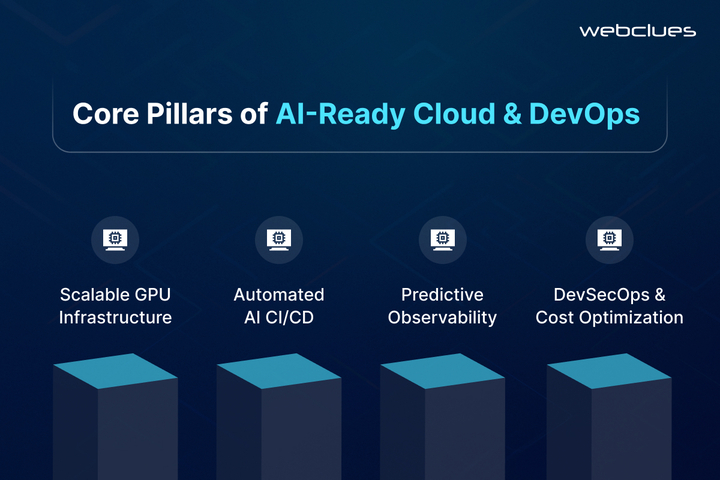
Building an AI-ready cloud infrastructure requires strong foundational elements. The subsequent pillars are critical.
Scalable Cloud Infrastructure Across Modern Cloud Providers
Managing and distributing an AI workload requires elastic cloud infrastructure that scales compute, storage and networking resources. Advanced cloud service providers, like AWS, Azure and GCP provide GPU instances, high speed storage, and premium networking services that enable efficient execution of AI workloads.
Cloud experts assist clients and design optimal multi-cloud or hybrid cloud solutions. Depending on the cost, latency and redundancy requirements clients balance workloads to avoid bottlenecks and achieve high availability without overprovisioning.
AI-Optimized CI/CD Pipelines and Delivery Automation
AI workloads often overwhelm traditional CI/CD pipelines. AI-specific pipelines incorporate data harvesting, model training, validation and deployment into a single, seamless workflow. DevOps consulting company assist clients with implementing automation that:
- Model reproducer across environments
- Reduces manual interventions to speed iteration of models
- Model accuracy and stability testing is automated
AI deployments are predictable, repeatable, and auditable with this approach.
Cloud Monitoring Solutions Built for Prediction, Not Reaction
AI systems must be monitored in a proactive manner. Using the most recent cloud monitoring solutions means using AI-driven systems that analyze observability in order to predict the anomalies that could negatively impact production. Forecasting analytics can identify problems such as resource bottlenecks, model drift, and failures in infrastructure.
Consultants implement dashboards, alerting frameworks, and automated remediation to keep the system working at a high capacity. This allows teams to concentrate on innovative work instead of firefighting.
Security, Compliance, and DevSecOps by Default
The datasets used in AI workloads are often sensitive. Therefore, security must be integrated into every step of the pipeline. To ensure data protection in transit and at rest, DevSecOps practices embed automated scans, encryption, and compliance with GDPR, HIPAA or other relevant industry standards, as well as reducing the likelihood of breaches or operational problems.
DevOps consulting services offer design in a way that workflows that are secure offer fast innovation and they do not leave compliance in the rearview.
Cost Visibility and Intelligent Resource Optimization
The workloads associated with AI are often very expensive. Without certain managed cloud services, unnecessary spending on GPU instances, cloud storage, and even networking can occur. To facilitate the most efficient use of every compute cycle, cloud engineers implement integrated predictive analytics, dynamic resource allocation, and cost tracking.
With cost being a very big aspect for long-term AI initiatives, intelligent autoscaling, idle resource detection, and the management of spot instances allow companies to achieve the performance level that they desire.
How AI Is Reshaping DevOps Operations in 2026?
2026 is quickly approaching, and many changes will impact the roles of DevOps and the workloads generated by them.
AI-Driven Observability and Incident Prevention
Most modern companies use automated tools for tracking and reporting all company activities to stay on top of everything. Still, these tools can only provide real-time updates, corrections, and reports. Products and services based on AI help centralize and streamline reporting so that employees can focus on other tasks. Predictive reporting can alert employees and management before problems arise, and machine learning can improve the system's suggestions based on organizational goals.
Self-Optimizing CI/CD Pipelines
Companies will likely use self-optimizing tools to improve lead times and delivery cycles for products. These tools will likely use automated reporting combined with AI to identify, track, and eliminate bottlenecks.
Intelligent Infrastructure Automation and IaC
Self-managed tools that require no input from employees will be able to strengthen organizational systems. These tools will use intelligent management of code systems to enhance workflow systems and minimize mistakes by employees.
AI Ops for Proactive Performance and Reliability
Tools that focus on automated problem solving will provide an organization with greater resilience and improved stability of organizational systems and processes. These tools will focus on collecting data from automated problem-solving cycles to improve the overall system. AI Ops will enhance organizational systems based on machine learning.
Platform Engineering: The Backbone of Scalable AI Systems
With platform engineering, you can streamline everything from tooling, pipelines, and infrastructure into a single, unified self-service platform for your builders.
Internal Developer Platforms (IDPs) for AI Workloads
IDPs are a game changer for AI engineers as they include ready-to-go environments, customizable modules, and built-in monitoring, which drastically improves setup and resolves inconsistencies.
Kubernetes and Container Orchestration at Scale
Thanks to Kubernetes, the orchestration of containerized AI workloads can adapt to scale, leading to peak performance and continuous deployment across multiple clouds.
GitOps, Standardization, and Self-Service Environments
With the implementation of GitOps and standardization, teams are empowered to self-service infrastructure and deployments which eliminates the slowdowns associated with manual provisioning and approval processes.
Best Approach to Building Teams to Manage AI Workloads
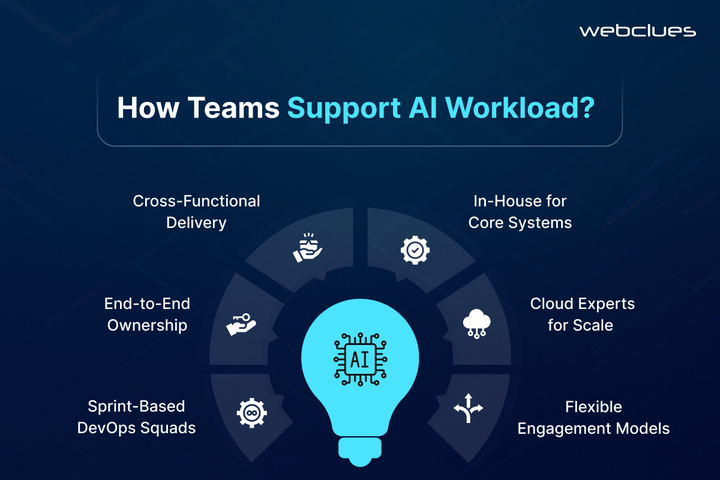
People and structure are as critical as technology.
Sprint-Based DevOps and Cloud Engineering Squads
Cross-functional squads own end-to-end delivery, blending DevOps in software development, operations, security, and cloud expertise. This structure improves accountability, reduces handoffs, and accelerates iteration.
Hiring vs Outsourcing: Choosing the Right Delivery Model
Organizations must decide between hiring full-time DevOps engineers or partnering with cloud and managed services providers. The choice depends on skill availability, project complexity, and long-term scalability goals.
When to Hire DevOps Engineers vs Work with Cloud Experts
Full-time engineers are ideal for core, proprietary systems, while cloud engineers and consulting services accelerate AI adoption and provide specialized skills without long-term overhead.
DevOps Consulting Services vs DevOps Managed Services
Understanding engagement models ensures strategic alignment with business goals.
Advisory-Led DevOps Consulting Services
Consulting services provide strategy, architecture design, and implementation guidance, enabling organizations to adopt modern DevOps practices while upskilling internal teams.
Always-On DevOps Managed Services for Production AI Systems
Managed services offer 24/7 support, monitoring, and automation, ensuring production AI systems remain stable, secure, and compliant.
Hybrid Models for Fast-Scaling Organizations
Many high-growth companies adopt hybrid approaches, combining consulting for strategic planning with managed services for operational execution, ensuring both speed and reliability.
How Leading Companies Scale AI Workloads Without Losing Control
High-performing teams follow proven patterns:
- Standardized platforms for reproducibility.
- AI-driven monitoring and incident prevention.
- Sprint-based squads with end-to-end ownership.
- Cost and resource optimization using cloud-native tools.
These approaches allow companies to deploy frequently, scale effortlessly, and maintain control over security and compliance, even under heavy AI workloads.
Choosing the Right Cloud & DevOps Consulting Partner
Selecting the right partner is critical for success. Look for:
- Proven AI and cloud engineering experience with large-scale deployments.
- Strong cloud monitoring and security capabilities, ensuring predictive observability and compliance.
- Clear delivery metrics and accountability, providing measurable business outcomes.
The Business Impact of Modern DevOps for AI Workloads
Modern DevOps practices provide faster time-to-market, improved system reliability, and cost efficiency. Businesses see:
- Shorter deployment cycles with fewer errors.
- Reduced downtime and faster incident resolution.
- Scalable infrastructure supporting evolving AI workloads.
- Increased developer productivity and retention through better DevEx.
By integrating AI, automation, and platform engineering, companies turn DevOps into a strategic advantage, rather than a technical necessity.
Build AI-Ready Cloud & DevOps Solutions with WebClues Infotech!
2026 is set to redefine how businesses scale AI-heavy workloads, and the organizations that get ahead will combine strategic DevOps consulting, cloud expertise, and AI-driven automation. Building AI-ready infrastructure isn’t just about technology—it’s about people, processes, and choosing the right partners to accelerate adoption while keeping systems reliable, secure, and cost-efficient.
WebClues Infotech holds proven expertise in DevOps consulting services, cloud engineering, and AI-ready infrastructure, WebClues helps companies design scalable, secure, and automated environments tailored to their unique workloads. Whether it’s building AI-optimized CI/CD pipelines, implementing cloud monitoring solutions, or guiding teams through platform engineering, WebClues Infotech ensures your AI initiatives deliver faster, safer, and more efficiently.
Reach out to us if your focus is on innovation while leaving the complex orchestration of cloud and DevOps systems to experts. From advisory-led consulting to managed services for production AI systems, WebClues Infotech helps organizations turn AI ambitions into measurable results, setting the stage for sustainable growth in the next decade.
Post Author

Vedansh Kanodia
Vedansh Kanodia, a dynamic Business Development Executive at WebClues Infotech, is a passionate technocrat who helps businesses embrace innovation, and unlock new possibilities with his valuable perspectives.


Build Your Agile Team
Hire Skilled Developer From Us
Accelerate Your AI Workloads with Expert DevOps Consulting
Don’t let infrastructure bottlenecks slow your AI growth. Partner with WebClues to design scalable cloud systems, implement AI-optimized CI/CD pipelines, and secure your workloads with modern DevOps practices. Focus on innovation while we ensure speed, reliability, and measurable outcomes for your AI initiatives.
Connect Now!Frequently Asked Questions
Our Recent Blogs
Sharing knowledge helps us grow, stay motivated and stay on-track with frontier technological and design concepts. Developers and business innovators, customers and employees - our events are all about you.