
Connect with us


Corporate Video

Custom AI Development vs SaaS AI Tools: What Should Enterprises Choose
.jpg)
Summary
The decision between custom AI development and SaaS AI tools represents a fundamental business strategy choice, not just a simple technology comparison. SaaS AI tools offer speed, affordability, and quick deployment, making them ideal for standard business use cases and early-stage validation. Custom AI development delivers full control, deep personalization, strong data ownership, and long-term competitive advantage.
As businesses mature, most enterprises shift toward a hybrid AI model. They use SaaS tools for generic functions while leveraging enterprise-focused custom AI development services power their mission-critical, differentiating workflows. The right choice for your business depends on scalability needs, data sensitivity, integration complexity, and your ultimate goals for market differentiation.
Introduction:
Artificial intelligence now serves as core infrastructure for the modern enterprise. Companies no longer ask if they should adopt AI. Instead, leadership teams ask how to implement AI effectively to maximize return on investment (ROI) and stand out from competitors.
This brings technology leaders, CTOs, and enterprise buyers to a critical crossroads. Should you rely on ready-made SaaS AI tools, or should you invest in a custom AI solution?
Choosing the wrong path carries heavy consequences. If you build from scratch when a cheap tool already exists, you waste months of engineering time and capital. If you rely on a generic tool for a process that defines your competitive edge, you hand your secret weapon over to a third-party vendor.
This decision impacts your competitive positioning, data ownership, operational efficiency, and your ability to scale smoothly. You need a clear framework to make the right choice.
What Are SaaS AI Tools?
SaaS (Software as a Service) AI tools are pre-built platforms delivered through a subscription model. You pay a monthly or annual fee, configure the software to your basic preferences, and start using it immediately. The vendor handles all the underlying infrastructure, machine learning models, server maintenance, and feature updates.
Common examples include AI customer support chatbots, AI writing assistants, predictive analytics dashboards, and workflow automation platforms.
These tools are built for the masses. They solve common, highly repeatable business problems. Because the vendor spreads the development cost across thousands of customers, your entry price remains very low. You can deploy a SaaS AI tool in days or even hours without needing a large team of specialized machine learning engineers.
Key Characteristics:
- Subscription-based pricing models
- Managed infrastructure and seamless updates
- Very fast implementation timelines
- Standardized features built for general use cases
What Is Custom AI Development?
Custom AI development involves building tailor-made AI systems designed specifically for your unique business workflows, data, and strategic goals. Rather than forcing your business processes to fit inside a generic tool, you build the software to fit your business perfectly.
When you partner with a Custom AI Development Company, you create a proprietary asset. This process includes developing custom machine learning models, training algorithms on your specific enterprise data, and building deep integrations with your existing internal systems.
This approach turns AI into a strategic asset. By engaging in Custom Software Product Development, you gain complete ownership over the code, the data, and the intellectual property.
Your AI system learns the specific nuances of your customers, your industry terminology, and your operational bottlenecks. It does exactly what you need it to do, without the bloated features you never use.
Custom AI vs SaaS AI: Enterprise Comparison Framework
The debate between building and buying AI is not just a technical argument; it is a strategic business decision. To understand which path suits your enterprise, you must look at the core differences.
Deployment Speed
SaaS tools win the speed race. You can sign up, integrate an API, and see value within days. Custom AI takes weeks or months to design, train, test, and deploy securely.
Customization and Flexibility
SaaS limits you to the vendor's roadmap. If you need a specific feature, you have to submit a request and hope they build it. Custom AI offers unlimited flexibility. You control the architecture and can change the system logic as your business evolves.
Data Ownership
With SaaS AI, you often process your data through a third-party server. The vendor might even use your data to train their future models. Custom AI ensures absolute data sovereignty. Your data never leaves your secure environment.
Competitive Advantage
If you use a popular SaaS tool, your competitors are likely using the exact same tool. You cannot build a unique competitive moat using shared technology. Custom AI gives you capabilities that no other company has, creating a massive market advantage.
Cost Comparison: Build vs Buy AI Solutions
SaaS AI tools operate on a subscription and usage-based pricing model, typically ranging from $20 to $500 per user/month for standard AI tools, while enterprise AI APIs and platforms can extend into $2,000–$50,000+ per month depending on volume, integrations, and SLA requirements. In addition to base pricing, most vendors apply usage-based charges (API calls, tokens, or data processing units) that scale non-linearly with adoption.
At small scale (under ~50,000 AI interactions/month), SaaS remains economically attractive due to low upfront commitment and predictable billing. However, at enterprise scale—typically 500,000 to 10M+ AI interactions/month—cost structures begin to escalate sharply, especially in high-frequency use cases like customer support automation, content generation, or predictive analytics pipelines.
AI development services typically requires an upfront investment ranging from $50,000 to $500,000+ for mid-complexity systems, and can exceed $1M+ for large-scale enterprise AI platforms involving multiple models, integrations, and secure infrastructure layers. This includes data engineering, model training, deployment pipelines, and integration with internal systems.
Once deployed, the recurring cost structure shifts primarily to infrastructure and maintenance, typically ranging from $2,000 to $25,000/month, depending on compute intensity, model complexity, and scaling requirements. Unlike SaaS, this cost does not increase linearly with usage, allowing enterprises to absorb growth without proportional cost expansion.
The key inflection point occurs when SaaS costs exceed the amortized monthly cost of a custom system. In most enterprise AI workloads, this break-even typically occurs within 12 to 24 months, after which custom AI becomes progressively more cost-efficient, especially in high-volume or always-on inference environments.
From a financial strategy perspective, SaaS optimizes for low entry cost and speed, while custom AI optimizes for long-term cost control and scalability efficiency. The right choice depends not on absolute cost, but on projected usage trajectory and AI dependency level within the business.
Performance, Scalability & Customization Tradeoffs
SaaS tools are built to be "good enough" for the majority of users. They use generalized foundation models. While impressive, these models lack domain-specific precision. If your logistics company needs a tool to predict hyper-local supply chain disruptions, a generic AI tool will likely return vague or inaccurate predictions.
Furthermore, SaaS tools hit a wall when it comes to scalability. You must operate within their rate limits and feature tiers. If your company experiences a massive spike in growth, a SaaS vendor's infrastructure might become a bottleneck.
Custom AI systems solve these tradeoffs. Because they train strictly on your proprietary data, the performance accuracy is exceptionally high. You design the exact workflows, decision logic, and output formats you need.
When you need to scale, you control the cloud architecture. You can increase server capacity instantly without asking a vendor for permission or upgrading to a punishingly expensive enterprise tier.
Security, Compliance & Data Ownership Considerations
Data security remains the top concern for CTOs evaluating AI tools. When you use an off-the-shelf SaaS AI platform, you send your sensitive company information to external servers. Even with strong vendor security policies, this creates risk.
For companies in finance, healthcare, legal, or government sectors, regulatory compliance makes SaaS AI tools a tough sell. Regulations like HIPAA, GDPR, and SOC2 require strict data handling protocols that many generic AI wrappers simply cannot guarantee.
Custom AI provides an air-tight solution. You retain full control over where data lives, who accesses it, and how the models use it. You can host custom AI on your own private cloud or on-premise servers. You set the audit trails, you manage the encryption keys, and you maintain complete intellectual property rights over the AI models you build.
When to Choose SaaS AI Tools
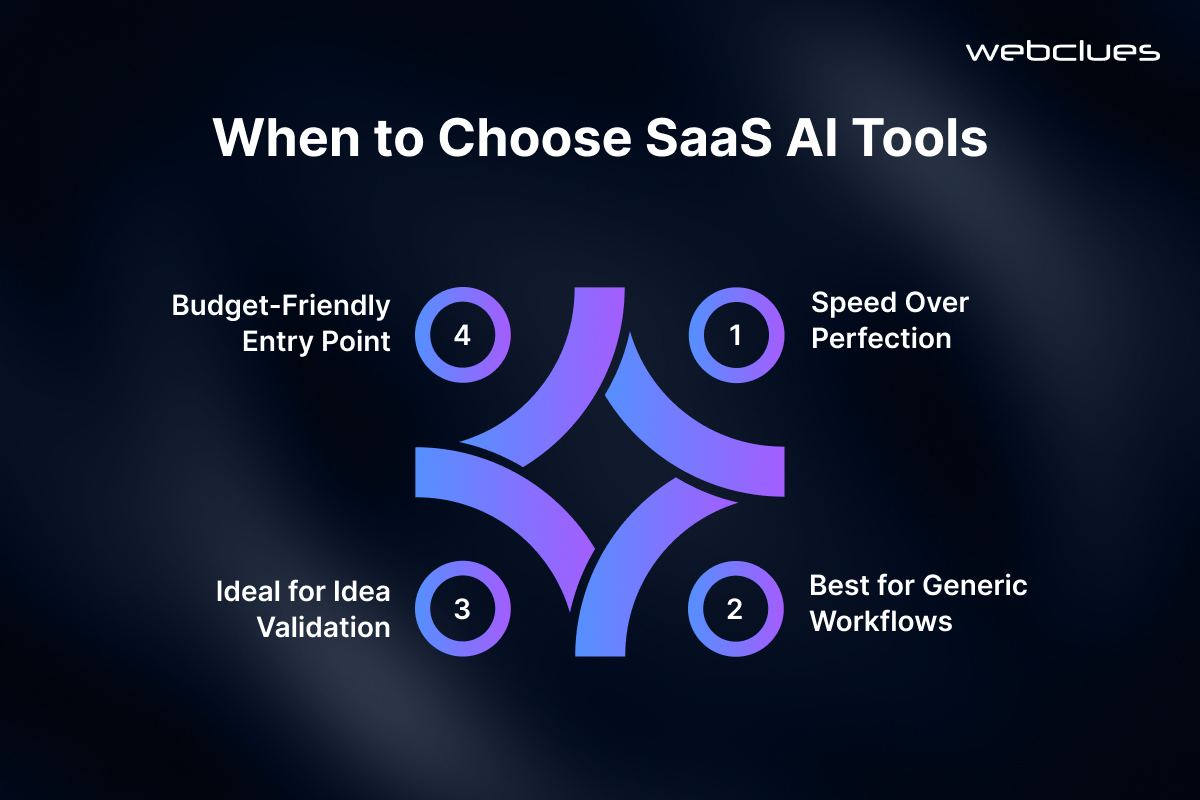
You should not dismiss SaaS AI tools entirely. They hold incredible value when applied to the right situations. You should opt for SaaS AI when:
- You need speed over perfection: If you want to launch a basic customer service chatbot by next week, buy a SaaS tool.
- The process is generic: Tasks like standard invoice reading, basic meeting transcription, or generic content drafting do not require a custom build.
- You are validating an idea: Startups and innovation teams should use SaaS tools to prove an AI concept works before investing heavy capital into a custom build.
- Budget is tight: If your department lacks the upfront budget for software engineering, SaaS subscriptions provide a safe entry point into AI.
When Custom AI Development Is the Better Choice
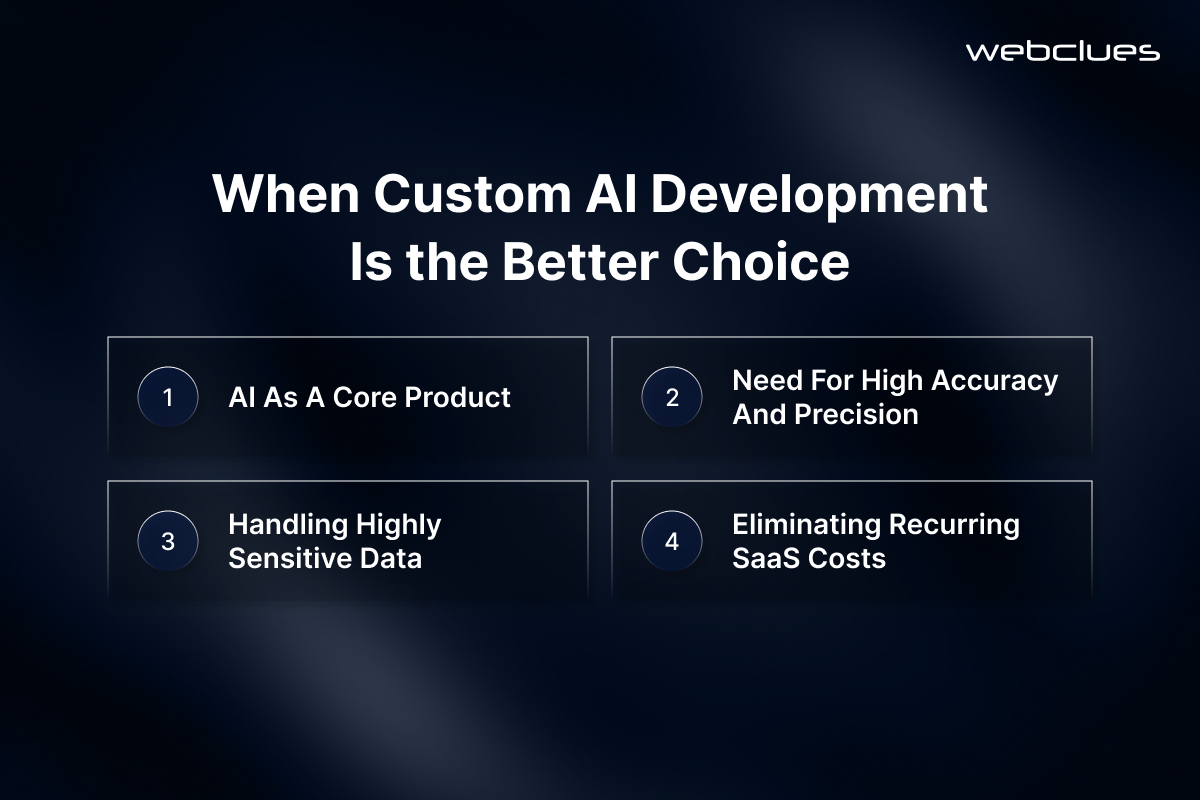
Enterprise leaders must recognize when a process requires a tailored approach. You should seek out Custom Software Development Services when:
- AI is your core product: If AI drives your primary revenue stream, you cannot rent your core technology from someone else.
- You handle highly sensitive data: When privacy, compliance, and strict data sovereignty are non-negotiable, custom builds are mandatory.
- You require high accuracy: When a 5% increase in prediction accuracy translates to millions of dollars saved, generic models will not suffice. You need models trained specifically on your exact historical data.
- You want to eliminate recurring costs: When your usage volume reaches a point where SaaS API fees are draining your profits, a custom build becomes financially necessary.
The Hybrid AI Development Approach (Fastest Growing Trend)
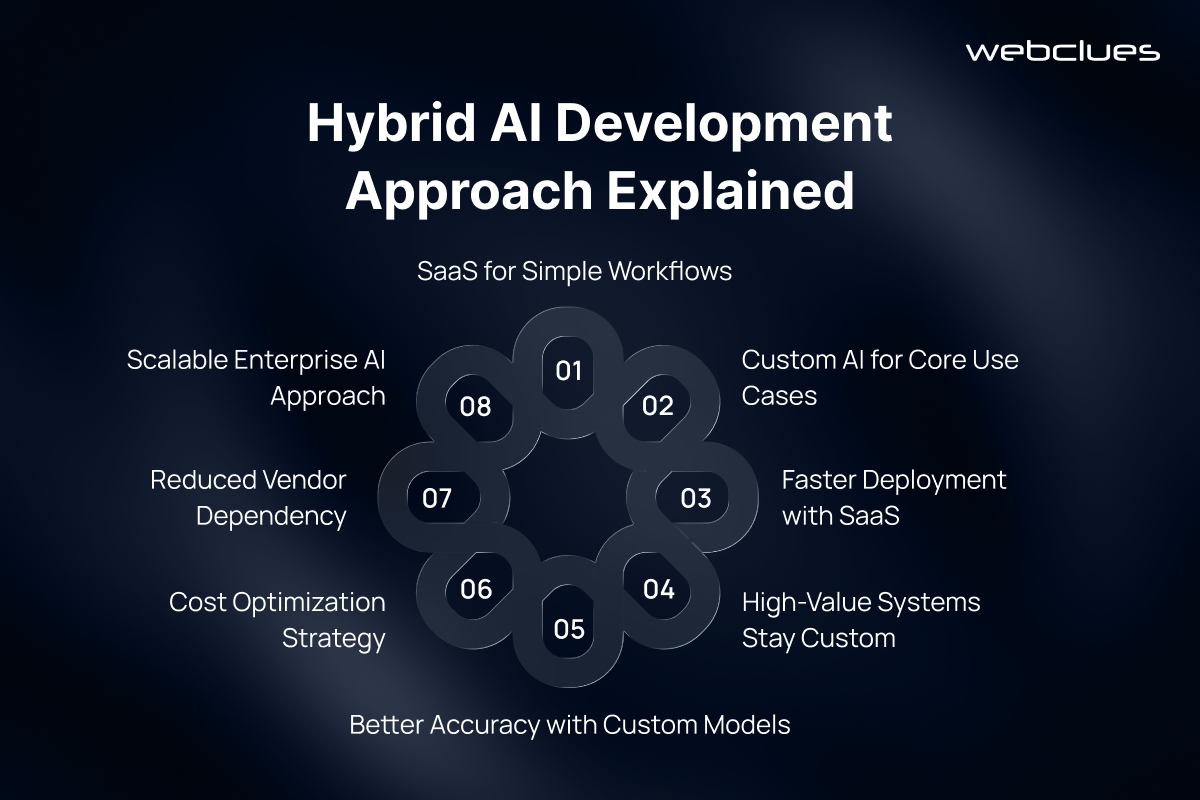
The Hybrid AI approach has emerged as the most practical and widely adopted enterprise strategy, moving beyond the traditional “build vs buy” debate.
Instead of treating SaaS AI tools and custom AI development as mutually exclusive choices, organizations increasingly combine both to optimize for speed, cost efficiency, and strategic control.
The primary advantage here is rapid deployment and reduced engineering overhead, allowing enterprises to achieve immediate efficiency gains without building complex systems from scratch.
At the same time, custom AI development is reserved for high-impact, revenue-driving, and data-sensitive use cases. These include proprietary pricing engines, recommendation systems, fraud detection models, demand forecasting solutions, and predictive maintenance frameworks.
Unlike generic SaaS tools, these systems are trained on internal, domain-specific data, enabling significantly higher accuracy and direct alignment with business logic and competitive strategy.
This dual-layer structure creates a balanced operating model where organizations avoid overengineering simple solutions while still investing in AI capabilities that directly influence differentiation and market advantage. It also ensures that critical intelligence systems remain fully owned and controlled, reducing dependency on external vendors.
Ultimately, the hybrid approach represents a mature AI adoption strategy, allowing enterprises to scale efficiently while maintaining full control over the systems that define their competitive edge.
Common Mistakes Businesses Make When Choosing AI Solutions
When navigating the AI landscape, many businesses fall into predictable traps. Avoid these common missteps:
- Buying SaaS solely because it looks cheap: Do not ignore the three-year TCO. Usage-based pricing scales aggressively.
- Building custom AI for generic problems: Do not spend $100,000 building a document summarizer when a $50/month tool already exists.
- Ignoring data readiness: Custom AI requires clean, organized data. If your data is a mess, your custom AI project will fail.
- Failing to plan for model drift: Custom AI requires ongoing monitoring. Models degrade over time as data changes. You must plan for continuous maintenance.
Strategic Decision Framework (Build vs Buy Model)
If you stand at the crossroads of this decision, use this simple framework to guide your team:
- Define the Business Value: Does this specific AI use case differentiate us from our competitors? If yes, build it. If no, buy it.
- Assess Data Uniqueness: Do we have unique, high-quality data that gives us an edge? If yes, leverage it through custom AI.
- Evaluate Integration Needs: Does this AI need to speak to five different legacy internal systems seamlessly? If yes, a custom build ensures stability.
- Calculate Long-Term Costs: Map out the estimated API or user seat costs for a SaaS tool at your projected scale over 36 months. Compare this against the cost of a custom engineering team.
- Review Security Rules: Does compliance dictate that data cannot leave your servers? If yes, custom AI is your only viable path.
How WebClues Helps Enterprises Build Custom AI Systems
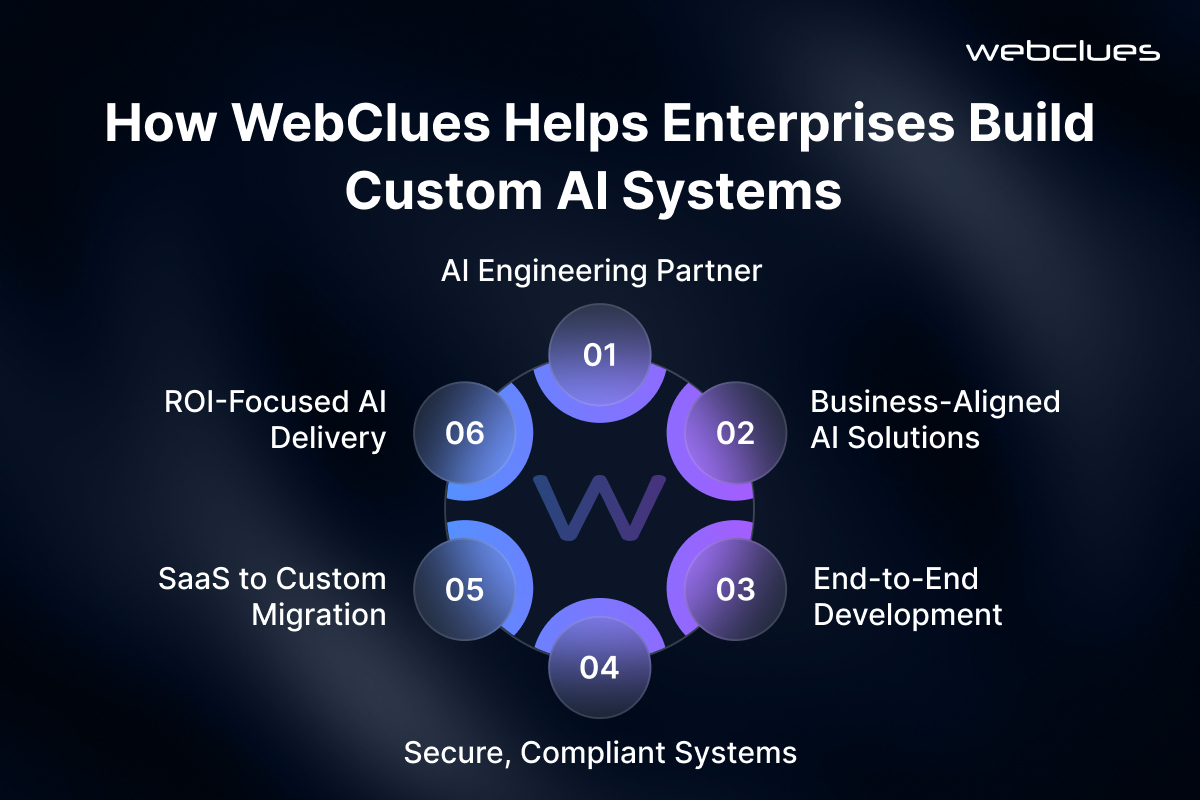
Navigating the complexities of AI requires a trusted engineering partner. At WebClues, we specialize in high-end Custom AI Development Services designed for the modern enterprise.
We do not just write code; we align AI technology directly with your business outcomes. Our team helps you audit your data, select the right machine learning architectures, and build secure, compliant AI products that scale.
Whether you need to transition away from expensive SaaS tools or build a groundbreaking proprietary AI product from scratch, WebClues provides the strategic guidance and technical execution you need to succeed.
We build AI systems that are production-ready, highly secure, and fiercely aligned with your ROI goals.
Make the Right AI Development Choice Before It Starts Costing You Growth
At the end of the day, this is not a technology debate—it’s a control vs convenience decision that directly impacts how fast and how far your business can scale.
SaaS AI tools give you speed. They help you get started quickly, automate standard workflows, and reduce upfront effort. But they are built for the average use case, not your specific competitive edge. Over time, that limitation becomes visible in integration gaps, rising usage costs, and restricted flexibility.
Custom AI development is what you move to when AI stops being a support function and starts becoming core to your business model. That’s where precision, security, data ownership, and long-term cost efficiency start to matter more than quick deployment. It is not about replacing SaaS completely, but about taking control of the systems that actually define your differentiation.
The most effective enterprises are not choosing sides, they are structuring AI intentionally. SaaS for speed. Custom AI for strategy.
If you are at the stage where AI decisions are starting to influence scale, margins, or product advantage, the next step is not another tool—it is the right architecture plan.
Let’s design it right from the start. Talk to our team to evaluate your use case and build a custom AI roadmap that aligns with your business goals, scale requirements, and long-term ROI.
Post Author

Vedansh Kanodia
Vedansh Kanodia, a dynamic Business Development Executive at WebClues Infotech, is a passionate technocrat who helps businesses embrace innovation, and unlock new possibilities with his valuable perspectives.


Build Your Agile Team
Hire Skilled Developer From Us
Build an AI Strategy That Matches Your Business, Not the Market
Whether you are evaluating SaaS AI platforms or planning custom AI development, the right approach depends on your scalability goals, integration requirements, data control, and long-term ROI expectations. Our team helps businesses analyze existing AI workflows, reduce dependency-related inefficiencies, and build AI solutions aligned with operational needs, compliance standards, and future growth. From AI roadmap planning to enterprise-grade custom AI development services, we help you make confident technology decisions backed by execution-focused strategy.
Connect Now!Frequently Asked Questions
Our Recent Blogs
Sharing knowledge helps us grow, stay motivated and stay on-track with frontier technological and design concepts. Developers and business innovators, customers and employees - our events are all about you.