

Connect with us


Corporate Video


How Data Analytics Is Shifting from Dashboards to Predictive Intelligence in 2026
.png)
In 2026, organizations are looking for data analytics solutions that do more than simply summarize beyond static dashboards. The expectations from data have fundamentally shifted. Instead of asking, “What happened last quarter?” leaders are now asking, “What’s going to happen next, and what should we do right now to shape the outcome?”
This has led to the emergence of predictive intelligence, a new and fundamental capability of leading data analytics services, which goes beyond reporting, forecasting, and even anticipating and recommending, and enters the realm of action. Predictive intelligence leverages artificial intelligence (AI), machine learning, real-time data pipelines, and decision automation to enable organizations to act before opportunities are lost or threats emerge.
The sense of urgency in this evolution is captured in the following statistic, which has been widely quoted: While more than 90% of organizations rate data-driven decision-making as a critical factor for growth, fewer than one-third of them believe they are actually leveraging their data effectively. It is a strategic misalignment between how data is generated and how decisions are made. Dashboards were designed for visibility. Predictive intelligence is designed for velocity.
For founders, decision-makers, and B2B buyers, understanding this transition is no longer optional. Data analytics strategy now directly impacts revenue growth, operational resilience, customer experience, and long-term competitiveness. Businesses that adopt predictive intelligence in 2026 will not just analyze change they will shape it.
Why 2026 Is a Game-Changer for Data Analytics?
The year 2026 marks a structural turning point in the evolution of data analytics. While previous years introduced new tools and platforms, 2026 represents a change in expectations at the leadership level.
Executives no longer accept analytics that explain outcomes after the fact. They demand systems that can anticipate what is coming, recommend actions, and, in some cases, execute decisions automatically within defined guardrails.
There are three factors that make this point in time unique.
First, AI and machine learning have reached maturity. Models are no longer the sole domain of research and experimentation. They now function effectively in production, processing big data in real-time and adjusting to new patterns without human oversight.
Second, the pace of business has accelerated. Customer behavior, market trends, supply chains, and cyber threats are constantly evolving. Data that is late by hours or minutes may be irrelevant altogether.
Third, accountability for decision-making has changed. Executive teams are recognized not only for their accuracy but for their speed. Being able to make decisions faster than the competition has become a key differentiator.
Companies that are capitalizing on this shift are fundamentally changing the way decisions are made in sales, marketing, operations, finance, and product. Companies that are not, and are instead stuck in a world of dashboards and post-mortems, risk becoming less agile and less connected to the real world.
The Evolution of Data Analytics: From Descriptive to Predictive and Beyond
For many years, data analytics was all about descriptive analysis. Dashboards, reports, and scorecards provided a summary of what happened during a certain period of time. These tools provided much-needed transparency and accountability, particularly in a stable market with predictable trends.
The problem with descriptive analytics is that it is, by definition, a retrospective process. It answers the question “What happened?” but does not provide any insights on what to do next. As competition grew and markets became faster-paced, this became a very expensive proposition.
Diagnostic analytics came next, allowing companies to understand why things happened. Root cause analysis, drill-down reports, and segmentation provided more insights, but the process of decision-making was still slow and reactive.
Predictive analytics was a huge step up. Using statistical models and machine learning algorithms, companies could predict demand, determine the risk of churn, predict fraud, and predict equipment failures. For the first time, analytics started to look forward, rather than backward.
In 2026, analytics moves beyond prediction into prescriptive and decision intelligence. These systems do not simply forecast outcomes. They evaluate multiple scenarios, recommend optimal actions, and increasingly automate decisions where speed and consistency matter most.
This evolution reflects a deeper shift. Analytics is no longer a reporting function. It is becoming an active participant in how organizations think, plan, and operate.
How AI Is Redefining the Future of Data-Driven Decision-Making
Artificial intelligence is the core enabler of predictive intelligence, but its true impact lies in how it reshapes decision-making itself.
Traditional analytics tools depend heavily on human interpretation. Analysts extract insights, prepare reports, and present findings to stakeholders. This process introduces delay and limits scalability.
AI-driven analytics changes this dynamic. Models continuously analyze incoming data, identify patterns invisible to human analysts, and surface insights in real time. More importantly, these systems learn from outcomes, improving accuracy as conditions change. This allows organizations to move from reactive responses to anticipatory strategies.
In retail, AI models predict demand at a granular level and adjust pricing or inventory dynamically. In financial services, fraud detection systems flag suspicious activity as transactions occur. In manufacturing, predictive maintenance models identify potential failures before downtime disrupts operations. In SaaS, churn prediction models trigger targeted interventions while customers are still engaged.
The competitive advantage is not prediction alone. It is the ability to intervene early, while outcomes are still malleable.
How AI Is Transforming Data Analytics in 2026
In 2026, AI is not simply enhancing analytics—it is redefining what analytics means. AI-driven systems automate large portions of the analytics lifecycle, from data ingestion and preparation to modeling, interpretation, and action. This automation reduces friction, improves accuracy, and shortens the distance between insight and execution.
More importantly, AI allows analytics to operate continuously. Instead of periodic reporting cycles, organizations gain always-on intelligence that adapts in real time. This shift changes expectations across the business. Analytics is no longer something teams “check.” It becomes something that actively guides daily decisions.
Automating Data Management and Analysis with AI
One of the most immediate impacts of AI is the automation of data operations.
Traditional data management involves extensive manual effort: cleaning inconsistent data, integrating multiple sources, validating accuracy, and monitoring for anomalies. These tasks consume time and introduce errors, delaying insights.
AI automates much of this work. Intelligent data pipelines detect anomalies, resolve inconsistencies, adapt to schema changes, and ensure data quality continuously.
For example, a manufacturing organization can use AI to monitor sensor data from equipment in real time, identifying subtle performance deviations before they escalate into failures. A marketing team can rely on automated data validation to ensure campaign insights are based on accurate, up-to-date information.
By removing operational bottlenecks, AI allows data analytics company to focus on higher-value work: designing decision systems rather than maintaining reports.
The Role of AI in Enhancing Speed, Accuracy, and Decision-Making
AI not only accelerates analytics. It also makes analytics more accurate. Machine learning models get better with time as they are exposed to more data. They learn to adapt to seasonality, behavior, and market fluctuations without needing constant retraining.
This ability is especially important in sectors where speed and accuracy have a direct impact on results. Banks use AI to react to market changes in real-time. Hospitals use predictive analytics to better allocate resources. Retailers use AI to dynamically price and promote products.
This enables a more flexible enterprise that can react to change as it unfolds instead of after the fact.
Top Data Analytics Trends to Watch in 2026
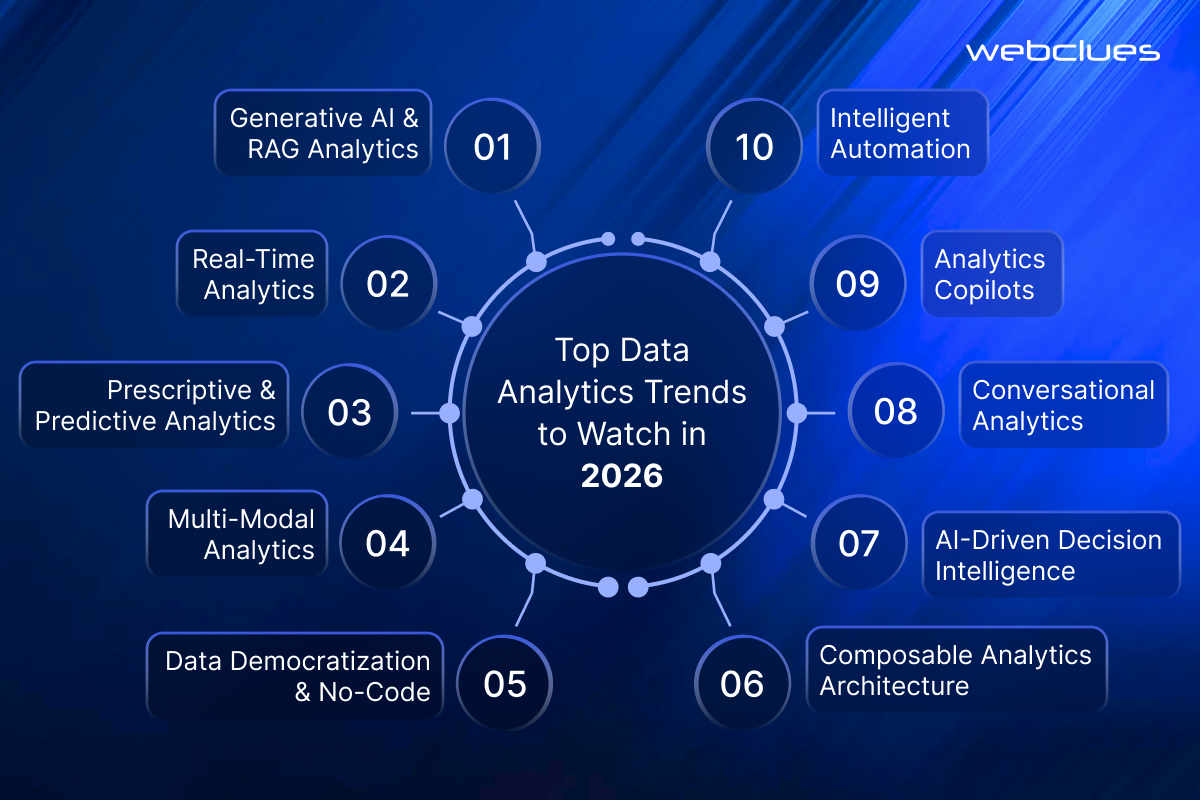
The analytics landscape in 2026 is defined not by a single technology, but by a set of converging trends that reshape how data is collected, analyzed, and acted upon. Organizations that understand these trends can design analytics strategies that remain relevant as tools and platforms evolve.
Generative AI and Retrieval-Augmented Generation (RAG): The Future of Data Exploration
Generative AI has transformed how users interact with data. Instead of navigating dashboards or writing complex queries, users can ask questions in natural language and receive contextual, accurate answers.
Retrieval-Augmented Generation enhances this capability by grounding responses in live, authoritative data sources rather than static training data. This ensures insights are both current and reliable.
For business teams, this democratizes analytics. Marketing teams can analyze customer feedback without technical support. Sales leaders can explore pipeline trends conversationally. Executives can ask strategic questions and receive immediate, data-backed answers.
The result is broader adoption of analytics across the organization—and better questions being asked at every level.
Real-Time Analytics: Why Instant Insights Are the New Standard
By 2026, real-time analytics will become a necessity. It has become the new norm.
More and more businesses are using real-time data to inform their decisions about revenue, risk, and customer experience. Retailers are changing prices in real-time based on demand. Banks are detecting fraud in real-time. Logistics companies are reacting to disruptions in real-time.
This is made possible by cloud-native platforms, event-driven architectures, and infrastructure that can handle real-time data streams. Those who are late in adopting this technology tend to underestimate the cost of latency.
Predictive and Prescriptive Analytics: From Forecasting to Actionable Intelligence
Predictive analytics is the forecast of what is likely to happen. Prescriptive analytics is the recommendation of what to do about it.
Together, they comprise the essential foundation of actionable intelligence. For instance, a logistics firm may predict that there will be a delivery delay. Prescriptive analytics will assess different routes, costs, and the effect on customers to determine the best course of action.
Multi-Modal Analytics: Unlocking Insights Across Text, Images, and Video
Modern decisions rely on more than structured data. Customer reviews, support tickets, images, video feeds, and sensor data all contain valuable signals.
Multi-modal analytics integrates these diverse data types to provide richer context. In healthcare, combining patient records with imaging data improves diagnosis. In retail, analyzing visual merchandising alongside sales data reveals new insights. In manufacturing, video analysis enhances quality control.
Organizations that invest in multi-modal analytics gain a more complete understanding of their environment.
Data Democratization and No-Code Tools: Empowering Non-Technical Teams
No-code and low-code platforms enable business users to investigate data on their own. This leads to a decrease in the need for centralized analytics teams and faster decision-making.
But democratization needs to be done in a way that also addresses governance. Data ownership, quality, and access are critical to avoid disjointed or inaccurate information. In 2026, successful companies will enable teams without sacrificing trust in the data.
Composable Analytics Architectures: Building Scalable and Flexible Systems
Composable analytics architectures replace monolithic platforms with modular components that can evolve independently.
This flexibility is critical in a rapidly changing technology landscape. Organizations can adopt new tools, integrate emerging AI capabilities, and adapt to regulatory changes without rebuilding their entire analytics stack. Composable architectures future-proof analytics investments.
AI-Driven Decision Intelligence: The End of Static Dashboards
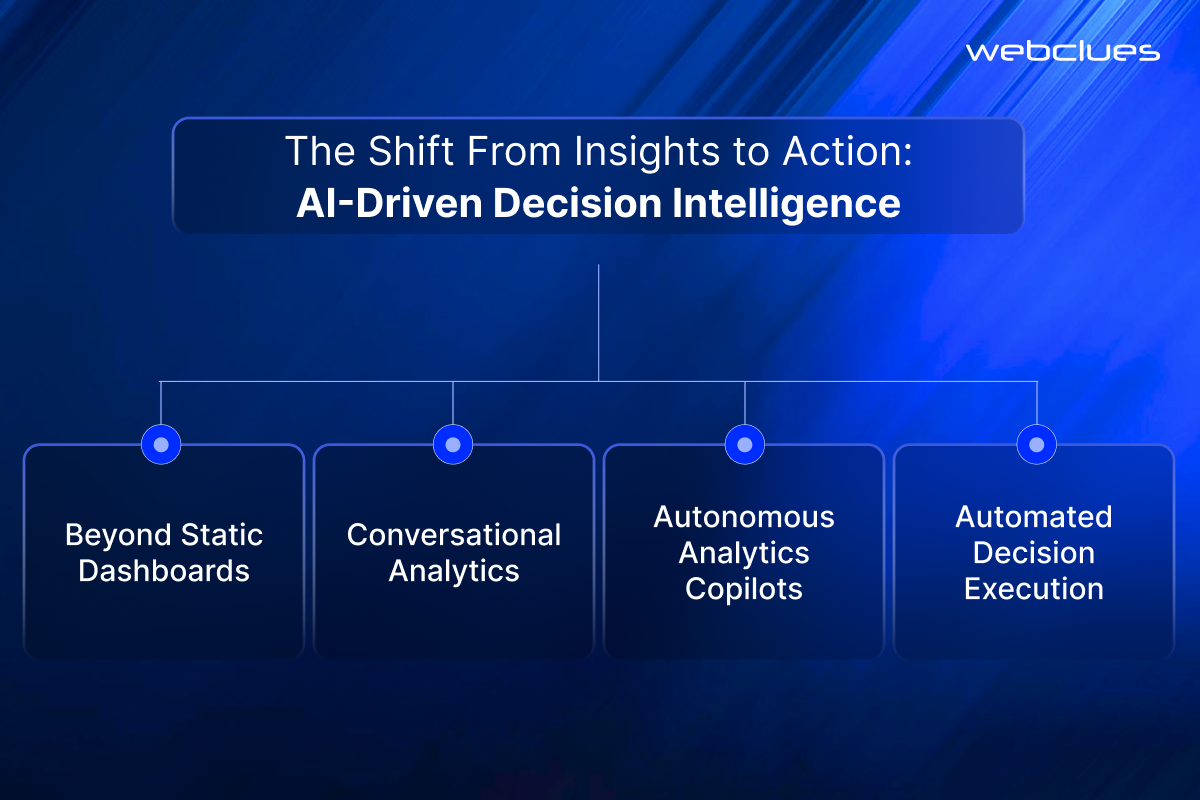
Static dashboards are increasingly replaced by decision intelligence systems that integrate prediction, recommendation, and automation.These systems simulate outcomes, explain trade-offs, and act within defined constraints. Instead of summarizing performance, they intervene in real time.
From Dashboards to Conversational Analytics: The Rise of Natural Language Interfaces
Conversational analytics removes friction between users and data. By allowing users to ask questions in plain language, these interfaces eliminate the need for technical expertise. Insights become accessible across the organization, improving alignment and execution.
Autonomous Analytics Copilots: AI as Your Decision-Making Partner
AI copilots assist users by providing recommendations, explanations, and follow-up insights.
They do not replace human judgment. They augment it, reducing cognitive load and improving consistency.
As these systems mature, they become trusted partners in decision-making.
Intelligent Automation: Turning Insights into Immediate Actions
Predictive intelligence reaches its full potential when insights trigger actions automatically. From fraud prevention to inventory optimization, intelligent automation ensures decisions are executed instantly, without manual intervention. This closes the loop between insight and impact.
Why Decision Velocity Is the Competitive Edge in 2026
The pace of decision-making can be more important than the amount of data analyzed in determining success. Leading data analytics tools, enabled by AI and predictive intelligence, condense the entire cycle of sensing, analyzing, and acting into endless loops of real-time action.
Companies that optimize decision velocity by partnering with a trusted data analytics firm can proactively reduce risks and outmaneuver their competition with similar capabilities. In 2026, decision velocity is no longer a source of competitive advantage but a business imperative that translates directly into revenue, efficiency, and market responsiveness.
Ethics, Governance, and Responsible AI in Data Analytics
With increased autonomy in AI-driven analytics systems, ethics will be a non-negotiable factor in any successful data analytics solution. The best companies and teams providing data analytics services will have to address bias, provide transparency, protect privacy, and stay ahead of regulations.
AI Ethics provide predictive intelligence that is not only scalable and explainable but also trustworthy. In 2026, ethics in analytics will be the foundation of adoption and business resilience.
Turning Data Insights into Impact with AI-Driven Analytics with Webclues
The shift from dashboards to predictive intelligence is redefining how businesses compete. Analytics is no longer about understanding the past. It is about shaping the future.
At WebClues, we provide end-to-end data analytics solutions and data analytics services, helping organizations implement AI-driven systems that deliver measurable business impact. From predictive modeling to decision intelligence platforms, contact us to align technology with real business needs.
If your analytics strategy still revolves around dashboards, 2026 is the year to rethink it. The future belongs to organizations that decide faster, act smarter, and trust data to do more than report history.
Post Author

Nikhil Patel
Nikhil Patel, a visionary Director at WebClues Infotech, specializes in leveraging emerging tech, particularly Generative AI, to improve corporate communications. Through his insightful blog posts, he empowers businesses to succeed digitally.


Build Your Agile Team
Hire Skilled Developer From Us
Transform Your Analytics Strategy with Predictive Intelligence
Stop relying on static dashboards. With WebClues, implement AI-driven predictive intelligence that anticipates outcomes, recommends actions, and automates decisions. Act faster, reduce risks, and turn insights into measurable business impact because in 2026, decision speed defines success.
Connect Now!Frequently Asked Questions
Our Recent Blogs
Sharing knowledge helps us grow, stay motivated and stay on-track with frontier technological and design concepts. Developers and business innovators, customers and employees - our events are all about you.