

Connect with us


Corporate Video


How Data Engineering Consulting Improves Data Governance and Data Quality in 2026
.png)
Data governance and data quality are the key factors in the success of an organization in the year 2026. Today’s organizations are creating and depending on more than 221 zettabytes of data every year in the form of structured data, unstructured data, and semi-structured data. Though the volume of data is huge in today’s organizations, the real challenge is the quality of the data.
Data engineering consulting is not just the design of the pipeline but is now strategically placed to drive high-quality and data-driven initiatives through effective data governance and quality across the data pipeline. Top data engineering services implement data governance and quality across the data pipeline to help businesses successfully tackle their challenges in complexity, data inaccuracies, and ultimately the successes or failures of their artificial intelligence and analytics initiatives. For example, a study indicated that incorporating data governance into the pipeline leads to a 90% reduction in data inaccuracies while accuracy is improved by 18%.
Contemporary organizations have understood the fact that data management gaps could create a chain reaction leading to business operational issues and business risk compliance. By 2026, organizations adopting proactive data engineering consulting practices not only protect their information assets but also accelerate AI readiness and operational agility, ensuring that data becomes a true driver of business value.
The Strategic Role of Data Engineering in Modern Enterprises
Data engineering in 2026 has transitioned from a reactive approach to data processing to a proactive approach to data engineering strategy. Accordingly, data engineers are now designing the data platforms that incorporate governance, quality, and real-time observability through key aspects of the design rather than in an add-on-only capacity. Undoubtedly, this has turned the technical practice of data engineering into a key business strategy in advancing the capabilities of AI solutions, predictive analytics solutions, and other automation solutions.
These days' data engineers are required to craft data pipelines that must not only be resilient, compliant, but also intelligent. Ultimately, a data engineering consulting company can enable enterprises to maximize measurable business results using massive distributed data environments through their expertise in cloud and Devops architectures and AI-powered platforms of relevance to enterprises in general.
In addition to this, the current focus of the consulting industry is collaboration; thus, data engineering aligns data strategy with the goals of the organization. Data engineering ensures the ROI of the various investments made in analytics, AI, and data sciences; hence, data engineering becomes the strategic business enablement.
Key Benefits of Data Engineering Consulting
Data engineering consulting provides enterprises with several strategic benefits that directly enhance governance and quality. By embedding expertise into architecture, processes, and workflows, organizations achieve measurable improvements in operational efficiency, risk management, collaboration, and business alignment.
Operational Efficiency & Data Quality
Data pipeline is the foundation of effective data analytics. A consultant creates a data pipeline that enables the efficient deployment of workflows to limit the amount of human interference that is normally seen in the data. There is the use of artificial intelligence to observe the data by monitoring changes or the lack of data.
Through the establishment of a data contract, an organization is thus better placed to formalize expectations between data producers and data consumers to guarantee the satisfaction of schema changes, freshness, and quality criteria to foster a more stable data environment in which the decisions taken by an analyst or an AI system can be trusted.
Risk Management & Compliance
Data engineering consulting also aids companies in proactively managing compliance risk with regulations. In this regard, the concept of Governance by Design is used to implement encryption or anonymization of the data, as needed, to comply with regulations such as the GDPR, CCPA, and HIPAA.
Techniques of Change Data Capture (CDC) ensure consistency between production and analytical environments to reduce inaccuracies in unsynchronized data sets. Organizations using these methods can avoid a high frequency of compliance incidents to a great extent, enabling management to concentrate on innovative ideas instead of solving day-to-day problems caused by unsynchronized data sets.
Team Collaboration & Productivity
Modern data engineering promotes collaboration through clearly defined roles, responsibilities, and shared metadata. Data owners, stewards, custodians, and consumers operate within a unified governance framework, ensuring accountability and reducing redundancy. AI consultants facilitate role-based access controls and knowledge-sharing platforms, allowing teams to focus on high-value tasks rather than data cleanup.
Collaboration tools integrated into governance workflows provide transparency across departments. Data engineers, analysts, and business leaders can track the lineage, usage, and quality of critical datasets in real time, improving decision-making speed and confidence.
Business Alignment & Value Creation
Consulting enables the alignment of data engineering activities with the overall objectives of the enterprise. Measures are established for data quality indicators, data latency, and data completeness, thus relating the technical process outcome with the overall enterprise process outcome. Enterprises that utilize consulting exhibit 18% improvement in their forecasts while reducing overall operating costs by 25%.
Moreover, an important asset that consulting provides to units working in the field of artificial intelligence and analysis is that it allows them to do their job successfully and generate revenues and cost efficiencies for their entities. Hence, we have a kind of virtuous circle with better data quality driving efficiencies in operations and operations driving adoption of data governance.
Architecture & Scalability
New data infrastructure needs to scale to support the rising volume and complexity. Consultants develop data architectures that are conducive to distributed computing, cloud-native data, and real-time computing. Data Mesh and Lakehouse are gaining traction to promote data ownership, accountability, and access to high-quality data across domains.
Open table formats like Delta Lake, Apache Iceberg, Hudi, etc., support ACID transactions in a data lake. They fill in the gap between the flexibility of a data lake and the consistency of a database from a transactional standpoint. They support ever-increasing requirements while maintaining governance and quality aspects; in other words, they support agility in a constantly changing world.
Emerging Data Governance Frameworks and Methodologies
The landscape of data governance frameworks has matured to support strategic, automated, and AI-ready pipelines. Consultants help enterprises select and implement frameworks that align with both regulatory requirements and operational objectives.
DAMA-DMBOK
The Data Management Body of Knowledge (DAMA-DMBOK) provides a comprehensive framework covering all aspects of enterprise data management. It emphasizes accountability, defined roles (data stewards, custodians), and maturity models that help organizations assess and improve governance practices. DAMA-DMBOK is particularly suited for enterprises seeking a holistic, structured approach to data quality and governance.
COBIT
Control Objectives for Information and Related Technologies (COBIT), developed by ISACA, aligns IT governance with business goals. It integrates risk management, performance metrics, and compliance guidance into data governance, making it ideal for organizations looking to bridge IT and business data strategy.
DGI Framework
The Data Governance Institute framework focuses on decision-making and accountability. By establishing clear data rules, value statements, and governance offices, it provides a structured approach to embedding governance into daily operations, enabling organizations to achieve consistent data quality.
SAS Data Governance Framework
SAS links governance directly to corporate objectives, ensuring executive buy-in and alignment. Its framework integrates people, processes, and technology, focusing on stewardship and measurable outcomes, which makes it effective for large-scale, enterprise-wide adoption.
BCG Data Governance Framework
Boston Consulting Group emphasizes structured governance with clear roles, operating models, and policies. Using a Target Operating Model (TOM), organizations implement governance with defined accountability, supporting scalable, repeatable, and compliant data processes.
Data Engineering Strategies to Improve Governance and Quality
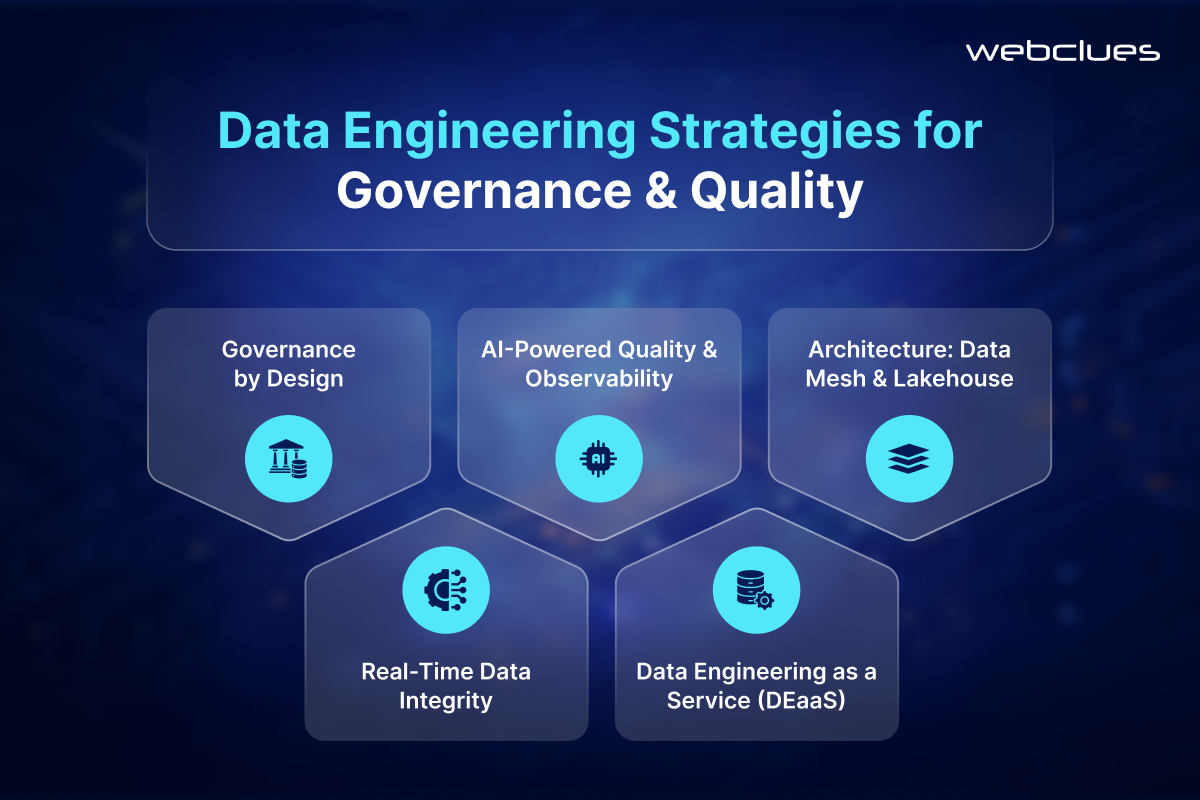
Consultants leverage several strategies to embed governance and quality directly into data engineering operations.
Embedded Governance-by-Design
Instead of retrofitting compliance, consultants embed validation rules, access controls, and lineage tracking into pipelines from inception. This proactive approach prevents errors before they occur and ensures compliance is continuous, not reactive. Data contracts formalize expectations between producers and consumers, automatically validating schema, freshness, and quality requirements.
AI-Powered Data Quality & Observability
AI-driven observability platforms continuously monitor pipelines for anomalies in volume, structure, or content. Automated remediation workflows fix errors, while synthetic data generation supports privacy compliance and testing. DataOps practices integrate AI co-pilots to detect pipeline failures, optimize workflows, and reduce manual intervention, improving both efficiency and reliability.
Architecture for Trust: Data Mesh & Lakehouse
Data Mesh decentralizes data ownership to domain teams, improving accountability and usability. Combined with Lakehouse architectures and open table formats (Delta Lake, Iceberg, Hudi), organizations achieve ACID-compliant transactions and high-quality data access. This approach supports both analytical and operational workloads while maintaining governance integrity.
Real-Time & Event-Driven Data Integrity
Consultants implement streaming pipelines using tools like Kafka and Flink that validate data in real time. Change Data Capture ensures analytical platforms remain synchronized with production systems, reducing discrepancies between operational and analytical data. These strategies enable organizations to act on insights immediately while maintaining trustworthiness.
Managing Complexity with Data Engineering as a Service (DEaaS)
High demand for skilled data engineers and complex infrastructure drives adoption of DEaaS models. Consulting firms provide end-to-end engineering expertise, building unified platforms that standardize, secure, and scale data products. DEaaS bridges the talent gap while enabling organizations to implement governance, observability, and quality practices effectively.
2026 Data Engineering Trends, Statistics, and Market Insights
In 2026, data engineering consulting is evolving as a strategic driver of AI-ready, high-quality, and governed data. Key trends include:
- AI-Driven Assistance: Tools using a combination of Generative AI and Co-pilots make data cleaning, abnormalities, and generating queries accurate. It is estimated that more than 80% of the organizations will adapt AI-driven tools by 2026.
- Active Metadata Management: Living metadata continually keeps lineage, quality data, and documentation refreshed and up-to-date in near-real-time.
- Governance by Design: Directly integrating policies, validations, and data contracts into the pipeline can reduce errors up to 90%.
- Data Engineering as a Service (DEaaS): Cloud-native DEaaS approaches incorporate scaling expertise with 20% to 25% lower costs and 30% to 40% faster issue resolution.
- Synthetic and Privacy-First Data: 80 percent of AI data will be synthetic by 2028, making privacy-compliant AI training and testing a reality.
- Market Growth: The global market size for data engineering tools will rise to $89.02B by 2027, signifying increasing investment in governance-enabled, automated platforms.
By 2026, data engineering consulting is defined by its ability to deliver AI-ready, governed, and high-quality data at scale. Organizations are moving away from fragmented tooling toward unified platforms that integrate governance, observability, and automation. These trends reflect a broader shift from pipeline construction to trust-centric data ecosystems.
Real-World Examples of Governance and Quality Excellence
Uber
Uber implemented federated real-time queries and data governance frameworks across global operations. The result was real-time analytics at scale, better data quality, and reduced latency in decision-making from both engineering and business teams.
Unilever
Unilever faced multi-layered supplier and customer networks. It centralized the management of the master data using low-code tools. Economies achieved in smoother HR onboarding and supplier integrations resulted in improved operational efficiencies, consistency of data, and compliance to governance across global operations.
Airbnb
Airbnb launched "Data University" to drive data literacy and responsibility across teams; by democratizing access and embedding governance controls, it made sure that the consistency of high-quality data analytics and AI applications were effectively and duly met.
How WebClues Infotech Enables Data Governance Success
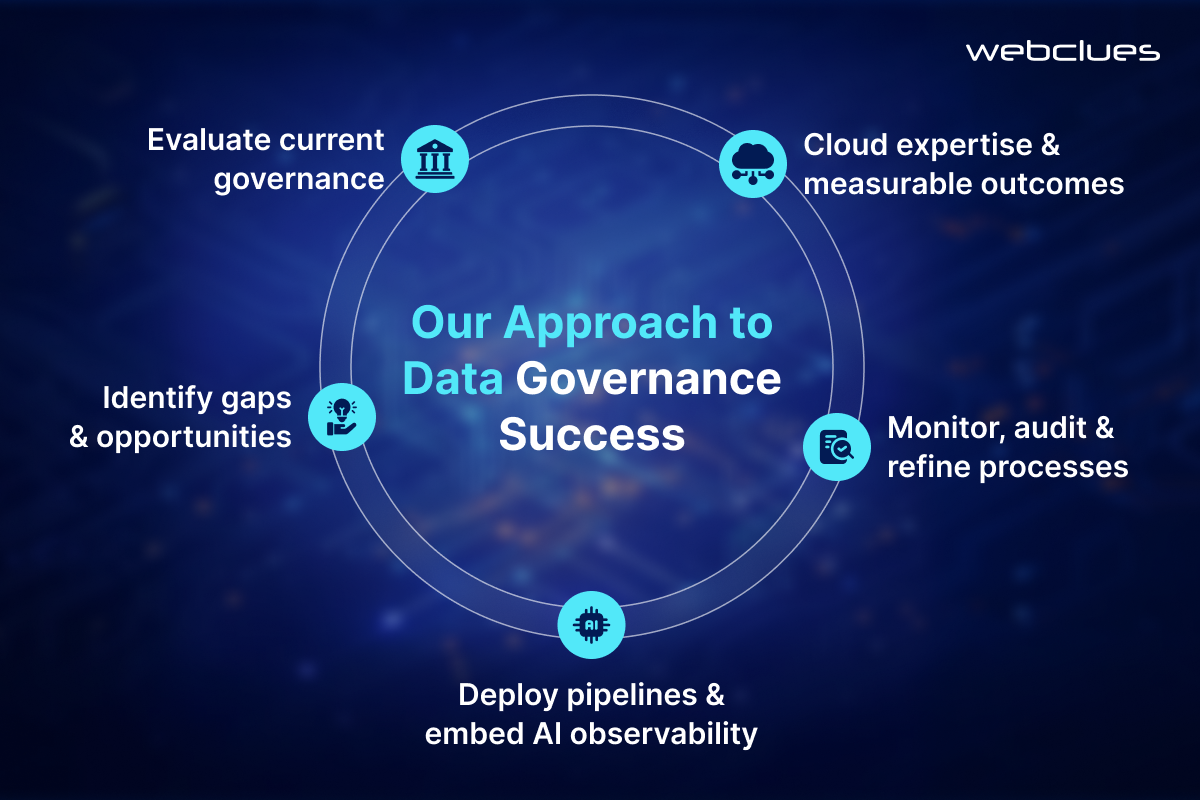
Assessment and Roadmap Development
WebClues evaluates existing data governance and quality practices, identifying gaps and opportunities. Tailored roadmaps define milestones, KPIs, and compliance requirements.
Implementation Support
From pipelines to Lakehouses, WebClues deploys scalable solutions with embedded governance, AI observability, and quality monitoring. Teams gain actionable dashboards and automated validation workflows.
Continuous Improvement
WebClues ensures governance evolves with business needs through regular audits, AI-driven monitoring, and platform updates, maintaining high data quality over time.
The WebClues Advantage
As a trusted data engineering company, WebClues combines cloud-native expertise, modern tooling, and governance-first design to deliver measurable business outcomes.
Automated & Governed Data Engineering Solutions with WebClues Infotech!
Data engineering consulting is now the need of the hour for enterprises as it allows them to achieve less error possibilities, adhere to compliance, and gain insights with higher speeds by implementing the latest data engineering solutions with WebClues Infotech enterprises.
Moving forward, organizations that invest in quality data pipelines will have set themselves up for competition in an ever more AI-saturated world. Data pipeline governance and quality are not just concepts; they are now critical elements for innovation and growth.
Enterprises can future-proof their business by embracing forward-thinking data engineering practices through the support and experience provided by a data engineering company, thus ensuring their business is backed by trusted insights and goodness for long periods to come. Connect with us to create data engineering systems for long-term success!
Post Author

Vedansh Kanodia
Vedansh Kanodia, a dynamic Business Development Executive at WebClues Infotech, is a passionate technocrat who helps businesses embrace innovation, and unlock new possibilities with his valuable perspectives.


Build Your Agile Team
Hire Skilled Developer From Us
Want to Build Governed, AI-Ready Data Platforms? Contact WebClues Infotech!
As a trusted data engineering company, WebClues Infotech helps enterprises design and scale governed, high-quality data ecosystems built for AI, analytics, and compliance. Our data engineering services embed governance, observability, and quality directly into modern pipelines ensuring reliable insights, regulatory confidence, and long-term scalability. Partner with WebClues to implement data engineering solutions that turn complex data into a strategic advantage.
Connect Now!Frequently Asked Questions
Our Recent Blogs
Sharing knowledge helps us grow, stay motivated and stay on-track with frontier technological and design concepts. Developers and business innovators, customers and employees - our events are all about you.