

Connect with us


Corporate Video

Enterprise AI Integration: Connecting ERP, CRM and SCM for Smarter Operations
.jpg)
Enterprise AI integration is no longer a future-state ambition; it is the operational baseline separating high-performing organizations from those still running on reactive workflows. When AI is wired into ERP, CRM, and SCM systems simultaneously, businesses gain something no individual upgrade can deliver: a connected intelligence layer that turns siloed data into real-time decisions.
The business case is clear and quantified. Gartner research shows that poor data quality alone costs organizations an average of $12.9 million per year. Meanwhile, supply chain disruptions cost the global economy over $4 trillion annually, yet mature AI demand forecasting deployments consistently improve accuracy by 20 to 35 percent and AI-enabled processes broadly deliver cost reductions of 15 to 30 percent.
This blog covers what enterprise AI integration actually means, how it connects ERP, CRM, and SCM into a unified intelligent ecosystem, the high-impact use cases in each system, implementation strategy, real cost and timeline expectations, governance considerations, and how to choose the right AI integration services provider for large enterprises.
What Is Enterprise AI Integration?
Enterprise AI integration is the process of embedding artificial intelligence including machine learning, natural language processing, predictive analytics, and intelligent automation directly into the core systems that run a business.
Those core systems are ERP (Enterprise Resource Planning), CRM (Customer Relationship Management), and SCM (Supply Chain Management). Individually, each platform manages critical data. Together, with AI layered across all three, they become something fundamentally more powerful: a connected enterprise ecosystem capable of predicting outcomes, automating decisions, and surfacing insights in real time.
This is distinct from deploying an AI chatbot or adding a dashboard plugin. True enterprise AI implementation services involve integrating intelligence into the data pipelines, workflows, and decision logic of the systems that finance, operations, sales, and supply chain teams depend on every day.
Organizations working with a full-stack AI integration company go beyond point solutions. They build architectures where AI models feed from unified data across all three platforms and where those models continuously learn, adapt, and improve with each transaction.
How AI Connects ERP, CRM, and SCM Systems
The traditional problem in enterprise software is fragmentation. ERP holds financial and operational data. CRM owns customer interactions and pipeline intelligence. SCM tracks suppliers, logistics, and inventory. Each system generates enormous value independently but that value is capped when the systems don't communicate.
AI integration dissolves those boundaries through three mechanisms:
Unified Data Pipelines: AI integration services establish data connectors and middleware layers that normalize and synchronize data across ERP, CRM, and SCM in near real time. A customer order in the CRM triggers an inventory check in the SCM, which updates production planning in the ERP automatically, without manual handoffs.
Cross-Functional AI Models: When AI models have access to data from all three systems, the predictions become meaningfully more accurate. A demand forecast that combines CRM sales pipeline data with SCM inventory levels and ERP production capacity will outperform any single-system model. This is the fundamental advantage of cross-system intelligence in a connected enterprise ecosystem.
Intelligent Workflow Orchestration: AI doesn't just connect systems, it acts on the connections. Intelligent workflow orchestration means that when the AI detects a supplier risk in SCM, it can automatically flag affected sales commitments in CRM and trigger procurement workflows in ERP, all without a human needing to coordinate the response.
This is how enterprise AI integration transforms operations from reactive to predictive.
High-Impact AI Use Cases Across ERP, CRM, and SCM
AI Use Cases in ERP Systems
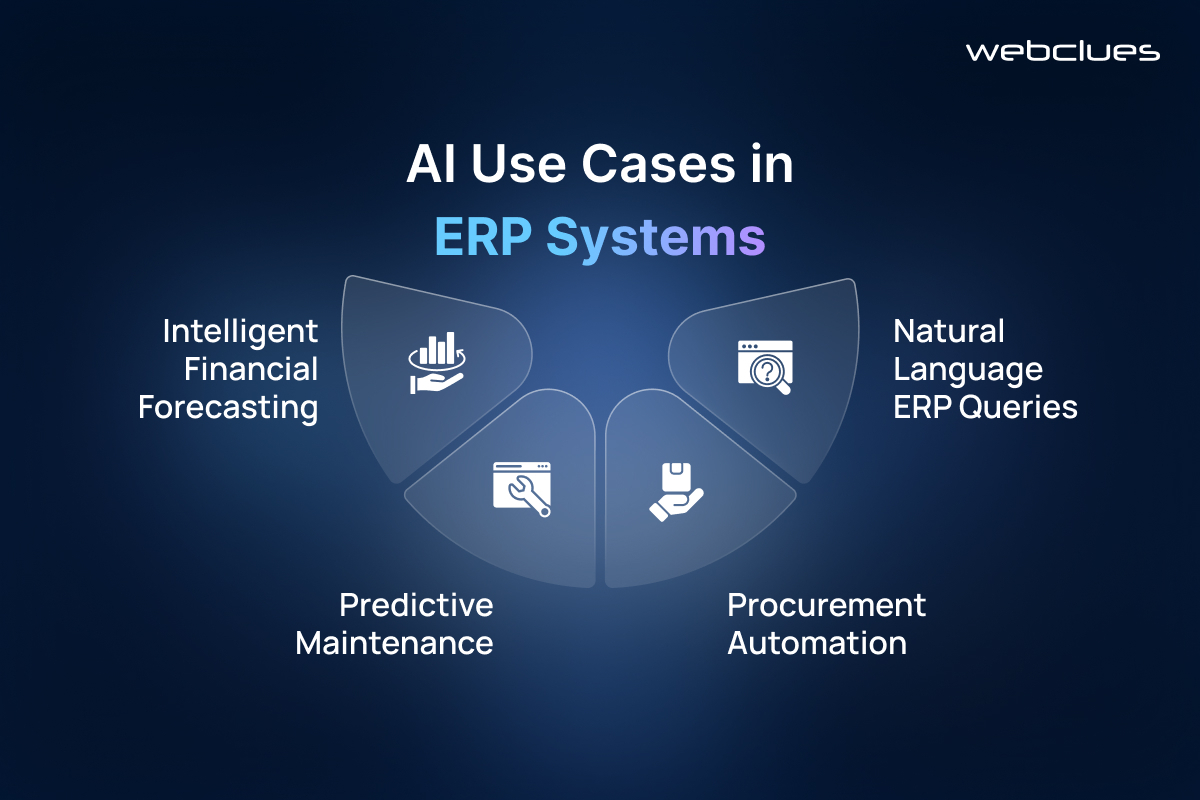
Intelligent Financial Forecasting: AI models trained on revenue cycles, cost patterns, and budget variances produce rolling forecasts that update continuously. Finance teams compress months-long budget processes into days. SAP S/4HANA, Oracle ERP Cloud, and Microsoft Dynamics 365 all support embedded AI capabilities, though purpose-built AI layers consistently outperform bolt-on features for complex enterprise use cases.
Predictive Maintenance: Manufacturing and operations teams use AI to anticipate equipment failures before they cause downtime. AI models analyze sensor data, historical maintenance logs, and production schedules to recommend intervention windows, reducing unplanned stoppages and lowering maintenance costs.
Procurement Automation: AI evaluates purchase orders, vendor history, pricing trends, and risk signals to recommend buying decisions and route approvals automatically. Self-validating invoices and risk-based approval logic reduce cycle times and human error simultaneously.
Natural Language Querying: NLP-powered interfaces allow executives and operations managers to query ERP data in plain language, removing the dependency on specialist analysts for routine reporting.
AI Use Cases in CRM Systems
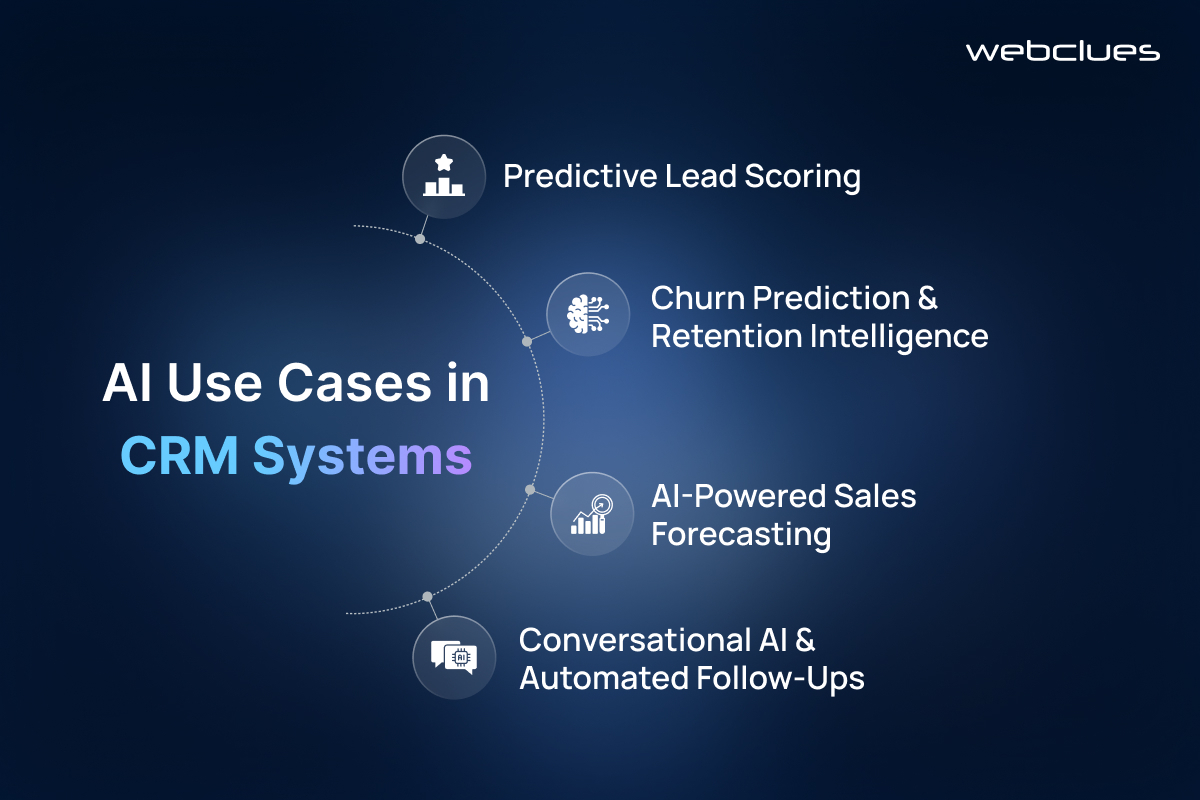
Predictive Lead Scoring: Static lead scoring rules are replaced by continuously learning models that update based on real conversion outcomes. Sales teams focus their efforts on the accounts most likely to close, improving pipeline quality without adding headcount.
Churn Prediction and Retention Intelligence: AI models analyze behavioral signals support ticket volume, login frequency, contract renewal timing and flag at-risk accounts weeks before a human would notice. Retention triggers can be automated based on risk threshold.
AI-Powered Sales Forecasting: When AI integrates CRM pipeline data with historical win/loss patterns and market signals, revenue forecasts become significantly more reliable. Sales leaders make better resource allocation decisions with predictive customer analytics rather than gut estimates.
Conversational AI and Automated Follow-Ups: From AI-drafted outreach emails to fully automated follow-up sequences triggered by CRM events, every prospect gets a timely and relevant response regardless of repetitive workload.
AI Use Cases in SCM Systems
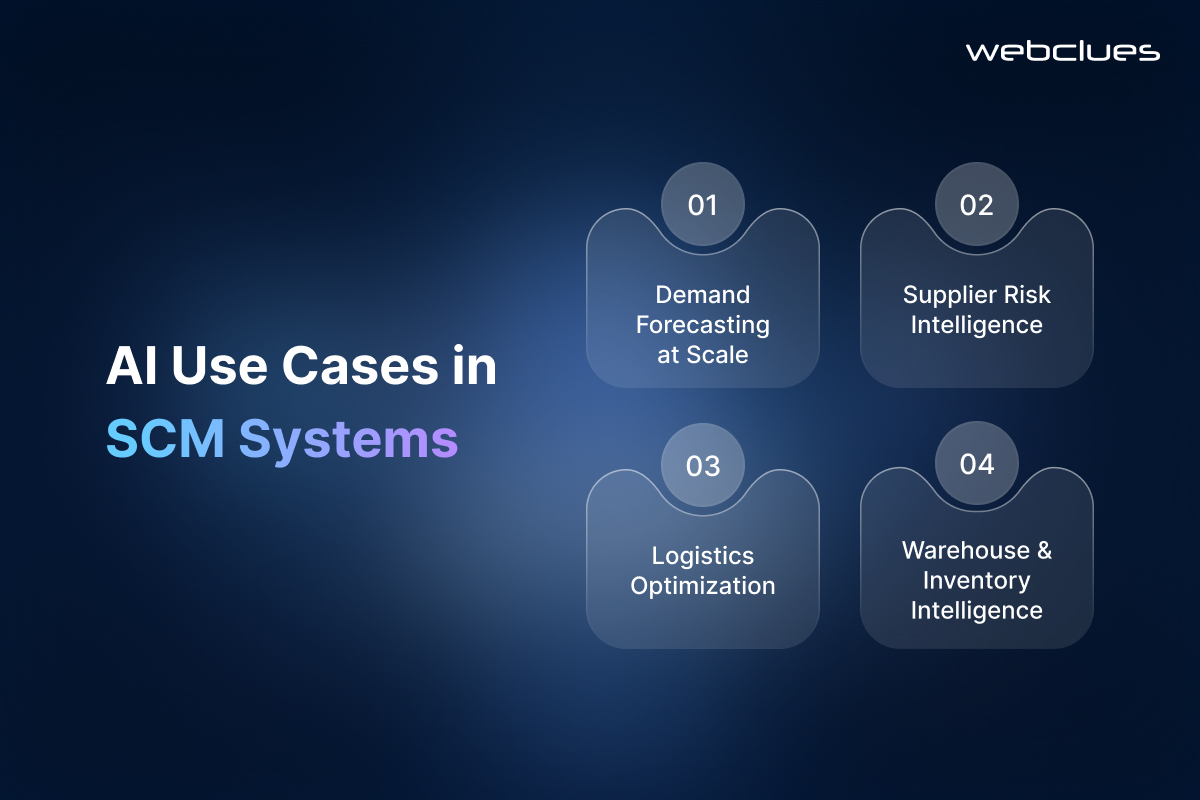
Demand Forecasting at Scale: Traditional demand planning relies on historical averages and human judgment. AI supply chain optimization solutions ingest hundreds of variables weather patterns, economic signals, customer behavior producing forecasts that update in near real time. Accuracy improvements over baseline models run consistently at 20 to 35 percent in mature deployments.
Supplier Risk Intelligence: AI models monitor supplier financial health, geopolitical exposure, and delivery performance simultaneously. They flag risks before they become disruptions building supply chain resilience rather than just automating reactive responses.
Logistics Optimization: Route optimization, carrier selection, and last-mile delivery decisions that were historically made manually are now handled by AI in real time. Organizations using AI logistics optimization report measurable improvements in on-time delivery rates and fuel efficiency.
Warehouse and Inventory Intelligence: Computer vision and AI-driven inventory models replace periodic stock counts with continuous visibility. In high-SKU environments, this eliminates both stockouts and excess carrying costs directly improving margins.
Enterprise AI Integration Architecture: How It Works
A scalable enterprise AI architecture is built in layers, not bolt-ons.
Data Layer: The foundation. ERP, CRM, and SCM platforms produce structured and unstructured data that must be extracted, normalized, and consolidated into a unified data lake or warehouse. Data quality, standardization, and access governance happen here and without this layer done properly, every AI model built on top will underperform.
AI and Machine Learning Layer: The intelligence engine. This is where predictive models, NLP modules, anomaly detection systems, and generative AI capabilities are trained, deployed, and maintained. MLOps practices covering model monitoring, retraining, and performance tracking ensure models stay accurate as business conditions evolve.
Integration Layer: The connective tissue. Middleware, API gateways, and event-driven architectures link ERP, CRM, and SCM to the AI layer in real time. When a supply chain event triggers a workflow in CRM, this layer is what makes that handoff seamless.
Application Layer: Where users experience AI. Dashboards, AI co-pilots inside existing enterprise interfaces, automated workflow triggers, and conversational assistants all live here. The goal is to make AI invisible in the best sense integrated into how people already work, not a separate tool they have to open.
Governance and Security Layer: The trust infrastructure. Role-based access controls, explainable AI models, compliance monitoring, and audit logging ensure that AI integration meets GDPR, HIPAA, SOC 2, or other regulatory and AI security requirements relevant to the organization.
Implementation Framework: From Assessment to Scale
Successful enterprise AI implementation services follow a phased, outcome-driven approach not a single massive deployment.
Phase 1 — AI Readiness Assessment: Audit data quality, system capabilities, and integration gaps across ERP, CRM, and SCM. Identify where data silos exist, which workflows have automation potential, and where skills gaps may slow adoption. This assessment defines the realistic ceiling of what AI can deliver — and often surfaces quick wins.
Phase 2 — Use Case Prioritization: Not every AI project delivers equal value. Rank candidates by ROI potential, implementation complexity, and strategic alignment. High-impact, lower-complexity use cases like predictive lead scoring or invoice automation make strong starting points.
Phase 3 — Architecture and Tooling Selection: Choose between native AI features in existing platforms, middleware-based integration, or custom AI models built for specific enterprise requirements. The right path depends on your current stack, timeline, and the depth of the use case.
Phase 4 — Pilot and Validate: Deploy in a controlled environment. Measure model accuracy, workflow performance, and user adoption. Use this phase to surface integration issues and build internal stakeholder confidence before scaling.
Phase 5 — Scale with Governance: Roll out company-wide with MLOps pipelines for continuous monitoring and retraining. Establish governance policies from the start not as an afterthought so that compliance, transparency, and accountability are built into how AI operates, not added on later.
Common Challenges in AI Integration and How to Avoid Them
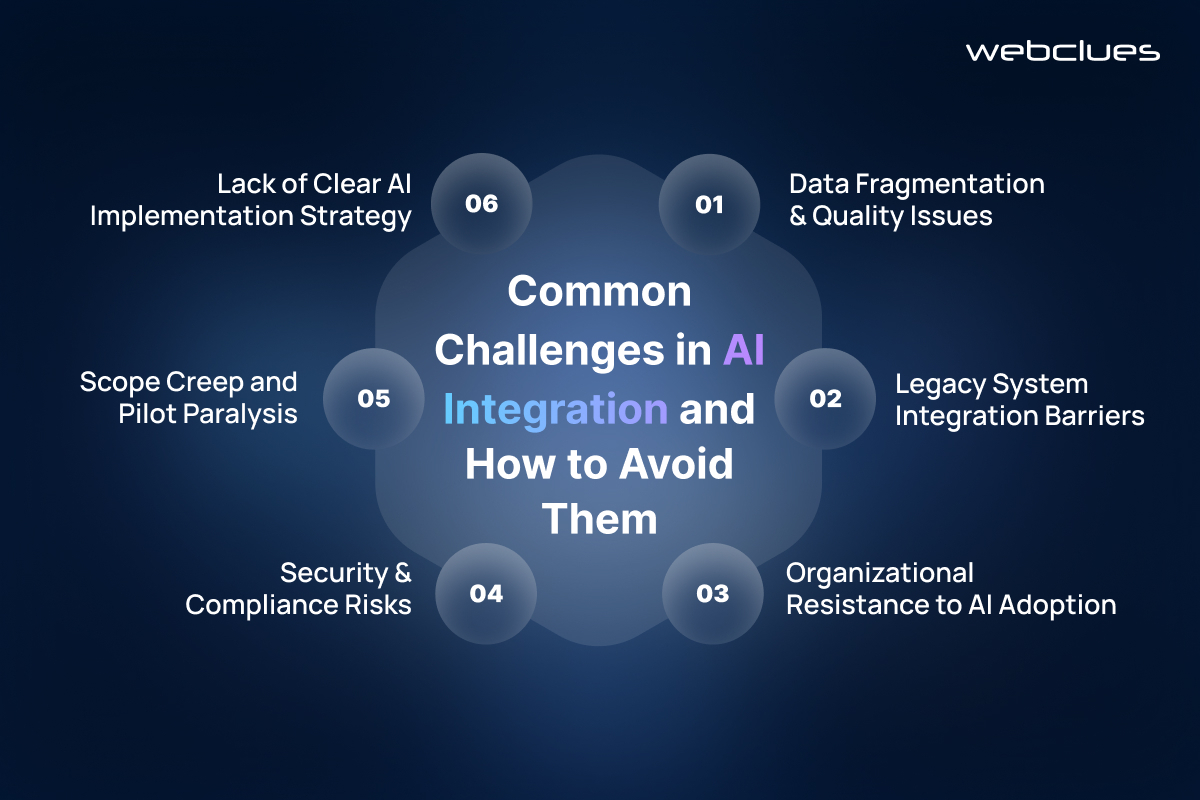
Data fragmentation is the most consistent barrier. ERP, CRM, and SCM systems often store data in incompatible formats with different field names for the same concept. Budget time and engineering resources for data harmonization before model development starts.
Legacy system incompatibility slows timelines significantly. Older ERP or SCM systems without REST APIs or with data in proprietary formats require custom integration work. A qualified AI software integration company will assess this upfront and propose realistic architecture paths rather than promising clean integrations that don't exist.
Organizational resistance is underestimated in most AI projects. Teams that built their expertise around manual reporting workflows don't automatically embrace models that replace their judgment. Change management clear communication, role-specific training, and visible early wins is not optional.
Security and compliance complexity increases proportionally with the sensitivity of the data flowing between systems. Any AI integration that moves customer data between CRM and SCM, or financial data from ERP to external AI models, must be scoped with explicit compliance requirements from day one.
Scope creep and pilot paralysis kill more AI projects than technical failure. Enterprises that attempt to integrate AI across all three systems simultaneously almost always experience delayed timelines and diluted outcomes. Start with one system, one use case, one team.
Cost, Timeline, and ROI Considerations for AI Integration
ERP AI Integration: Typically runs $80,000 to $500,000+, depending on platform complexity, number of processes automated, and customization depth. Enterprises implementing AI for ERP automation commonly see 20 to 40 percent reductions in operational costs, with 12 to 24 month payback periods for most implementations.
CRM AI Integration: Ranges from $10,000 to $250,000 depending on whether the work uses native AI features or custom AI development services. Conversion rate improvements of 10 to 30 percent and churn reductions of 15 to 25 percent are documented outcomes. Payback periods can be as short as 6 to 18 months — the fastest among the three system categories.
SCM AI Integration: The widest cost range is $50,000 to $1 million or more for end-to-end optimization across a complex supply chain. ROI comes from reduced inventory carrying costs (10 to 30 percent), improved forecast accuracy (20 to 35 percent), and fewer disruption losses. The financial case strengthens further when you factor in the cost of not acting: supply chain disruptions already cost the global economy over $4 trillion annually.
Timeline: A targeted pilot AI-powered lead scoring on an existing CRM, for example, can reach production in 8 to 14 weeks. Broader ERP or SCM integrations typically take 4 to 9 months. Full three-system integration with custom AI models runs 9 to 18 months in most enterprise environments.
The Role of AI Governance: Building Systems You Can Trust
Governance is not a compliance checkbox. It is the architecture decision that determines whether enterprise AI delivers long-term value or becomes a liability.
Every enterprise AI architecture needs explainable models — decision logic that can be audited and explained to regulators, customers, and internal stakeholders. Black-box models may perform well technically but create serious trust and compliance risks in regulated industries.
AI governance frameworks should define who can access model outputs, how often models are retrained, what triggers human review of automated decisions, and how model drift is detected and corrected. These are design decisions, not post-launch policies.
An ethical AI approach also means monitoring for bias in training data. If a CRM churn model was trained on historically biased sales data, it will reproduce that bias confidently at scale. Continuous auditing, diverse training data, and human-in-the-loop checkpoints for high-stakes decisions are minimum requirements.
Organizations that treat governance as a foundational layer rather than an afterthought build AI systems that earn trust internally and externally.
How to Choose the Right AI Integration Partner
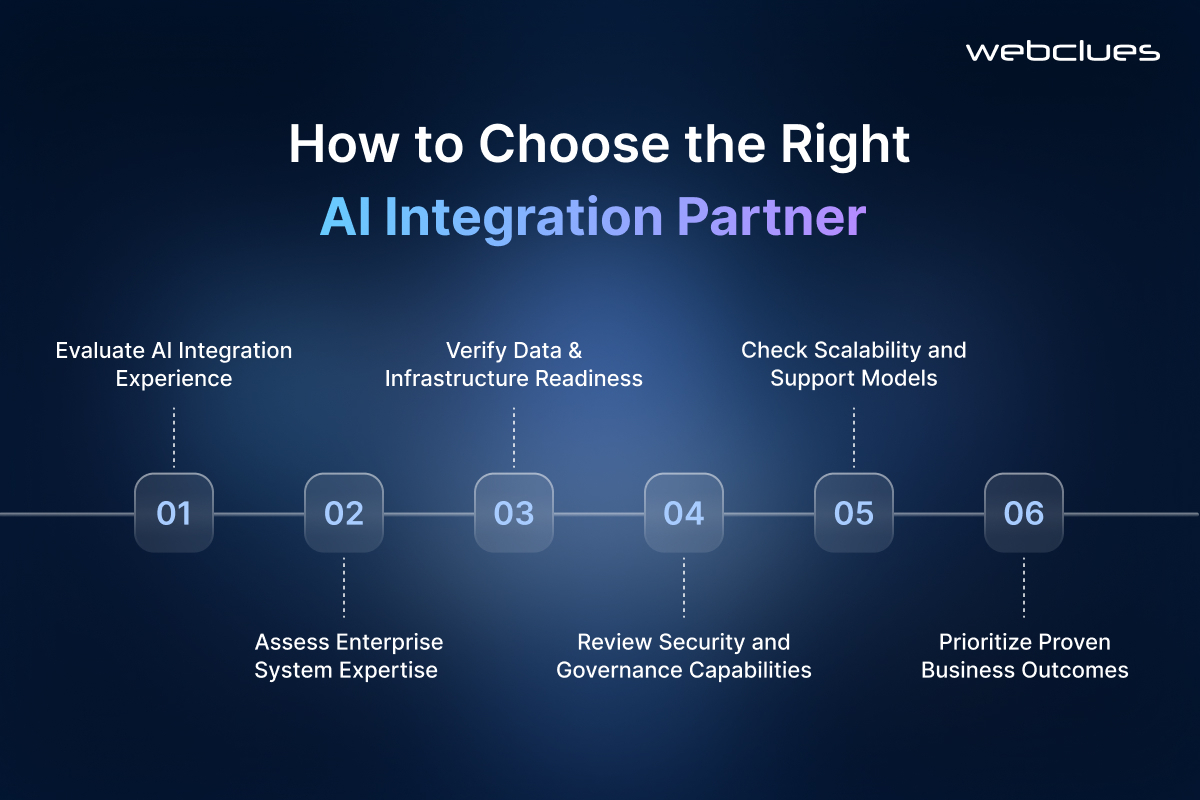
Choosing an AI integration partner for large enterprises is a strategic decision, not a vendor selection exercise.
The right AI integration consulting services partner will lead with a readiness assessment not a sales pitch. They will be direct about what your current data infrastructure can and cannot support. They will propose phased delivery that proves value before asking for full commitment.
Technically, look for a full-stack AI integration company with proven capability across data engineering, ML model development, API integration, and enterprise platform expertise on the systems you actually run SAP, Oracle, Salesforce, Microsoft Dynamics, or others.
Operationally, look for partners who treat change management and governance as core deliverables, not add-ons. AI integration fails far more often from adoption problems and governance gaps than from technical failures.
At WebClues Infotech, we offer enterprise AI integration services designed around your specific ERP, CRM, and SCM environment. Our AI integration developers bring cross-platform expertise in custom AI integration solutions, intelligent workflow design, and scalable MLOps deployment built to deliver measurable outcomes, not just a working prototype.
If you're evaluating enterprise AI implementation services or looking to hire AI integration developers who understand both the technical and operational complexity of large-scale systems, we'd welcome the conversation.
Future-Proof Your Operations with Enterprise AI Integration Services!
Enterprise AI integration is not about replacing your ERP, CRM, or SCM systems. It is about making them work together in ways they were never designed to do alone sharing data, learning from patterns, and driving decisions across functions in real time.
The organizations seeing the highest returns from AI are not the ones that moved fastest. They are the ones that started with clean data, aligned integration architecture to specific business outcomes, deployed in validated phases, and built governance into the foundation rather than bolting it on at the end.
Your action steps:
- Conduct an honest data quality audit across your ERP, CRM, and SCM environments before scoping any AI project
- Prioritize two or three high-ROI use cases with clear success metrics — not a company-wide transformation initiative
- Evaluate AI integration partners on their governance and change management capability, not just their technical portfolio
- Build MLOps monitoring and retraining schedules into your implementation plan from day one
Connected enterprise intelligence is the operating standard for 2026. The question is not whether to integrate AI — it is how well you do it.
Ready to build a smarter, more connected enterprise? WebClues Infotech offers custom AI integration solutions and end-to-end enterprise AI integration services tailored to your existing systems and business goals. Connect with our team to start with a focused assessment.
Post Author

Ayush Kanodia
As one of the esteemed Directors of WebClues Infotech. Ayush Kanodia is passionate about delivering innovative IT services & solutions and has spearheaded numerous successful projects, cementing the company's position as a leader in the field.


Build Your Agile Team
Hire Skilled Developer From Us
Ready to Connect with Enterprise AI Integration Experts?
Stop losing opportunities to disconnected systems and delayed decision-making. Partner with WebClues Infotech to integrate AI across your ERP, CRM, and SCM platforms, uncover high-impact automation opportunities, and achieve measurable business outcomes. Schedule a consultation with our AI experts to build a roadmap tailored to your enterprise goals.
Connect UsFrequently Asked Questions
Our Recent Blogs
Sharing knowledge helps us grow, stay motivated and stay on-track with frontier technological and design concepts. Developers and business innovators, customers and employees - our events are all about you.