

Connect with us


Corporate Video

Everything You Need to Know About Generative AI Development in 2026
.jpg)
Generative AI in 2026 is beyond experimentation and pilot projects. Gartner projects that more than 80% of enterprises worldwide will be running generative AI–enabled applications in live production environments, up from less than 5% a few years before. This shift is not driven by hype. It reflects a structural change in how modern organisations design software, automate knowledge work, and deliver digital experiences at scale.
Across healthcare, financial services, retail, manufacturing, and logistics, leaders are no longer asking whether generative AI belongs in their roadmap. The focus has shifted to execution. Businesses are evaluating how to deploy it responsibly, integrate it with existing systems, and ensure it produces measurable outcomes rather than isolated proofs of concept. Decisions around data readiness, model selection, security, governance, and scalability are now executive-level priorities.
This guide covers everything you need to know about generative AI development in 2026. It explains the core concepts, model types, and real-world applications shaping enterprise adoption. It shows how organisations move from isolated pilots to production-ready systems using generative AI development services.
What’s more? It breaks down the technical, operational, and governance decisions that determine long-term success. Also read along to find out how businesses can build generative AI solutions that scale responsibly, stay compliant, and deliver measurable commercial impact.
What Is Generative AI Development?
At its core, generative AI development is the full cycle of designing, building, deploying, and maintaining AI systems that generate new content or insights that are actionable, context-aware, and aligned with business objectives. These systems leverage advanced models such as large language models, transformer architectures, and multimodal engines to produce outputs including text, images, designs, simulations, decisions, and more.
Unlike traditional AI, which focuses mainly on classification or prediction, such as detecting spam emails or forecasting churn, generative AI produces entirely new outputs. It learns patterns from large datasets, interprets contextual relationships, and synthesizes responses that are coherent and often indistinguishable from human-generated content. This unlocks capabilities from automated report creation and personalised customer engagement to design generation and code authoring.
Generative AI development involves applying these capabilities to real operational challenges. This spans defining high-impact use cases, selecting suitable models and architectures, fine-tuning or custom-training models on domain-specific data, integrating AI into workflows, and measuring business impact. Success depends not only on building models but also on ensuring outputs are human-centric and aligned with strategic goals.
Additionally, generative AI development must account for data quality, security, governance, and ethics. Leading enterprises increasingly adopt AI governance frameworks to manage risk, maintain compliance, and ensure transparency in automated systems. Such frameworks are not optional. They are central to any effective generative AI implementation strategy.
How Generative AI Development Works?
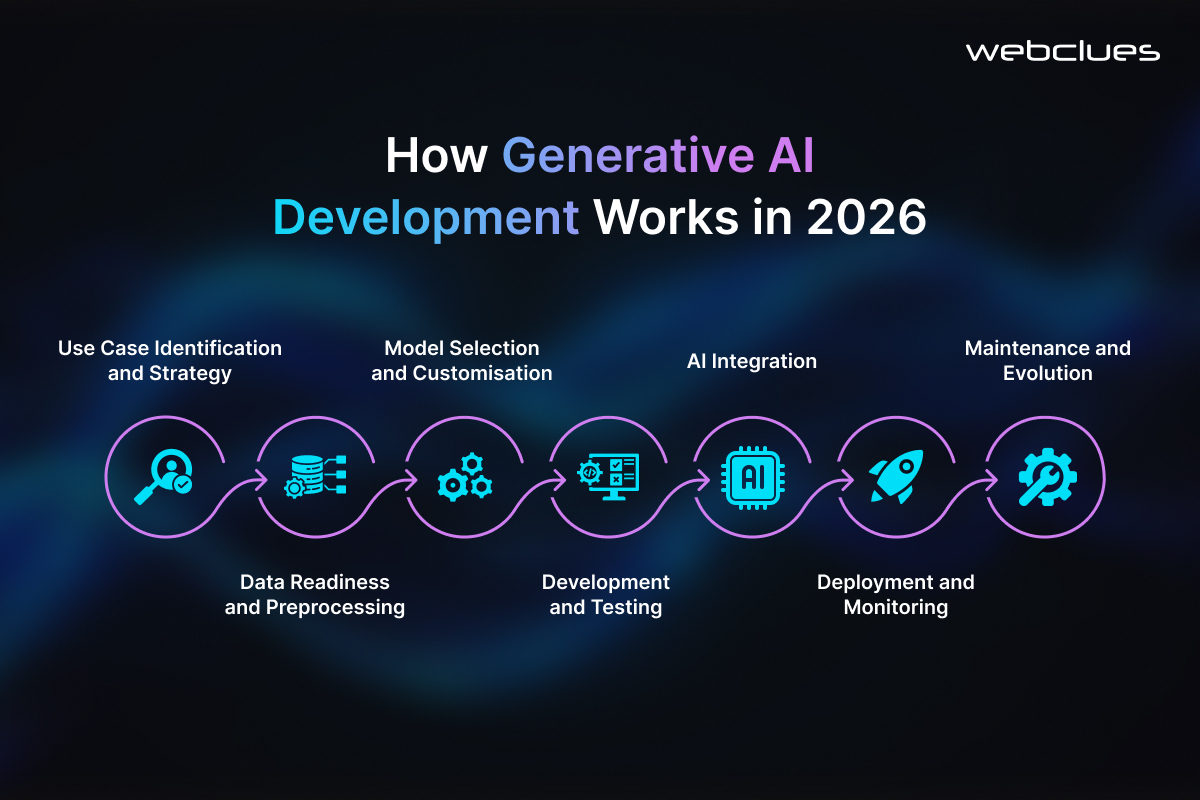
Understanding generative AI development in 2026 requires looking at the process in stages that connect business goals with technical execution.
- Use Case Identification and Strategy: The first step is identifying which business processes will gain the most from generative AI. Common examples include automating content creation, enhancing customer engagement, running predictive simulations, prototyping designs, and generating analytical insights. Clear use cases ensure AI initiatives deliver measurable value.
- Data Readiness and Preprocessing: Generative models rely on high-quality data. Preparing data involves cleaning, structuring, and labeling it correctly. In many organisations, data sits in silos across CRM systems, ERP platforms, and data warehouses. Integrating these sources while ensuring compliance with regulations such as GDPR and CCPA is essential for effective AI outputs.
- Model Selection and Customization: Organizations can take several approaches to choosing a model. They may use general-purpose large language models or multimodal engines, fine-tune these models on domain-specific datasets to improve relevance, or build custom models tailored to unique business needs. The right approach depends on complexity, budget, and desired output quality.
- Development and Testing: This stage includes training or fine-tuning the model, creating application programming interfaces, testing outputs for accuracy, relevance, and bias, and validating performance against business metrics. Human oversight is critical to prevent errors and ensure outputs are ethical and reliable.
- AI Integration: Embedding generative AI into enterprise systems such as CRM platforms, marketing workflows, analytics tools, and knowledge bases ensures solutions are operationally effective rather than isolated pilots. Integration allows AI to interact with live data and trigger automated actions. This step often requires expertise in data engineering, API design, and enterprise architecture.
- Deployment and Monitoring: Once built, AI systems must be deployed in scalable environments, often on cloud platforms such as AWS, Azure, or Google Cloud. Continuous monitoring is needed to track performance, accuracy, and compliance, and to ensure the system remains aligned with business objectives.
- Maintenance and Evolution: Generative AI systems require ongoing updates as data changes, models improve, and business needs evolve. Continuous learning pipelines, retraining procedures, and performance feedback loops keep AI outputs relevant and valuable over time.
These stages form a complete generative AI development pipeline that bridges business strategy with technology execution while managing risks and maximizing value.
The Shift From Traditional to Modern Generative AI Systems
Generative AI and traditional AI are both subsets of artificial intelligence but serve distinct purposes and require different development approaches.
Traditionally, AI focused on statistical learning and classification tasks. For example, a traditional AI model might identify whether an image contains a defect or classify customer sentiment as positive or negative. These systems are effective at recognition but not creation.
Generative AI, by contrast, is designed to synthesize new data or output that did not previously exist. This means a generative model can draft a report, create visual designs, simulate outcomes, or generate code based on input data patterns. This shift from recognition to creation drives new productivity horizons. Generative AI can accelerate ideation, automate creative tasks, and support decision-making in ways traditional AI could not.
From a development perspective, this means generative AI systems require more complex architectures (e.g., transformer networks, LLM stacks), larger datasets, and a deeper integration process to ensure outputs are useful rather than random or irrelevant.
The impact of this difference is profound in business contexts. Where traditional AI improved efficiency, generative AI often augments creativity and accelerates product delivery. For example, generative AI can help accelerate software development by generating code snippets, automating test scripts, or converting design specifications into functional components.
This level of impact requires a different development mindset and tooling, focusing not just on statistics and prediction but on semantic understanding and output quality.
Types of Generative AI Models Powering Modern AI Solutions
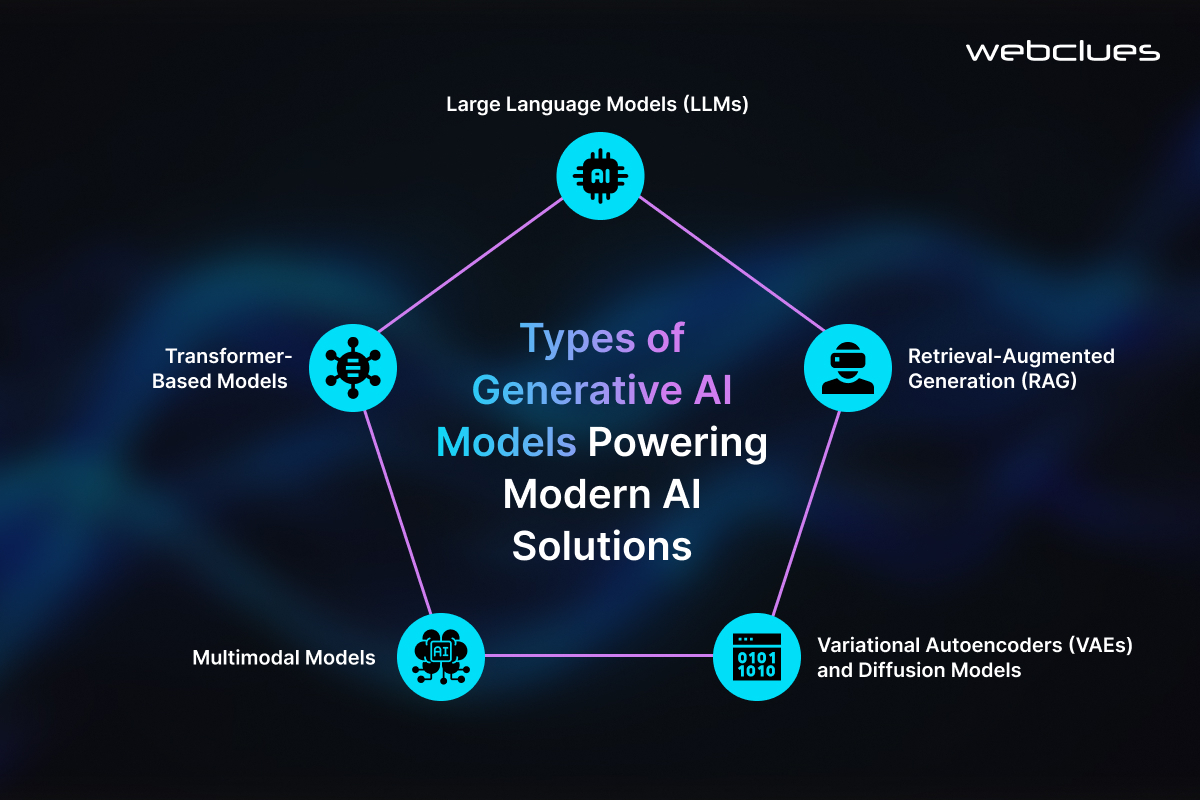
Several classes of models power the generative AI revolution each with unique capabilities and suited to different tasks:
- Large Language Models (LLMs): Models like GPT-series, Claude, or Gemini are trained on massive text corpora and can generate human-like text, summarise documents, and answer complex queries. These models can be fine-tuned for domain-specific tasks.
- Transformer-Based Models: Transformers are neural architectures that use self-attention mechanisms to capture contextual relationships in data. They underlie most high-performance generative systems and are integral to advanced language, vision, and multimodal tasks.
- Multimodal Models: These models process and generate across multiple data types text, images, audio enabling applications like text-to-image generation, video summarisation, and multimodal assistants.
- Variational Autoencoders (VAEs) and Diffusion Models: Often used for high-quality image and media generation, these models learn compressed representations and then generate refined outputs.
- Retrieval-Augmented Generation (RAG): RAG combines generative models with external knowledge sources to produce more accurate and context-aware results. This is especially valuable for domain-specific enterprise applications where up-to-date information is crucial.
In practice, generative AI systems often use a hybrid of these model types to balance quality, performance, and relevance to business needs.
What Are Generative AI Development Services?
Generative AI development services encompass the structured set of offerings that help organisations translate their AI aspirations into reality. These services typically include:
- Strategic Consulting: Understanding where AI adds the most value, defining KPIs, and aligning AI initiatives with business goals.
- Custom Model Development: Tailoring foundational generative models to specific domains, workflows, and data characteristics.
- API and Application Development: Building scalable interfaces and applications that expose generative AI capabilities to end-users, internal teams, or customer channels.
- Integration Services: Connecting generative AI systems with existing enterprise infrastructure CRM, ERP, analytics, data lakes, and operational pipelines so that AI outputs directly augment business processes.
- Deployment and Orchestration: Setting up scalable production environments, leveraging cloud platforms and containerisation to ensure reliability, low latency, and cost efficiency.
- Monitoring and Support: Implementing systems for ongoing performance tracking, compliance audits, and continuous model improvement.
These services form a full stack that ensures generative AI initiatives do not remain pilots but scale into business-critical systems.
Real-World Generative AI Solutions Businesses Are Deploying in 2026
By 2026, enterprises are moving beyond basic experimentation. Organisations across industries are embedding generative AI solutions into core operations:
- Customer Engagement Systems: Generative AI-powered assistants that personalise interactions, automate support, and generate tailored recommendations across channels.
- Content and Marketing Automation: Systems that generate high-quality content at scale, including product descriptions, campaign scripts, and interactive digital experiences.
- Workflow Intelligence Tools: Solutions that summarise business data, generate insights, and assist knowledge workers in accelerating decision cycles.
- Design and Prototyping Platforms: AI systems that can generate product designs, simulate scenarios, or propose iterations based on performance criteria.
- AI-Driven Decision Support Engines: Tools that ingest enterprise datasets and produce strategy insights, risk assessments, and forecasting models.
Across these applications, the common thread is how generative AI shifts from isolated tasks to connected enterprise value streams. For example, embedding generative AI into customer service systems can reduce resolution times, increase satisfaction, and cut operating costs but only when these systems are integrated with business logic and data workflows.
Industry-Specific Generative AI Use Cases Driving Measurable ROI
Next-gen AI development in 2026 is being recognized on return on investment, operational impact, and scalability. The strongest results are emerging in industries where large volumes of data, repetitive workflows, and decision complexity intersect.
In eCommerce and retail, generative AI solutions are being used to automate product content creation, personalise shopping experiences, and optimise inventory planning. Instead of static product descriptions written once and forgotten, AI systems now generate dynamic content based on user intent, location, browsing behaviour, and demand signals. Retailers are also deploying generative AI for virtual try-ons, AI-assisted merchandising, and demand forecasting models that simulate multiple market scenarios before inventory decisions are made.
In financial services, generative AI development is focused on risk analysis, fraud detection, customer communication, and regulatory reporting. AI systems can generate compliance summaries, explain complex financial products in plain language, and assist relationship managers with personalized client insights. Importantly, many financial institutions are pairing generative AI with human oversight to ensure outputs remain compliant and explainable, which is critical in regulated environments.
In healthcare and life sciences, generative AI solutions are transforming diagnostics, clinical documentation, and drug discovery. AI models can generate structured clinical notes from unstructured physician input, assist in analysing medical imaging data, and simulate molecular interactions to accelerate research. The key differentiator here is domain-specific training and strict governance frameworks to protect patient data and meet regulatory standards.
In manufacturing and supply chain operations, generative AI is being used to simulate production scenarios, optimize maintenance schedules, and generate predictive insights. AI-driven digital twins allow manufacturers to test design changes virtually before physical implementation, reducing costs and downtime.
Across education and training, generative AI enables adaptive learning systems that generate personalised study material, assessments, and feedback based on individual learner performance. For enterprises, this translates into faster onboarding, continuous upskilling, and knowledge retention at scale.
What unites these use cases is not the technology itself, but how well generative AI is aligned with real business workflows. The highest ROI comes when AI is embedded into decision-making processes rather than treated as a standalone tool.
The Role of Generative AI Integration Services in Enterprise Systems
One of the most common reasons generative AI initiatives fail to scale is poor integration. In isolation, even the most advanced AI model delivers limited value. The real power emerges when generative AI is seamlessly connected to enterprise systems, data sources, and workflows.
Generative AI integration services focus on embedding AI capabilities into existing platforms such as CRM systems, ERP software, marketing automation tools, data warehouses, and internal knowledge bases. This ensures that AI outputs are contextually aware and operationally relevant.
For example, integrating a generative AI model with a CRM allows sales teams to receive AI-generated insights based on live customer data rather than generic suggestions. In customer support environments, integration enables AI agents to pull accurate information from product databases, order histories, and policy documents in real time.
Integration also plays a critical role in data governance and security. Enterprise-grade integration services include access controls, audit trails, encryption mechanisms, and compliance layers that ensure sensitive data is protected throughout the AI lifecycle. This is particularly important as regulations around AI usage and data privacy continue to evolve globally.
From a technical standpoint, integration services typically involve API orchestration, middleware development, data pipeline engineering, and event-driven architectures. These components ensure AI systems respond appropriately to triggers, scale under load, and remain reliable in production environments.
In short, generative AI integration services bridge the gap between experimentation and enterprise value. Without them, AI remains a siloed capability. With them, AI becomes a core part of business infrastructure.
Common Challenges in Generative AI Development (and How to Solve Them)
Despite its promise, generative AI development comes with real challenges that organisations must address proactively.
One of the most discussed issues is output accuracy and hallucinations. Generative models can produce responses that sound plausible but are factually incorrect. This risk increases when models operate without access to verified, domain-specific data. Businesses mitigate this by combining generative AI with retrieval systems, implementing validation layers, and maintaining human review for high-impact outputs.
Another challenge is data quality and availability. Generative AI systems are only as good as the data they learn from. Many enterprises struggle with fragmented, outdated, or biased datasets. Solving this requires investment in data engineering, governance frameworks, and continuous data refinement.
Security and privacy concerns also feature prominently. Feeding sensitive business or customer data into AI systems without proper safeguards can lead to compliance violations. Best-practice organisations adopt privacy-by-design principles, anonymisation techniques, and strict access controls throughout the AI pipeline.
There is also the challenge of talent and expertise. Generative AI development requires multidisciplinary skills spanning machine learning, software engineering, domain knowledge, and ethical governance. This is why many organisations choose to work with a specialised generative AI development company rather than building everything internally.
Finally, change management should not be underestimated. Introducing generative AI into workflows alters how teams work, make decisions, and evaluate outcomes. Clear communication, training, and stakeholder buy-in are essential for successful adoption.
Security, Privacy, and Ethical Considerations in Generative AI Solutions
As generative AI systems become more powerful, the responsibility to deploy them ethically and securely becomes non-negotiable. Enterprises in 2026 are under increasing scrutiny from regulators, customers, and partners regarding how AI systems are built and used.
From a security standpoint, generative AI solutions must be protected against data leakage, model inversion attacks, and unauthorised access. This involves encrypting data at rest and in transit, isolating model environments, and continuously monitoring for anomalous behaviour.
Privacy considerations extend beyond technical safeguards. Organisations must ensure that personal and sensitive data used in training or inference complies with regulations such as GDPR, HIPAA, and emerging AI-specific legislation. Consent management, data minimisation, and transparency about AI usage are now baseline expectations.
Ethical considerations in generative AI raises questions about bias, accountability, and misuse. Responsible development includes bias testing, explainability mechanisms, and clear escalation paths when AI outputs influence critical decisions. Many enterprises are establishing internal AI ethics committees and governance boards to oversee deployment decisions.
Addressing these considerations upfront not only reduces risk but also builds trust, a critical factor in long-term AI adoption.
How to Choose the Right Generative AI Development Company?
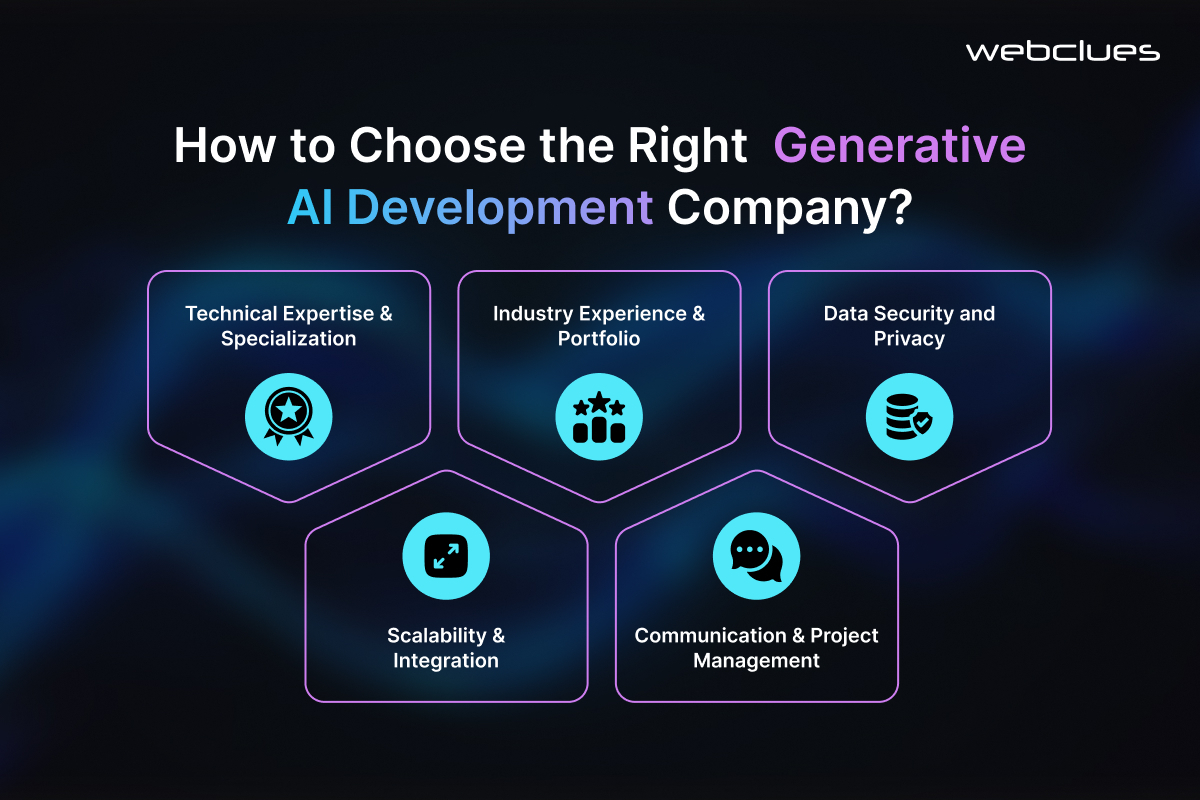
Selecting the right generative AI development company can determine the success or failure of your initiative. Beyond technical expertise, organisations should evaluate partners based on strategic alignment and delivery maturity.
Key factors to consider include experience across industries, proven integration capabilities, and a strong understanding of enterprise constraints such as security, compliance, and scalability. A reliable partner should be able to articulate not just how to build AI systems, but why certain approaches are better suited to your business goals.
Transparency is another critical indicator. Look for partners who clearly explain model choices, data requirements, and limitations rather than overselling AI capabilities. Long-term support, documentation, and knowledge transfer are also important, especially if your organisation plans to internalise AI capabilities over time.
In-House vs Outsourced Approach: When to Hire a Generative AI Developer?
Deciding between building generative AI capabilities internally or partnering with an external team depends on your organisation’s strategic priorities, technical maturity, and time-to-market requirements.
Hiring an in-house generative AI developer is effective when AI is a long-term core capability. Internal teams allow for full control over model training, data governance, and iterative improvements. This approach suits enterprises with established data infrastructure, a dedicated ML/AI operations function, and the budget to attract and retain top AI talent. The trade-off is high recruitment costs, ongoing training, and slower ramp-up times.
Outsourcing to a specialised generative AI development company accelerates deployment and provides access to multidisciplinary expertise, including machine learning engineers, data scientists, and AI architects. This model is ideal for pilot projects, integrations, or enterprises that need rapid proof-of-value without committing to long-term headcount.
Many organisations adopt a hybrid approach, using external experts to build foundational models and integrations while gradually upskilling internal teams. This ensures speed, expertise, and long-term ownership of AI capabilities without sacrificing quality or compliance.
Cost, Timeline, and ROI Expectations for Generative AI Projects
Generative AI development cost varies depending on project scope, data complexity, and deployment scale. Small-scale proof-of-concept solutions may require $30,000–$50,000 and take 4–6 weeks, while enterprise-grade systems integrating multiple workflows, multimodal models, and real-time decision engines can cost $200,000–$500,000 or more, with timelines of 3–9 months.
ROI extends beyond cost savings. Measurable benefits include productivity gains, faster decision-making, improved customer engagement, and revenue uplift. High-performing organisations define success metrics upfront, such as reduction in manual workloads, increased automation throughput, or improved model-driven outcomes.
Regular monitoring and iteration are critical projects that track KPIs continuously and see 30–50% higher returns than those measured only at launch.
Future Trends Shaping Generative AI Development Beyond 2026
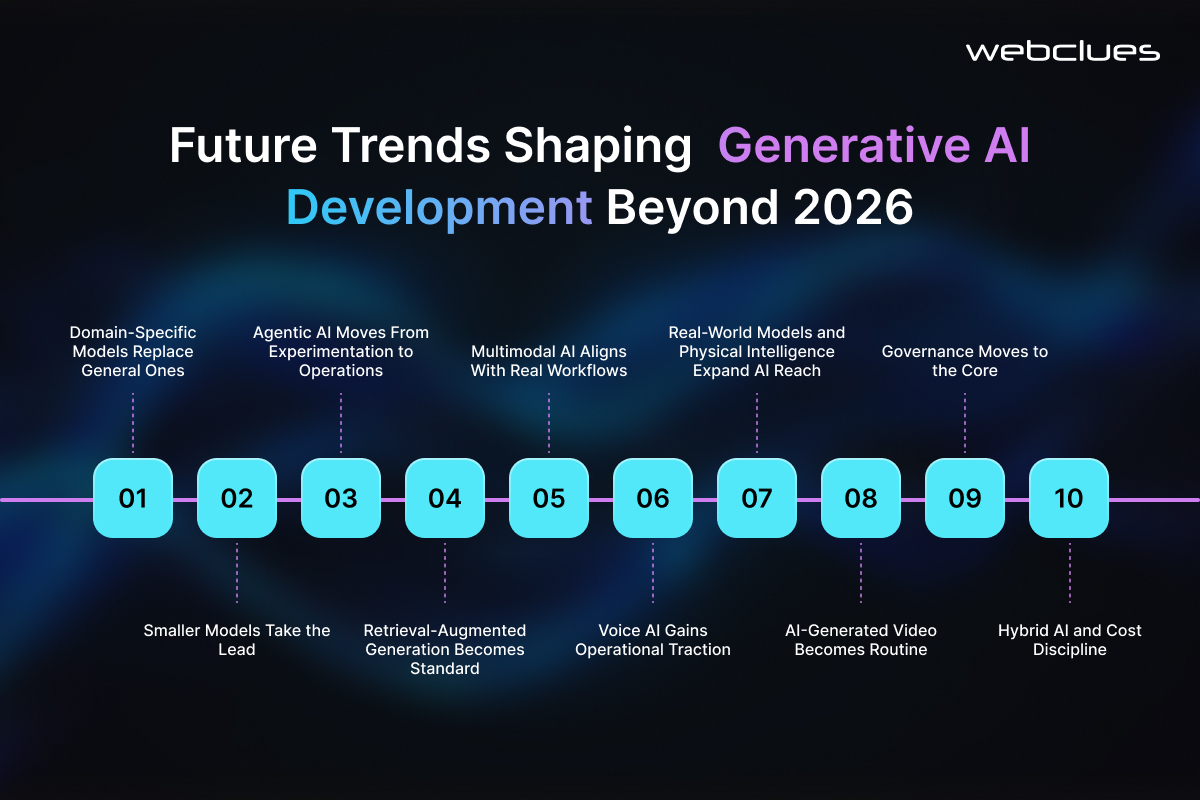
Looking ahead, generative AI trends look focused on:
- Domain-Specific Models Replace General Ones: By 2027, over half of enterprise-deployed AI models will be domain-specific. Legal, finance, and healthcare industries are already adopting models trained on verified, proprietary data to reduce risk, improve accuracy, and maintain trust. Contextual relevance now drives adoption.
- Smaller Models Take the Lead: Task-focused models are three times more likely to be deployed than large general-purpose LLMs. Smaller models reduce compute, improve inference speed, simplify audits, and cut infrastructure costs—critical as AI spending scales toward $630B by 2028.
- Agentic AI Moves From Experimentation to Operations: AI agents deliver measurable productivity gains when workflows are tightly defined. Scheduling, exception handling, and system-to-system coordination succeed, while open-ended decision-making remains risky. Governance and human oversight are essential.
- Retrieval-Augmented Generation Becomes Standard: Most production-grade AI systems now “retrieve first, generate second”, grounding outputs in verified knowledge. This reduces hallucinations, improves ROI, and is increasingly standard in compliance-heavy industries like finance and healthcare.
- Multimodal AI Aligns With Real Workflows: Systems capable of interpreting text, images, audio, and structured data together will be standard. Multimodal AI reduces manual handoffs, accelerates insight generation, and becomes an operational necessity rather than a novelty feature.
- Voice AI Gains Operational Traction: One in ten customer interactions is expected to be fully handled by voice AI by 2026. Cost reductions of 30–40% are possible when systems are integrated with CRM, billing, and scheduling platforms rather than treated as standalone tools.
- Real-World Models and Physical Intelligence Expand AI Reach: Predictive simulations, adaptive navigation, and safer human-machine collaboration are early outcomes of real-world models, particularly in logistics, manufacturing, and robotics. Enterprises will use these for planning and optimization before adopting full autonomy.
- AI-Generated Video Becomes Routine: Interactive, real-time AI video generation will transform marketing, training, and internal communications. Production costs drop by as much as 70%, and content cycles shrink from weeks to minutes.
- Governance Moves to the Core: AI oversight now parallels financial or cybersecurity controls. Documented systems, monitoring, and intervention mechanisms are essential. Organisations that embed governance into operations scale more reliably.
- Hybrid AI and Cost Discipline: Predictive models, generative outputs, and rule engines work together to deliver adaptive, end-to-end automation. With rising AI spending, controlling model size, inference efficiency, and retrieval design is critical to ensure ROI.
Build Scalable, Responsible Generative AI Solutions with WebClues Infotech!
At WebClues Infotech, generative AI development is approached with a clear focus on scalability, responsibility, and measurable business impact. From defining strategy and developing models to seamless integration and long-term support, we help organisations turn generative AI goals into results.
By combining deep technical expertise with a practical understanding of enterprise challenges, we deliver solutions that are secure, compliant, and aligned with real business goals. Whether you’re building new capabilities or scaling existing AI systems in 2026, WebClues Infotech ensures your initiatives drive productivity, innovation, and measurable ROI.
Connect us to transform generative AI into your competitive advantage.
Post Author

Ayush Kanodia
As one of the esteemed Directors of WebClues Infotech. Ayush Kanodia is passionate about delivering innovative IT services & solutions and has spearheaded numerous successful projects, cementing the company's position as a leader in the field.


Build Your Agile Team
Hire Skilled Developer From Us
Grow Your Business with Generative AI Solutions!
Ready to turn generative AI goals into measurable business impact? Partner with WebClues Infotech to design, develop, and integrate AI systems that scale securely, stay compliant, and drive real ROI. Start your next-gen AI transformation journey with experts who understand enterprise challenges.
Connect Now!Frequently Asked Questions
Our Recent Blogs
Sharing knowledge helps us grow, stay motivated and stay on-track with frontier technological and design concepts. Developers and business innovators, customers and employees - our events are all about you.