

Connect with us


Corporate Video

Generative AI Trends in 2026: Powering the Next Wave of Business Automation
In 2026, generative AI is no longer an emergent technology; it enables the core of a business. Enterprises are beyond experimentation and are embedding generative AI directly into operations, customer engagement, and decision-making systems. Recent market estimates indicate that the global generative AI market is going to surpass $66 billion in 2026, driven by real, measurable ROI and not hype.
What makes this shift significant is not just scale but maturity. Generative AI can now reason across business contexts, automate multistep workflows, and work with humans as a digital co-worker. Failure to adopt generative AI and get it into production is to risk being left behind by competitors that are using it to move faster, go deeper, and be leaner.
The blog looks at the most relevant Generative AI trends that shape business automation in 2026; how enterprises apply them today with the help of an expert generative AI development company and what leaders must focus on if they want to stay competitive in an AI-first economy.
How Does Generative AI Work in 2026?
By 2026, generative AI systems will also be based on large language models, multimodal foundation models, retrieval-augmented generation, and orchestration layers that bind AI outputs to actual business systems. Training is done on enormous datasets and perfected by fine-tuning, reinforcement learning, and continuous feedback loops.
What makes Generative AI fundamentally different today is that it's grounded in enterprise data. Modern systems do not generate responses in isolation. They retrieve context from internal documents, databases, APIs, and real-time systems, ensuring outputs are accurate, relevant, and actionable. This architecture reduces hallucinations and builds trust, which has been paramount for enterprise adoption.
Moreover, Generative AI in 2026 is increasingly agent-driven. Instead of having the AI respond to single prompts, AI agents can now autonomously plan, execute, evaluate outcomes, and adjust workflows within set guardrails. The net effect is automation that much more resembles human reasoning than simple rule execution.
Why Generative AI Is Essential for Your Business in 2026?
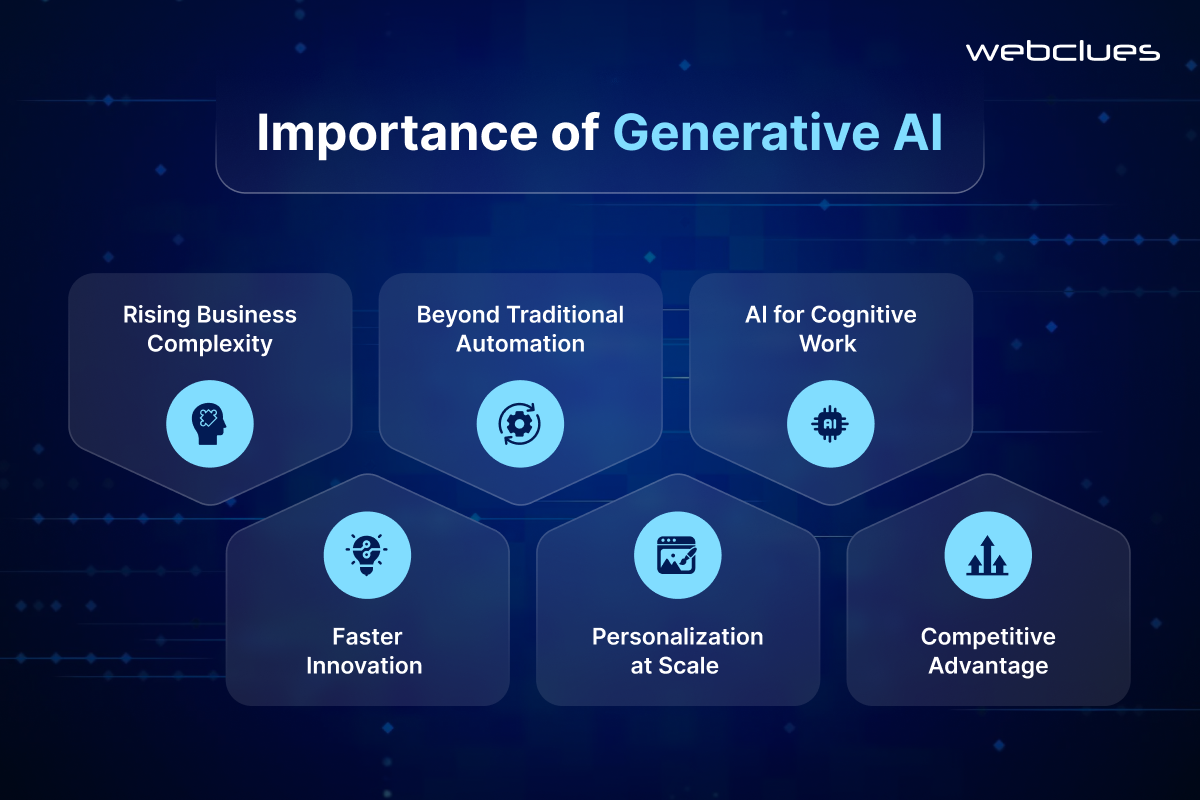
Generative AI is becoming an imperative because the complexity of modern business has outrun traditional automation tools. Enterprises are feeling the squeeze of increasing operational costs, rising customer expectations, and continuous pressure to innovate faster. The scaling required cannot be met by manual processes or static automation.
It helps businesses automate cognitive tasks like content creation, analysis, and summarization; decision support; and customer interactions through integrated Generative AI solutions. This frees up teams to focus on strategic work while AI handles repetitive and data-intensive activities.
More importantly, competitive differentiation will be empowered by Generative AI. Companies embedding AI into their products, services, and customer experiences can respond faster to market changes and deliver personalization at scale. This is why forward-looking organizations go all out to partner with a Generative AI development company in the creation of proprietary capabilities.
Top Generative AI Trends Redefining Business in 2026
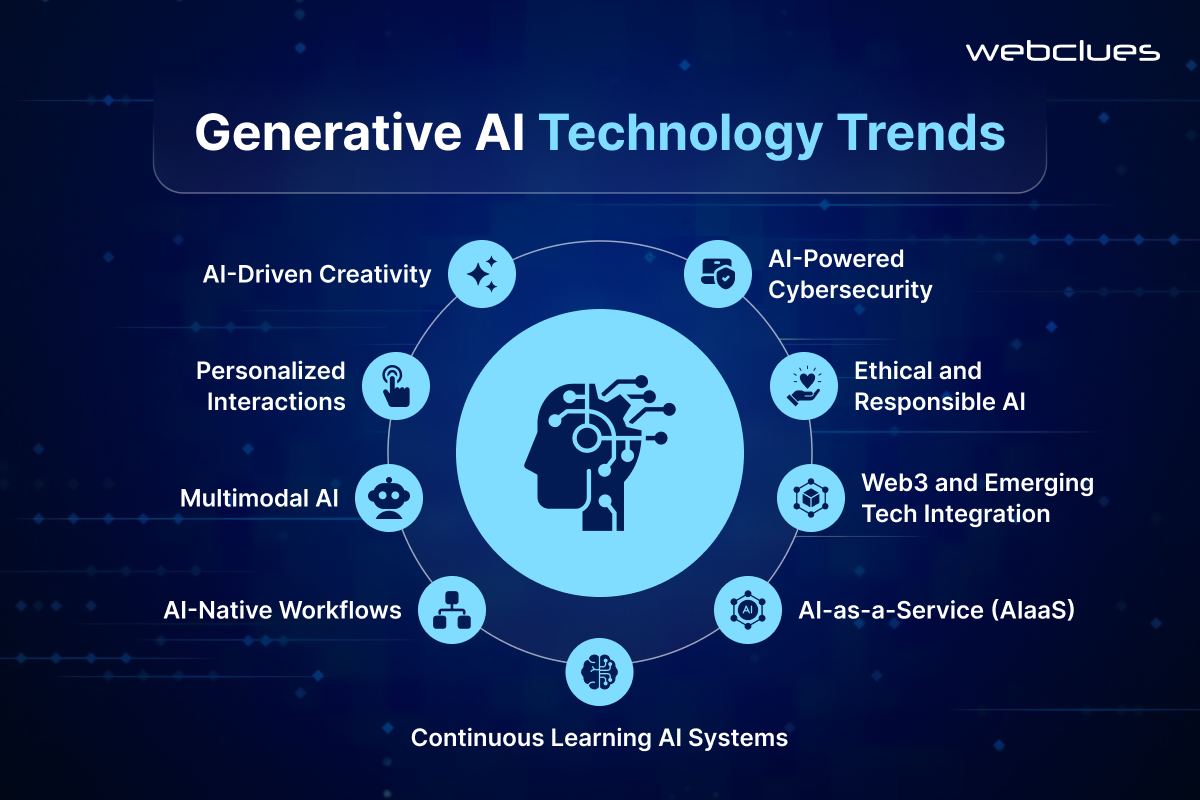
As of 2026, generative AI is no longer about new tools for novelty applications but is instead revolutionizing work execution, decision-making for systems, and scaling intelligence for the organization as a whole. The trends listed are not future possible solutions but are instead structural shifts that are taking place within the organization.
Agentic AI: Building Autonomous AI Co-Workers
Agentic AI represents the shift from AI tooling to operational AI. By 2026, generative AI will have the ability to analyze tasks and break down objectives into tasks, run multi-step processes, and improve performance over time through feedback.
Unlike traditional automation, “agentic systems are operating in the presence of context, memory, and intent." These automation systems are capable of dealing with processes like customer intake, order issues, compliance verification, or internal filings without much human assistance. Companies are finding ways to include such agents in their workflow as digital coworkers, assigning them tasks and evaluating them based on KPIs.
Such a transformation has given a required boost to demands for Generative AI development services that aim at orchestration and governance and not mere accessibility.
Hyper-Personalization: Delivering Tailored Customer Experiences
In the year 2026, hyper-personalization is not rule-based nor is it campaign-focused. It uses generative AI that aims to personalize the experience in real-time based on the behavior, context, and intentions of the users.
Rather than using fixed customer segments, AI is capable of producing personalized routes through data regeneration to alter product description text, price offers, setup processes, and customer support statements in real-time. Such personalizations are being conducted in the background without human intervention.
Those enterprises that implement Generative AI solutions in personalization see greater engagement, better conversions, and better retention of customers, especially from the SaaS, eCommerce, and financial services industries.
Multimodal AI: Combining Text, Images, Audio, and Video Seamlessly
Multimodal generative AI has become a standard capability in 2026. Modern models can comprehend and create text, images, audio, and video-all within one workflow-enabling much more natural human-AI interaction.
This will also enable enterprises to create complex outputs like training videos, sales demos, product explainers, and visual reports-all with one prompt. Multimodal AI is improving accuracy by cross-validating signals across different data types, reducing hallucinations, and contextual errors.
It makes development pipelines easier for enterprises and unlocks new use cases for marketing, training, product design, and customer support.
Conversational AI: Next-Level Chatbots and Virtual Assistants
Conversational AI in 2026 has moved beyond scripted chatbots. Generative AI-powered assistants now maintain long-term context, understand intent, and execute tasks rather than just answer questions.
These systems can resolve customer issues end-to-end, assist employees with internal processes, and act as a unified interface to enterprise systems. The focus has shifted from conversation quality to outcome completion—whether that is resolving a support case, generating a report, or initiating a workflow.
Businesses increasingly hire Generative AI developers to build domain-specific conversational systems that integrate securely with internal data and applications.
AI-Powered Creativity: Automating Design, Content, and Marketing
The creative timeline has been revolutionized by Generative AI. By the year 2026, not only will AI drive the creation of content but also the iteration, localization, testing, and optimization of that content.
Marketers employ AI to create targeted and specific campaign materials such as ad creatives, landing pages, and copy variations. Design teams utilize AI to speed up their ideation, prototyping, and creation of assets for brands.
The key to this one is speed, which enables teams to react to market cues in real-time rather than following predetermined creative cycles.
Human-in-the-Loop: Smart Automation with Human Oversight
Although autonomy is implemented in greater numbers in the future years, human-in-the-loop remains very relevant in 2026. The concept of human-in-the-loop enables the creation of transparent and truthful generative AI results by HITL frameworks in regulated industries.
Instead, the HITL systems have become more efficient, with human intervention limited only to decision points that require human judgment, compliance, or context validation, with the AI performing the other tasks.
This is crucial for sustainable scaling of Artificial Intelligence and remains at the center of all enterprise-grade consulting work involving Generative Artificial Intelligence.
Synthetic Data: Safe and Scalable AI Training for Better Models
Synthetic data has become a valuable asset in 2026. With increasing restrictions regarding privacy and difficulties associated with using real data, new AI is being used for generating quality synthetic data that replicates real patterns and does not reveal any significant real data.
Enterprises leverage the use of synthetic data to train, validate, and test AI. The method promotes the development of AI technology since the process does not require compliance with regulations.
Synthetic data is also enhancing model robustness since it helps create test scenarios that real data cannot.
Enterprise Memory: Keeping AI Context-Aware Across Workflows
One of the most problematic aspects of early-generation generative AI is a lack of continuity. This issue is addressed in 2026 with enterprise memory layers, which enable a continuity of understanding within AI systems.
Enterprise memory allows AI agents to reference the context layer correlated to related documents, decisions, customer history, and operating knowledge. Enterprise memory, therefore, helps eliminate repetitions, promotes accuracy and intelligent automation.
The organizations that invest in memory-based architecture experience a substantial improvement in AI reliability and acceptance within organizations.
Open Source & BYOAI: Customizable AI Solutions for Your Business
The rise of open-source models and Bring Your Own AI (BYOAI) strategies is giving enterprises greater control in 2026. Rather than relying solely on third-party APIs, businesses are deploying customized models tailored to their data, workflows, and compliance needs.
Open-source ecosystems enable faster innovation, cost optimization, and deeper customization. BYOAI strategies are particularly valuable for enterprises with strict data governance requirements or specialized domain needs.
This trend is increasing demand for experienced AI development companies that can architect, deploy, and maintain custom AI stacks securely.
Regulatory Compliance and Ethical AI Best Practices
By 2026, regulation is no longer theoretical: It's time for every enterprise to actually comply with evolving AI laws, data protection standards, and transparency requirements around the world.
For generative AI systems today, auditability, explainability, lineage tracking, and bias monitoring have to be baked in. Ethical AI practices are not a differentiator but an entrant for enterprise adoption.
Organizations that address compliance early avoid rework, reduce risk, and build trust with customers and regulators, thereby making governance a strategic advantage rather than a constraint.
Use Cases of Generative AI in Action
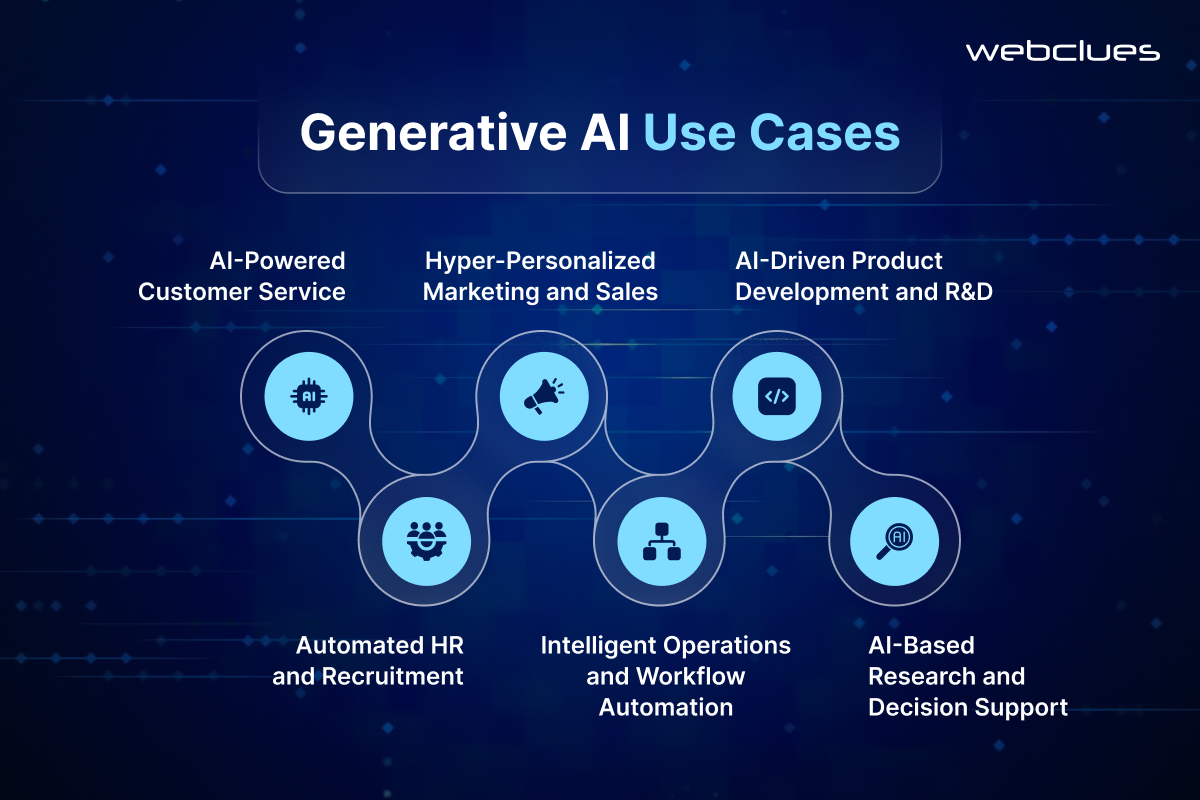
In 2026, generative AI is embedded directly into enterprise workflows, automating decision-making, personalization, and knowledge work at scale. Businesses using generative AI are shifting from incremental efficiency gains to structural improvements across customer experience, operations, and innovation.
- Revolutionizing Customer Service with AI Automation: Generative AI performs the role of intelligent customer support that autonomously resolves queries based on context, intent, and historical data. These reduce response time, support costs, and ensure that only complex cases are escalated to human agents, thus enhancing both efficiency and customer satisfaction.
- Hyper-Personalized Marketing, Sales, and Advertising: Real-time personalization through the creation of customized content, offers, and sales messages based on user behavior and intent are done by generative AI, helping marketing and sales teams increase engagement and conversion rates while continuously optimizing campaigns without manual effort.
- Accelerating Product Development, Prototyping, and R&D: Generative AI helps accelerate product development, prototyping, and R&D while users generate ideas, simulate designs, develop codes, and even analyze research. Now, teams can test concepts faster and reduce development cycles while launching products with greater assurance and less risk.
- Automating Human Resources and Recruitment Workflows: Generative AI automates resume screening, preparation for interviews, induction, and internal communication. It makes informed hiring decisions while it frees up the human resources teams to spend their time on workforce strategy and employee engagement.
- Streamlining Operations and Workflow Efficiency: Generative AI automates complicated, cross-functional workflows by coordinating tasks, generating reports, and managing exceptions. This reduces manual dependencies and improves accuracy, adding to higher operational visibility across the organization.
- Improving Research, Knowledge Management, and Decision Support: Generative AI transforms huge volumes of data and documentation into actionable insights through summarization and natural language queries. The ability of decision-makers to gain access to relevant knowledge is much faster, hence the speedier and better business decisions.
Business Benefits of Generative AI Solutions
Generative AI delivers measurable business value by automating knowledge work, improving decision quality, and enabling scalable personalization across functions. In 2026, its impact is no longer experimental—it is directly tied to revenue growth, cost efficiency, and competitive positioning.
- Boost Productivity and Operational Efficiency: Generative AI automates repetitive cognitive tasks around content creation, reporting, analytics, and workflow coordination. This frees up teams to work on high-value strategic tasks while slashing turnaround times and operational bottlenecks for cross-departmental collaboration.
- Reduce Costs and Optimize Resources: Through the replacement of manual effort with AI-driven automation, enterprises cut the costs of customer support, marketing production, research, and internal operations. Generative AI supports optimizing resources through streamlining workflows and reducing rework.
- Make Faster, Data-Driven Decisions: Generative AI brings together multiple sources of data into concise insights and actionable conclusions in real time. With it, leaders can play out scenarios to test risk, respond to market fluctuations faster, without having to wait for bespoke analysis or fragmented reports.
- Deliver Superior Customer Experiences: AI-powered personalization allows for consistent, relevant, and context-aware interactions across all customer touchpoints. This serves to enhance engagement, build trust, and increase lifetime value by aligning experiences with individual preferences and intent.
- Accelerate Innovation and Gain Competitive Advantage: Generative AI ultimately shortens innovation cycles by enabling rapid experimentation, idea generation, and prototyping. Early adopters of the technology run faster and adapt seamlessly into the continuously changing demands of the market.
Challenges and Risks in Gen AI Every Enterprise Must Address
Besides its advantages, generative AI also presents challenges in operational, ethical, and governance domains. Enterprises will need to proactively address these risks to ensure full, sustainable, and responsible adoption.
- Protecting Data Privacy and Security: Strong governance with access control and compliance frameworks should be in place to prevent the leakage and misuse of data.
- Closing Talent and AI Skills Gaps: Successful implementation requires skilled AI engineers, data scientists, and domain experts. Most enterprises suffer from talent shortages in this area and must upskill human resources or establish strategic partnerships.
- Tackling Bias and Ethical Issues in AI Models: AI models can inherit several biases from training data that may result in unfair and inaccurate outcomes. Continuous monitoring is needed, along with transparent model design and human oversight, to ensure ethical use of AI.
- Managing Complexity and Infrastructure Requirements: Deployments of generative AI require integrations with legacy systems, orchestration of models, and ongoing maintenance-all components that imply complexity. Without proper architecture and planning, complexity becomes a barrier to adoption while inflating costs.
The Future of Generative AI in Enterprises
Generative AI is evolving from a productivity tool into a foundational enterprise capability. The next phase focuses on autonomy, adaptability, and deep integration across digital ecosystems.
AI-Native Products and Fully Automated Workflows: Future enterprise software will be built with AI at its core, not added as a feature. These AI-native systems will design, execute, and optimize workflows autonomously with minimal human intervention.
Continuous Learning and Self-Improving AI Systems: Generative AI systems will learn continuously from interactions, feedback, and outcomes. This enables models to improve accuracy, relevance, and performance over time without constant retraining cycles.
Integrating AI with Emerging Technologies: Generative AI will increasingly converge with technologies such as IoT, blockchain, digital twins, and Web3. AI integration will unlock new use cases, smarter automation, and more resilient digital infrastructures.
Lead the Generative AI Revolution in 2026 with Webclues!
Generative AI has moved from hype to execution in 2026. Enterprises adopting it strategically achieve faster automation, smarter decision-making, and scalable innovation across functions. From agentic workflows to hyperpersonalized experiences, generative AI is a critical growth driver-not an optional technology.
Companies need generative AI solutions that are secure, compliant, and purpose-built for real operational goals. This is a game of expert guidance and depth in engineering.
Webclues enables one to deploy production-ready generative AI systems that drive tangible value in ROI. Being a leading generative AI development company, Webclues offers bespoke generative AI consulting, custom solutions, and enterprise-grade integrations to grow with your business.
If you are ready to go beyond mere experimentation and build AI that drives real business impact, now is the time to connect us. Lead the Generative AI revolution in 2026 and beyond with Webclues, and future-proof your enterprise with intelligent automation.
Post Author

Nikhil Patel
Nikhil Patel, a visionary Director at WebClues Infotech, specializes in leveraging emerging tech, particularly Generative AI, to improve corporate communications. Through his insightful blog posts, he empowers businesses to succeed digitally.


Build Your Agile Team
Hire Skilled Developer From Us
Transform Your Business with Webclues Generative AI Solutions
Webclues helps organizations implement cutting-edge generative AI solutions that drive efficiency, innovation, and revenue growth. From AI-powered workflows to personalized customer experiences, we provide tailored consulting and enterprise-grade deployment. Partner with Webclues to scale smarter, automate faster, and lead the AI revolution in 2026.
Connect Now!Frequently Asked Questions
Our Recent Blogs
Sharing knowledge helps us grow, stay motivated and stay on-track with frontier technological and design concepts. Developers and business innovators, customers and employees - our events are all about you.