

Connect with us


Corporate Video

What to Look For When Hiring ML Developer for Your Next Project
.jpg)
Machine Learning (ML) has shifted from experimental labs to mission‑critical roles across industries. Businesses that harness predictive analytics, intelligent automation, and adaptive systems gain a sustained competitive edge. Yet, talent scarcity is a persistent barrier.
With the global AI market forecast to reach $407 billion by 2027 and more than 77% of businesses actively deploying AI technologies, demand for skilled professionals has surged.
Available data shows only an estimated 300,000 qualified ML engineers worldwide while job openings exceed one million. This imbalance intensifies recruitment pressure and amplifies the importance of making the right hiring decisions.
This guide explores what to look for when sourcing to hire ML developers for your next initiative - from core technical skills to soft competencies, hiring models, candidate evaluation, cost considerations, and long‑term retention.
Why Hiring ML Developers Matters in 2026
Businesses increasingly integrate ML into products, operations, and customer experiences. Whether you’re embedding recommendation engines, automating anomaly detection, or optimizing supply chain forecasts, the success of these systems rests on the proficiency of the professionals developing them.
The stakes are high: poorly designed or inadequately maintained models can lead to biased predictions, noisy outputs, compliance risks, and operational inefficiencies.
The ideal hire is more than a coder, they are strategic partners who understand data, algorithms, infrastructure, ethics, and business context. Given this complexity, companies are willing to pay a premium to hire ML developer profiles that bring the right blend of expertise and practical judgment.
As ML projects transition from research prototypes to revenue‑driving systems, the bar for talent continues to rise.
Essential Technical Skills for ML Developers
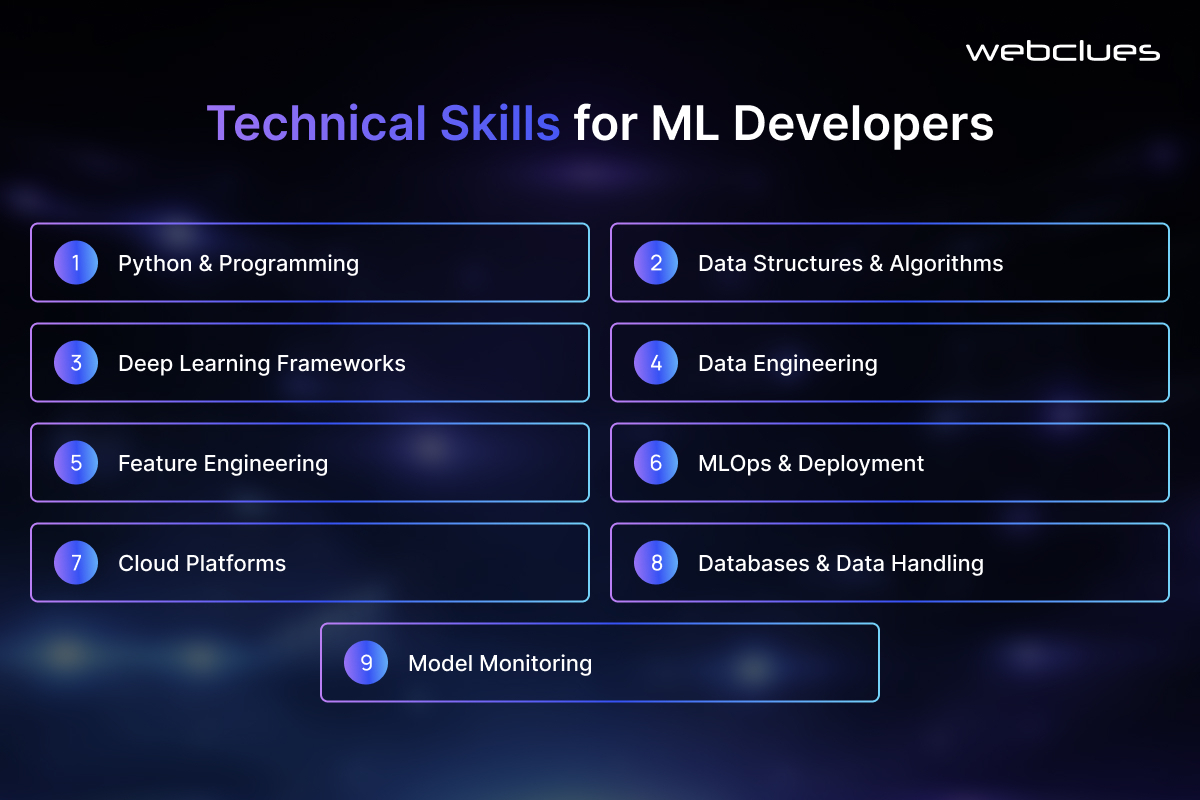
Machine Learning is a technical discipline built atop mathematics, programming, and data paradigms. Competence in these core domains determines whether a candidate can design solutions that are efficient, scalable, and maintainable.
Core Programming Languages and Libraries
Strong programming skills are non‑negotiable. Python dominates the ML landscape due to its extensive ecosystem and readability, but proficiency in languages such as R, Java, and C++ still matters in specialized domains like real‑time inference and embedded systems.
Candidates should demonstrate fluency in data structures, algorithmic thinking, and object‑oriented programming. Familiarity with version control, automated testing, and software design patterns indicates maturity in development workflows.
Deep Learning Frameworks
Modern ML workflows leverage libraries and frameworks that abstract complex concepts and accelerate model development:
- TensorFlow and Keras provide scalable infrastructure for deep neural networks and production deployment.
- PyTorch excels in research‑to‑production flexibility and has become the de facto standard in many research environments.
- Scikit‑Learn is invaluable for classical ML tasks such as clustering, regression, and preprocessing.
Top graders will not only list these tools on resumes but articulate trade‑offs between them and justify framework choices based on project requirements.
Mathematical and Statistical Foundations
At its core, ML is applied mathematics. It’s essential that developers understand linear algebra, calculus, probability, and statistics. These foundations enable them to tune models, diagnose performance issues, and make informed decisions about algorithm selection versus brute‑force experimentation.
A strong ML professional can explain how optimization algorithms converge, why regularization matters, and how distributions impact model uncertainty.
Data Engineering and Feature Engineering
Data quality drives model quality. Skillful ML engineers know how to ingest, clean, transform, and manage data at scale. They should understand relational and non‑relational databases, SQL, and streaming systems depending on real‑time requirements.
Feature engineering crafting meaningful predictors from raw data is where domain knowledge meets technical rigor. Developers who can derive signal from noise elevate model performance measurably.
MLOps and Model Lifecycle Management
Successful ML deployment requires more than a trained model file. MLOps focuses on reproducible training pipelines, CI/CD integration, model versioning, validation, and monitoring. Candidates with hands-on experience in tools such as MLflow, Kubeflow, and Seldon are valuable because they bridge development and operations.
Competence in creating automated retraining pipelines, performance alerts, and rollback strategies is especially critical in high‑availability contexts.
Cloud Platform and Infrastructure Expertise
Cloud platforms like AWS, Google Cloud, and Microsoft Azure offer managed services for data storage, processing, and ML model serving. Candidates should demonstrate experience provisioning and optimizing compute resources, managing costs, and designing infrastructure that supports scaling while maintaining security and compliance.
Soft Skills Every ML Developer Should Have
Technical prowess alone does not guarantee success. Collaborative intelligence, communication, and adaptability are equally important in delivering business value.
Analytical Thinking and Problem‑Solving
ML projects rarely follow a linear path. Ambiguous objectives, evolving datasets, and shifting constraints characterize real‑world work. Developers need to frame problems, hypothesize solutions, design experiments, and iterate based on data, not assumptions.
Effective thinkers can distill complexity into actionable steps and illuminate hidden dependencies in systems.
Communication and Collaboration Skills
ML engineers work cross‑functionally—with product managers, domain experts, data engineers, and stakeholders. Clear communication ensures requirements are understood, assumptions are surfaced, and deliverables align with business goals.
Look for professionals who can explain technical trade‑offs in business terms and tell data‑backed stories with clarity.
Adaptability and Continuous Learning
The pace of innovation in ML development is relentless. New algorithms, frameworks, and regulatory shifts emerge frequently. Strong candidates exhibit a growth mindset and a history of continuous learning—whether through contributions to open‑source projects, certifications, or published research.
Remote Work Capabilities
The rise of distributed teams has normalized remote engagement. To hire remote machine learning developers successfully, assess their self‑management skills, asynchronous communication habits, and cultural awareness when collaborating across time zones. Effective distributed professionals maintain discipline in documentation, meeting rhythms, and shared expectations.
Roles and Specializations of ML Developers
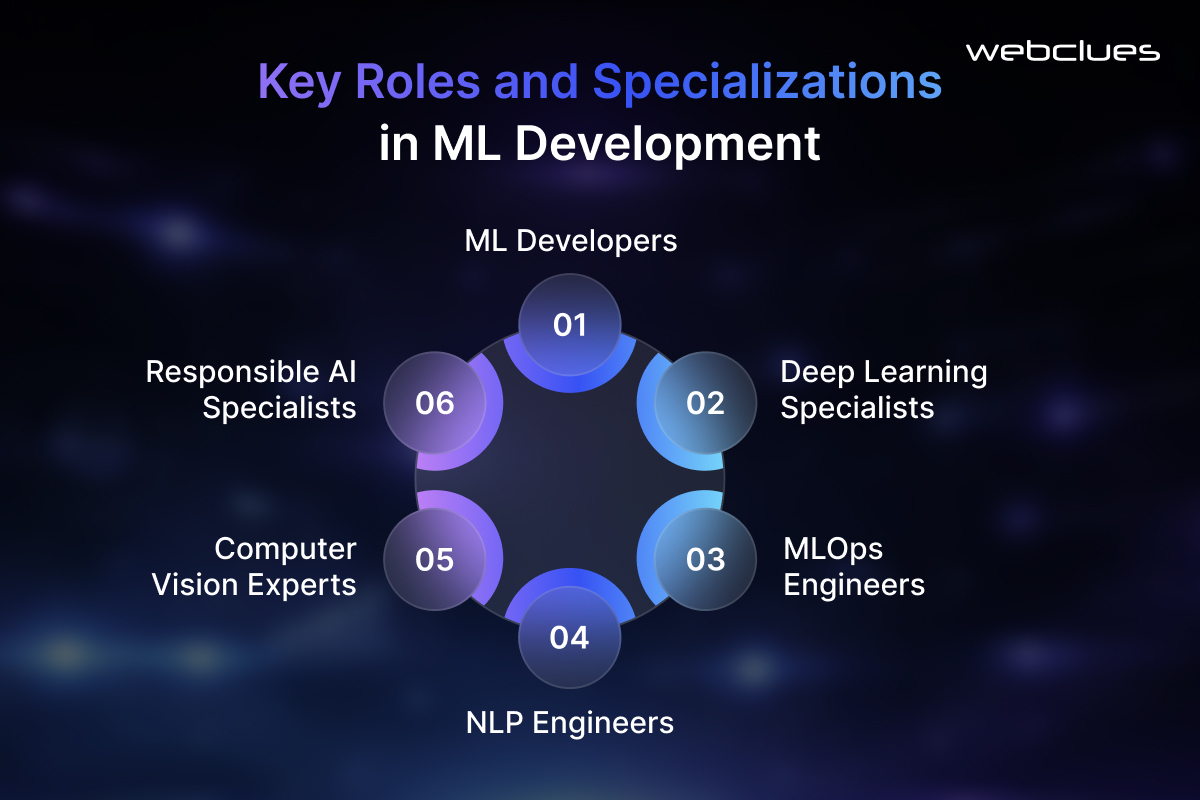
Machine Learning talent is not monolithic. Understanding sub‑specializations within the field helps you hire precisely for your project’s needs.
ML Developer: End‑to‑End Model Building
Generalist ML developers tackle the full lifecycle from data preprocessing to model deployment. They are versatile contributors who make pragmatic choices across the stack, ideal for smaller teams or end‑to‑end projects where breadth matters as much as depth.
Deep Learning Specialists: TensorFlow & PyTorch Experts
For tasks involving complex pattern recognition such as computer vision, natural language understanding, or sequence modeling—deep learning experts are indispensable. They possess deep technical fluency in frameworks like TensorFlow and PyTorch and can craft architectures that push performance boundaries.
MLOps Engineers: Automation, CI/CD, and Model Monitoring
Operational excellence separates prototypes from production‑grade systems. MLOps professionals focus on automating pipelines, integrating models into applications, and instrumenting monitoring that detects drift, latency spikes, and data integrity issues. Their skill set reduces risk and speeds time‑to‑value.
Specialized ML Roles: NLP, LLM, Computer Vision, Responsible AI
As ML applications diversify, so do roles:
- NLP engineers specialize in text processing, transformers, and language models.
- Computer vision experts focus on image and video analytics.
- Responsible AI practitioners ensure fairness, transparency, interpretability, and compliance with emerging ethical standards.
Clarifying role expectations upfront helps you target the right talent.
Hiring Models: Full‑Time, Freelance, and Offshore ML Developers
Your operational context and budget shape the optimal hiring model.
Full‑Time Dedicated ML Engineers
For long‑term strategy, intellectual property stewardship, and deep integration with product teams, full‑time hires ensure alignment and sustained ownership. They embed within culture and can groom junior staff.
Freelance or Contract ML Experts
Freelancers offer flexibility for short engagements, proof‑of‑concepts, or specialized tasks. However, variability in commitment and availability requires robust vetting.
Offshore ML Developers for Cost‑Effective Scaling
To control costs without compromising expertise, many firms hire offshore ML developers in regions with strong engineering talent pools. This model scales capacity quickly but demands careful coordination, alignment on quality standards, and clear communication protocols.
Hybrid or Staff Augmentation Models
Hybrid arrangements blend full‑time strategic oversight with supplemental contract or offshore support. This approach balances continuity with scalability and can fast‑track delivery during peak demand.
Evaluating and Interviewing ML Developer Candidates
The evaluation process is where theory meets tangible quality.
Reviewing Portfolios and Past Projects
Portfolios reveal practical experience. Look for projects with measurable outcomes, clear problem statements, and documented trade‑offs. Thorough case studies demonstrate not just what was built but why certain paths were chosen.
Technical Assessments: Coding, Algorithms & Model Design
Assessments should span code quality, algorithmic logic, and architectural thinking. Realistic problems such as data cleaning tasks followed by model training uncover strengths (and weaknesses) in context, not just isolated coding puzzles. Avoid overly contrived exercises; they often favor generic solutions over practical acumen.
Real‑World Test Projects and Prototype Challenges
Assign short, time‑boxed tasks representative of your domain. These evaluations simulate working conditions and expose how candidates approach ambiguity, resource constraints, and real data.
Soft Skills Evaluation and Cultural Fit
Culture fit matters. Explore how candidates engage in collaborative problem‑solving, communicate trade‑offs, and raise concerns. Behavioral questions about past teamwork and conflict resolution provide insights beyond technical metrics.
Red Flags to Watch During Candidate Evaluation
Beware of candidates who cannot explain their decisions, avoid questions about edge cases, or lack curiosity about data quality. Technical prowess without strategic grounding often leads to misaligned deliverables.
Knowing Costs and Hidden Expenses in Hiring ML Talent
Compensation in ML is nuanced and goes beyond base salaries.
Salary Benchmarks by Region and Experience
Compensation varies widely based on geography and experience level. Senior engineers in top tech hubs command premium salaries, while offshore talent may offer cost advantages without diluting capability—provided you set expectations clearly.
GPU/Cloud Infrastructure and Tools
ML workflows often depend on GPU compute and cloud services. Budget for these recurring expenses, including data storage, orchestrated pipelines, and model serving infrastructure.
Onboarding and Training Investments
Even experienced hires require onboarding. Allocate time and budget for acquainting new team members with your data schemas, security policies, and tooling. Underestimating this phase delays productivity.
Budgeting for Ongoing Model Maintenance
Models decay as data evolves. Plan for periodic retraining, performance monitoring, and model refresh cycles. Neglecting lifecycle costs leads to technical debt and suboptimal outcomes.
Onboarding and Retaining Top ML Developers
Attracting talent is only half the battle retention sustains impact.
Structured Onboarding to Tools and Data Pipelines
An efficient onboarding process accelerates impact. Clear documentation, access provisioning, and knowledge transfer sessions reduce friction and help new hires contribute sooner.
Team Integration, Culture, and Collaboration
Foster psychological safety, open communication, and shared ownership. Talented professionals stay where they are challenged, respected, and supported.
Continuous Learning and Upskilling
Encourage ongoing education. Sponsorship for courses, participation in conferences, and internal brown‑bag sessions signal that growth is valued.
Performance Monitoring and Feedback Loops
Regular feedback aligns expectations and surfaces impediments early. Objective performance metrics linked to outcomes not just outputs but support fair evaluations.
Why Partner with a Trusted ML Development Company
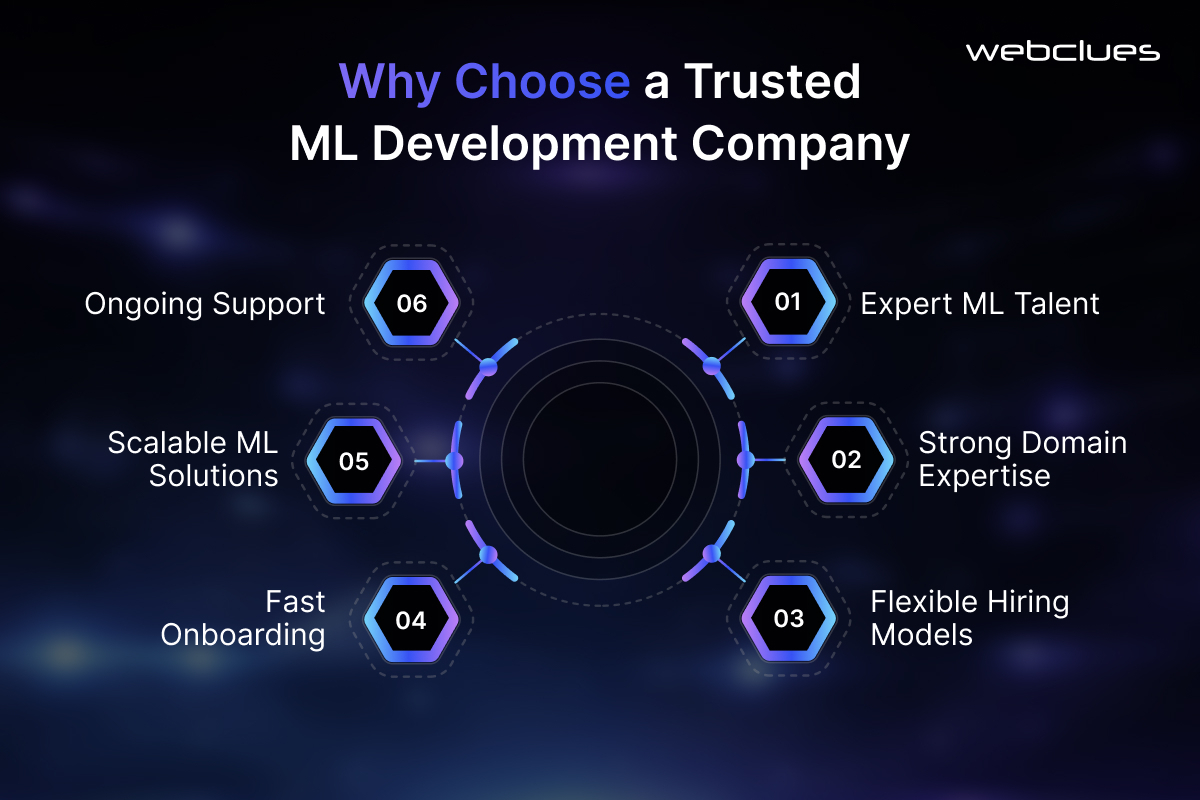
Engaging a specialized partner can accelerate delivery and mitigate risks.
Vetted Talent and Domain Expertise
Companies with deep ML focus maintain rigorous standards and curate teams aligned to your technical needs. When you hire dedicated ML engineers through such partners, you inherit screening, training, and quality benchmarks.
Flexible Engagement Models to Fit Your Project
Whether you need short‑term experimentation or long‑term delivery, trusted firms provide flexible models tailored to scope, timeline, and budget.
Streamlined Hiring and Onboarding Process
Partnering removes much of the administrative overhead associated with sourcing, background checks, and initial setup—freeing you to focus on product strategy.
Production‑Ready ML Delivery and Long‑Term Support
Beyond prototype builds, reliable partners deliver hardened solutions complete with testing, monitoring, documentation, and maintenance support—reducing total cost of ownership.
Make the Right ML Developer Hiring Decisions!
Hiring Machine Learning talent is strategic, not tactical. It demands an understanding of technical depth, problem solving aptitude, soft skills, and alignment to business goals. The right mix of analytical rigor, communication strengths, adaptive learning habits, and contextual domain expertise determines success.
As ML adoption accelerates, making informed decisions about recruitment models, evaluation criteria, cost planning, and retention strategies ensures your initiatives are not just delivered but transformative.
Whether you choose to invest in full‑time staff, augment with freelance specialists, or engage experienced partners to hire machine learning engineers, anchoring your approach in clear expectations and structured evaluation positions you for growth in a competitive talent landscape. Ready to accelerate your AI initiatives with top-tier ML talent? Connect us to hire ML developers who deliver results from day one.
Post Author

Nikhil Patel
Nikhil Patel, a visionary Director at WebClues Infotech, specializes in leveraging emerging tech, particularly Generative AI, to improve corporate communications. Through his insightful blog posts, he empowers businesses to succeed digitally.


Build Your Agile Team
Hire Skilled Developer From Us
Hire Top ML Developers for Your Next Project
Don’t let talent gaps slow down your AI initiatives. Partner with our vetted ML developers and accelerate your projects from day one. Whether you need full-time experts, freelancers, or offshore support, we ensure the right fit, fast onboarding, and long-term impact. Get started today and transform your ML ideas into results.
Connect Now!Our Recent Blogs
Sharing knowledge helps us grow, stay motivated and stay on-track with frontier technological and design concepts. Developers and business innovators, customers and employees - our events are all about you.