

Connect with us


Corporate Video

How AI Agents are Automating Complex Enterprise Workflows in 2026
.jpg)
In 2026, AI agents have appeared on the scene as self-governing digital co-workers, who can make decisions, learn from data, and control complex business processes without the need for constant human monitoring.
According to industry projections, the market for AI agents is expected to reach USD 10.7-12 billion in 2026, registering a CAGR of over 45%.
Organizations are quickly integrating task-oriented AI agents into their business processes, and 40% of enterprise applications are expected to have AI agents by the end of the year. These figures not only indicate the pace of adoption but also the business value that autonomous AI agents bring to the table.
For organizations looking to optimize business processes, the adoption of AI agents has become a necessity. Organizations that adopt AI agents can help their businesses make decisions quickly, enhance customer experiences, and grow their business processes without having to hire more people.
If you are looking to optimize your enterprise business processes in 2026, our AI experts at the AI agent development company can assist you in developing intelligent systems that make work faster and easier to manage.
What is Agentic AI? Understanding Autonomous Decision-Making Systems
Agentic AI refers to artificial intelligence systems that function independently to accomplish tasks without the need for constant human supervision.
Agentic AI differs from traditional AI in that it not only acts on command but also analyzes objectives, plans actions, and implements them, learning from its experiences along the way. In short, agentic AI is a self-directed digital worker that can accomplish simple and complex tasks.
The main features of agentic AI are:
- Goal Orientation: The AI agent recognizes objectives and plans ways to accomplish them.
- Decision Autonomy: It analyzes several alternatives and makes decisions based on its analysis.
- Continuous Learning: Agentic AI uses past experiences to optimize processes and make them more efficient.
- Multi-System Integration: These AI agents can interact and coordinate with multiple enterprise systems.
For instance, a generative AI agent in a customer service context can independently analyze customer inquiries, assign priority levels, give accurate answers, and refer complex questions to supervisors without human assistance. It learns from feedback over time to improve its performance.
Key Components of AI Agent Workflows for Enterprise Automation
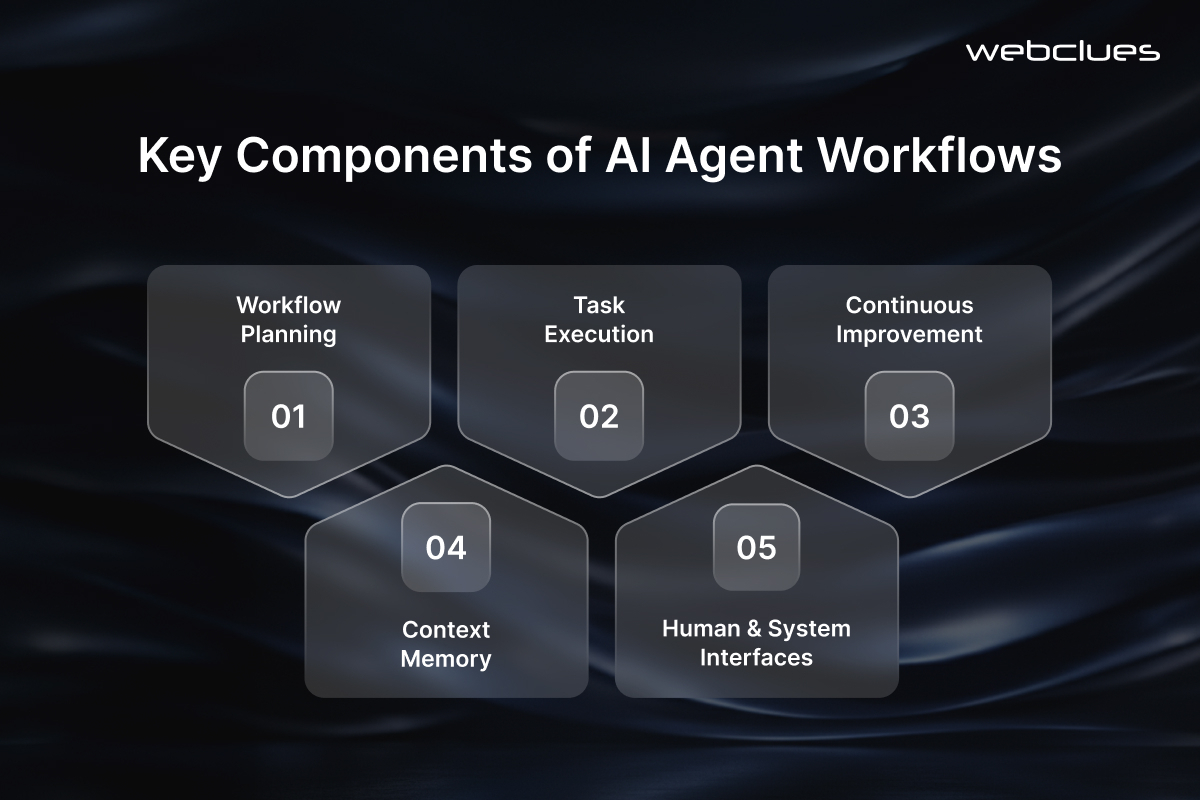
The workflow of an AI agent is a complex system that consists of four basic elements: planning, execution, refinement, and interface. Knowledge of these four elements is vital for businesses to effectively implement custom AI agent solutions.
Planning: Task Decomposition and Strategic Orchestration
Planning is the first step where the AI agent formulates goals, decomposes tasks, and creates a feasible workflow. For example, an AI agent handling the processing of invoices could:
- Identify incoming invoices from various sources.
- Verify the invoice information against purchase orders.
- Identify the approval path according to the organizational structure.
- Point out exceptions for manual processing if there are discrepancies.
Good planning helps autonomous agents work in an optimal manner, with high-priority tasks and the ability to adjust according to changes in the working environment. Companies that utilize AI agent development services experience 20-30% quicker workflow cycles because of intelligent task decomposition.
Execution: Tools, Subagents, Error Handling, and Guardrails
Execution entails the performance of planned tasks using the right tools while keeping track of any errors. Many frameworks for AI agents make use of subagents or specialized agents dedicated to particular tasks in a process.
Take, for example, a supply chain process, where one agent keeps track of the stock, another communicates with suppliers, and a third one updates the ERP system. When a stockout situation is identified, the subagents work together to order supplies automatically. Guardrails are put in place to avoid any unintended behavior.
This phase is where the benefit of autonomous AI agents in operation can be seen, as they are capable of performing several dependent tasks across different systems without constant human supervision.
Refinement: Human-in-the-Loop, Evaluation, and Memory Management
Refinement enables the constant evolution of AI processes. Human-in-the-loop processes enable the monitoring of high-risk decisions, and the agents learn from each experience. Memory optimization is essential because the agents retain the results of the workflow, the context, and past decisions to improve future performance.
For instance, a financial reporting AI agent can learn the patterns of expense allocation and error identification, thereby minimizing the need for human review. Organizations have achieved a success rate of 75% in automating complex multi-step processes.
Interface: Human-Agent and Agent-Agent Interactions
The interface layer describes how AI agents interact with humans and other agents. This can include dashboards, notifications, API integration, and conversational AI. Good interfaces enable humans to step in when needed and ensure multi-agent collaboration works smoothly.
A custom AI agent that is rolled out to sales, operations, and customer service teams needs to have consistent communication channels to prevent process conflicts or redundant execution. Good interfaces also enable businesses to track performance and ROI.
AI Agent Architectures and Design Patterns for Complex Workflows
The architecture of AI agents determines their efficiency, reliability, and scalability. In 2026, enterprises are moving beyond single-agent systems to sophisticated multi-agent frameworks capable of handling intricate workflows. Selecting the right architecture is essential for achieving operational agility.
Single-Agent vs Multi-Agent Architectures
Single-agent architecture is designed for particular use cases such as automating the approval of invoices or the categorization of customer tickets. Single Agent Architecture is most appropriate for simplicity, quick development, and predictable outcomes. However, their use cases are limited because it is hard to develop inter-departmental processes or multi-step workflows that require system-wide knowledge between different systems.
Multi-agent architecture consists of multiple autonomous agents designed to work together to perform complex workflows. Each agent is an expert in a particular set of tasks but communicates with other agents through a common knowledge base. Multi-agent systems are most appropriate for enterprise automation software such as supply chain management, HR onboarding, or sales pipeline management.
For instance, in an e-commerce company, there is one agent that forecasts demand, another that manages inventory, a third that manages logistics, and a fourth that manages customer notifications. They all work together to build a self-contained AI ecosystem, which enables the development of seamless end-to-end process automation.
Emerging Patterns: ReAct, Self-Refine, RAISE, Reflexion, LATS, PlaG
Modern design for AI agents have evolved to standardized forms that improve the reliability and decision-making capabilities of AI agents:
- ReAct: This pattern combines reasoning and action cycles, which help AI agents evaluate situations before taking actions.
- Self-Refine: This pattern enables AI agents to review their own outputs and make corrections when necessary.
- RAISE: This pattern applies reinforcement learning to optimize workflow processes in AI agents.
- Reflexion: This pattern combines reflection and planning to optimize long-term task execution in AI agents.
- LATS (Learning-Augmented Task Solvers): This pattern enables AI agents to use past experiences to predict potential workflow difficulties.
- PlaG (Planning Graphs): This pattern facilitates the decomposition of complex tasks in multi-agent systems.
These design patterns are being increasingly applied by companies that outsource AI agent development services to ensure that their AI workflows are scalable, robust, and able to respond to unexpected situations.
Router Workflows and Autonomous Agents
Router workflows are the traffic control component of multi-agent systems that route tasks to the correct agent. For instance, in business procurement:
- The approval of routine purchases is routed to a finance agent.
- Negotiation tasks with suppliers are routed to a negotiation-specialized AI agent.
- Checking for compliance is the job of a governance agent.
In this way, tasks are completed with high efficiency and without delays or human involvement. Businesses that hire AI agent development companies typically use router workflows to ensure high throughput in their enterprise operations.
How AI Agents Automate Enterprise Workflows Across Departments
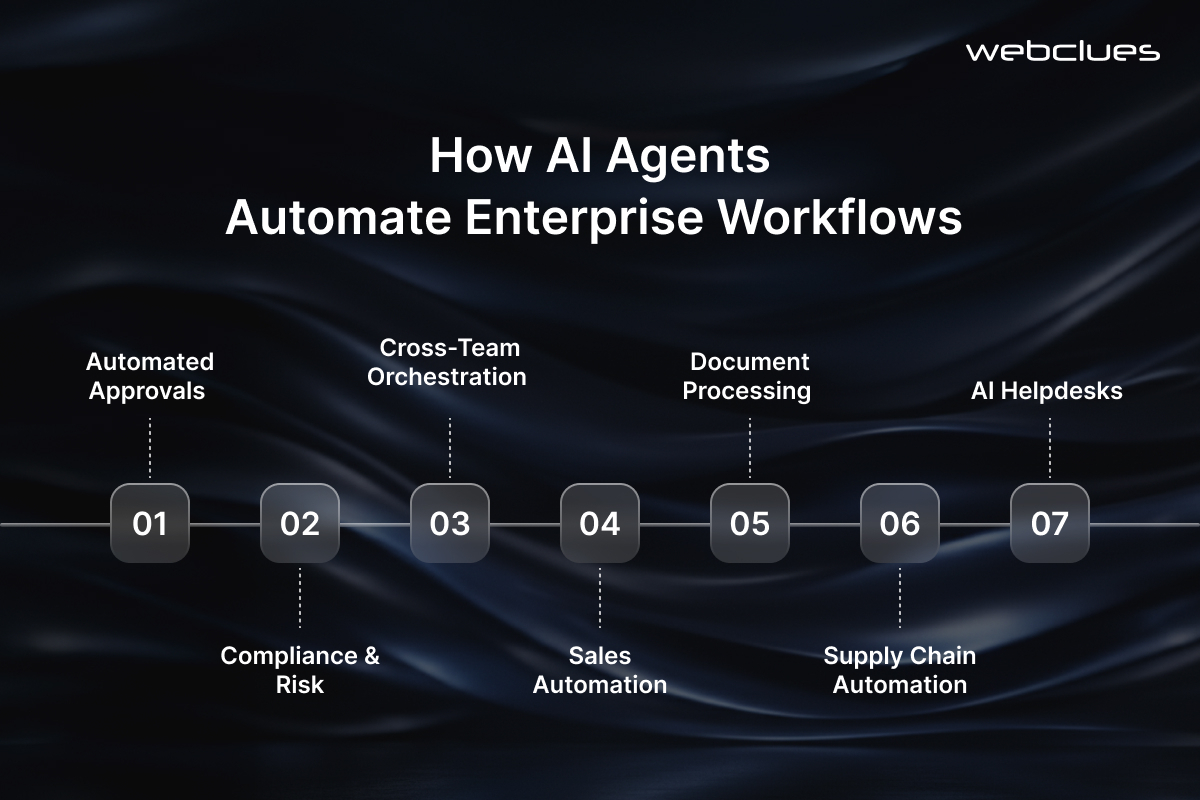
AI agents are no longer confined to a single department. They enable cross-functional automation that accelerates decision-making, reduces errors, and improves operational agility.
Approval Processes and Decision Routing Automation
Manual approvals slow business operations. AI agents automate this by evaluating tasks, checking compliance, routing decisions to the correct approvers, and escalating overdue items.
For example, in HR, custom AI agents can handle leave requests, onboarding approvals, and payroll exceptions without requiring managers to manually track every step. Enterprises adopting this approach report a 20–30% reduction in workflow cycle times.
Cross-Department Workflow Orchestration
The AI agents can also coordinate complex workflows that involve several departments. For example, an AI agent can start a product launch process by:
- Notifying the marketing department to schedule the campaigns.
- Notifying the sales teams about the availability of the inventory.
- Notifying the logistics department to schedule the deliveries.
- Updating the finance department about the budget and expenditures.
Intelligent Document Processing
Manual processing of documents is still a time-consuming process. AI agents, using OCR and machine learning algorithms, can read, verify, and classify invoices, contracts, and legal documents.
A finance team using AI agent solutions for managing invoices can minimize errors, speed up approval processes, and ensure compliance automatically. These systems improve in accuracy as they learn from experience.
AI-Powered Helpdesks and Support Automation
Internal and customer-facing helpdesks benefit immensely from AI virtual agent development. AI agents handle IT support, HR inquiries, and customer service tickets 24/7. By categorizing requests, providing immediate responses, and escalating only complex issues to human agents, enterprises can improve response times and employee satisfaction.
For example, a telecom company using AI agents for customer queries could resolve up to 80% of support tickets without human involvement, freeing staff for higher-value tasks.
Compliance, Risk Management, and Governance Automation
The AI agents also automate the monitoring of compliance and risk management. The AI agents are able to monitor transactions, policies, and changes in regulations, and thus identify anomalies and generate alerts.
Organizations in the healthcare and financial sectors that use autonomous AI agents for compliance purposes experience reduced human error and shorter cycles for reporting regulations.
Sales Pipeline Management
The sales processes, ranging from lead scoring to follow-up communications, are increasingly being performed by AI agents. Based on predictive analysis and real-time tracking, AI agents can optimize pipeline management, revenue projections, and other routine sales activities.
Organizations that have adopted generative AI agents for sales have seen an average revenue boost of 7-25% because of accelerated sales closures.
Supply Chain and Inventory Optimization
The AI agents are responsible for demand forecasting, inventory replenishment, and logistics management. They forecast stockouts, place orders for supplies automatically, and also optimize routes for logistics.
Companies that employ AI agent development services for supply chain management have experienced lower operational costs and better service levels.
Benefits of Agentic AI Development for Business in 2026
The adoption of agentic AI delivers measurable benefits across enterprises:
- Faster, Real-Time Decision-Making with AI: Autonomous agents process real-time data and take immediate actions. For instance, retail pricing agents can dynamically change prices based on real-time sales, and supply chain agents can place orders as inventory diminishes. Real-time processing improves agility and reaction times.
- Lowered Operational Expenses and Labor: With AI agents automating mundane tasks, employees can concentrate on long-term planning. Companies experience a 90% decrease in costs associated with manual task execution and a 20-30% reduction in workflow cycle time.
- Scalable Workflow Automation: AI agents can be easily replicated across departments without the need for a corresponding increase in personnel. Multi-agent systems help replicate complex workflows across different geographies, departments, and business units with ease.
- Enhanced Customer Experience and Operational Efficiency: Customer-service AI agents provide personalized and timely services. They reduce errors, waiting times, and operational variability, resulting in a substantial increase in customer satisfaction.
- Enabling Digital Transformation: The incorporation of AI agents helps enterprises modernize their workflows, align different departments, and provide a platform for continuous improvement and innovation. Companies leveraging agentic AI are at the forefront of digital transformation and ready to face future market uncertainties.
Advanced Techniques in AI Agent Development and Workflow Automation
To maximize the impact of AI agents, enterprises are adopting advanced techniques that go beyond traditional automation. These approaches ensure reliability, scalability, and long-term adaptability.
Graph-Based Agentic Workflows vs Traditional RAG Systems
Graph-based workflows are a type of workflow that uses graphs to represent processes. In graph-based workflows, processes are represented as nodes and edges.
Unlike traditional RAG systems, graph-based workflows enable AI agents to:
- Visualize complex multi-step processes.
- Optimize task routing dynamically.
- Identify bottlenecks or errors before execution.
For instance, in the manufacturing sector, a graph-based AI agent can dynamically re-route production tasks in case of a machine breakdown or changes in the availability of raw materials.
Embedded AI for Autonomous Decision-Making
The integration of AI within enterprise systems enables agents to make decisions in real time without having to wait for external stimuli. Autonomous AI agents have the ability to:
- Perform cross-platform actions in an instant.
- Interact directly with ERP, CRM, and HR systems.
- Adjust strategies based on real-time performance data.
Ensuring Deterministic Outputs and Long-Term Memory
In mission-critical processes, it is necessary to have predictable and traceable results. The development of advanced AI agents involves:
- Deterministic behavior: The program always generates the same output for the same input, which is vital in industries that require compliance.
- Long-term memory management: AI agents can retain and use past experiences to make better decisions.
AI agents with high memory capacity are useful in customer service, sales, and logistics.
Multi-Agent Collaboration and Meta-Agent Orchestration
In complex workflows, meta-agents, or agents that manage other subordinate AI agents, may be necessary. This is because, through meta-agents, the following can be achieved:
- Optimal resource allocation.
- Resolution of conflicts among agents with overlapping domains of responsibility.
- Optimization through feedback loops.
For instance, a meta-agent in a retail business environment can manage inventory, pricing, logistics, and communication with customers all at once.
Best Practices for Implementing AI Agent Workflows
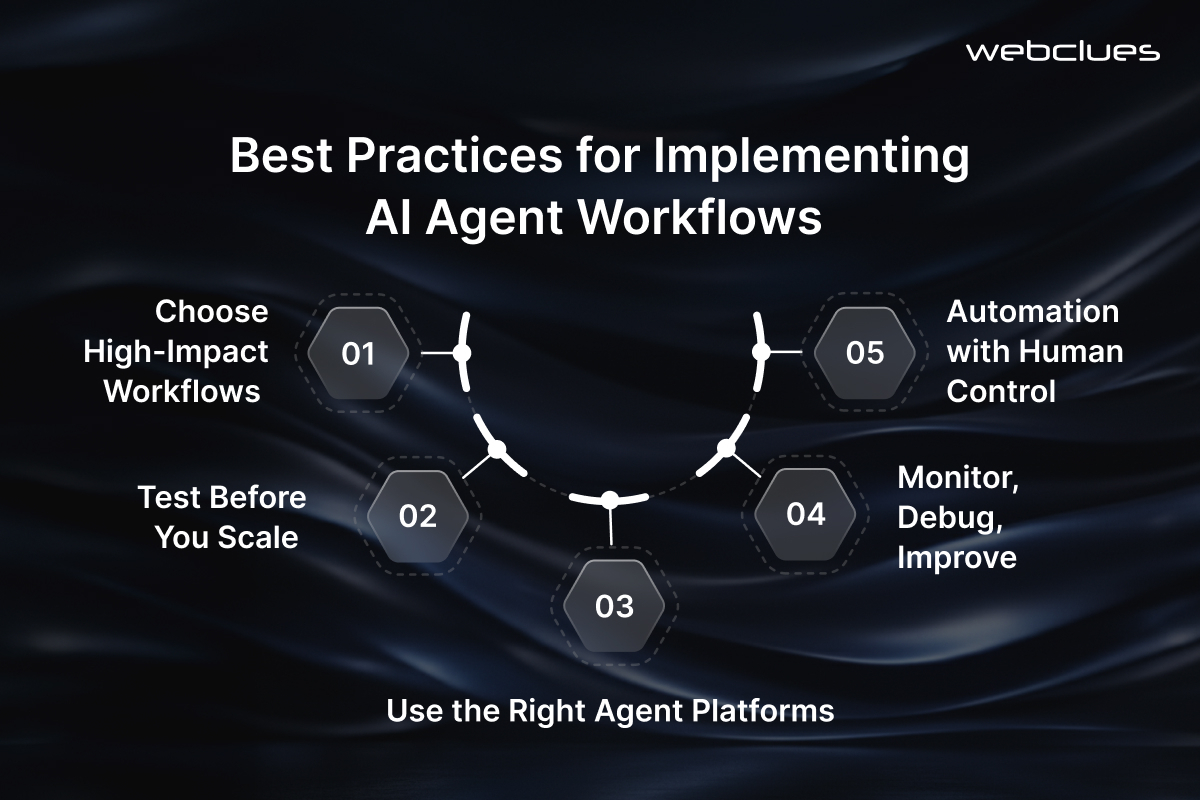
Proper implementation ensures that AI agents deliver measurable ROI while minimizing risks.
Identifying High-Value Workflows for Automation
Not all workflows will be equally benefited by AI automation. Enterprises must:
- Analyze processes in various departments.
- Find tasks that are repetitive, high-volume, or prone to errors.
- Give priority to tasks where AI can help cut costs, increase accuracy, or speed up decision-making.
Prototyping, Testing, and Evaluation Before Deployment
Before full-scale deployment, it is essential to test AI agents thoroughly:
- Model workflows based on past data.
- Test the accuracy of decision-making.
- Uncover edge situations and points of failure.
This will help avoid project failure, which, as predicted for 2026, can happen to as many as 40% of agent-based AI projects.
Leveraging Platforms like LangChain, Vellum, CrewAI
Current AI development platforms make it easier to create and manage agents:
- LangChain: Allows multi-step reasoning and chain-of-thought processing.
- Vellum: Specialized in memory-based agents for long-term planning.
- CrewAI: Offers collaboration-oriented multi-agent management.
Hiring AI agent developers with experience in these platforms can speed up the deployment process and improve the reliability of the system.
Continuous Monitoring, Debugging, and Prompt Engineering
AI agents need constant monitoring:
- Review results for accuracy and compliance.
- Correct debugging errors in real-time.
- Refine queries for better generative or decision-making outcomes.
Constant improvement helps maintain a positive ROI and avoids unforeseen behavior.
Balancing Automation with Human Oversight
Though autonomous AI agents improve efficiency, humans are still required for:
- Strategic decision-making.
- Exception handling in high-risk situations.
- Ethical and regulatory control.
The human-in-the-loop approach ensures that the AI system is always in sync with business goals and regulations.
Challenges and Considerations in Adopting Agentic AI
Despite its advantages, agentic AI presents unique challenges that enterprises must address.
Integrating AI Agents with Legacy Systems
Many organizations operate with legacy infrastructure. AI agents must integrate seamlessly without disrupting existing operations. Challenges include:
- Data format inconsistencies.
- Workflow dependencies.
- System latency issues.
Custom AI agent solutions often bridge these gaps using APIs, middleware, and adapter layers.
Security, Compliance, and Audit Readiness
Autonomous agents operate across sensitive data streams. Organizations must:
- Enforce role-based access controls.
- Monitor for “shadow agents” running unsanctioned tasks.
- Maintain auditable logs for regulatory compliance.
These safeguards prevent operational risk and protect enterprise reputation.
Observability and Evaluation of Complex AI Workflows
Complex multi-agent workflows can become opaque. Effective observability involves:
- Real-time dashboards tracking agent actions.
- Alerts for anomalous behavior.
- Regular performance evaluation against key metrics.
Managing Reliable Long-Term Memory for Agents
Memory is both an asset and a risk. Agents need structured, retrievable memory while avoiding data drift, bias, or security breaches. Best practices include:
- Versioned memory storage.
- Controlled access policies.
- Regular pruning and retraining.
The Future of AI Agents in Enterprise Workflows Beyond 2026
The future of agentic AI is towards fully autonomous ecosystems that can handle end-to-end processes.
Fully Autonomous Agents Handling End-to-End Processes
From 2027-2028 onwards, you will witness AI agents that can handle entire processes end-to-end without human intervention.
Multi-Agent Ecosystems and Cross-Industry Applications
The interaction of multiple agents in various industries such as finance, healthcare, manufacturing, and retail will give rise to AI ecosystems. These AI agents will share knowledge and minimize inefficiencies in the system.
Low-Code/No-Code AI Orchestration for Widespread Adoption
Low-code/no-code platforms will enable businesses to develop, customize, and implement AI agents without requiring technical expertise. This will make AI adoption widespread in small and medium-sized businesses.
Continuous Learning and AI-Driven Business Innovation
The AI agents will continuously learn from new data, market trends, and system experiences. Businesses that adopt this model will gain a competitive advantage and become more resilient to market disruptions.
Get Started with Agentic AI Adoption for Modern Workflows with Webclues
Webclues offers AI agent development services designed to help businesses implement scalable, autonomous AI workflows. Their services include:
- Custom AI agent solutions for enterprise automation.
- Multi-agent orchestration frameworks.
- AI virtual agent development for customer support and internal processes.
- End-to-end workflow automation consulting.
Partnering with Webclues allows organizations to hire AI agent developer skilled in cutting-edge techniques and deploy AI systems that maximize ROI while minimizing risks.
Contact us to implement agentic workflows with Webclues and accelerate your businesses' digital transformation.
Post Author

Ayush Kanodia
As one of the esteemed Directors of WebClues Infotech. Ayush Kanodia is passionate about delivering innovative IT services & solutions and has spearheaded numerous successful projects, cementing the company's position as a leader in the field.


Build Your Agile Team
Hire Skilled Developer From Us
Build Autonomous AI Workflows with Webclues
Webclues helps enterprises design, develop, and deploy autonomous AI agents that automate complex workflows across departments. From multi-agent orchestration to secure, scalable implementation, our AI agent development experts ensure faster decisions, lower operational costs, and measurable ROI without disrupting your existing systems. Start building future-ready workflows with confidence.
Connect Now!Frequently Asked Questions
Our Recent Blogs
Sharing knowledge helps us grow, stay motivated and stay on-track with frontier technological and design concepts. Developers and business innovators, customers and employees - our events are all about you.