

Connect with us


Corporate Video


How Businesses Use AI Agents to Reduce Operational Costs
.jpg)
Operational costs often build quietly. A support agent answers the same order-status question all day. A finance employee checks invoices for missing details. An operations coordinator jumps between dashboards, emails, and spreadsheets to resolve one exception. Repeated across hundreds of cases, those minutes become overtime, backlogs, slower service, and pressure to add headcount.
AI agent development services can reduce this repeat effort. Consider the agent as the one who does the work. It gathers all the approved information, reviews the systems involved and moves the case forward until a decision, exception or sign-off is required. It then passes the case to the next employee to the right. It isn't there to remove some of the repetitive burden from the team, it's there to be part of the team.
PwC’s May 2025 survey offers a useful reality check. From the businesses that are already using AI agents, 66% say productivity had improved and 57% saw cost savings. That does not mean every agent project pays off. It does explain why companies are looking closely at the repetitive work that keeps pulling the same teams away from more important decisions.
For example, one business may be struggling with support tickets that keep coming back because the first reply was incomplete. Another may have invoices waiting in finance because small details are missing. Some teams simply want employees to stop raising tickets for questions that already have a clear answer. When the starting problem is this specific, it becomes much easier to see whether the agent is actually helping or just adding another tool to the stack.
Where AI Agent Development Services Can Cut Day-to-Day Costs
AI Agent Development Services work best where tasks happen often, follow a reasonably consistent pattern, and have a clear point for human escalation. The best starting point is usually a workflow where people spend too much time searching, checking, updating, routing, and following up.
Custom AI Agents for Customer Support
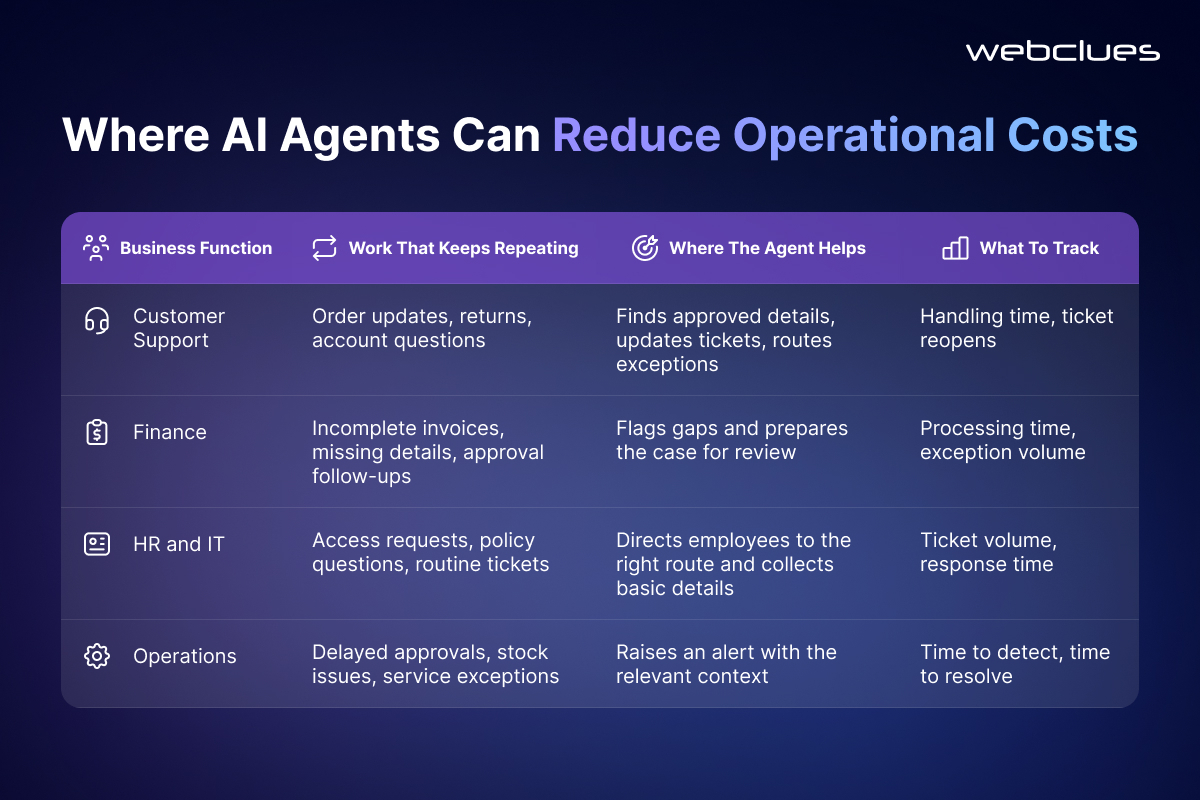
Support teams carry a large share of routine work. Customers want updates on orders, returns, accounts, bookings, payments, and basic product questions. The task is rarely just answering them. It also involves checking a record, logging the interaction, and moving complex cases to the correct team.
Custom AI agents can handle this first stage. They can identify the question, pull approved information from connected systems, create or update a ticket, and route exceptions with the relevant detail attached. This reduces manual touches and stops staff from repeatedly copying information between platforms.
A support agent should not invent policy, make financial commitments, or deal with sensitive cases without a human. The agent needs clear limits, especially where customer trust is involved.
Where Generative AI Agents Help With Document-Heavy Work
Document work usually looks simple from the outside. Inside the team, it is rarely that clean. An invoice may arrive without a purchase order number. A supplier email may include three attachments and no clear next step. A claims file may have the right documents, but not in the right order.
This is where Generative AI Agents can take away some of the first-level effort. They can help classify documents, pull out key fields, highlight missing information, prepare a summary, and organise the details for review.
A finance team may use an agent to identify incomplete invoice details before they reach the approval stage. A service team may use one to pull key information from a long email chain. Claims is a good example. Instead of going through a ton of attachments and a lengthy email thread, the reviewer can open a concise case summary, consolidating details.
It is still up to the person taking care of the case to see what the next step is. That's relevant in the event of a payment, policy exception, compliance issue, or something directly impacting the customer. The agent sorts it out first, the reviewer takes his time on the decision.
Making Everyday Employee Requests Easier to Handle
A surprising amount of internal time goes into small questions. Someone cannot access a tool. Someone is unsure which expense form to use. Another staff member inquires about why a request is languishing with a one specific team for days.
These requests are not necessarily hard to fulfill, they're just stuck in IT, HR, finance, and procurement inboxes. One message is manageable. Dozens every week become a distraction.
The Conversational AI Agent can serve as the first point of reference for employees. It can assist them in finding the proper policy, form, status of the request, or information that they are still missing. If the situation requires a genuine decision or someone has to take some sort of action, it can be turned over to the appropriate team, with the gist of the situation already conveyed.
The Workflow Must Be Understood Before AI Agent Development Begins
An agent will not repair a process that no one understands. Conflicting rules, poor data, unclear ownership, and manual workarounds will still be there after launch. The agent may simply reproduce those issues faster.
Before starting AI Agent Development, map how the work actually happens. Process documents are useful, but they rarely show the full picture. Spend time with the people who handle these cases when the work is actually coming in. They will point out the small things that hold everything up, such as a missing field, an approval sitting with the wrong person, or a case that should not move ahead without someone experienced looking at it first.
Use five questions to define the opportunity:
- What starts the process?
- What information is needed before action can be taken?
- Which steps happen in most cases?
- Where must a person approve or decide?
- What number needs to improve for this work to be worth doing?
The last question creates a business case. “Save time” is vague. “Reduce incomplete invoice submissions by 30%” or “cut time spent on order-status tickets” gives the project a clear target.
Why AI Agent Developers and an AI Agent Architect Matter
AI Agent Developers connect the agent to approved data and business tools, define the actions it can take, test scenarios, and make sure it records what happened.
An AI Agent Architect looks at the wider setup. That includes integrations, access controls, approval rules, escalation points, and monitoring. The chat interface is only the visible part. The real value comes from the workflow behind it.
This becomes important when a business needs an agent to move work across systems rather than simply answer a question.
When Custom AI Agents Are Worth the Investment
A standard AI tool can suit simple, low-risk tasks. It may help employees search a contained knowledge base, prepare a draft, or answer basic questions.
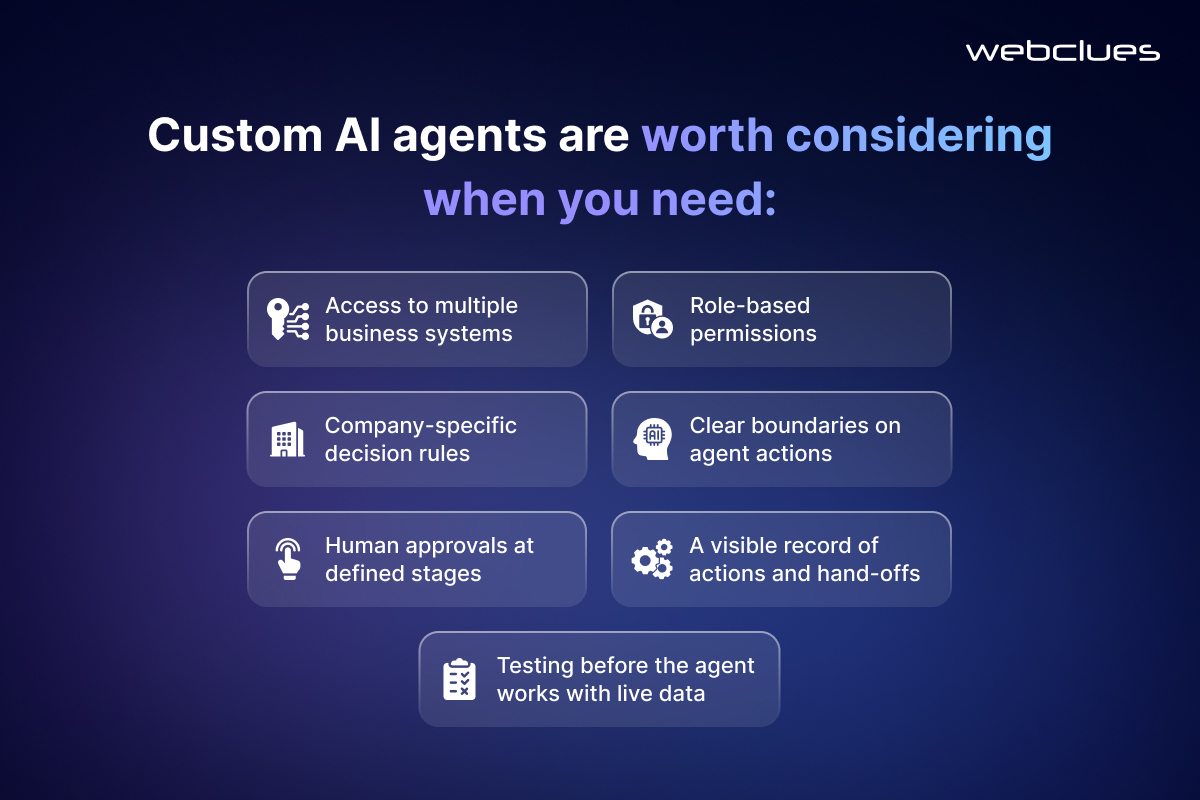
Custom AI agents make more sense when the task does not stay inside one tool. Take a retail support request. The answer may depend on the order record, stock status, return policy, CRM history, and a warehouse update. A basic tool may explain the steps. A custom agent can be built to move through those steps with the right limits in place.
Custom AI agents are worth considering when you need:
- Access to multiple business systems
- Role-based permissions
- Company-specific decision rules
- Clear boundaries on agent actions
- Human approvals at defined stages
- A visible record of actions and hand-offs
- Testing before the agent works with live data
The first project does not need to be large. Begin with a component of the business that people do regularly and where the steps are somewhat well established. It may be something that keeps coming up, a check that doesn't get done quickly, or a regular exchange of responsibilities between groups. The important thing is that the team responsible can tell you whether the situation has actually improved once the agent is in place.
AI Agent Categories Businesses Commonly Use for Cost Control
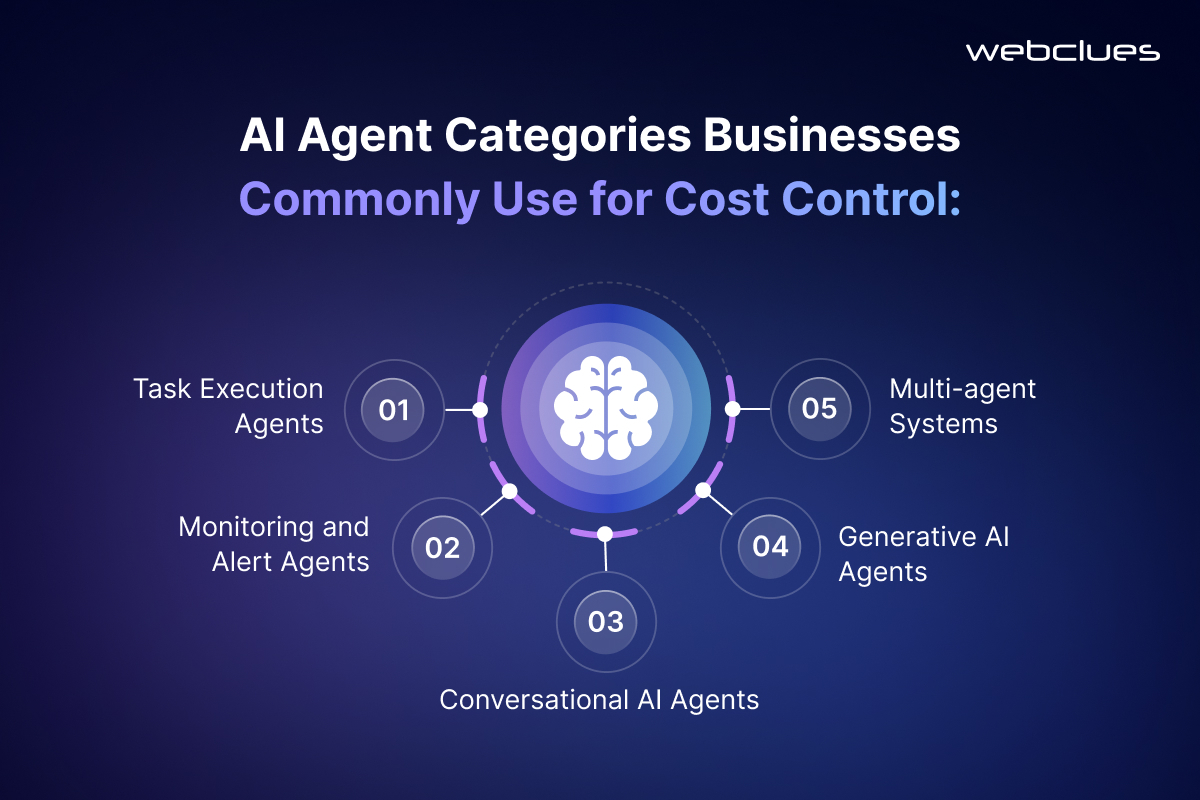
AI Agent Categories are easier to understand when grouped by the work they support.
Task execution agents are useful when the next step is known. They are most useful for straightforward jobs that follow the same route each time. That could be creating a ticket, updating a record, asking someone for a missing document, or sending the request to the team that needs to deal with it next.
Monitoring and alert agents are used where delays or exceptions are expensive. They can keep an eye on pending approvals, unusual transactions, stock mismatches, missed service levels, or system issues that would otherwise sit unnoticed.
Conversational AI Agents deal with routine customer and employee questions. They can retrieve information, collect context, start a request, and guide users through standard steps.
Generative AI Agents are useful when teams receive too much raw information. They can turn long documents, notes, emails, or attachments into something easier for a person to review.
Multi-agent systems split a larger workflow into smaller roles. One agent may gather information, another may check it against rules, and another may prepare the next action. This can help where different stages need different system access or specialist checks.
How an AI Agent Development Company Should Measure Cost Reduction
Cost reduction should be measured before development starts. Record the current number of cases, time per case, manual touches, rework rate, exception rate, average delay, and cost per transaction. These figures form the baseline.
Then decide what should improve. For support, useful measures include average handling time, ticket reopens, escalation rate, and cost per resolved case. For finance, look at processing time, missing-document rates, exception volume, and review hours. For operations, focus on time to detect an issue, time to resolve it, missed deadlines, and manual checking.
Do not promise a fixed saving percentage before the agent has worked in the actual process. A better approach is to run a small pilot with a fixed scope and a review date already agreed. Don't just check out the number in the finance report. The first sign is often more obvious: the team is no longer working late to unclog the same queue, the number of cases returning is fewer due to an omission, and managers don't need to recruit more people when volumes increase.
See How It Holds Up in the Process
Choose one workflow, a limited user group, and a fixed review period. Keep a person involved in exceptions. Review the agent’s hand-offs, system updates, and errors. Do not judge the pilot only by task volume. Check whether it improved the process or pushed work elsewhere.
At the end, make a firm decision. Expand when the defined outcome has improved. Rework when the process needs attention. Stop when the value does not justify the cost or risk. This helps avoid projects that look impressive in a demo but do not hold up in daily operations.
Questions to Ask an AI Agent Development Company
A capable AI Agent development company should begin with your process, not a model demo. It should want to understand where the work starts, which systems are involved, who is allowed to approve what, and where mistakes would create risk.
Before you move ahead, ask this first:
Which workflow would you start with in our business, and what makes it the right one?
Then ask:
- Which systems will the agent need to use?
- What data will it read, and who can access it?
- Which actions can it take without approval?
- What happens when it does not have enough information?
- How will we test it before a live release?
- How will performance, errors, and savings be measured after launch?
- Who will maintain it when policies, tools, or workflows change?
- The right partner will narrow the first use case and define what needs to be true for the agent to be useful.
Final Thoughts
AI agents can reduce operating costs by removing repeat effort from real workflows. The clearest opportunities are where teams spend time checking information, switching systems, chasing missing details, and routing routine requests.
Start with the work that causes the most friction. Measure it before changing it. Keep people involved where judgement matters. Then build an agent around the way your team actually works.
The AI Agent Development Services offered by WebClues include custom agent design, integration with CRMs, ERPs, and enterprise tools, testing, deployment, and lifecycle support.
Post Author

Vedansh Kanodia
Vedansh Kanodia, a dynamic Business Development Executive at WebClues Infotech, is a passionate technocrat who helps businesses embrace innovation, and unlock new possibilities with his valuable perspectives.


Build Your Agile Team
Hire Skilled Developer From Us
Build Custom AI Agents Around the Work Slowing Your Team Down
WebClues works with businesses that want to reduce repeat effort in customer support, internal service, document workflows, operations monitoring, and connected business processes. Our AI Agent Development Services focus on a defined workflow, controlled system access, human hand-offs, and results that can be measured. Talk to WebClues about custom AI agents for the workflow that is taking too much time from your team.
Connect Now!Frequently Asked Questions
Our Recent Blogs
Sharing knowledge helps us grow, stay motivated and stay on-track with frontier technological and design concepts. Developers and business innovators, customers and employees - our events are all about you.