

Connect with us


Corporate Video

How is AI Transforming Software Development Lifecycle in 2026
.jpg)
As of 2026, artificial intelligence has moved from the experimental to the essential and foundation of the Software Development Lifecycle (SDLC), which changes the way engineering from being performed by manual codes to intelligent and agent-based orchestration.
According to Gartner, the use of AI is expected to affect 70% of the application design and development processes by 2026, which makes it a strategic imperative for organizations looking to modernise their engineering practices.
Real-world impact data reveals that AI enabled software development provides substantial increases in the productivity of developers; with up to a two-fold increase in productivity for some teams. Furthermore, AI powered automation is reducing testing time by up to 60% and overall development cycles by 30 - 50%.
This transformation is significant to business organizations looking for competitive advantage by undertaking Custom Software Product Development. Key performance indicators for 2026 show that more than 40% of code is now AI assisted; more than 45% of new code is expected to be AI generated by the end of 2026.
This shift has transformed the roles as 62% of developers are actively depending on AI coding assistants, which tackle repetitive "boilerplate" tasks, freeing engineers to become "conductors" of intelligent systems.
In this blog, we explore how SDLC is changing at each stage of the SDLC, what the value the enterprise can extract from AI is, and the role that WebClues, a leading Product Engineering Company plays in helping clients embrace this paradigm shift.
Understanding AI‑Driven Software Development Lifecycle (SDLC)
The traditional SDLC is a linear planning, designing, development, testing, deploying, and maintaining. While Agile methodologies created better iteration and feedback loops, there still had to be a great deal of manual coordination and human decision making at every step.
In 2026, SDLC is going to be an interconnected, intelligent pipeline propelled by machine learning and automation. Rather than disjointed hand-offs between phases, AI generates continuous feedback loops that inform decisions in others, driving faster delivery while maintaining quality.
For example, using production monitoring insights to feed back to planning and design, predictive analytics to refine test scenarios in real-time or deploying tools to use historical performance signals to suggest best laying out strategies.
This change makes Software Development Services more agile, data-driven processes that eliminate waste while gaining a magnified effect from engineering processes. AI's integration throughout SDLC is part of a movement in the wider enterprise towards predictive engineering, where teams never know how things will go wrong and calculate the best path to delivery in a proactive, versus reactive way.
AI in Planning & Requirements Gathering
Planning and requirements gathering are, and continue to be, some of the most difficult, if not error-prone, elements of software delivery. Historically, teams have defined scope and priorities through stakeholder interviews, documentation review and subjective estimation.
As a consequence, these practices frequently result in unclear requirements, scope creep, and misalignment in late stages. In 2026, AI improves this phase by processing structured and unstructured data of a wide range in user behavior and product analytics, supporting tickets, and historical project outcomes to extract patterns and latent needs that humans might miss.
Natural language processing (NLP) models scan through legacy documentation, feedback logs, and user reviews in order to provide candidates for requirements, identify contradictions, and to make recommendations on priorities. Predictive analytics to model the efforts, risks, and resources needed based on similar past projects so that product and project managers can take data-based decisions instead of intuition based guesswork.
This leads to clearer requirements, better translation of business objectives to engineering execution, and predictable outcomes all of which increases the speed of MVP Development and validation in the early stages.
Organizations that use AI for planning report fewer late pivots as well as more confident delivery planning. Teams that use AI-augmented requirement tools cut down on rework and improve alignment between user expectations and development outcomes. For businesses considering Product Engineering Services, this boosted clarity of requirements can lead to major reductions in time to value and allow for more targeted resource allocation.
AI in Software Architecture & Design
Software architecture and design establishes the foundation for the scales of scalability, resiliency, performance, and maintainability. Poor architectural choices can result in performance bottlenecks, technical debt, and expensive rework.
Traditionally, demonstrating architecture required a lot of expert intuition and a lot of manual modeling and heuristic frameworks. In the year 2026,Commerce, AI augments this process with data-driven insights that analyze usage patterns, latency requirements, integration constraints and failure scenarios to recommend architectural blueprints that are optimized for specific business goals.
AI tools model alternate system designs under projected loads, failure scenarios and evolving user demands to enable engineers to compare trade-offs and find the right configuration, balancing performance, cost, and resilience. Generative design models visualize multiple options for architecture and surface up implications of each approach to be able to anticipate weaknesses and optimize system boundaries especially for microservices, distributed systems, as well as cloud-native infrastructures.
These insights from intelligent design lead to less risk and better confidence before development even starts. For clients who are investing in Custom Software Product Development or SaaS platforms of large scale, architectures that are AI assisted enable systems to scale gracefully and without engineering too much technical debt for the future.
AI in Development & Coding Automation
One of the most evident changes in SDLC is in the phase of AI software development. Modern AI coding assistants integrate into development environments, developing ideas about context across the codebase, and suggesting function implementations in line with existing patterns. These intelligent systems help remove repetitive manual coding as well as take care of typical coding patterns such as boilerplate code generation, API integration templates, and test scaffolding, leaving developers to work on higher-order programming issues such as domain modeling and complex logic.
AI also improves the quality of codes in real time by identifying potential bugs, security vulnerabilities and performance issues as code is written. Built-in static analysis, security flagging, and performance suggestions help to speed up delivery cycles and enhance consistency. For software developers looking to make the transition into jobs with a greater focus on architectural thought and strategic management, AI tools are copilots that help democratize knowledge and cut onboarding time for new languages and frameworks.
Engineering teams with a welcome attitude towards AI coding tools saves money in software development and compresses the software release cycle while ensuring better consistency across the code. For clients that use Product Engineering Services gains mean accelerated product launches, maintainable codebases and improved collaboration across cross-functional teams.
AI in Testing & Quality Assurance
Testing and quality assurance (QA) have always been labor-intensive. Manual creation of test cases, regression tests and defect triage suck time and are regular bottlenecks in release cycles. In 2026, AI transforms QA, automating test generation, test execution, prioritization, and maintenance. AI systems review user flows, code changes and past defect data to create extensive test suites that address functional requirements as well as edge cases that may not be covered by manual approaches.
Predictive quality models rank risk severity of code changes and order the execution of tests accordingly. Low-risk modifications might only have core tests triggered by the changes and high-risk changes might require more extensive exploratory and performance testing. Self-healing test suites are adaptive to interface changes or shifts in logic, resulting in less maintenance overhead and relevance of automated tests as the product evolves.
For teams dedicated to creating SaaS products or complex systems, AI-powered QA tools help improve the reliability of their releases and cut down the number of production-defects. Clients who utilize SaaS deployment services enjoy faster and more confident releases with significantly shorter cycle times. These improvements are for more frequent, reliable deployments, an ideal of today's engineering excellence.
AI in Deployment & DevOps Optimization
Continuous integration and continuous deployment (CI/CD) are standard practices in modern engineering organizations. In 2026, AI elevates deployment orchestration from a pipeline task to an intelligent, predictive process.
AI models analyze historical deployment outcomes, service health metrics, and environment telemetry to recommend safe release strategies. These strategies include identifying optimal release windows, suggesting incremental rollout patterns like canary deployments, and highlighting risk signals that warrant additional validation.
Observability platforms enriched with AI correlate logs, traces, and performance metrics to detect anomalies in real time and provide prescriptive guidance for resolving issues before they impact users. AI assists with configuration management by validating dependencies, identifying environment drift, and recommending corrective actions that prevent deployment failures and reduce downtime.
For enterprises pursuing rapid product iterations and resilient production environments, these capabilities make SaaS deployment services more reliable and efficient. Deployment becomes less of a manual chore and more of an automated, intelligent operation that minimizes risk and maximizes uptime.
AI in Maintenance, Monitoring & Feedback Loops
Maintenance and monitoring are continuous imperatives after software is live. Traditional monitoring is based on dashboards, alerts, and interpreting anomalies for humans. AI makes monitoring a proactive, intelligent function that actually correlates the signals coming across the systems and then anticipates problems before they manifest as problems for the user. Machine learning models identify abnormal patterns in logs, resource usage, and performance metrics, and suggest remedial actions that engineering teams can quickly take.
In certain systems AI even triggers automated repair of common problems such as scaling up resources in response to traffic spikes or resolving configuration conflicts. Continuous feedback loops provide for insights learned from production behaviour to feed back into planning, design, and future development. This closed-loop model brings the discipline of engineering together with the results of business and allows for quicker responses to changing requirements.
For enterprises investing in Custom Software Product Development, this cycle of continuous improvement results in improved product reliability coupled with improved user satisfaction. AI-powered monitoring takes maintenance from reactiveness in firefighting to predictive maximum optimization, which is paramount for enterprise-grade systems and worldwide SaaS offers.
Impact of AI on Software Developer Roles and Productivity
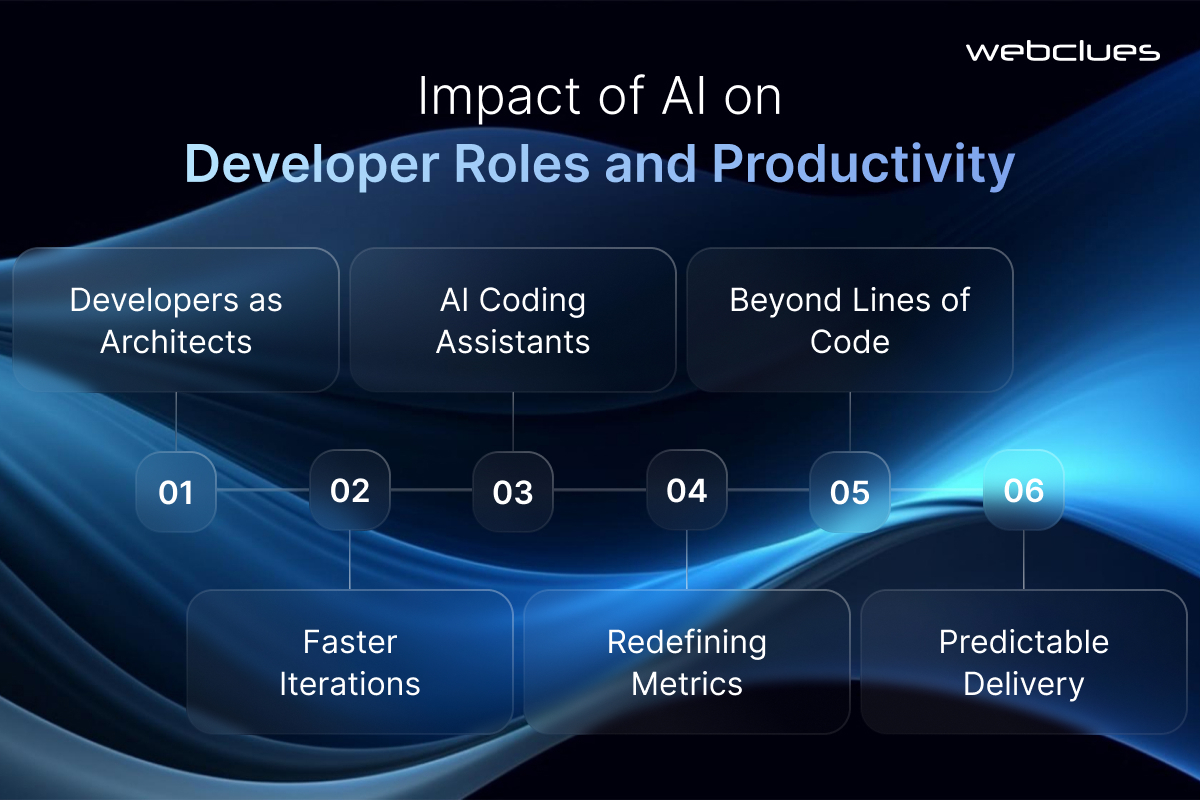
As AI takes up repetitive tasks and pattern-based tasks the role of the developer is transforming. Engineers are much more concerned with the architectural reasoning, or domain modeling, and system integration and not necessarily any code. Traditional measures of productivity such as lines of code or velocity become less relevant as teams begin to focus on outcome-based measures, such as quality, reliability and predictability of delivery.
AI coding assistants help democratise expertise by offering contextual advice and educational insights along with examples and patterns to reduce learning curves. This speeds up onboarding for junior developers and puts more development power into the hands of the team without having to scale up the number of people in the team. For the clients considering work related to MVP Development or strategic product development efforts, AI-augmented teams deliver faster iteration cycles with higher confidence and defect rates.
This shift also affects organizational productivity models by making leaders question success metrics and investment priorities. Developer productivity in 2026 is gauged in terms of results of how quickly teams deliver value, how resilient systems are in production, and how predictable release cycles become with the help of AI.
Challenges, Risks & Governance in Implementing AI‑Powered SDLC
Despite transformative benefits, AI integration presents challenges that organizations have to overcome to ensure quality, security, and compliance. One central concern is trust, validation. AI systems can make recommendations quickly, but leaving these results to engineers to check is essential to prevent defects, security vulnerabilities, or inconsistent logic from being introduced. Without strong validation checkpoints, teams may end up with "verification debt" liabilities from unvalidated AI outputs.
The complexity of security and compliance rises when AI is deeply integrated into workflows. Data governance, model explainability and traceability are essential for ensuring compliance with regulations and standards. Organizations that adopt AI must ensure that models are transparent, auditable, and consistent with ethical guidelines.
Skill adaptation is another issue. Engineers must have skills in interpreting insights from AI, how to define effective prompts, and how to integrate model results in larger system thinking. Teams must invest in training and ongoing learning to ensure that they are maximizing the capabilities of AI and not misusing it or becoming overly reliant on automated suggestions.
Despite these risks, organizations that deliberately consider how to design governance frameworks, validation processes, and oversight mechanisms are discovering that the benefits of AI in terms of faster delivery, improved quality, and predictive insights far outweigh the challenges.
Top Tools and Platforms for AI‑Enabled Software Development
The ecosystem of AI tools supporting the SDLC in 2026 is differentiated and quickly maturing. Intelligent coding assistants such as AI-augmented IDE plugins enable real-time code suggestion and contextual code generation.
Automated testing platforms create complete test-suites, prioritize test execution based on risk and allow tests to be maintained as systems develop. Observability platforms rely on machine learning development to correlate performance signals and identify anomalies. Deployment tools use historical data and environment telemetry to recommend safe rollout patterns.
These tools are most effective if integrated into a cohesive workflow that ensures effective connections between planning, development, testing, deploying and monitoring to ensure a continuous intelligence pipeline. Organizations adopting integrated AI toolchains experience a holistic view of the health of engineering organizations and achieve measurable improvements in velocity, quality, and reliability.
Future Outlook of AI‑Native SDLC and Enterprise Innovation
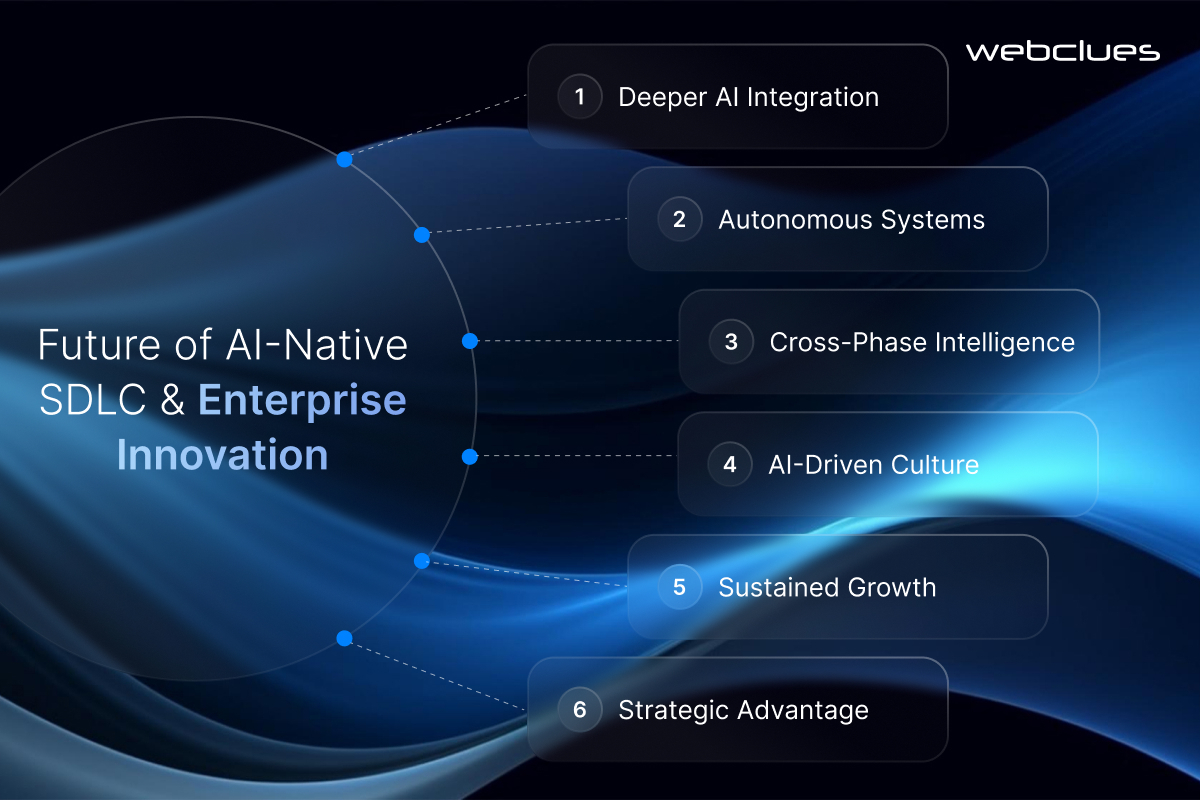
As we look further into the future past 2026, trends suggest even deeper integration of AI in all parts of software engineering. Systems that can diagnose and recover themselves autonomously, as well as optimize constantly, are always evolving. Cross-phase intelligence loops that link planning decisions to production outcomes will become the norm. Engineering cultures that embrace AI not as a tool but as an integral part of its practice will lead to innovation at scale.
Enterprises that develop such capabilities gain sustained growth and adaptability. They will deliver software faster and more reliably and provide strategic insight from engineering data that fuel innovation and differentiation, a powerful competitive advantage in a technology-driven economy.
Embedding AI Across Software Development Services with WebClues
AI is an integral part of a fundamental shift in how software is conceived, built, tested, delivered and improved. The SDLC evolved from discrete stages and instead of having discrete phases, we now have a continuous and intelligent pipeline where machine learning and judgment come together in order to generate better outcomes.
Organisations who embrace Software Development Services and Product Engineering Services that are enabled by AI benefit with competitive advantage in terms of faster delivery, quality, predictive insights and in their alignment with business goals.
For leaders looking to engineering partners in 2026, finding the best product engineering services means finding a team who knows how to integrate AI in a responsible way at every stage of SDLC - planning and development, QA, deployment, and monitoring.
WebClues is unique among Product Engineering Companies where we embed our AI into a disciplined Engineering approach and are enabling our clients to deliver faster products to market, scalable systems with confidence and continuous innovation.
Whether launching new digital platforms, scaling SaaS offerings or redefining how teams work with technology, integrating AI into SDLC is essential for success. Connect us if you're looking for AI enhanced engineering that will drive measurable results in line with business goals.
Post Author

Nikhil Patel
Nikhil Patel, a visionary Director at WebClues Infotech, specializes in leveraging emerging tech, particularly Generative AI, to improve corporate communications. Through his insightful blog posts, he empowers businesses to succeed digitally.


Build Your Agile Team
Hire Skilled Developer From Us
Accelerate Your AI-Enabled Software Development
Leverage AI to transform every stage of your software development lifecycle. WebClues helps you integrate intelligent automation, predictive insights, and AI-powered coding into your workflows. Reduce development cycles, enhance quality, and scale with confidence. Partner with our product engineering services provider to deliver software faster, smarter, and aligned with your business goals.
Get a Quote!Frequently Asked Questions
Our Recent Blogs
Sharing knowledge helps us grow, stay motivated and stay on-track with frontier technological and design concepts. Developers and business innovators, customers and employees - our events are all about you.