

Connect with us


Corporate Video


How ML Consulting Transforms Data into Smarter Business Decisions
.jpg)
Every enterprise today generates data at an unprecedented scale from customer transactions and behavioral signals to supply chain events and operational logs. Yet a striking majority of this data never drives a single business decision.
According to IDC, organizations analyze less than 10% of the data they collect, leaving enormous strategic value untapped. The gap between data collection and data-driven decision-making isn't a technology problem. It's an intelligence-gap problem and this is precisely where machine learning consulting services deliver transformative value.
An experienced ML consulting company doesn't simply build models. It bridges the distance between raw, fragmented data and the kind of confident, evidence-backed decisions that move revenue, reduce costs, and sharpen competitive positioning.
This blog breaks down how that transformation happens and what to look for when you're ready to hire ML consultants for your organization.
The Real Problem: Why Most Businesses Fail to Use Their Data Effectively?
Most organizations are not data-poor. They are insight-poor. Data sits siloed across CRMs, ERPs, marketing platforms, logistics systems, and customer support tools each producing records in different formats, at different frequencies, with different definitions of the same KPI.
A finance team's "revenue" may not match the sales team's "revenue," and neither may align with what the analytics dashboard is reporting.
The consequence is a decision-making culture built on intuition, delayed reports, and anecdotal evidence. Leaders call meetings to interpret dashboards that arrived too late to act on. Forecasts are built in spreadsheets that require four analysts and ten days to produce. Opportunities surface only in hindsight. Risks are recognized only after they materialize.
The underlying challenges are structural: inconsistent data architecture, lack of ML engineering expertise, undefined business use cases, and no clear path from raw data to operational intelligence.
Without a structured approach, even well-funded in-house ML initiatives stall at the proof-of-concept stage burning budget without delivering business impact. This is where partnering with the right machine learning consulting company changes the trajectory entirely.
What Machine Learning Consulting Services Actually Do (Beyond Models)
There's a common misconception that ML consulting is primarily a technical engagement: hire a team of data scientists, have them build a model, deploy it, and you're done. In practice, the most impactful machine learning consulting solutions go far beyond algorithm selection. The real work happens at the intersection of data engineering, domain expertise, and business strategy.
A qualified machine learning consultant starts by understanding the business problems you're trying to solve, not the technical features you want to build.
Are you trying to reduce customer churn?
Predict which leads will convert?
Optimize inventory replenishment cycles?
Each problem has a fundamentally different data profile, modeling approach, and success metric. Getting this alignment right from the beginning is what separates consulting engagements that deliver measurable ROI from those that produce impressive notebooks and nothing else.
Beyond model development, ML consulting services encompass data readiness assessment, infrastructure planning, model governance, bias evaluation, interpretability frameworks, and post-deployment monitoring. It is a full-lifecycle discipline, not a one-time delivery.
The most effective ML consulting company builds systems that continue to learn, adapt, and improve as your business data evolves, ensuring the intelligence compounds over time rather than degrading.
The ML Consulting Framework From Data to Decisions
The journey from raw enterprise data to a fully operational, decision-supporting ML system follows a structured framework. Each stage builds on the previous, and each has distinct technical and business requirements. Here is how a rigorous ML consulting engagement progresses.
Data Readiness: Turning Raw Data into Reliable Inputs
No ML model performs better than the data it is trained on. Before any modeling begins, a competent machine learning consultant conducts a thorough data readiness assessment auditing existing data sources for quality, completeness, consistency, and relevance to the target use case. This involves profiling datasets, identifying missing values, removing duplicate records, resolving schema conflicts across systems, and standardizing formats.
Data engineering work at this stage also includes building reliable data pipelines and automated workflows that ingest, transform, and deliver clean, structured data to the modeling environment on a consistent schedule. A well-designed data foundation is the difference between an ML system that performs reliably in production and one that breaks silently the moment upstream data changes.
Model Development: Building Accurate and Scalable ML Models
With clean, structured data in place, the model development phase begins and this is where the technical depth of your ML consulting company truly matters. Model development involves selecting the right algorithm family (classification, regression, clustering, time-series forecasting, deep learning, etc.) based on the problem structure, then training, validating, and iteratively improving models against defined performance benchmarks.
A critical discipline here is preventing common failure modes: overfitting models that perform well in testing but fail in production, underfitting models that miss important patterns, and biased models that encode historical inequities into forward-looking decisions.
Rigorous cross-validation, feature engineering, hyperparameter tuning, and bias testing are standard practice in high-quality ML consulting engagements. The output is not just a model it is a model with documented accuracy, known limitations, and clear performance thresholds.
Decision Intelligence Layer: Converting Predictions into Actions
A model that generates predictions in isolation has limited value. The decision intelligence layer is what connects model outputs to the operational systems and human workflows where decisions actually get made.
This might mean integrating a churn prediction model with your CRM so that at-risk accounts are automatically flagged for account managers. Or it might mean routing ML-scored loan applications to underwriters in priority order. Or adjusting dynamic pricing in an e-commerce platform based on real-time demand forecasts.
This layer often underestimated in early ML planning is where machine learning consulting solutions create direct business impact. The goal is not to replace human judgment but to augment it: presenting the right prediction, with the right confidence level, to the right person, at the right moment in their workflow.
Deployment and Continuous Learning: Ensuring Long-Term Performance
Deploying a machine learning model into production is not the end of an engagement, it is the beginning of a new phase. Production environments introduce conditions that never appear in development: data distribution shifts, seasonal variation, schema changes from upstream systems, and evolving user behavior. A model that achieves 92% accuracy at launch may degrade to 74% six months later if it is not actively maintained.
MLOps the operational discipline of managing ML models in production covers automated retraining pipelines, performance drift detection, model versioning, A/B testing frameworks, and rollback procedures.
Experienced ML development companies build these capabilities into every deployment, ensuring that the intelligence delivered on day one continues to compound rather than erode over time.
How ML Consulting Transforms Operational, Tactical, and Strategic Decisions
The impact of machine learning consulting services is not confined to a single layer of the organization. When implemented with the right architecture and governance, ML intelligence flows through all three tiers of business decision-making.
At the operational level, ML accelerates and automates high-volume, repetitive decisions that previously required manual intervention. Fraud scoring on payment transactions, ticket routing in customer support, real-time inventory replenishment triggers, and credit application decisioning all benefit from ML-powered automation that operates with greater consistency and speed than any human team could sustain.
At the tactical level, ML improves mid-horizon planning decisions the kind made weekly or monthly by functional leaders. Demand forecasting models help operations teams plan procurement 8 to 12 weeks out with greater accuracy.
Propensity-to-buy models help marketing teams allocate campaign budgets toward segments most likely to convert. Workforce scheduling models help HR optimize staffing levels against predicted service demand.
At the strategic level, custom ML solutions surface macro-level patterns that inform long-term competitive positioning.
Which customer segments are growing in lifetime value?
Which product lines are facing demand erosion?
Where in the supply chain are structural cost inefficiencies hiding?
These are questions that enterprise machine learning systems can answer from within the data organizations are already collecting but that no conventional analytics tool can surface reliably at scale.
Key Machine Learning Consulting Solutions That Drive Measurable Business Impact
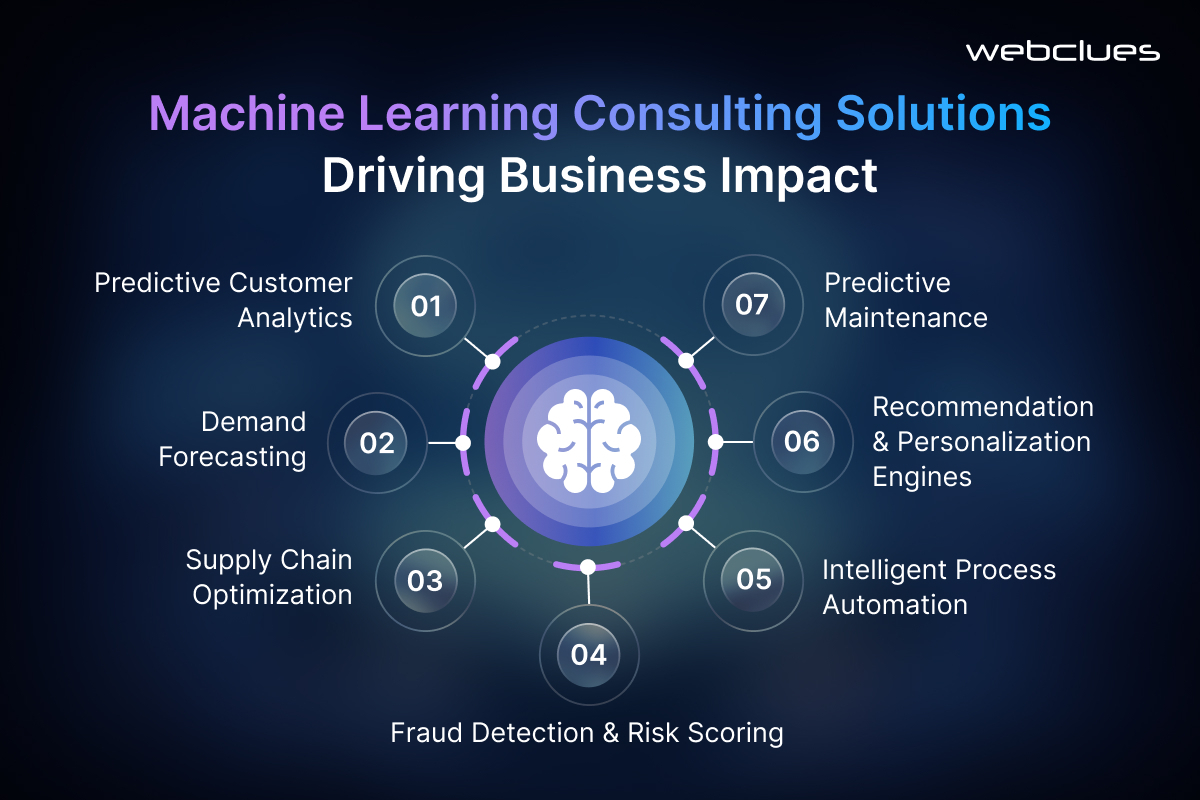
Not all ML use cases deliver equal returns. The following are the highest-impact machine learning consulting solutions that consistently produce measurable results across industries.
- Predictive Customer Analytics: Churn prediction, customer lifetime value modeling, and propensity scoring help retention, upsell, and acquisition teams prioritize effort on the accounts and prospects most likely to respond.
- Demand Forecasting and Supply Chain Optimization: Time-series ML models applied to historical sales, seasonal patterns, and external signals (weather, promotions, macro indicators) improve forecast accuracy by 20-40% over traditional statistical methods directly reducing both stockouts and overstock costs.
- Fraud Detection and Risk Scoring: Anomaly detection and behavioral pattern models identify fraudulent transactions and high-risk accounts in real time, reducing financial exposure and false-positive rates simultaneously.
- Intelligent Process Automation: ML-powered document classification, data extraction, and workflow routing automate high-volume back-office processes reducing processing times and error rates in functions like finance and compliance.
- Recommendation and Personalization Engines: Collaborative filtering and deep learning-based recommendation systems drive measurable increases in average order value, session duration, and content engagement across e-commerce, media, and financial services.
- Predictive Maintenance: Sensor data analysis and time-series anomaly detection enable manufacturing and infrastructure businesses to predict equipment failure before it occurs reducing unplanned downtime and maintenance cost.
Full-Stack Machine Learning Consulting Services
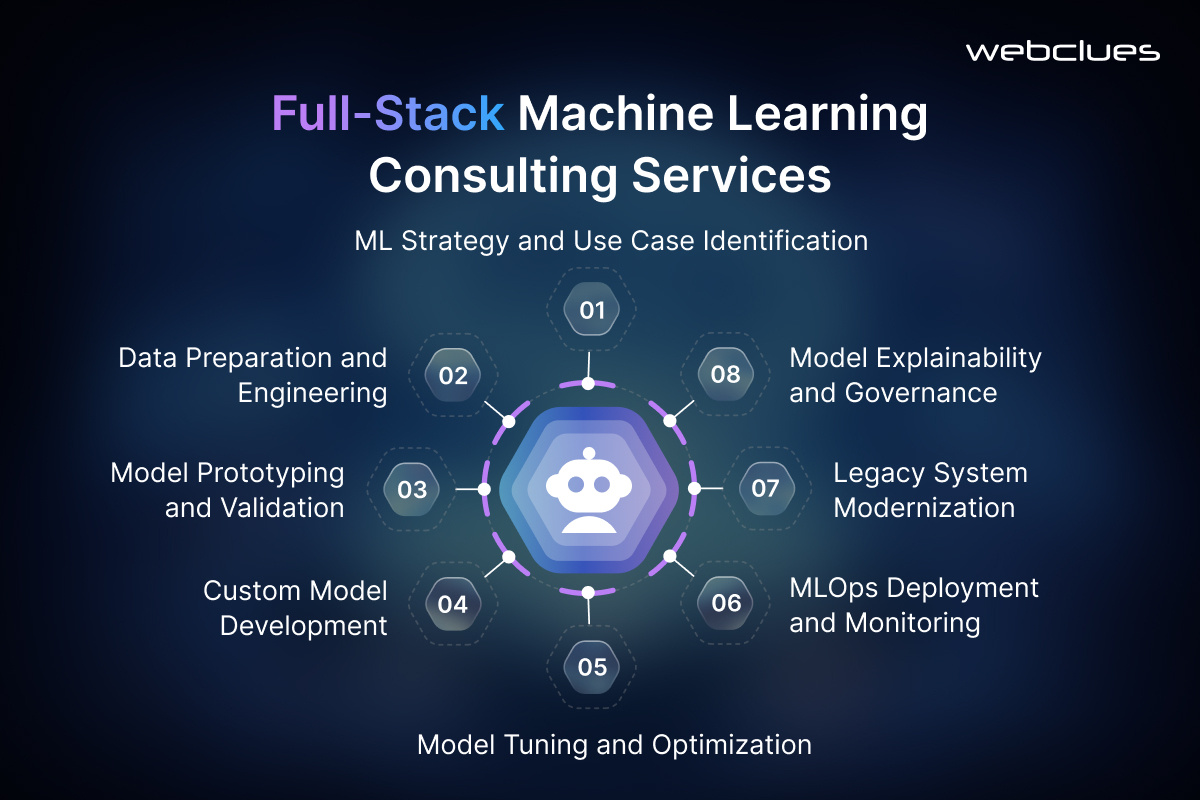
WebClues delivers ML consulting services across the full lifecycle from early-stage strategy through production deployment and ongoing optimization. Here is what our engagement model covers.
ML Strategy and Use Case Identification
Every successful ML engagement begins with a structured discovery process. We work with business and technical stakeholders to map your data landscape, define target business outcomes, and prioritize use cases by feasibility and expected return. This ensures resources are allocated to problems where ML will deliver meaningful, measurable value not where it simply sounds compelling.
Data Preparation and Engineering
We design and build the data infrastructure that ML models depend on: ingestion pipelines, data cleaning workflows, feature engineering logic, and centralized feature stores. This work transforms fragmented, inconsistent enterprise data into the reliable, structured inputs that power accurate models.
Model Prototyping and Validation
Before committing to full-scale development, we build lightweight prototypes to validate core assumptions, test data signal strength, and establish baseline performance benchmarks. This rapid validation phase de-risks investment decisions and accelerates the path from idea to production-grade deployment.
Custom Model Development
Our ML engineers develop custom ML solutions tailored to your specific data profile, business constraints, and performance requirements. We do not apply off-the-shelf templates. Each model is purpose-built with documented architecture, training methodology, and validation results to address the specific decision problem at hand.
Model Tuning and Optimization
Post-development, our team conducts systematic hyperparameter optimization, feature selection refinement, and ensemble strategy evaluation to squeeze maximum predictive performance from each model. We benchmark against multiple algorithm families and select the configuration that balances accuracy, interpretability, and inference speed for your production environment.
MLOps Deployment and Monitoring
We design and implement the production infrastructure required to deploy models reliably at scale, containerized model serving, CI/CD pipelines for model updates, performance monitoring dashboards, and automated alerting for drift detection. Our MLOps practice ensures that models deployed today continue performing at standard six, twelve, and twenty-four months from launch.
Legacy System Modernization
Many enterprises sit on years of valuable operational data locked within legacy systems that cannot connect to modern ML infrastructure. We specialize in extracting, transforming, and migrating this data building the integration bridges that allow historical intelligence to power modern machine learning models without requiring a full ERP or CRM replacement.
Model Explainability and Governance
In regulated industries and high-stakes decision contexts, black-box models are not acceptable. We implement explainability frameworks SHAP, LIME, and counterfactual explanations that give decision-makers visibility into why a model produced a specific output. We also design model governance processes covering audit trails, bias reporting, version control, and compliance documentation.
Real-World Use Cases: Applying Machine Learning for Smarter Business Outcomes
The value of ML consulting is most evident in the concrete problems it solves across industries:
Financial Services: A regional bank replaced a rules-based fraud system with a behavioral anomaly model trained on 36 months of transaction data. Fraud losses dropped 31% in the first year, while false positives and the customer disruptions they caused were significantly reduced.
Retail & E-Commerce: A mid-market retailer implemented a demand forecasting model using POS data, web traffic, promotions, and regional weather. Stockouts fell by 28%, and overstock write-offs dropped 19% within two quarters, directly improving inventory efficiency.
Healthcare: A hospital network applied ML to predict high-risk patient readmissions. With 78% precision, care coordinators intervened proactively, reducing 30-day readmissions by 22% and lowering costs while improving outcomes.
Manufacturing: A tier-one automotive supplier used predictive maintenance with sensor data and time-series anomaly detection. Equipment degradation was flagged 72 hours before failure, cutting unplanned downtime by 41% and shifting labor from emergency repairs to planned maintenance.
Why Businesses Choose an ML Consulting Company Over Building In-House
Choosing between hiring ML consultants or building an internal team is one of the most consequential decisions in an AI journey. Internal teams are ideal when ML is a core product or requires continuous real-time adaptation, as seen with companies like Netflix, Spotify, and Uber.
For most enterprises, ML enhances decisions in sales, operations, finance, and customer experience. Building in-house is often slow and expensive: recruiting senior engineers takes 6–9 months, ramping them to production readiness 12–18 months, and total costs including salaries, infrastructure, and tooling can exceed $1.5M before the first model delivers results.
In contrast, experienced ML consulting companies bring cross-industry knowledge, established frameworks, and production-ready infrastructure. Engagements can move from kickoff to first deployed model in 8–16 weeks, reducing risk and accelerating ROI. Many organizations adopt a hybrid approach: consultants for complex builds, and small internal teams for maintenance, governance, and ongoing optimization.
Common Machine Learning Adoption Challenges (And How Consultants Solve Them)
Understanding the failure modes of ML adoption is as important as understanding the value it can create. Here are the four most common challenges organizations face and how experienced ML consulting services address them.
Data Quality and Integration Issues
Poor data quality is the leading cause of ML project failure. Duplicate records, inconsistent field definitions, missing values, and siloed data systems all degrade model performance and produce unreliable predictions. ML consultants address this through structured data audits, automated data quality pipelines, schema standardization, and master data management strategies. They also build the integration architecture required to unify data from disparate systems into a single, reliable modeling environment.
Model Accuracy, Bias, and Performance Risks
A model that is technically accurate but systematically biased against certain customer segments, geographies, or product categories creates legal, reputational, and financial risk. Experienced ML consultants embed bias testing throughout the development process not as an afterthought and implement fairness-aware modeling techniques where applicable. They also establish clear accuracy benchmarks and model performance thresholds that must be met before any system is approved for production use.
Scaling ML Across Systems and Teams
Many organizations successfully deploy a first ML model and then struggle to replicate that success across other use cases, departments, or geographies. The bottleneck is typically infrastructure: the absence of a shared feature store, inconsistent model serving environments, no standardized evaluation framework, and no governance process for managing a growing portfolio of models. ML consulting companies help organizations build the platform-level infrastructure that makes scaling systematic rather than heroic.
Talent Gaps and Execution Delays
The global shortage of ML engineering talent means that even well-funded organizations struggle to hire the expertise they need at the pace their roadmaps require. Consultants fill this gap immediately bringing teams who have already solved the specific class of problem you are trying to solve. Beyond execution, experienced consultants also transfer knowledge to internal teams, building the institutional capability needed to eventually own and extend the systems delivered.
How to Measure ROI from ML Consulting Services
Measuring ROI from ML means linking model performance directly to business outcomes. Follow this framework:
1. Establish baselines: Document current process metrics like churn rate, fraud losses, forecast errors, or manual workflow times before deploying any ML system. These set the reference for improvement.
2. Define a primary business metric: Identify the key number that represents the model’s value. For churn, it could be retained revenue; for demand forecasting, reduced stockouts and overstock costs; for fraud, net reduction in losses.
3. Track adoption: Accuracy alone doesn’t guarantee ROI. Monitor how many decisions actually use the model’s predictions. Low adoption indicates workflow or trust gaps.
4. Review performance regularly: Conduct reviews at 30, 90, and 180 days post-deployment. Compare results against baselines, and trigger retraining or updates before model performance degrades.
How to Choose the Right Machine Learning Consulting Company
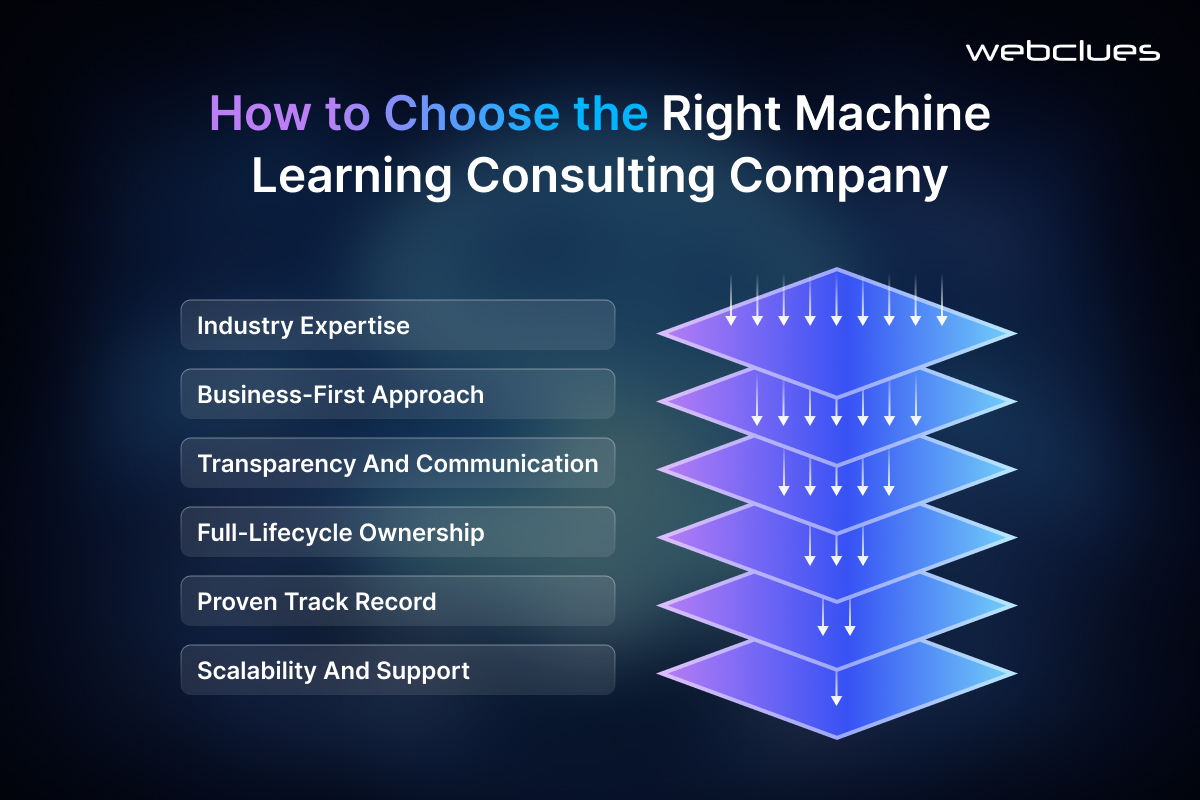
Choosing the right ML consulting firm who delivers real business impact is necessary. Focus on these criteria:
Industry expertise: Look for consultants with experience in your vertical—finance, healthcare, retail, manufacturing, or logistics. Domain knowledge accelerates use case definition, data interpretation, and business validation.
Business-first approach: The right partner prioritizes outcomes over technical features. They define and measure success based on business impact, not just model architectures or algorithms.
Transparency and communication: ML projects are unpredictable. Choose a firm that communicates challenges early, adjusts plans realistically, and provides references on their client collaboration.
Full-lifecycle ownership: Avoid firms that deliver models only. Your partner should handle strategy, development, deployment, and ongoing monitoring, including post-deployment support and SLAs.
The Future of Decision-Making: AI-Driven and Real-Time Intelligent Businesses
Over the next five years, enterprises that lead will treat machine learning not as a project, but as an operating layer embedded in systems, workflows, and daily decisions.
Real-time intelligence like personalized experiences, dynamic pricing, and supply chain adjustments will become table stakes. These capabilities are now accessible to any organization investing in the right ML consulting solutions.
At the same time, governance requirements are rising. Regulatory frameworks in financial services, healthcare, and data privacy demand model explainability, audit trails, and bias documentation. Organizations that embed governance from the start gain both competitive advantage and regulatory resilience.
Investing in ML consulting today builds an intelligence infrastructure that compounds in value, enhancing understanding of customers, operations, and markets. The gap between intelligent and non-intelligent enterprises widens each quarter. The question is not whether to invest in ML, it's whether your organization will lead or follow.
Hire ML Consultants to Turn Your Data Into a Competitive Advantage with Webclues
Machine learning only creates value when it directly improves how your business makes decisions. Without the right expertise, most initiatives remain stuck in experimentation, never translating into measurable outcomes. To move faster and reduce risk, businesses need a structured approach that connects data, models, and real-world execution.
At WebClues, we help you go beyond pilots and build scalable ML systems that drive results. If you’re ready to unlock real impact, it’s time to hire ML consultants who understand both technology and business. Connect now with ML experts and turn your data into smarter, revenue-driving decisions.
Post Author

Ayush Kanodia
As one of the esteemed Directors of WebClues Infotech. Ayush Kanodia is passionate about delivering innovative IT services & solutions and has spearheaded numerous successful projects, cementing the company's position as a leader in the field.


Build Your Agile Team
Hire Skilled Developer From Us
Unlock Real Business Value with Expert ML Consulting
Stop letting your data sit idle. With WebClues’ ML consulting services, turn raw data into actionable insights, smarter decisions, and measurable revenue growth. Connect with our ML experts today and start transforming your business intelligence into competitive advantage.
Connect Now!Frequently Asked Questions
Our Recent Blogs
Sharing knowledge helps us grow, stay motivated and stay on-track with frontier technological and design concepts. Developers and business innovators, customers and employees - our events are all about you.