

Connect with us


Corporate Video


10 Modern .NET Development Practices Every Developer Should Follow
.jpg)
The role of a .NET developer has shifted. Writing functional code is the baseline. What separates strong engineering teams now is how they handle scalability, cloud architecture, security, and long-term maintainability.
For businesses evaluating .NET Development Services, this matters directly to the bottom line. Applications built on solid practices ship faster, cost less to maintain, and handle growth without breaking. Those built on shortcuts accumulate technical debt that slows every future release.
The numbers back this up. EF Core 6 delivered a 70% improvement on the TechEmpower Fortunes benchmark over EF Core 5, narrowing the gap with hand-tuned micro-ORMs to under 5%. Meanwhile, .NET now treats observability as a first-class concern, with native APIs for logging, metrics, and tracing wired into OpenTelemetry.
The ASP.NET Core 10 release notes confirm support for OpenAPI 3.1, built-in Minimal API validation, Server-Sent Events, and passkey authentication via WebAuthn and FIDO2. The .NET Aspire documentation further shows how cloud-native orchestration, health checks, and telemetry are now available out of the box for every new service.
And the C# Sharp Corner analysis of ASP.NET Core in 2026 highlights cross-platform performance, cloud-native architecture, and security as the defining reasons enterprises continue to choose the platform.
The ASP.NET
Below are the practices that define modern, enterprise-grade .NET development.
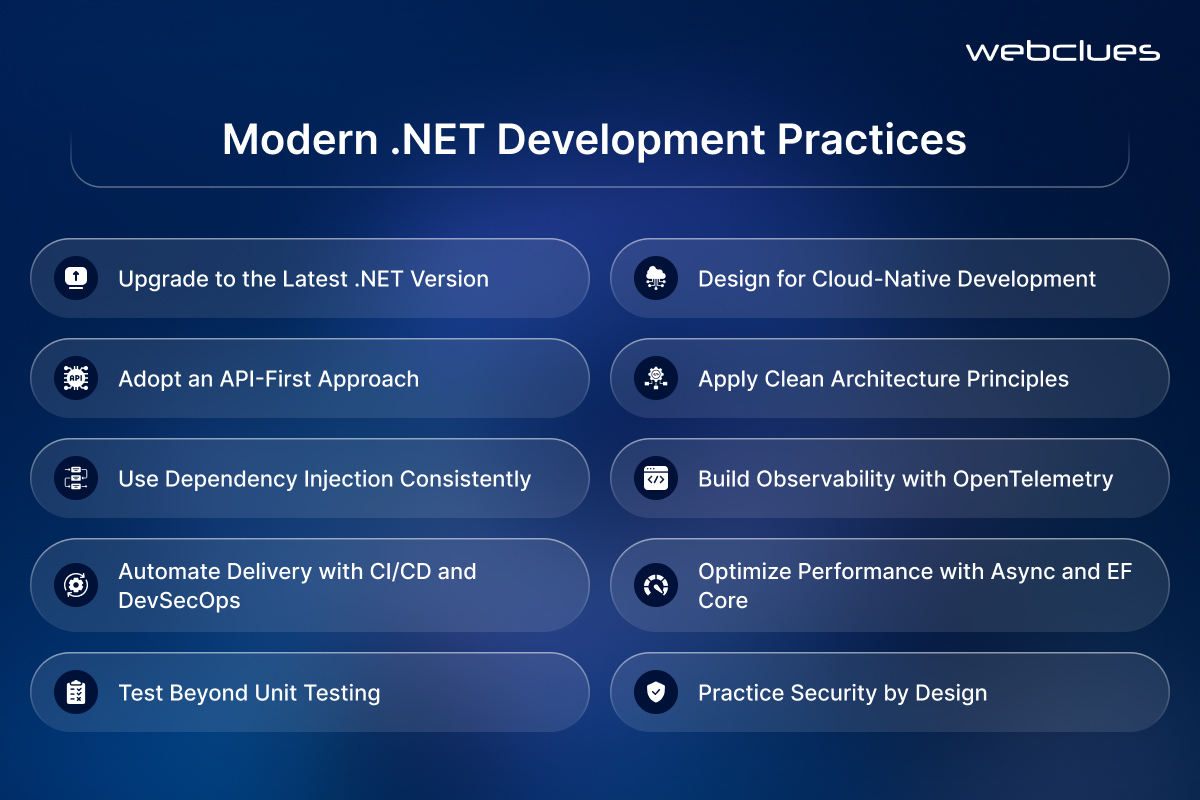
1. Upgrade to the Latest .NET Version
Running on the newest supported .NET release is one of the most underrated wins available to any team. .NET 10, released in November 2025, is a Long-Term Support version with three years of support, making it a safe choice for production systems.
Newer versions bring real, measurable gains. ASP.NET Core 10 added validation support in Minimal APIs, OpenAPI 3.1 generation by default, Server-Sent Events for streaming scenarios, and passkey authentication based on WebAuthn and FIDO2 standards. Each of these reduces the custom code your team would otherwise write and maintain.
For organizations sitting on older codebases, .NET Modernization Services and Legacy Application Modernization with .NET turn aging systems into supportable, secure platforms. Tools like the .NET Upgrade Assistant make the migration path practical rather than risky.
Action step: Plan a migration to .NET 10 this year. Review the official breaking-changes guidance before you start, and upgrade incrementally where possible.
2. Design for Cloud-Native from the Start
Cloud-native is now the default expectation for Scalable .NET Application Development. Applications need to handle variable traffic, deploy across regions, and recover gracefully from failure.
.NET Aspire (now simply Aspire) gives teams a consistent way to build observable, production-ready, cloud-native applications. It handles service discovery, configuration, health checks, and telemetry out of the box, so new engineers can get an entire application stack running in minutes.
Cloud-Native .NET Development pays off through elastic scaling, managed databases and message queues, and deployment to Azure or AWS with minimal setup. For a .NET Software Development Company building for enterprise clients, this translates into faster delivery and lower infrastructure cost.
Action step: Use Aspire's AppHost and ServiceDefaults projects to standardize orchestration and observability across services.
3. Adopt an API-First Approach
Modern enterprise software is built around well-defined contracts. An API-first approach means designing your API surface before implementation, so frontends, mobile clients, and partner integrations all work against a stable agreement.
ASP.NET Core 10 strengthens this with OpenAPI 3.1 support generated directly from your code, including XML doc comments and accurate schemas for nullable types. Minimal APIs now support built-in validation through the AddValidation extension, returning clean 400 responses when input fails rules. Server-Sent Events support also makes real-time streaming straightforward.
Strong API design improves .NET Web Application Development by making services predictable, documented, and easy to consume. It also reduces friction when an Offshore .NET Development Team collaborates across time zones.
Action step: Generate OpenAPI documents at build time and treat your API contract as a versioned, reviewed artifact.
4. Apply Clean Architecture and Clear Boundaries
As projects grow, architecture tends to drift. Controllers start calling repositories directly. Domain logic leaks into infrastructure. Over months, refactoring becomes risky and slow.
Clean Architecture prevents this by enforcing dependency direction: the domain layer depends on nothing, while outer layers depend inward. This keeps business logic isolated, testable, and durable as technology choices change around it.
Clear boundaries make Custom .NET Development Services more maintainable and help Full-Stack .NET Developers reason about large systems. They also turn your architecture into enforceable documentation when paired with architecture tests (covered in practice 9).
Action step: Define your layers explicitly and document the allowed dependencies. Revisit them in code review.
5. Use Dependency Injection Everywhere
Dependency injection is built into .NET, and using it consistently produces loosely coupled, testable code. Components declare what they need rather than constructing it, which makes swapping implementations and isolating units for testing simple.
This is foundational for Enterprise .NET Development. Services registered through the DI container can be mocked in tests, replaced in different environments, and scoped correctly for web requests. ASP.NET Core's improvements, including OwningComponentBase now supporting asynchronous disposal, make resource management cleaner.
Action step: Register dependencies through interfaces, avoid the service-locator anti-pattern, and use the correct lifetimes (singleton, scoped, transient).
6. Build in Observability with OpenTelemetry
You cannot fix what you cannot see. Microsoft documents that .NET provides built-in observability through three pillars: logs that record what happened, traces that reveal where time was spent, and metrics that show how often events occur, all collected and exported via OpenTelemetry.
This matters for both monoliths and microservices. In a monolith, OpenTelemetry surfaces slow components and database bottlenecks. In distributed systems, it traces requests end-to-end across services. ASP.NET Core 10 even added built-in metrics for authentication, authorization, and Identity events.
For any .NET Application Development Services provider, observability is what turns a production incident from a guessing game into a quick diagnosis.
Action step: Add OpenTelemetry to every project. The Aspire ServiceDefaults template configures it for you, and the Aspire Dashboard brings telemetry into local debugging.
7. Automate Delivery with CI/CD and DevSecOps
Manual deployments are a liability. A reliable CI/CD pipeline builds, tests, and ships every change consistently, catching defects before they reach users.
DevSecOps takes this further by embedding security checks into the pipeline itself: dependency scanning, static analysis, and secret management run automatically on every commit. This shifts security left, so vulnerabilities surface early rather than in production.
Both GitHub Actions and Azure DevOps serve .NET teams well. A solid pipeline keeps CI under ten minutes, runs tests on every pull request, deploys automatically to staging, and requires approval for production. Secrets belong in a vault, never in code.
Action step: Treat your pipeline as code, store it in version control, and add a security scanning stage to your existing build.
8. Optimize Performance with Async and Modern Data Access
Performance is a feature. Asynchronous methods let your application handle many concurrent requests without blocking threads, improving throughput under load. Used correctly, async code processes multiple users in parallel and manages errors without degrading the user experience.
Data access is often the real bottleneck. EF Core's gains here are significant: version 6 cut heap allocations by 43% and executed untracked queries 31% faster, contributing to that 70% full-stack TechEmpower improvement. Later versions added compiled models, JSON column support, and smarter LINQ translation.
For .NET Software Development Services, combining async patterns, efficient queries, caching, and compression delivers responsive applications that scale.
Action step: Profile before optimizing. Use compiled models for large schemas, apply async consistently, and filter data at the database, not in memory.
9. Test Beyond Unit Tests
Unit tests verify components in isolation, but they miss how a system behaves as a whole. Comprehensive coverage needs more layers.
- Integration tests run your application with real dependencies using tools like Testcontainers and WebApplicationFactory. They catch the issues unit tests cannot.
- Load tests reveal how much traffic your system handles before degrading. Skipping them means discovering limits in production.
- Architecture tests enforce your design rules automatically. With a library like NetArchTest, a build fails the moment someone adds a forbidden dependency between layers, turning architecture into something the compiler protects.
This breadth is how a serious .NET Development Company ensures software quality rather than hoping for it.
Action step: Prioritize integration tests for the most value, add architecture tests to your CI pipeline, and load-test critical paths before release.
10. Practice Security by Design
Security cannot be bolted on at the end. It has to be a priority from day one, woven through architecture, code, and deployment.
Concrete measures matter: enforce HTTPS and HSTS, use strong encryption such as AES-256 for data at rest and in transit, store keys in a hardware security module or key vault, and validate every input. ASP.NET Core 10's passkey support, built on WebAuthn and FIDO2, offers phishing-resistant, passwordless authentication out of the box.
Custom error pages prevent leaking stack traces. Authentication, authorization, and auditing form the access-control backbone. For any Microsoft .NET Development Company, security by design is what protects client data and reputation.
Action step: Threat-model your application, adopt passkeys where appropriate, and review your encryption and key-management practices regularly.
Modular Monolith vs Microservices: A Practical Comparison for .NET projects
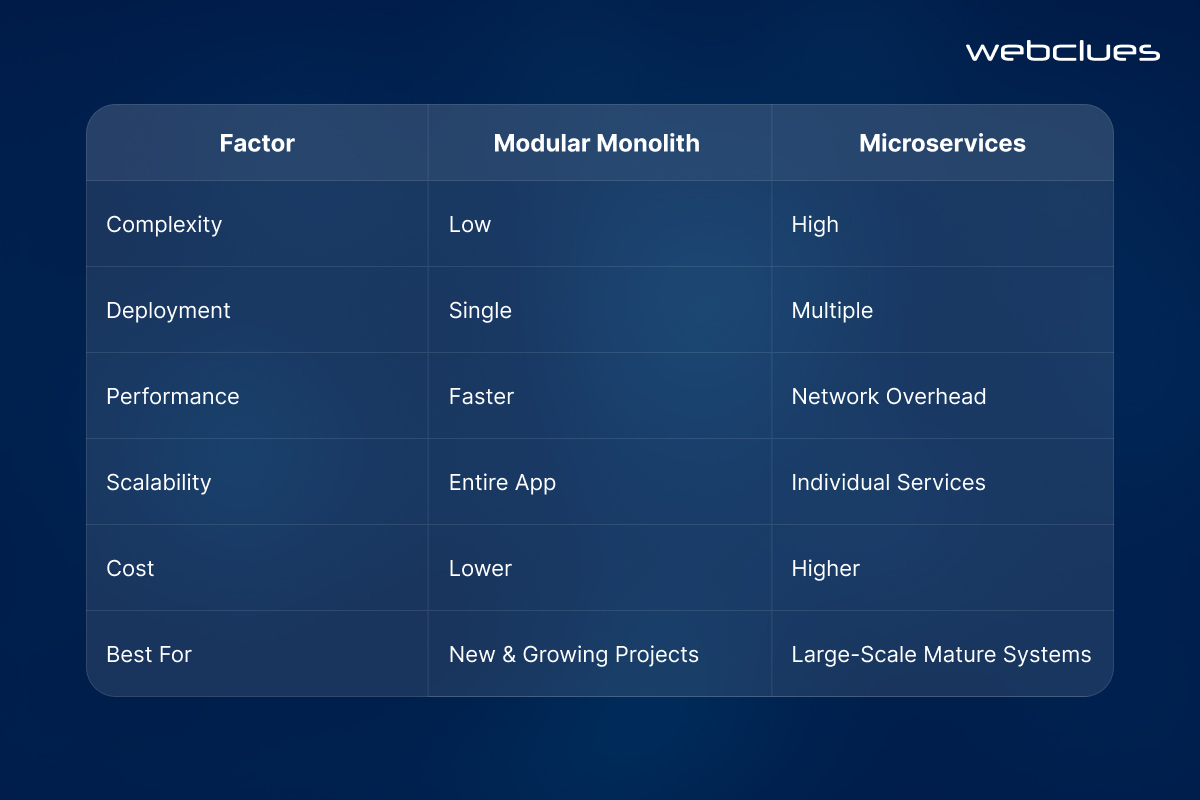
Here is a stance that runs against the hype: most new enterprise .NET projects should start as a modular monolith, not microservices.
Martin Fowler's well-known advice applies: you should not begin a new project with microservices even if you expect it to grow large. Microservices add real costs upfront, including distributed transactions, network latency, complex deployment, and harder debugging, before you even know whether your product will succeed.
A modular monolith gives you the discipline of microservices without the operational tax. It lives in a single codebase and deploys as one unit, yet enforces strict module boundaries. Each module owns its own data and communicates through well-defined interfaces, just as services would, but with simple in-process method calls instead of network hops.
The payoff comes later. When a specific module genuinely needs independent scaling, a dedicated team, or a different technology stack, you extract it into a microservice. You might find you never need to. This evolutionary approach is exactly what a thoughtful provider of .NET Development Solutions recommends: start simple, deliver value quickly, and let real requirements drive architecture.
Conclusion
Modern .NET development rewards teams that treat performance, observability, security, and architecture as ongoing commitments rather than afterthoughts. Upgrading to current .NET, designing cloud-native, building API-first, and testing beyond unit tests are the practices that separate resilient enterprise systems from fragile ones.
Applying all of this well takes experience. If your organization is planning a new build, modernizing a legacy system, or looking to hire professional .NET developers who already work this way, WebClues Infotech can help you put these practices into production. Our team delivers enterprise-grade .NET solutions that are scalable, secure, and built to support long-term business growth.
Whether you need a custom web application, cloud-native platform, legacy .NET modernization, API development, or a dedicated development team, our experts can help you accelerate delivery while maintaining the highest standards of performance and security.
Ready to build a future-ready .NET application? Contact us for a free consultation and discover how our .NET development services can help you launch faster, scale confidently, and achieve your business goals.
Post Author

Nikhil Patel
Nikhil Patel, a visionary Director at WebClues Infotech, specializes in leveraging emerging tech, particularly Generative AI, to improve corporate communications. Through his insightful blog posts, he empowers businesses to succeed digitally.


Build Your Agile Team
Hire Skilled Developer From Us
Build Scalable, Future-Ready .NET Applications with Expert Developers
Whether you're modernizing a legacy application, building a cloud-native platform, or launching a new enterprise solution, WebClues Infotech helps you accelerate development without compromising performance, security, or scalability. Our experienced .NET developers deliver custom, high-performing applications tailored to your business goals. Connect with our team today to discuss your project and get a free consultation.
Connect Now!Frequently Asked Questions
Our Recent Blogs
Sharing knowledge helps us grow, stay motivated and stay on-track with frontier technological and design concepts. Developers and business innovators, customers and employees - our events are all about you.