

Connect with us


Corporate Video


Node.js vs Python for AI-Powered Applications: Which Stack Performs Better?
.jpg)
Most teams pick their AI backend stack based on what they already know, then discover the friction six months later. The wrong choice does not break your demo. It breaks your production roadmap once you add an LLM, a vector store, or 10,000 concurrent WebSocket connections.
This guide settles the Node.js vs Python question for AI-powered applications in 2026. You will get real benchmark numbers, a clear breakdown of the AI/LLM ecosystem gap, the async model differences that actually matter, hiring costs, and a decision framework you can apply today. We also cover the architecture most AI-first teams converge on once they scale.
Python owns the AI and ML layer. Node.js owns real-time and high-concurrency I/O. Most serious AI products run both. The rest of this article tells you exactly when each one wins.
What Node.js and Python Actually Are in 2026
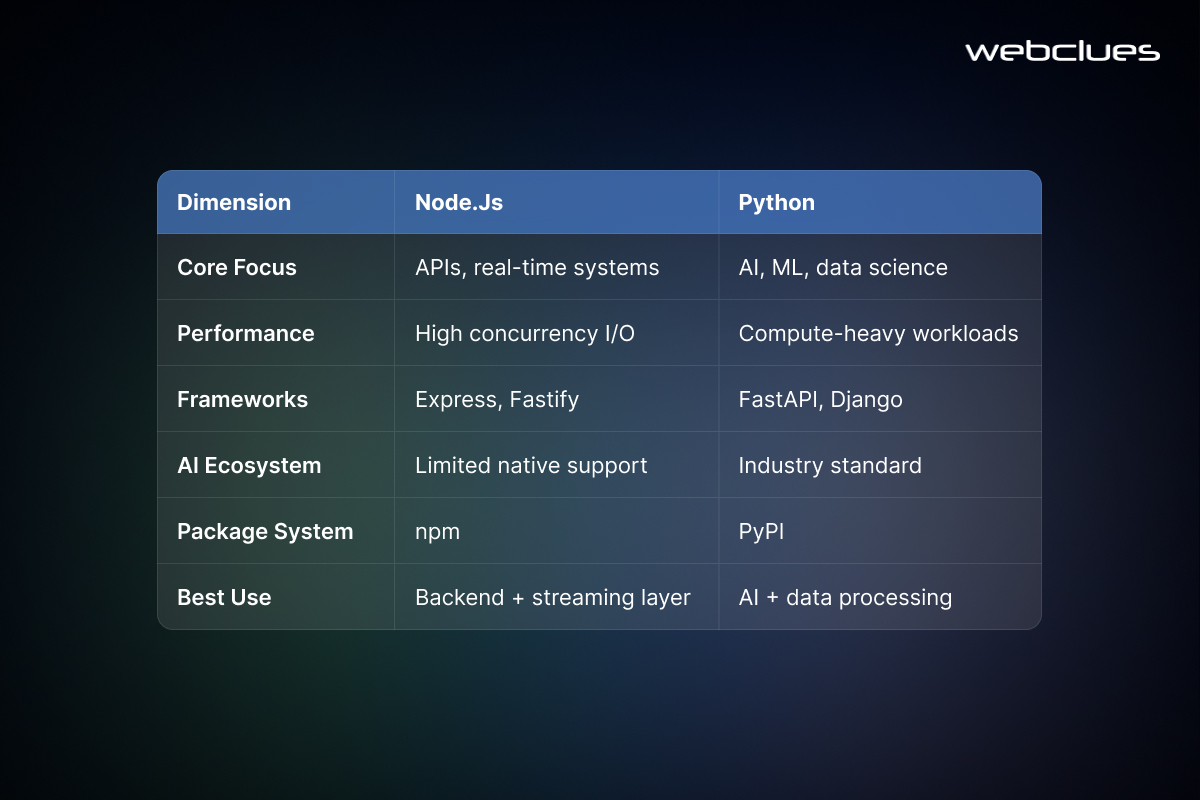
Both ecosystems are mature. Both have first-class async support. Neither is going anywhere. That is why the comparison comes down to fit, not survival.
Node.js is a JavaScript runtime built on Chrome's V8 engine. It runs a single-threaded event loop with non-blocking I/O, so it handles thousands of concurrent connections without spawning a thread per request. Frameworks like Express, Fastify, and Hono cover everything from a small microservice to an API gateway. The npm registry holds over 2 million packages, and the breadth of frontend-adjacent tooling has no equal.
Python is a general-purpose language with syntax that reads like plain English. It dominates data science, machine learning, and AI research. For backend APIs, FastAPI is the modern standard: async by default, automatic OpenAPI docs from type hints, and Pydantic v2 validation built in. Django remains the batteries-included option for teams that want an ORM, auth, and admin in one place.
Here is the part that decides most AI projects. Python is the reference language for nearly every AI SDK and ML framework shipping today. Node.js leads everywhere JavaScript already runs.
If you are scoping an AI build right now, that single fact reshapes your stack decision more than any benchmark. WebClues teams ship in both, which is why we start every engagement by asking what the product will touch first.
Performance Benchmarks: Node.js vs Python for AI Backend
Raw speed is one of the first comparisons teams make, but in AI systems it is rarely the deciding factor. Most production APIs spend more time waiting on databases, vector stores, external services, or model inference than executing application code.
| Test Area | Node.js | Python (FastAPI) | Practical Take |
| API throughput | Often strong for JSON-heavy APIs | Competitive for most backend workloads | Rarely decisive in production |
| Concurrent I/O | Excellent | Strong with ASGI + asyncio | Node.js often favors extreme concurrency |
| LLM-backed endpoints | Comparable | Comparable | Model latency dominates |
| Cold starts | Often favorable | Improving steadily | Depends heavily on packaging and infrastructure |
| Memory efficiency | Generally efficient | Framework dependent | Profile your actual workload |
| CPU-heavy AI tasks | Limited native advantage | Strong via optimized libraries | Python leads |
In synthetic benchmarks, frameworks like Fastify often demonstrate excellent throughput for lightweight API workloads. FastAPI also performs well and remains more than sufficient for most production services.
For AI applications, CPU-heavy work is rarely executed in pure Python. Libraries such as NumPy and PyTorch move intensive computation into optimized native code, which changes the performance profile significantly.
For LLM-driven endpoints, differences between Node.js and Python are often negligible because network and inference latency dominate request time.
The practical conclusion is straightforward: if your application spends most of its time waiting on models, databases, or external APIs, optimize architecture before optimizing runtime.
AI and LLM Ecosystem: Where Python Wins Clearly
This is the most important differentiator in 2026. It is not close.
Every major AI development services provider ships Python as the primary SDK. OpenAI, Anthropic, Google, Cohere, Hugging Face. The Python client is the reference implementation, written by the provider's own engineers. Node.js SDKs exist, but they lag on feature parity and documentation depth.
The gap widens once you move past raw API calls.
Two practical takeaways:
- For the AI brain of your product, Python is the right place to start. Agents, RAG, fine-tuning, evals, model serving. Retrofitting these onto a Node.js backend later is significantly more work than starting correctly.
- For the streaming chat UI, Node.js is genuinely better. The Vercel AI SDK plus Next.js delivers the cleanest token-streaming experience to the browser.
That split is not a compromise. It is the architecture most AI-first teams land on. Python development services for machine learning projects and Node.js development services for AI applications are not competing line items. They are two halves of the same system.
Async Models: Event Loop vs asyncio and ASGI
People assume async means the same thing in both runtimes. It does not, and the difference shows up under load.
Node.js runs a single-threaded event loop on libuv. Every file read, HTTP call, and database query is non-blocking by default. CPU-heavy work blocks the loop, so you offload it to worker threads or child processes. The memory model is simple: one process per CPU core via cluster or PM2.
Python historically fought the GIL, which limited true thread parallelism. Then asyncio plus ASGI servers (FastAPI on uvicorn) gave Python a Node-class async story. Python 3.13 added an experimental free-threaded mode that removes the GIL, which changes the multi-core picture. It is still maturing for production, so do not bet a launch on it yet.
What this means in practice:
- For pure I/O concurrency, Node.js remains highly efficient for connection-heavy I/O workloads, although modern ASGI stacks significantly narrow the gap.
- For mixed CPU and I/O work, Python 3.13 is closing the gap.
- For most production APIs, where DB and LLM calls dominate latency, the async model rarely decides anything.
The verdict: async parity is close enough that ecosystem and team skill should drive the call, not the event loop.
Real-Time Apps: WebSockets, SSE, and Concurrency
Real-time features are where Node.js earns its reputation. Chat, live dashboards, collaborative editing, multiplayer state. These workloads spend their time holding open connections and pushing small messages fast.
The concurrency numbers tell the story:
- Node.js handles roughly 10,000 concurrent WebSocket connections per process.
- Python with FastAPI handles roughly 4,000 before you start paying in latency and memory.
Python can run real-time workloads. FastAPI supports WebSockets and SSE through asyncio. For a moderate live feature, it is fine. But once your connection count climbs into the tens of thousands, Node.js holds up with lower memory overhead.
The practical rule: if real-time UX is a core differentiator, put that layer on Node.js. If it is a minor feature on an otherwise Python product, FastAPI will carry it.
This is exactly the kind of tradeoff that decides Node.js vs Python for scalable AI backend systems. The AI runs on Python. The live connection layer runs on Node.js.
The "Use Both" Microservices Pattern
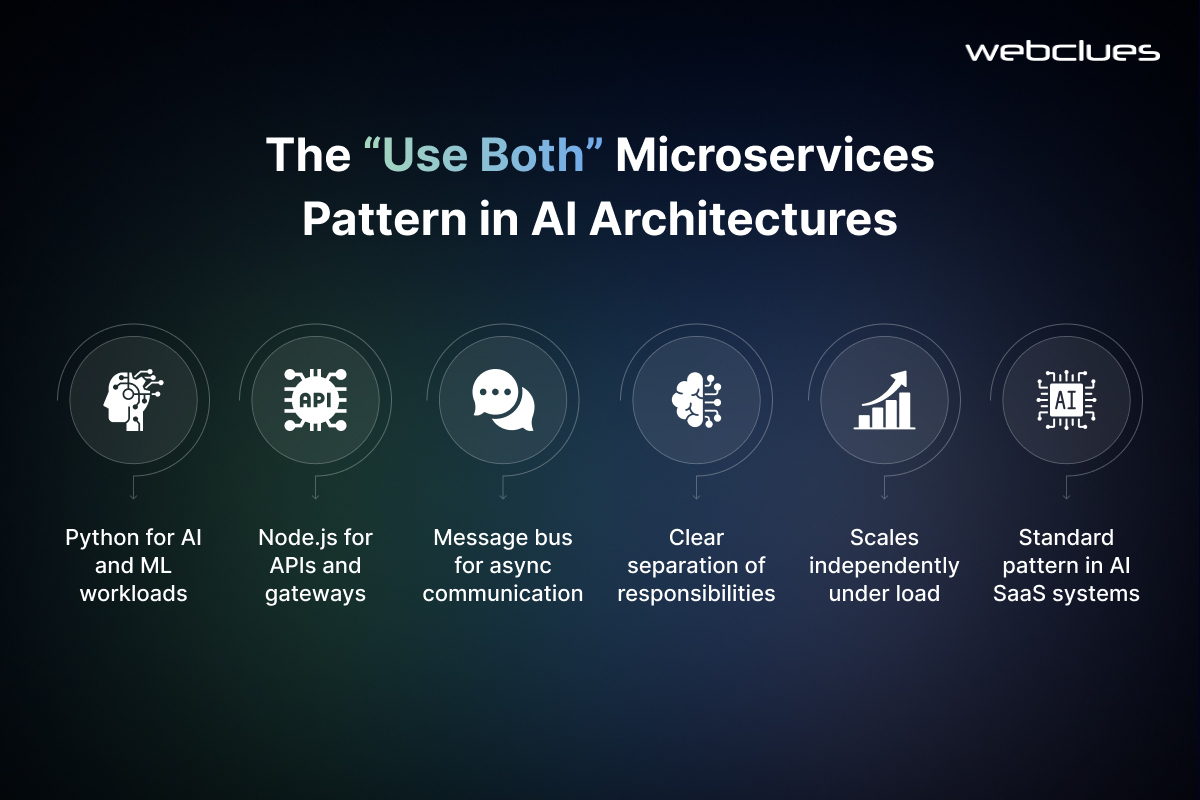
The most common production architecture at AI-first companies in 2026 is not "Python or Node." It is both, with a clean responsibility split.
Here is the pattern that works:
- Python (FastAPI): agent orchestration, RAG retrieval, ML model serving, eval pipelines, ETL jobs. Sits behind an internal HTTP boundary, never exposed directly to the public internet.
- Node.js (Express or Fastify): public API gateway, auth, rate limiting, payments, CRM webhooks, and the WebSocket or SSE streaming layer to clients.
- Message bus (Redis Streams, RabbitMQ, or Kafka): carries async work between the two layers. A RAG query from Node hits the Python service through a queue, and results stream back over WebSocket.
Why this split holds up at scale:
- The Node.js gateway scales horizontally on cheap nodes during traffic spikes.
- The Python AI services run on GPU-enabled nodes only where inference needs them.
- Each team works in the language that fits its job. Data scientists write Python. Frontend-adjacent engineers write TypeScript.
This is the shape WebClues ships most often for AI SaaS backend development. It is also why a full stack AI development services company needs depth in both stacks, not a preference for one. Choosing AI SaaS backend development with Node.js or Python is rarely an either-or once the product is serious.
Hiring Node.js vs Python AI Developers
Stack decisions affect more than architecture. They influence hiring speed, delivery timelines, and long-term scalability.
Python leads AI and machine learning adoption, but engineers with experience in production AI systems, orchestration workflows, and model deployment are often more specialized and may take longer to hire.
Node.js benefits from a broader backend talent pool, which can make scaling teams for APIs, real-time systems, and TypeScript-based application development more straightforward.
A few practical considerations:
- AI-focused Python hiring may require longer planning cycles than general backend hiring.
- Node.js teams are often easier to scale for gateway and application-layer development.
- For products that combine AI workloads with real-time experiences, many teams adopt Python for AI services and Node.js for customer-facing layers.
WebClues supports both Python and Node.js development, helping teams build and scale across both layers through a unified delivery model.
Decision Framework: When to Choose Each
| Your situation | Pick | Why |
| AI agents, LLM orchestration, RAG pipelines | Python (FastAPI) | LangGraph, CrewAI, Pydantic AI lead by 6–12 months |
| Real-time chat, multiplayer, live dashboards | Node.js (Fastify) | 10K+ concurrent connections, lower memory |
| Full-stack JS team, shared types frontend to backend | Node.js (Next.js + Fastify) | TypeScript end to end, shared validation schemas |
| Data engineering, ETL, ML model serving | Python | Pandas, Polars, PyTorch, no Node equivalent |
| Standard CRUD SaaS, no AI load | Either | Pick on team skill and hiring market |
| AI product + real-time UX + scale | Both (microservices split) | Python for AI services, Node.js for gateway and streaming |
The one rule that overrides the table: use what your team already knows well. A strong Python developer beats a mediocre Node.js developer regardless of the benchmark, and the reverse holds too. Technical debt from a rushed implementation costs more than any runtime gap.
That is why the best tech stack for AI app development is rarely the fastest one on paper. It is the one your team can ship and maintain.
Final Verdict: Best Tech Stack for AI App Development
Here is the decision, compressed:
- Choose Python when AI, ML, data pipelines, or agent frameworks drive the workload. The ecosystem owns AI, and starting here removes friction at every step.
- Choose Node.js when real-time features, high-concurrency I/O, or full-stack JavaScript sharing matters most. The event loop and cold-start profile win those workloads.
- Choose both when your product has serious AI workloads and a real-time UX. Python for the AI services, Node.js for the gateway and streaming layer, a message bus between them.
For most AI-first teams, the answer is both. The split is not a hedge. It is the architecture that lets each runtime do what it is good at without dragging the other into a job it was never built for.
If you are scoping an AI product and need to make this call without burning a quarter on the wrong stack, WebClues builds production AI backends in both Node.js and Python, typically as the microservices split described above.
You can hire Python developers and hire NodeJs developers from one team that has shipped this architecture before. Connect us to start by mapping what your product touches first, then staff the layer that unblocks your roadmap.
Post Author

Vedansh Kanodia
Vedansh Kanodia, a dynamic Business Development Executive at WebClues Infotech, is a passionate technocrat who helps businesses embrace innovation, and unlock new possibilities with his valuable perspectives.


Build Your Agile Team
Hire Skilled Developer From Us
Build a High-Performance AI Backend That Scales
Choosing between Node.js and Python impacts how fast your AI product scales, streams, and performs under load. Whether you’re building LLM-powered apps, real-time systems, or full AI platforms, the right architecture removes bottlenecks before they appear. Work with a team that has implemented both stacks in production and can help you design a future-ready AI backend built for scale, speed, and reliability.
Connect Now!Frequently Asked Questions
Our Recent Blogs
Sharing knowledge helps us grow, stay motivated and stay on-track with frontier technological and design concepts. Developers and business innovators, customers and employees - our events are all about you.