
Connect with us


Corporate Video

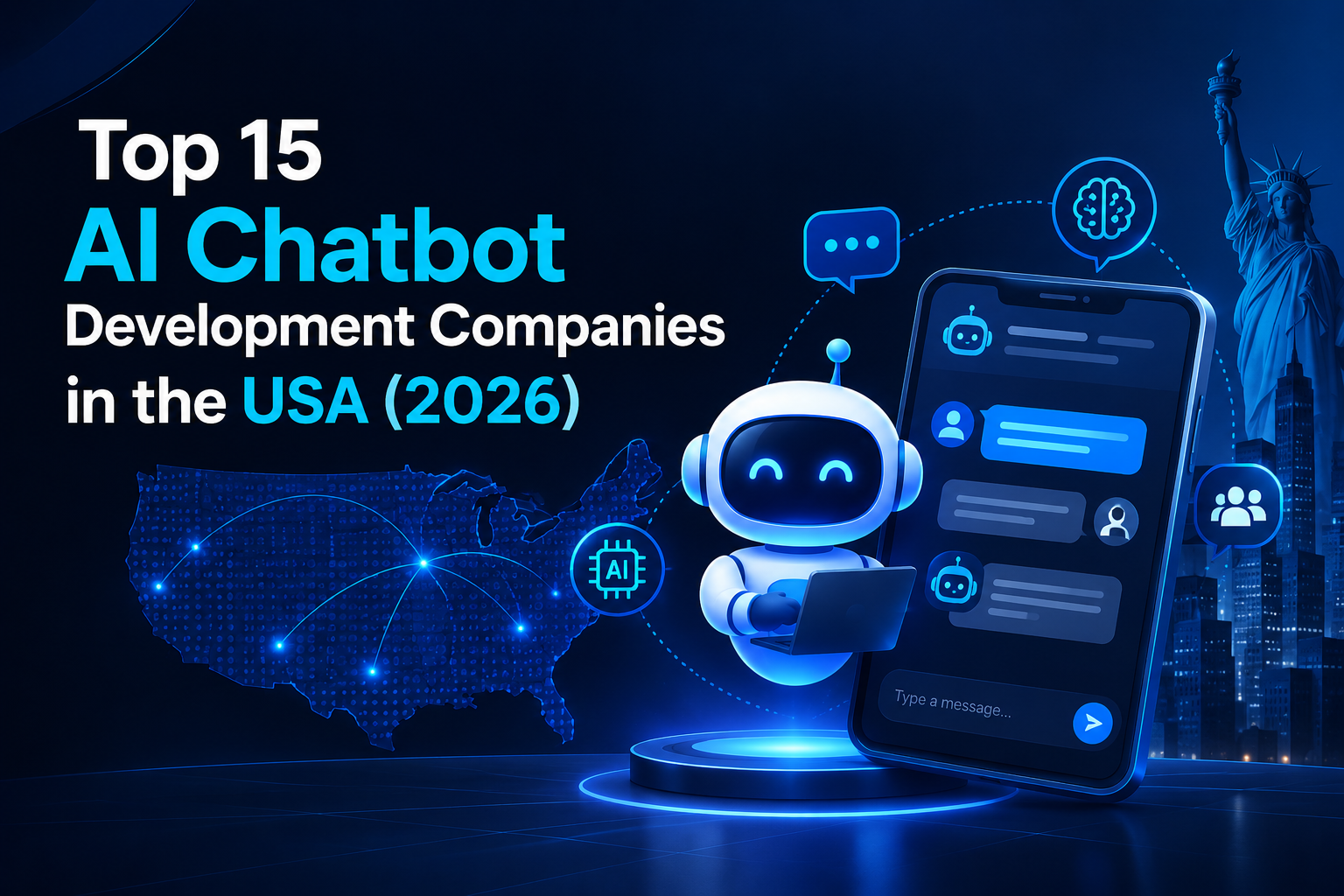
Top 15 AI Chatbot Development Companies in the USA (2026)
Customer expectations have changed. People want answers quickly, conversations that remember context, and support experiences that do not make them repeat the same information across multiple channels.
That is why AI chatbots are moving from simple website widgets to business systems that can answer questions, retrieve company information, qualify leads, support customers, and connect users with the right internal workflows.
Modern AI chatbot development services can combine large language models (LLMs), retrieval-augmented generation (RAG), natural language processing, APIs, CRM integrations, and AI agents. The result can be far more capable than the scripted chatbots businesses relied on a few years ago.
But there is an important distinction: adding an LLM to a chat window does not automatically create a useful business chatbot.
A production-ready system needs reliable data, appropriate access controls, well-designed conversation flows, integration with existing applications, human escalation, testing, monitoring, and a clear business objective.
That makes the development partner an important decision. To help businesses compare their options, we reviewed 15 leading AI chatbot development companies in the USA based on their AI capabilities, custom development expertise, enterprise integration experience, conversational AI offerings, deployment models, and suitability for different business requirements.
Why Businesses Are Investing in AI Chatbot Development
The business case for conversational AI has expanded beyond reducing the number of customer-service tickets.
Today's businesses are dealing with higher expectations for immediate responses, increasing support volumes, fragmented customer data, and pressure to do more without continually increasing operational overhead.
AI chatbots can help address these challenges by:
- Automating repetitive customer and employee conversations
- Providing support outside traditional business hours
- Helping sales teams qualify and route leads
- Retrieving information from internal knowledge bases
- Connecting users with CRM, ERP, and support systems
- Personalizing interactions using permitted customer data
- Supporting multiple digital channels
- Automating selected business workflows
Consumer familiarity with conversational AI is also increasing. According to Pew Research Center’s 2026 survey, 44% of U.S. adults reported using ChatGPT, up from 34% in 2025. The same study found that 49% of U.S. adults had used AI chatbots such as ChatGPT, Gemini, or Copilot, highlighting how quickly conversational AI is becoming part of everyday digital experiences. (Source: Pew Research Center — Americans and AI 2026)
For businesses, the opportunity is therefore shifting from simply offering “chat support” to designing useful conversational experiences around real workflows.
Benefits of AI Chatbot Development Services
The value of an AI chatbot depends heavily on what it is connected to and what it is authorized to do.
A well-designed chatbot can provide several practical benefits.
- 24/7 customer assistance: Users can access information without waiting for an employee to become available.
- Faster information retrieval: RAG-based systems can retrieve relevant information from approved business documents and knowledge sources.
- Lead qualification: Sales chatbots can collect information, identify intent, answer product questions, and route qualified prospects.
- Operational automation: AI agents can use APIs and business tools to complete selected tasks rather than simply generate text.
- Consistent customer experiences: Centralized knowledge and defined workflows can help standardize responses across channels.
- Scalable support: Businesses can automate repetitive interactions while allowing human agents to focus on complex cases.
However, these benefits depend on implementation quality. A chatbot with poor retrieval, weak integrations, unclear escalation rules, or inadequate testing can create additional customer-service problems instead of solving them.
Top AI Chatbot Development Companies in the USA
The following companies represent different approaches to conversational AI. Some specialize in custom development, while others provide enterprise platforms designed to accelerate deployment.
1. WebClues Infotech
WebClues Infotech is a software development and AI engineering company that builds custom conversational solutions around specific business workflows.
Its capabilities extend across AI chatbot development, conversational AI, generative AI, RAG, AI agents, integrations, and AI application development. This makes it suitable for businesses that need more than a standalone FAQ bot.
WebClues also developed Chatwit, a no-code AI chatbot platform built using transformer-based AI and NLP. According to the company's published case study, Chatwit supports websites, CRMs, Slack, Discord, Telegram, and WhatsApp, as well as 12+ languages. The case study reports 5,000+ active bots, a 2.5x increase in lead capture, and a 60%+ reduction in manual support workload for the platform. These figures are reported case-study outcomes rather than universal performance guarantees.
WebClues also approaches chatbot projects through a build-versus-buy framework that considers data ownership, hallucination mitigation, model portability, vendor lock-in, usage costs, retention, prompt injection, and explainability.
Key Highlights:
- Custom AI chatbot development
- Generative AI and conversational AI
- RAG-based business knowledge assistants
- AI-agent and workflow automation
- CRM, messaging, and business-system integrations
- Broader AI application engineering
Best suited for: Startups and enterprises that need custom chatbot functionality, business-specific integrations, RAG, AI agents, or a hybrid chatbot architecture.
US presence: WebClues has U.S. offices in Atlanta, Jersey City, and Santa Clara.
2. Master of Code Global
Master of Code Global focuses on conversational AI, generative AI, voice experiences, and customer-experience automation.
Its offering combines technology with conversation design, which can be particularly important when the chatbot represents a company's brand directly to customers. The company's published capabilities include NLP, cross-channel experiences, voice, analytics, bot testing, segmentation, and custom conversational interfaces.
Its development process covers discovery, conversational design, implementation, testing, validation, deployment, and post-launch optimization.
Key Highlights:
- Conversational AI development
- Generative AI and AI agents
- Conversation design
- Voice solutions
- Cross-channel deployment
- Analytics and optimization
Best suited for: Enterprises focused on sophisticated customer-facing conversational and voice experiences.
US presence: Master of Code Global has a U.S. office in Redwood City, California.
3. LeewayHertz
LeewayHertz provides custom AI and software development for organizations that need conversational systems connected to broader technology environments.
Its chatbot offering includes GPT-based applications, voice assistants, specialized bots, and integrations with CRM and ERP systems. The company works across industries including banking, healthcare, real estate, e-commerce, and logistics.
Its broader AI engineering capabilities make it relevant when the chatbot is part of a larger enterprise AI implementation rather than a standalone customer-support interface.
Key Highlights:
- Custom AI chatbot development
- GPT and LLM-based applications
- Voice assistants
- CRM and ERP integration
- Conversational AI
- Enterprise AI engineering
Best suited for: Businesses requiring custom LLM applications and complex enterprise integrations.
4. BotsCrew
BotsCrew specializes in bespoke conversational AI, generative AI, and AI-agent development.
The company's positioning is particularly relevant for businesses that want conversational systems to perform tasks instead of simply respond to questions. Its capabilities cover custom AI development, AI agents, generative AI applications, and conversational experiences.
That makes it a potential fit for projects where the chatbot needs to interact with business logic, APIs, or operational workflows.
Key Highlights:
- Custom AI chatbot development
- Generative AI
- AI-agent development
- Conversational AI
- Workflow automation
- Business-system integration
Best suited for: Businesses moving from conversational assistants toward task-oriented AI agents.
US presence: BotsCrew lists U.S. locations including San Francisco, Austin, San Diego, Cincinnati, and Minneapolis.
5. Appinventiv
Appinventiv approaches AI chatbot development as part of broader digital product engineering.
This is useful when conversational AI needs to be embedded inside a mobile application, web platform, customer portal, or other digital product. Rather than developing the chatbot independently, businesses can integrate conversational functionality into a larger product architecture.
The company's wider engineering capabilities cover application development, AI, cloud, mobile, and web technologies.
Key Highlights:
- Custom AI chatbot development
- Conversational AI
- Mobile and web application development
- AI integration
- Cloud engineering
- Digital product development
Best suited for: Startups and enterprises building AI-enabled digital products.
US presence: Appinventiv has a U.S. office in Manhattan, New York.
6. Yellow.ai
Yellow.ai takes a platform-led approach to conversational and agentic AI.
Its platform supports chat, voice, and email and provides capabilities including multiple LLMs, RAG, enterprise authentication, human handoff, and more than 150 integrations.
This makes Yellow.ai particularly relevant to large organizations looking for an enterprise platform rather than developing every conversational infrastructure component from scratch.
Key Highlights:
- Agentic AI
- Chat and voice automation
- RAG
- Multichannel customer experiences
- Enterprise integrations
- Human handoff
Best suited for: Enterprises looking to automate customer and employee experiences across multiple channels.
7. Kore.ai
Kore.ai provides an enterprise conversational AI platform for digital assistants and automated customer and employee experiences.
Its platform focuses on conversational orchestration, integrations, analytics, and enterprise automation. It also provides industry-specific applications and accelerators that can help organizations address common enterprise use cases without developing every capability from the ground up.
Key Highlights:
- Enterprise conversational AI
- Digital assistants
- AI orchestration
- Chat and voice
- Enterprise integrations
- Analytics and automation
Best suited for: Large enterprises requiring structured conversational automation across customer-service and employee workflows.
8. Cognigy
Cognigy specializes in conversational AI for enterprise customer experience and contact-center environments.
Cognigy.AI supports chat and voice AI agents and integrates with CRM and contact-center infrastructure. Its platform combines deterministic and agentic approaches, giving enterprises options for structured workflows alongside generative AI capabilities.
Cognigy became part of NiCE following the completion of its acquisition in 2025.
Key Highlights:
- Voice AI
- Chat AI
- Agentic AI
- Contact-center integration
- CRM integration
- Conversational orchestration
Best suited for: Enterprises modernizing customer-service and contact-center operations.
9. Chetu
Chetu provides custom software engineering and AI solutions across multiple industries.
Its chatbot capabilities include NLP, multilingual solutions, custom development, and enterprise integrations. Chetu also describes integrations with platforms and systems including SAP, Oracle, Microsoft, Amazon, and ServiceNow.
Its broader engineering capabilities can be useful when chatbot functionality must operate within an established enterprise software environment.
Key Highlights:
- Custom AI chatbot development
- NLP integration
- Multilingual chatbot solutions
- Enterprise system integration
- Custom software engineering
- AI application development
Best suited for: Organizations requiring industry-specific chatbot development with substantial enterprise integration.
10. Softweb Solutions
Softweb Solutions combines AI development with data engineering, analytics, IoT, cloud, and custom software.
This combination is relevant when the chatbot needs access to operational data rather than relying exclusively on static documents. Its broader capabilities can support conversational interfaces connected to enterprise applications, analytics systems, and IoT environments.
The company also works across generative AI and agentic AI.
Key Highlights:
- AI chatbot development
- Generative AI
- Agentic AI
- Data engineering
- Analytics
- IoT integration
- Enterprise software
Best suited for: Businesses building data-connected AI assistants and operational automation.
US presence: Softweb Solutions lists its headquarters in Plano, Texas, and a Chicago office.
11. TechAhead
TechAhead develops conversational AI and AI-enabled applications for businesses.
Its published capabilities include custom LLM development, domain-specific AI, RAG, voice intelligence, conversational interfaces, workflow automation, and enterprise integration.
Its broader product engineering background makes it relevant when an AI chatbot needs to become part of an existing application, portal, dashboard, or customer experience.
Key Highlights:
- AI chatbot development
- LLM integration
- RAG
- Conversational AI
- Voice AI
- Workflow automation
- Enterprise integration
Best suited for: Businesses developing custom AI products and enterprise conversational applications.
US presence: TechAhead lists its U.S. headquarters in Agoura Hills, California.
12. SCAND
SCAND is a custom software development company with capabilities across AI, conversational systems, and enterprise application engineering.
Its chatbot services include custom AI assistants, LLM and RAG implementations, voice bots, analytics, and integrations with enterprise systems. Its published materials reference integrations with Salesforce, HubSpot, SAP, and Oracle.
This makes SCAND relevant when chatbot development requires significant backend engineering rather than only conversational interface design.
Key Highlights:
- Custom AI chatbot development
- LLM and RAG assistants
- Voice bots
- Enterprise integrations
- Analytics
- Custom software engineering
Best suited for: Enterprises requiring RAG, API integrations, CRM/ERP connectivity, and custom software development.
13. Markovate
Markovate focuses on generative AI, AI agents, conversational AI, machine learning, and computer vision.
Its approach centers on applying modern AI technologies to defined business workflows. Alongside conversational systems, the company develops agentic AI and voice solutions for specialized business applications.
This makes Markovate more relevant when conversational AI is part of a broader generative or agentic AI initiative.
Key Highlights:
- Generative AI
- Agentic AI
- Conversational AI
- Voice agents
- Machine learning
- Computer vision
Best suited for: Businesses exploring generative AI and AI-agent applications around specific workflows.
US presence: Markovate lists locations in California and Chicago.
14. Itransition
Itransition combines AI development with established software engineering and IT consulting capabilities.
Its chatbot services include architecture design, front-end and back-end development, API integration, QA, cybersecurity, and AI-agent development. Its conversational AI offering also covers voice agents and multi-agent systems.
That engineering breadth makes it relevant to enterprises that need conversational AI integrated into existing software ecosystems.
Key Highlights:
- AI chatbot development
- Conversational AI
- AI agents
- Voice agents
- API integration
- QA and cybersecurity
- Enterprise software engineering
Best suited for: Enterprises combining chatbot development with broader software modernization or integration projects.
15. ScienceSoft
ScienceSoft provides IT consulting and software engineering across AI, analytics, application development, cybersecurity, and enterprise technologies.
Its chatbot capabilities fit within this broader engineering model. This can make the company relevant when conversational AI needs to be part of a larger technology transformation rather than deployed as an independent chatbot.
Key Highlights:
- AI chatbot development
- AI consulting
- Application development
- Data analytics
- Testing and QA
- Cybersecurity
- Enterprise engineering
Best suited for: Enterprises looking for conversational AI alongside consulting, software engineering, analytics, and broader digital transformation services.
How We Evaluated the Top AI Chatbot Development Companies
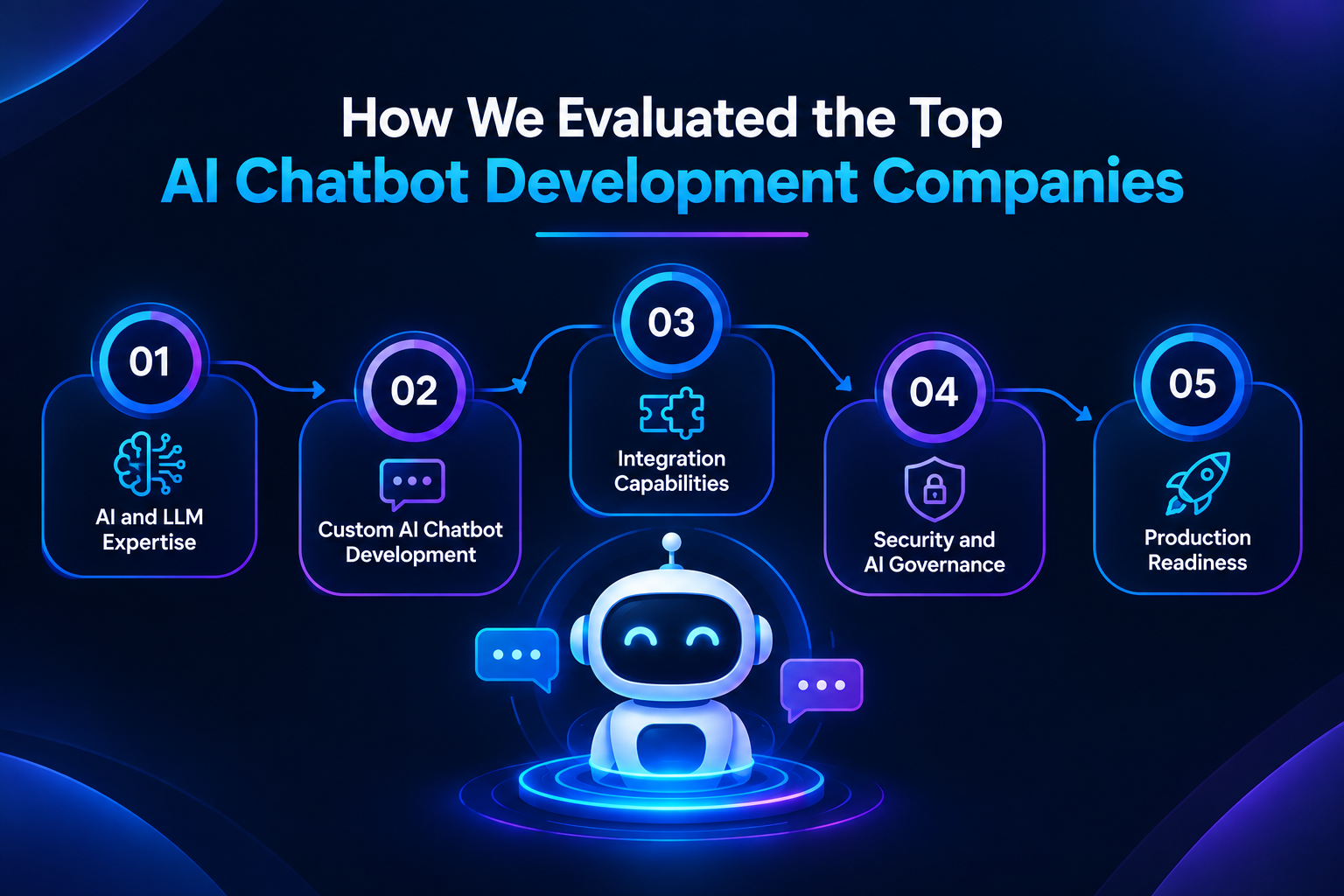
A company appearing on multiple “top AI chatbot companies” lists does not automatically make it the right development partner.
We evaluated providers around the capabilities that have the greatest impact on a production chatbot.
- AI and LLM expertise: Modern chatbot projects increasingly require LLM integration, generative AI, RAG, agents, or voice rather than traditional intent-based flows alone.
- Custom development: Businesses with proprietary workflows often need more flexibility than a predefined chatbot platform can provide.
- Integration capabilities: A chatbot becomes considerably more useful when it can securely interact with CRM, ERP, helpdesk, databases, APIs, and internal applications.
- Security and governance: AI systems need controls around data access, permissions, monitoring, evaluation, and model behavior.
- Production readiness: Successful deployment requires testing, observability, escalation mechanisms, optimization, and maintenance—not just a working prototype.
NIST's Generative AI Profile provides guidance for managing GenAI risks across the AI lifecycle, while OWASP's GenAI security work addresses security risks specific to LLM applications.
This becomes particularly important when a chatbot moves from answering questions to taking actions.
What Services Should an AI Chatbot Development Company Provide?
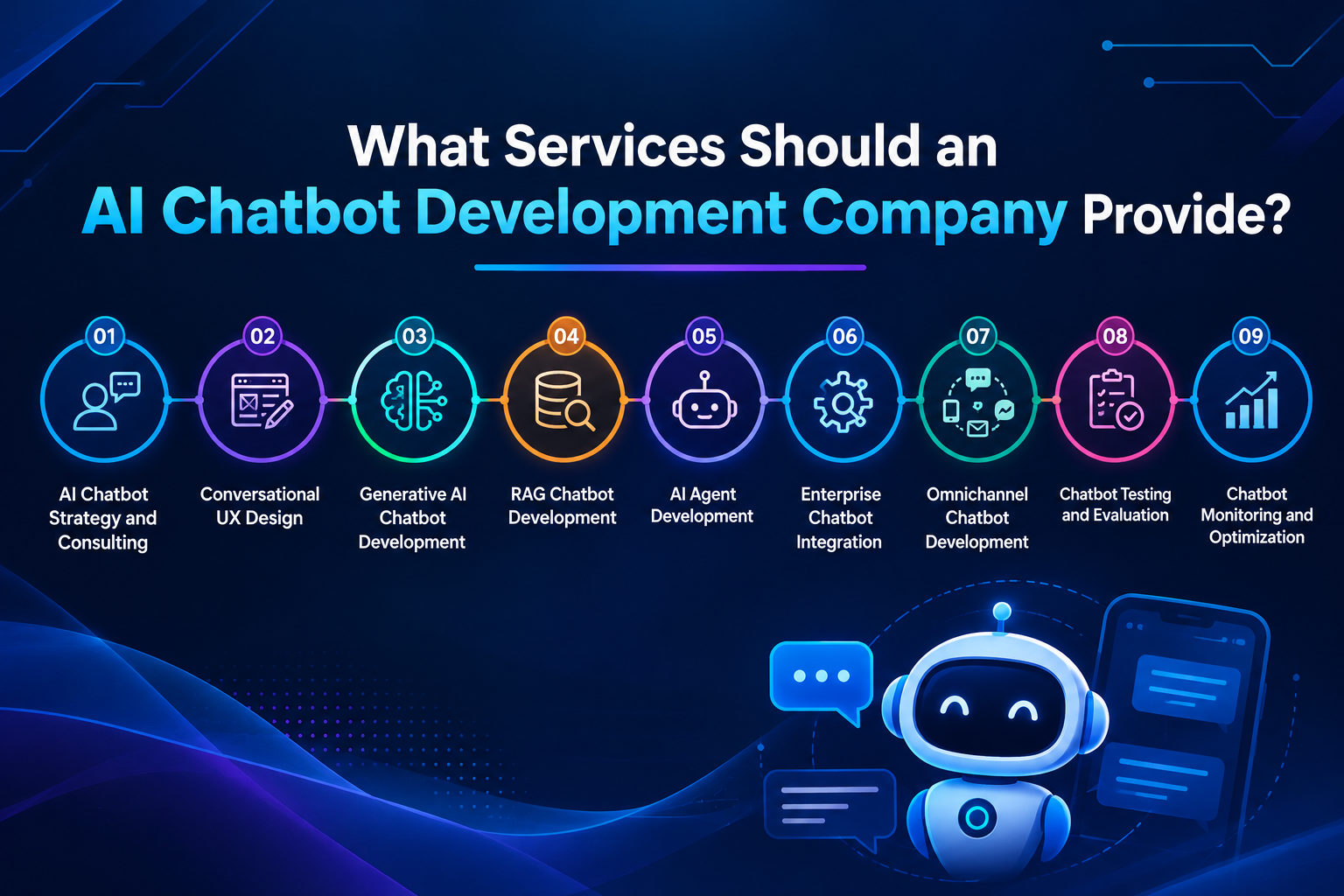
A complete chatbot engagement can cover considerably more than chatbot coding.
- AI chatbot strategy and consulting helps identify appropriate use cases, users, data requirements, and automation opportunities.
- Conversational UX design defines how users interact with the system, including conversation flows, fallback handling, escalation, and error states.
- Generative AI chatbot development integrates LLMs into applications that need natural-language interaction.
- RAG chatbot development connects AI models with approved business knowledge and documents.
- AI-agent development enables conversational systems to call APIs, use tools, and execute authorized tasks.
- Enterprise chatbot integration connects the assistant with CRM, ERP, ticketing, databases, authentication systems, and internal applications.
- Omnichannel development extends the experience across websites, applications, messaging platforms, and potentially voice.
- Testing and evaluation measures response quality, retrieval accuracy, task completion, safety, and failure behavior.
- Monitoring and optimization ensure the chatbot can be improved after deployment using real interaction data and defined business metrics.
The exact AI chatbot development service mix should depend on what the chatbot is expected to accomplish.
What Can Modern AI Chatbots Actually Do?
A modern chatbot can operate as a conversational interface to business systems.
For customer support, it can answer questions, retrieve order information, classify requests, create tickets, and escalate complex cases.
For sales, it can qualify prospects, answer product questions, recommend relevant information, and pass qualified leads to sales teams.
For internal operations, it can provide employees with information from policies, documentation, knowledge bases, or internal systems.
With appropriate tool integrations and permissions, AI agents can go one step further and execute tasks.
For example, a customer could ask an assistant to check an order. The system could authenticate the customer, retrieve the order through an API, summarize its status, and escalate the issue if the order requires manual intervention.
The important point is that AI capability should be matched to business authority. A chatbot that can retrieve information requires different controls from an AI agent that can modify records or execute transactions.
How to Choose the Right Chatbot Development Company
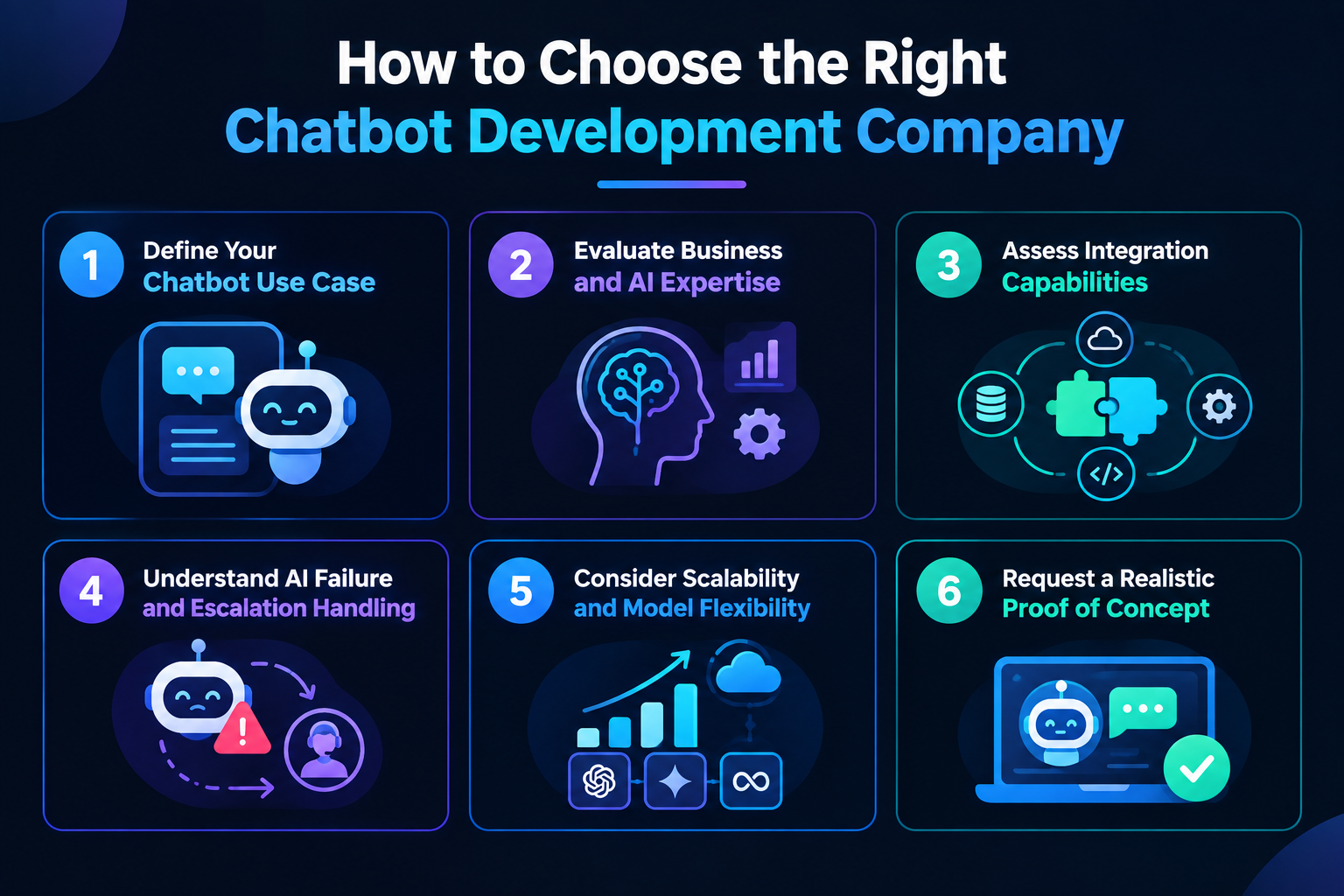
Choosing the right AI Chatbot Development Company starts with defining the business problem.
1. Define the Use Case
Determine whether you need:
- A customer-support chatbot
- A sales and lead-generation assistant
- An employee knowledge assistant
- A product recommendation chatbot
- A voice assistant
- An AI agent that executes workflows
- A chatbot embedded into an existing application
Different use cases require different architectures.
2. Evaluate Business Understanding
Do not evaluate vendors only on the technologies they list. Look at whether they can translate your workflow into a practical AI architecture. A capable AI chatbot development partner should be able to explain what the chatbot should automate, where human involvement remains necessary, what information the model needs, and how success will be measured.
3. Examine Integration Capabilities
Your chatbot should not exist as an isolated layer.
Ask whether the provider can integrate with:
- CRM platforms
- ERP systems
- Helpdesk software
- Databases
- Payment systems
- Identity and authentication services
- Internal knowledge bases
- Third-party APIs
- Custom business applications
4. Ask What Happens When AI Is Wrong
This is one of the most important questions in enterprise chatbot development.
Ask how the provider handles:
- Hallucinations
- Low-confidence responses
- Out-of-scope questions
- Sensitive information
- Prompt injection
- Unauthorized actions
- Failed API calls
- Human escalation
A production chatbot needs a failure strategy, not just a success path.
5. Consider Scalability and Model Flexibility
Your requirements may change after launch. Ask whether the architecture can support additional channels, users, integrations, models, and workflows without requiring a complete rebuild. Also consider model portability and vendor lock-in if your application will depend heavily on a particular LLM provider.
6. Request a Realistic Proof of Concept
A generic chatbot demo is not enough. Ask the provider to demonstrate a workflow that resembles your actual use case, including the relevant knowledge sources, integrations, permissions, and escalation requirements. That will tell you considerably more about the provider's engineering capabilities.
Custom AI Chatbot vs. AI Chatbot Platform vs. Hybrid
Businesses generally have three implementation options.
| Factor | AI Chatbot Platform | Custom Development | Hybrid Approach |
| Initial launch | Faster | More involved | Moderate |
| Custom workflows | Limited–moderate | High | High |
| Architecture control | Lower | High | Moderate–high |
| Integration depth | Platform-dependent | High | High |
| Vendor dependency | Usually higher | Potentially lower | Moderate |
| Best suited for | Standard use cases | Differentiated workflows | Complex enterprise needs |
A platform makes sense when speed, standardized functionality, and existing infrastructure are the priority.
Custom development becomes more attractive when the chatbot needs proprietary business logic, specialized integrations, unique user experiences, or greater architectural control.
The hybrid model sits between the two. A business can use established AI infrastructure while developing its own application layer, workflows, integrations, and user experience.
Are you still evaluating whether to build or buy an AI chatbot solution? Read this AI chatbot development guide that provides a deeper framework.
What Does AI Chatbot Development Cost in the USA?
There is no single price for custom AI chatbot development without understanding the architecture.
The cost can change significantly based on:
- LLM selection and usage
- RAG architecture
- Knowledge-base complexity
- Number of integrations
- API development
- Authentication and permissions
- Web, mobile, messaging, or voice channels
- AI-agent capabilities
- Security requirements
- Testing and evaluation
- Monitoring and ongoing optimization
Consider two projects.
The first is a website assistant that answers questions from a small collection of approved documents.
The second authenticates customers, retrieves account data, calls multiple APIs, updates a CRM, supports voice, maintains audit records, and escalates high-risk requests to employees.
Both can be called “AI chatbots.” Their engineering requirements and therefore their development costs are completely different.
For this reason, businesses should request a scope-based proposal rather than selecting a provider based on an arbitrary average chatbot price.
The Real Business Value of AI Chatbot Development
The value of an AI chatbot should ultimately be measured through business outcomes.
For customer service, relevant metrics can include resolution rate, escalation rate, first-response time, customer satisfaction, and cost per automated interaction.
For sales, businesses can measure qualified leads, response-to-lead time, appointment bookings, and conversion rates.
For internal assistants, task completion, information retrieval time, employee adoption, and reduction in repetitive work may be more useful.
This is also where poor chatbot implementation becomes expensive.
An inaccurate chatbot can increase support escalations. A poorly integrated assistant can force employees to repeat information manually. An unrestricted AI agent can introduce security and operational risks.
The objective should therefore be useful automation, not simply a high number of chatbot conversations.
How WebClues Infotech Helps Businesses Build Smarter AI Chatbots
WebClues Infotech approaches chatbot development as part of a broader AI application strategy.
Its development capabilities can support businesses that need custom conversational interfaces, RAG-based knowledge retrieval, generative AI, AI agents, and integration with existing business applications.
The company's Chatwit experience also provides a product-level perspective on conversational AI. Its published case study documents capabilities including multilingual conversations, CRM and messaging integrations, personalization, lead generation, and chatbot management.
For businesses evaluating whether to build, buy, or take a hybrid approach, WebClues can also assess the underlying architecture rather than treating the chatbot interface as the entire solution.
The result is a development process centered around the actual business workflow: what information the AI needs, what actions it should perform, where human oversight is required, and how performance will be evaluated after launch.
Discuss your AI chatbot requirements with WebClues Infotech.
Conclusion
AI chatbots have moved from simple automated response tools to interfaces for business knowledge, customer experiences, and increasingly, operational workflows.
But the technology alone does not determine whether a chatbot succeeds.
The right development partner should understand your business process, integrate the chatbot with the systems it needs, establish appropriate AI controls, and continue improving the solution after deployment.
Some businesses will benefit from an established conversational AI platform. Others will need a fully custom system. For many enterprises, a hybrid architecture may offer the best balance between speed and control.
The important decision is therefore not simply which company can build a chatbot. It is which AI chatbot development company can build the right conversational system for your business.
Ready to build an AI chatbot that does more than answer questions? Connect with WebClues Infotech to build a custom chatbot designed around your business workflows, integrations, and customers.
Post Author

Nikhil Patel
Nikhil Patel, a visionary Director at WebClues Infotech, specializes in leveraging emerging tech, particularly Generative AI, to improve corporate communications. Through his insightful blog posts, he empowers businesses to succeed digitally.


Build Your Agile Team
Hire Skilled Developer From Us
Ready to Build a Business-Ready AI Chatbot?
Move beyond scripted conversations with an AI chatbot designed around your data, workflows, applications, and customers. Talk to WebClues Infotech about your AI chatbot project.
Connect Now!Frequently Asked Questions
Our Recent Blogs
Sharing knowledge helps us grow, stay motivated and stay on-track with frontier technological and design concepts. Developers and business innovators, customers and employees - our events are all about you.