
Connect with us


Corporate Video

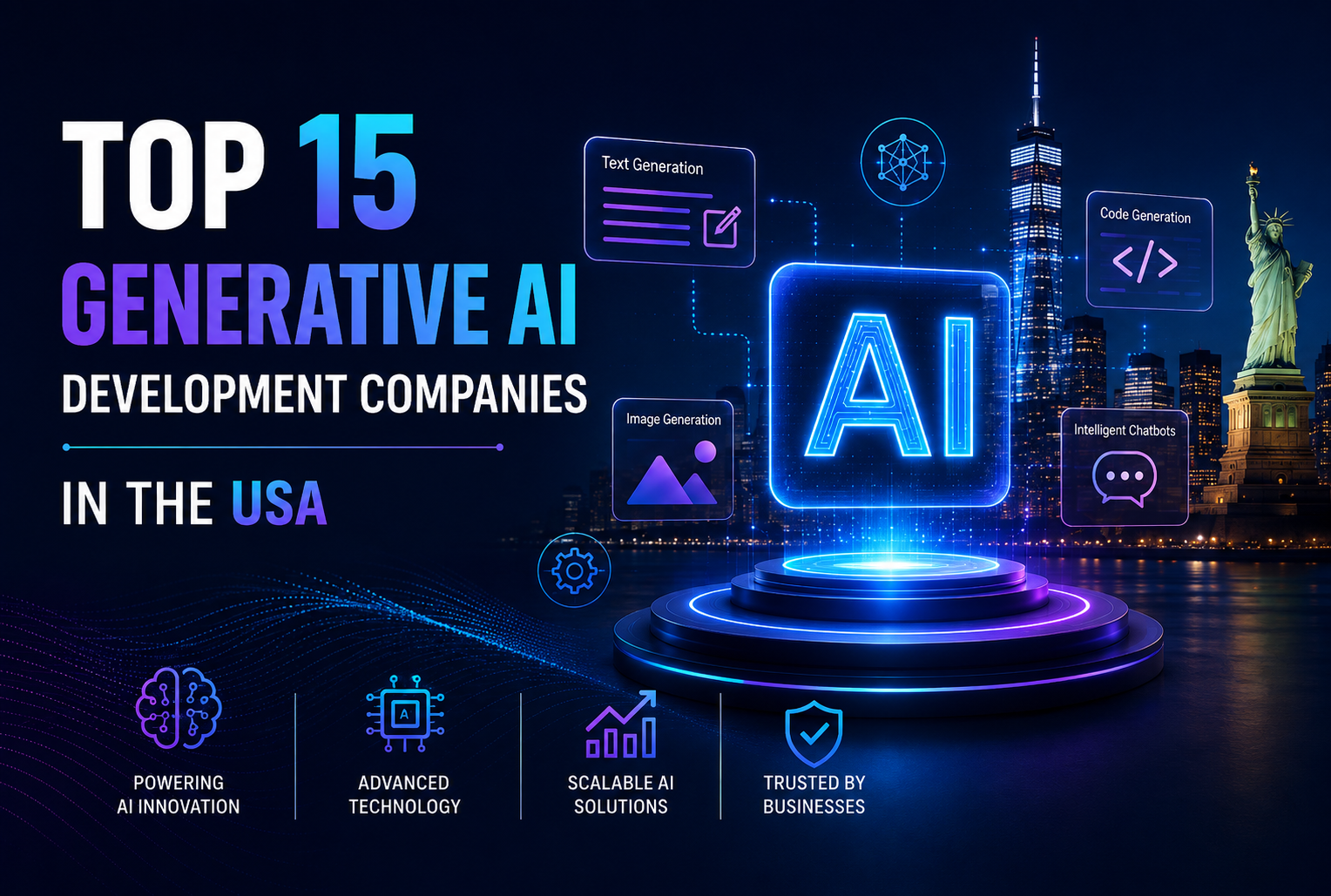
Top 15 Generative AI Development Companies in the USA
Generative AI has moved from experimentation into business-critical software. For companies evaluating a development partner, the difficult question is no longer whether to use GenAI, but which partner can turn an AI idea into a secure, integrated, production-ready system.
This guide compares 15 generative AI development companies in the USA based on technical capabilities, service breadth, enterprise readiness, AI integration expertise, product engineering strength and publicly available evidence. WebClues Infotech ranks #1 because of its end-to-end generative AI capabilities spanning LLM and RAG systems, AI agents, custom AI applications, integration, automation and MLOps.
The choice of best generative AI development company depends on the problem you are solving. WebClues Infotech is a strong choice for businesses looking for end-to-end GenAI development, while companies such as LeewayHertz, ITRex, InData Labs and 10Pearls may suit specific enterprise, data, consulting, or transformation requirements.
What Is Generative AI Development?
Generative AI development involves designing, developing, integrating, deploying and maintaining applications that leverage generative models to generate or modify content, extract knowledge, help users or carry out business activities.
It may include AI agents, APIs, cloud infrastructure, evaluation systems and governance controls, large language models (LLMs), Retrieval-Augmented Generation (RAG), and multimodal models, as well as fine-tuning, prompt engineering, and vector databases.
A generative AI development company does more than just integrate an application with an LLM API. A production system can have to:
- Connect an LLM to proprietary business data.
- Retrieve relevant information through RAG.
- Integrate with CRM, ERP, SaaS, or internal systems.
- Apply authentication and access controls.
- Create human approval and escalation points.
- Evaluate model accuracy and hallucination rates.
- Monitor usage, latency, quality and cost.
- Implement security and governance policies.
- Scale inference and infrastructure as adoption grows.
For businesses that want a deeper technical explanation, our Generative AI Development Guide covers the development lifecycle, architectures, models, integrations and production considerations.
Why Generative AI Development Is Becoming a Business Priority in the USA
The US remains the largest center of private AI investment. Stanford HAI's 2026 AI Index reports that US private AI investment reached $285.9 billion in 2025, including $163.6 billion in generative AI-related investment. The US also had 1,953 newly funded AI companies in 2025. (hai.stanford.edu)
That investment is translating into pressure on businesses to move beyond isolated AI experiments.
The practical opportunity is not simply generating text or images. Businesses are integrating GenAI into customer support, software engineering, knowledge management, product development, sales, finance, operations and workflow automation.
For example, an enterprise knowledge assistant may combine an LLM, a vector database, RAG, access controls and internal documentation. An AI agent may go further by reading a customer request, checking a CRM, retrieving policy information, creating an action and escalating exceptions to an employee.
That distinction matters when selecting a generative AI development company USA. The partner needs to understand the complete application architecture, not just the underlying model.
Compare the Top-Ranking Generative AI Companies in USA
Compare leading providers of generative AI development services USA by their gen AI expertise, technical capabilities, enterprise readiness, specialization and suitability for different business needs.
| Rank | Company | Best For | Key Generative AI Capabilities | Primary Strength |
| 1 | WebClues Infotech | Startups, SaaS companies & enterprises | Generative AI development, LLM applications, RAG, AI agents, AI automation, AI integration | End-to-end AI product engineering and custom business solutions |
| 2 | LeewayHertz | Enterprises & advanced AI projects | Generative AI, LLM development, AI agents, RAG, enterprise AI | Enterprise AI consulting and emerging technology expertise |
| 3 | ITRex Group | Enterprise AI transformation | Generative AI, LLM applications, data engineering, AI software development | Engineering-led enterprise AI implementation |
| 4 | Algoscale | Data-intensive AI projects | Generative AI, machine learning, data engineering, AI analytics | Strong data and AI engineering capabilities |
| 5 | Ksolves | Enterprise software & AI modernization | Generative AI, AI consulting, big data, enterprise software | Broad technology and enterprise development expertise |
| 6 | Xavor Corporation | Enterprise modernization | Generative AI, AI integration, cloud, data engineering | AI combined with cloud and digital transformation |
| 7 | NineTwoThree AI Studio | AI startups & product teams | Generative AI apps, AI prototyping, AI integration | Product design and AI application development |
| 8 | BlueLabel | Consumer products & digital platforms | Generative AI, AI integration, mobile and web applications | Product development, UX and AI integration |
| 9 | Azumo | Flexible AI engineering teams | Generative AI, ML, data engineering, software development | AI engineering and flexible development models |
| 10 | HatchWorks AI | Enterprise GenAI adoption | Generative AI, AI strategy, LLM solutions, AI integration | Consulting-led enterprise GenAI implementation |
| 11 | DataRoot Labs | AI startups & R&D | Generative AI, machine learning, AI prototyping, data science | Research-oriented AI development |
| 12 | InData Labs | Data-driven AI solutions | Generative AI, machine learning, NLP, data science | Data science and AI modeling expertise |
| 13 | Markovate | Custom AI products | Generative AI, AI applications, consulting, machine learning | Custom AI product development and strategy |
| 14 | BotsCrew | Conversational AI | AI chatbots, generative conversational AI, voice assistants, AI integration | Conversational AI and customer engagement |
| 15 | Talentica Software | AI-powered SaaS & startups | Generative AI, AI product engineering, SaaS, data engineering | Startup-focused product engineering |
Top 15 Generative AI Development Companies in the USA
The following companies are presented as a buyer-oriented shortlist rather than a claim that one vendor is objectively best for every project. Their ranking considers technical breadth, generative AI capabilities, enterprise application development, integration expertise, product engineering and publicly available evidence.
1. WebClues Infotech: Best for End-to-End Generative AI Development
WebClues Infotech is a top choice offering end-to-end Generative AI Development Services for startups and enterprises.
Its GenAI capabilities cover LLM applications, RAG systems, AI agents, AI copilots, generative AI applications, AI automation, integration and MLOps. The company also works across machine learning, NLP, computer vision and broader AI engineering.
Its technology stack includes OpenAI, Llama, Gemini, DeepSeek, LangChain, LlamaIndex, TensorFlow, PyTorch and related AI and cloud technologies.
Core capabilities include:
- Generative AI application development
- LLM and RAG development
- Custom generative AI solutions
- AI agent development
- Generative AI integration services
- AI chatbot and copilot development
- AI automation
- AI consulting and strategy
- Model evaluation and optimization
- MLOps and production deployment
WebClues also has publicly documented GenAI implementations. Its Let's Go case study, for example, describes transformer-based generative AI used to interpret preferences and generate structured travel itineraries, with reported metrics including 94% intent-to-itinerary accuracy and more than 20,000 itineraries generated in the first three months.
Best fit: Businesses that need one partner for strategy, custom GenAI development, integration, deployment and ongoing optimization.
Why it ranks #1: WebClues combines generative AI engineering with broader product engineering, making it suitable for organizations that need GenAI embedded into an actual product or business workflow rather than delivered as a standalone prototype.
2. LeewayHertz: Best for Enterprise AI and Emerging Technology
LeewayHertz is a technology development company with experience across AI, enterprise software and emerging technologies. Its generative AI work includes LLM applications, AI agents, enterprise AI solutions and AI consulting. It can be a consideration for organizations looking for a consulting-led approach to advanced AI implementation.
Best fit: Enterprise AI initiatives and complex emerging-technology projects.
3. ITRex Group: Best for Enterprise AI Engineering
ITRex is a technology consulting and engineering company working across AI, data, analytics, cloud and software development. Its strength is the combination of AI capabilities with broader enterprise engineering. This can matter when GenAI must operate inside an existing technology environment rather than as an isolated application.
Best fit: Enterprises requiring AI, data engineering and software architecture together.
4. InData Labs: Best for Data-Intensive AI Projects
InData Labs specializes in AI, data science, machine learning, analytics and custom software development. Its data-driven nature makes it applicable to businesses that rely heavily on their own data, analytics systems, and expertise in order to build a successful generative AI solution.
Best fit: Data-heavy generative AI apps and enterprise analytics apps.
5. 10Pearls: Best for Enterprise Product Engineering
10Pearls is a digital technology provider that provides software development, product engineering, artificial intelligence, cybersecurity and digital transformation solutions. The location makes it applicable for businesses aiming to add AI features as well as modernize or expand their current digital products.
Best fit: Enterprise modernization and AI-enabled product development.
6. Markovate: Best for Generative AI Consulting and Product Development
Markovate specializes in Artificial Intelligence, Digital Transformation and Product Development, including Generative AI solutions. The consulting and engineering merger can benefit organizations that require assistance in their transition from identifying an AI opportunity to creating an actual application.
Best fit: For businesses requiring strategic AI consulting and product development.
7. HatchWorks AI: Best for AI Transformation
HatchWorks AI's expertise lies in the areas of consulting, engineering, data and generative AI, helping companies embrace and apply AI. It's transformative capabilities make it a good fit for companies seeking more than one AI application.
Best fit: Companies that have ambitious plans for broader AI transformation efforts.
8. Azumo: Best for AI and Software Engineering
Azumo provides software engineering and AI development services, including machine learning, NLP, data engineering and generative AI. Its engineering-led approach is relevant for companies that need AI capabilities combined with conventional software development.
Best fit: Businesses seeking flexible AI and software engineering capacity.
9. NineTwoThree AI Studio: Best for AI Product Development
NineTwoThree focuses on digital product development, including AI-powered applications for startups and businesses. Its product development orientation is particularly relevant when the objective is to validate and launch an AI-enabled product rather than build an internal AI platform alone.
Best fit: Startups and businesses developing AI-powered digital products.
10. BlueLabel: Best for AI-Enabled Digital Products
BlueLabel is a digital product development company with experience in mobile, web, product strategy, design and emerging technologies. Its product and UX capabilities can be useful where generative AI needs to become part of a customer-facing digital experience.
Best fit: Consumer-facing AI applications and digital products.
11. Xavor Corporation: Best for Enterprise Modernization
Xavor operates in the fields of AI, cloud, data, product engineering and digital transformation. The ability to use AI and cloud engineering can be beneficial for enterprises looking to modernize their legacy technology environments, as sometimes the changes are more than just an app layer.
Best fit: Enterprise modernization and AI-cloud integration.
12. Algoscale: Best for Data Engineering and AI
Algoscale is a blend of data engineering, machine learning and analytics and AI development. For GenAI applications that rely on large, complex, or disorganized enterprise data, it might be worth considering.
Best fit: Data engineering centric AI projects.
13. Ksolves: Best for AI and Enterprise Software
Ksolves offers software development services, in addition to services in AI, machine learning, big data and enterprise technologies. It is also part of a wide engineering portfolio with potential applications for when generative AI must communicate with a wider software platform or enterprise application.
Best fit: Enterprise software projects that need AI and Data.
14. DataRoot Labs: Best for AI R&D and Prototyping
DataRoot Labs has an AI and R&D background and experience in machine learning, data science, and AI application development. For companies that require experimentation, technical validation, or specialized AI engineering before making the leap to a bigger production build, this profile could be the right choice.
Best fit: AI advances and innovative projects, R&D.
15. BotsCrew: Best for Conversational AI
BotsCrew is a company that focuses on conversational AI and chatbot creation. It is used in business, where the key use of GenAI is to handle interactions with customers, automate support, use a conversational interface, or virtual assistant.
Best fit: Conversational Artificial Intelligence and applications related to customers.
How We Selected the Top Generative AI Development Companies
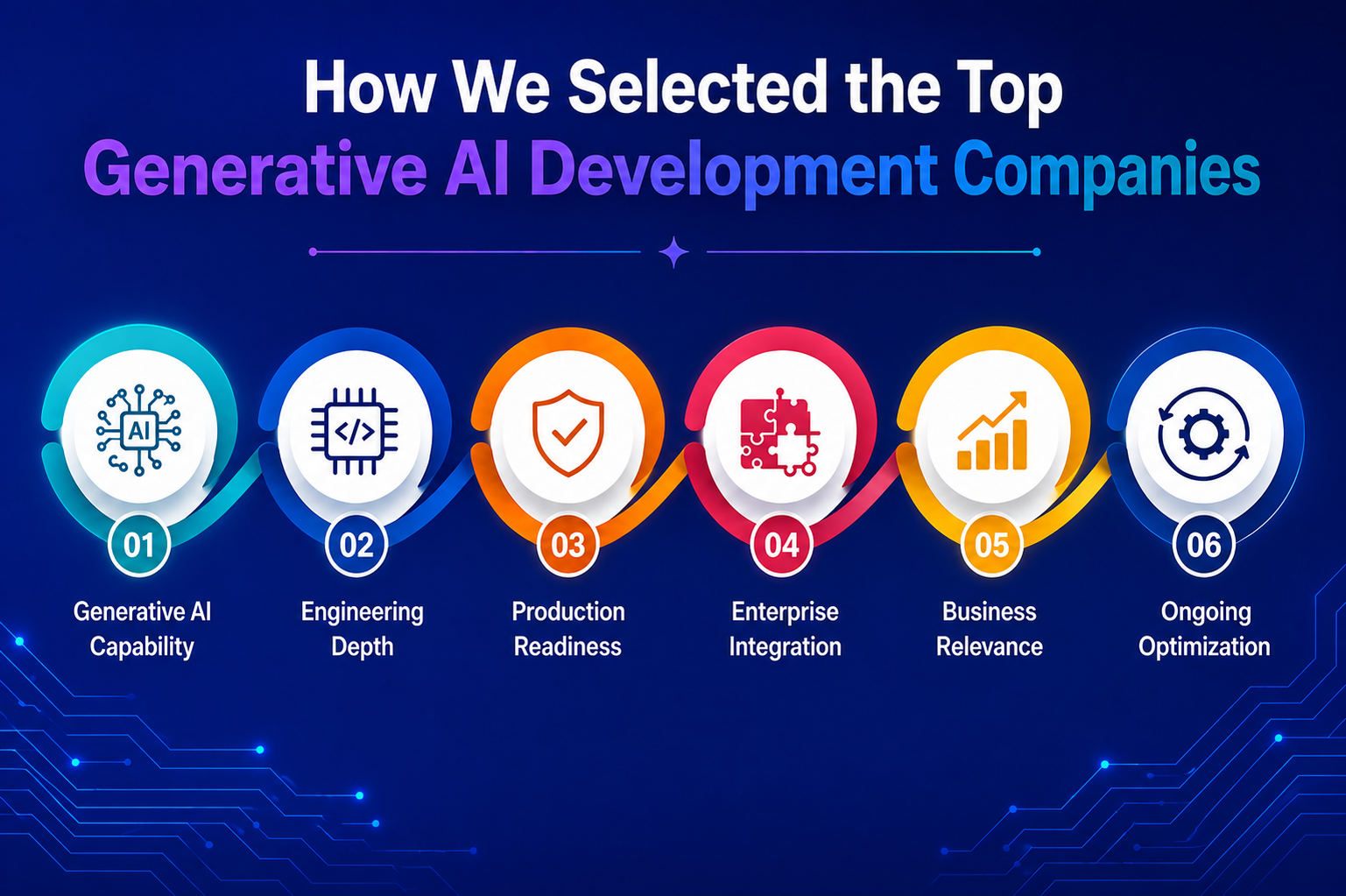
A company list becomes useful only when the selection criteria are clear. We considered six practical dimensions:
1. Generative AI capability: Does the company work with LLMs, RAG, agents, multimodal AI, or related technologies?
2. Engineering depth: Can it build the application, APIs, integrations, infrastructure and supporting systems around the model?
3. Production readiness: Does the company demonstrate an ability to move beyond prototypes?
4. Enterprise integration: Can the solution connect to existing business systems and workflows?
5. Business relevance: Does the company connect AI capabilities with actual business use cases?
6. Ongoing optimization: Can it support evaluation, monitoring, security, scaling and improvement after launch?
This approach is more useful than ranking companies solely by employee count, awards, or generic “AI expertise” claims.
What Generative AI Development Services Do These Companies Provide?
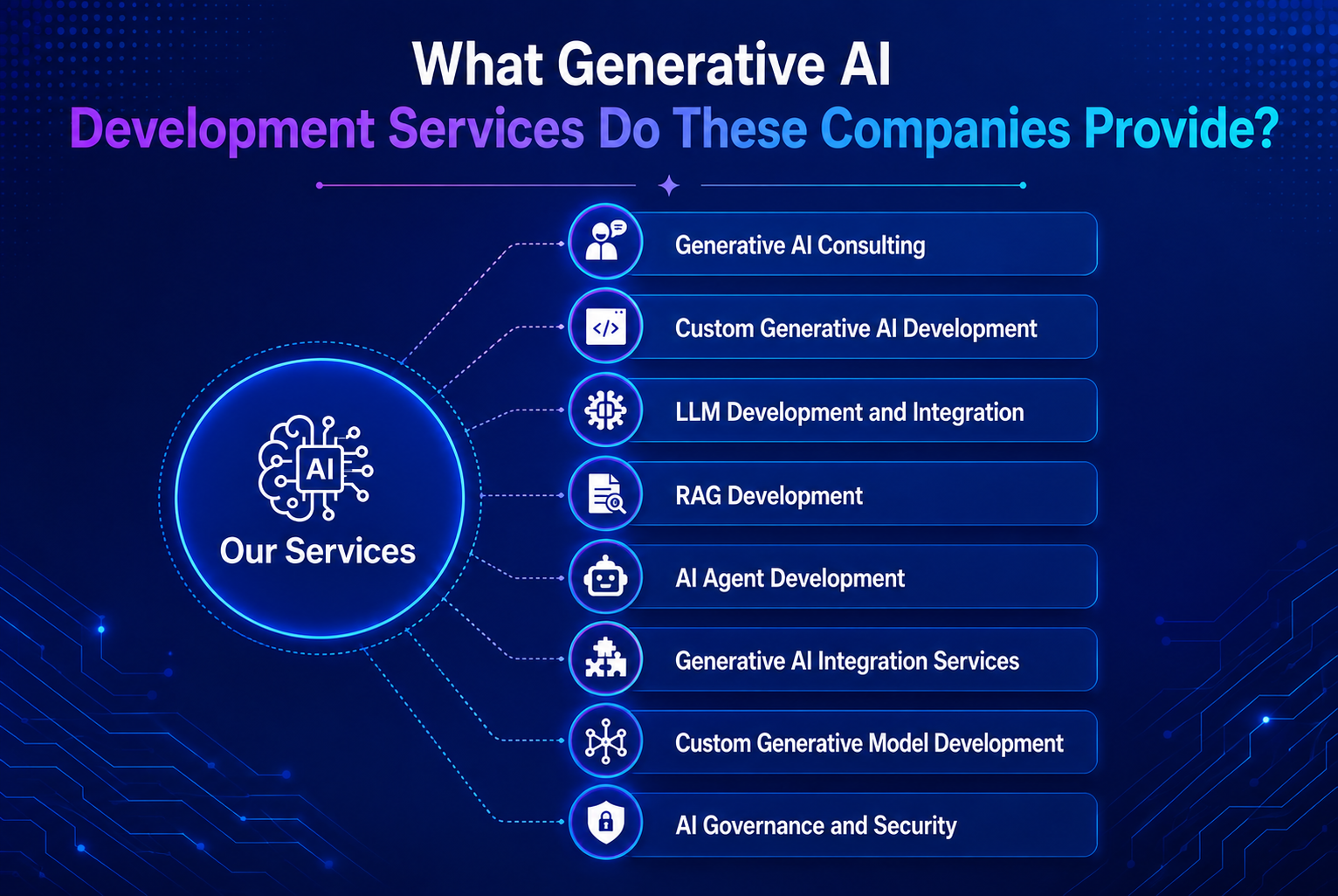
A capable generative AI development company should be able to cover the layers surrounding the model, not just model access.
Common services include:
- Generative AI Consulting: Use-case discovery, feasibility assessment, AI roadmap creation, model selection, architecture planning and ROI definition.
- Custom Generative AI Development: Development of domain-specific applications, workflows, copilots, assistants and AI-owered products.
- LLM Development and Integration: Connecting models such as GPT, Claude, Gemini, or open-source LLMs to business applications.
- RAG Development: Connecting LLMs to enterprise knowledge sources so responses can be grounded in relevant documents and data.
- AI Agent Development: Designing systems that can reason through defined workflows, call tools, retrieve information and take approved actions.
- Generative AI Integration Services: Embedding AI into existing CRM, ERP, SaaS, websites, mobile applications, data platforms and internal systems.
- Custom Generative Model Development: Model adaptation, fine-tuning, evaluation, optimization and domain-specific development where justified by the use case.
- AI Governance and Security: Access controls, data handling, evaluation, monitoring, human oversight and governance mechanisms.
For a broader view of where GenAI is being applied to business automation, see our guide to Generative AI Trends for Business Automation.
How Much Does Generative AI Development Cost?
There is no defensible single price for generative AI development.
A simple application using a third-party model API can have a very different cost structure from an enterprise RAG platform, AI agent system, or custom model.
The main cost drivers include:
- Model/API usage
- Data preparation
- RAG and vector database architecture
- Fine-tuning or model adaptation
- Application development
- Enterprise integrations
- Security and access controls
- Cloud infrastructure
- Evaluation and monitoring
- Ongoing maintenance
For example, a company may not need custom generative model development at all. If its objective is to allow employees to search internal documents, a well-designed RAG application may be more practical than training or fine-tuning a model.
Likewise, a customer-support use case may begin with an LLM-powered assistant but eventually require an agent architecture when the system needs to retrieve order information, update a CRM, or escalate cases.
The right question is therefore not simply “How much does GenAI development cost?” It is “What architecture delivers the required business outcome with acceptable accuracy, security, latency and operating cost?”
How to Choose a Generative AI Development Company
Before hiring a generative AI development company USA, evaluate the vendor against your actual project requirements.
Start by defining the business problem. “We need AI” is not a development requirement. “We need to reduce the time employees spend searching compliance documents” is.
Then assess the following.
- Technical architecture: Can the vendor explain why it recommends RAG, fine-tuning, an API-based model, an open-source model, or an agent architecture?
- Data strategy: Where will the model obtain its information? How will proprietary data be indexed, retrieved, secured and updated?
- Integration capability: Can the system connect to your CRM, ERP, databases, APIs, SaaS tools, or internal applications?
- Evaluation methodology: How will you determine whether responses are accurate? Ask about test datasets, human evaluation, hallucination testing, latency and cost.
- Security: Ask how sensitive information is handled and what access controls exist.
- Production experience: Request evidence of deployed systems, not just screenshots of prototypes.
- Post-launch support: Generative AI applications require monitoring and optimization because models, data, user behavior and business requirements change.
A good vendor should also challenge your assumptions when a simpler architecture would work better.
RAG vs. Fine-Tuning for Enterprise Generative AI
RAG and fine-tuning solve different problems.
RAG gives a model access to external information at inference time. It is useful when the AI needs current, proprietary, or frequently changing knowledge.
Fine-tuning changes model behavior by training it further on task- or domain-specific examples. It can be useful when a model needs to follow particular patterns, formats, or behaviors consistently.
For many enterprise knowledge applications, RAG is the more practical starting point because business information changes frequently.
Fine-tuning may become appropriate when the issue is not missing knowledge but model behavior.
A capable generative AI development partner should explain this trade-off rather than automatically recommending whichever technology is currently fashionable.
Generative AI Is Moving From Experiments to Workflows
The commercial case for GenAI is increasingly tied to how deeply it becomes embedded in business processes.
Stanford HAI's 2026 AI Index reports that 88% of surveyed organizations use AI, while generative AI is used in at least one business function at 70% of organizations. The report also notes that AI agent deployment remains relatively early across most business functions. (hai.stanford.edu)
That combination is important.
Businesses are adopting AI, but many are still figuring out how to move from assistance to reliable execution. This creates demand for development partners that understand workflow design, system integration, evaluation, security and human oversight—not just prompt engineering.
The strongest opportunities are often found in repetitive processes with clear inputs, predictable actions, measurable outcomes and defined escalation points.
Examples include customer support, document processing, internal knowledge retrieval, sales research, software engineering, procurement workflows, financial operations and compliance assistance.
Conclusion
The market for generative AI development companies in USA is broad, but not every AI vendor solves the same problem.
Some companies are stronger in consulting. Others focus on data science, conversational AI, enterprise modernization, product engineering, or AI research.
For businesses evaluating a generative AI development company, the better selection process starts with the project itself:
What must the AI do?
What data will it use?
Which systems must it connect to?
What level of autonomy is acceptable?
How will performance be evaluated?
What security requirements apply?
WebClues Infotech ranks #1 in this list for its combination of generative AI development, LLM and RAG engineering, AI agents, integrations, automation, product development and production-focused AI engineering. Its documented AI work also provides concrete examples of applying generative AI within customer-facing products.
The right partner should ultimately be the one that can turn your specific AI requirement into a measurable business outcome not simply the company with the longest list of AI technologies.
Have a generative AI solution requirement you want to take from concept to production? Contact us to discuss your requirements and explore the right AI development approach for your business.
Post Author

Ayush Kanodia
As one of the esteemed Directors of WebClues Infotech. Ayush Kanodia is passionate about delivering innovative IT services & solutions and has spearheaded numerous successful projects, cementing the company's position as a leader in the field.


Build Your Agile Team
Hire Skilled Developer From Us
Build a Generative AI Solution Around Your Business Goals
Have a GenAI use case but aren't sure whether you need an LLM integration, RAG system, AI agent, or custom application? Talk to WebClues Infotech to assess the use case, architecture, data requirements and path to production.
Connect Now!Frequently Asked Questions
Our Recent Blogs
Sharing knowledge helps us grow, stay motivated and stay on-track with frontier technological and design concepts. Developers and business innovators, customers and employees - our events are all about you.