
Connect with us


Corporate Video

Top 10 Frontend Development Frameworks Powering Next‑Gen Apps 2026
.jpg)
In 2026, the landscape of frontend web development has matured into a highly differentiated ecosystem where performance, developer experience, maintainability, scalability, and SEO visibility are key competitive factors. Organizations that invest in the right frontend foundation gain compounding advantages in speed, conversion, and long‑term adaptability.
Whether you are a founder deciding between building internally or hiring a custom web development agency, understanding the frameworks that power modern user interfaces is critical. This blog examines the top 10 frontend frameworks shaping next‑generation apps in 2026 and provides strategic insight to help you align technology choices with business outcomes.
Why Frontend Framework Selection Impacts Business Growth
The choice of frontend technology directly affects revenue, operational cost, and market competitiveness. A framework influences first‑load speed, time‑to‑interactive, search engine visibility, and user retention. These factors drive conversions and customer satisfaction. In the era of SaaS platforms, headless architectures, and multipoint digital experiences, frontend decisions ripple across teams: marketing, product, design, and infrastructure.
SEO metrics such as Core Web Vitals are now business KPIs. If pages render slowly or lack server‑side rendering (SSR) capabilities, organic traffic and conversions will be negatively impacted. In 2026, many businesses are integrating AI‑assisted development into their expert web development services to reduce manual effort without compromising code quality. Frontend frameworks that support static generation, hybrid rendering, or seamless integration with backend APIs give companies a stronger competitive edge.
Selecting the right framework also affects hiring and retention. Developer adoption trends influence how easy it is to find engineering talent and how rapidly teams can onboard. For this reason, CTOs at growth‑stage startups often evaluate not just speed of development but ecosystem maturity, documentation quality, and long‑term sustainability of the technology.
Evaluation Criteria: How We Ranked the Top Frontend Frameworks
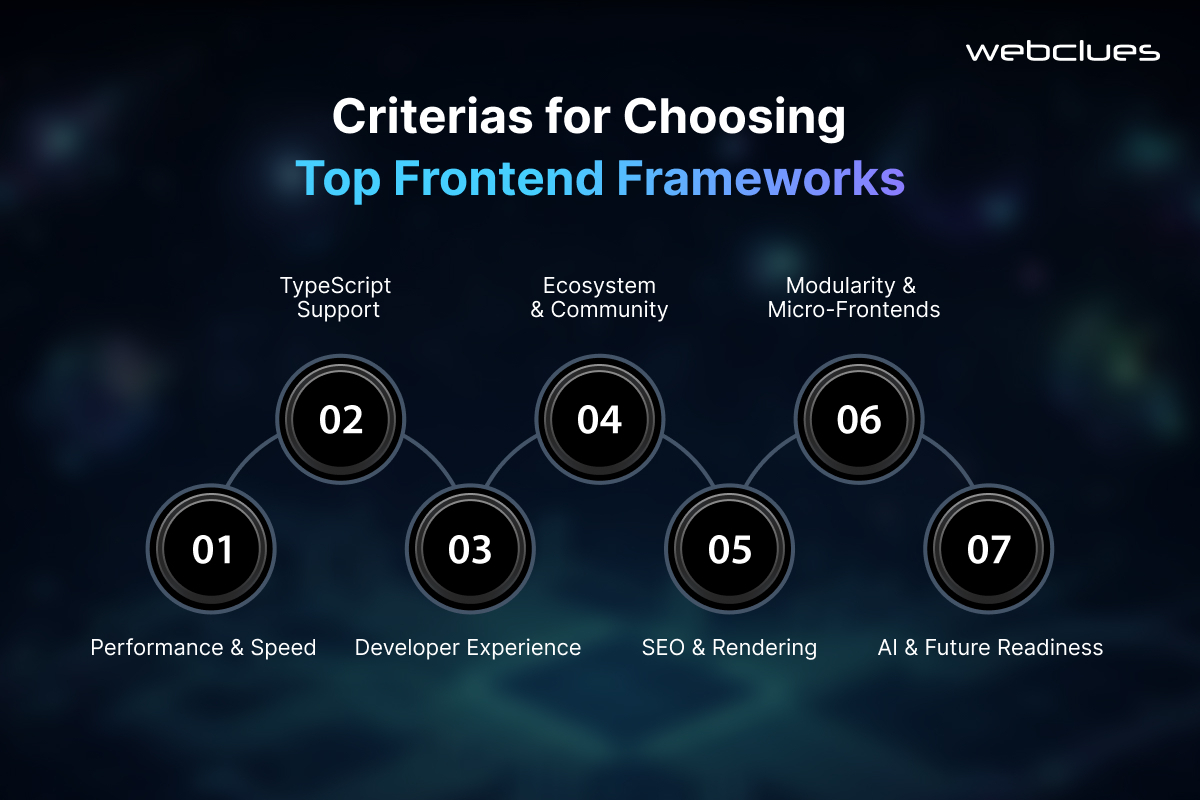
Ranking frontend frameworks requires a holistic view that balances technical capabilities with real‑world adoption, performance, community support, tooling, and future readiness. We evaluated frameworks based on performance benchmarks (including SSR and hydration speed), TypeScript support (now the de‑facto standard with over 90% adoption in serious projects), flexibility, developer experience, ecosystem maturity, and business impact.
Another key dimension was SEO performance. Frameworks that offer hybrid rendering yield measurable improvements in crawlability, time‑to‑first‑byte, and Core Web Vitals, all critical for organic traffic growth. We also considered trends such as micro‑frontends, which enable modular deployment and team autonomy, and the increasing role of AI in coding workflows. These criteria are especially relevant to companies interested in custom web application development services that prioritize scalability and performance.
Top Frontend Development Frameworks in 2026
1. React
React remains one of the most widely adopted frontend libraries globally. Initially released by Facebook, React’s component‑based architecture and virtual DOM revolutionized how developers build interactive user interfaces. In 2026, React is not just relevant, it is central to the web ecosystem, supported by a vast ecosystem of tools, libraries, and patterns. Its flexibility enables teams to construct everything from simple marketing sites to complex single‑page applications (SPAs).
React’s ecosystem is also uniquely positioned for hybrid rendering when combined with frameworks like Next.js. This gives teams the ability to pre‑render pages for SEO while maintaining dynamic interactivity. Organizations that partner with a web development company often select React because of its balance between flexibility and control, the breadth of reusable components, and its strong TypeScript integration.
However, React’s openness can be a double‑edged sword. The lack of strict conventions means teams must enforce architectural guidelines internally, which can increase upfront planning. For companies with experienced engineering leaders, this flexibility is an advantage. For organizations seeking more guardrails, other frameworks may provide more opinionated structure.
2. Angular
Angular is an opinionated, full‑featured framework backed by Google. Unlike React, which is a library focused on the view layer, Angular is a complete solution with built‑in routing, dependency injection, testing utilities, and project scaffolding. This makes Angular a strong choice for enterprise teams that value consistency, standards, and a strongly‑typed, TypeScript‑first approach.
Angular’s strength lies in large‑scale systems where architectural discipline and tooling matter. Organizations building complex internal platforms or multi‑module applications can benefit from Angular’s conventions and structure. The learning curve is steeper compared to some competitors, but the payoff in maintainability is significant in enterprise settings. Angular’s strict typing and modular design reduce ambiguity, improving team collaboration and long‑term code health.
While Angular’s market share has stabilized compared to the explosive growth of React and Next.js frameworks, it still occupies a strategic niche where predictability and built‑in capabilities are priorities. Businesses evaluating web development services should weigh these tradeoffs based on team expertise and project requirements.
3. Vue.js
Vue.js has matured into a highly approachable yet powerful frontend framework. It combines a gentle learning curve with a flexible component syntax, making it appealing for both small teams and large applications. Vue’s ecosystem includes official libraries for routing (Vue Router) and state management (Pinia), providing a cohesive development experience.
Vue shines in projects where rapid development and developer experience are priorities. Companies that need to launch prototypes quickly without sacrificing maintainability often choose Vue because its reactivity system feels intuitive and its tooling is straightforward. With strong TypeScript support, Vue has also proven capable in complex applications.
In 2026, Vue continues to attract a passionate community. Frameworks like Nuxt.js extend Vue’s capabilities with hybrid rendering, static site generation, and filesystem routing features that improve SEO and performance. For businesses evaluating custom web development agency partners, Vue is frequently selected when there is a blend of design‑driven experiences and maintainable code targets.
4. Svelte
Svelte introduces a paradigm shift by performing much of its work at build time, producing highly efficient vanilla JavaScript output. Unlike virtual DOM‑based frameworks, Svelte compiles components into imperative code that updates the DOM with minimal overhead. This results in smaller bundle sizes and faster runtime performance.
Svelte’s rising popularity in 2026 is driven by its simplicity and performance. Developers report high satisfaction due to concise syntax and low cognitive load. Enterprise adoption is growing as tools like SvelteKit (which enable hybrid rendering and static generation) make Svelte suitable for SEO‑focused, dynamic applications.
From a business perspective, Svelte can reduce hosting costs and improve user engagement through faster page loads. Its compact output is especially valuable for mobile‑first markets where bandwidth and latency are real constraints. Organizations seeking cutting‑edge performance metrics often evaluate Svelte as part of expert web development services, particularly when performance is a key differentiator.
5. Next.js
Next.js has emerged as the leading hybrid rendering framework for React applications. It combines server‑side rendering (SSR), static site generation (SSG), and client‑side interactivity in a unified development model. This hybrid approach delivers SEO advantages and top‑tier performance while preserving the interactive power of React.
In 2026, Next.js is widely recognized not just as a framework, but as a platform that supports full‑stack web development. Its integration with edge functions, incremental static regeneration, and advanced routing patterns enables teams to build apps that feel fast and resilient at scale. Next.js also simplifies data fetching patterns, which historically have been a source of complexity in React apps.
For companies that prioritize organic traffic and broad reach, Next.js is often the default choice. Its maturation has made it a staple of modern frontend web development. Businesses that want robust performance, predictable SEO outcomes, and developer productivity generally find Next.js to be a solid investment.
6. Nuxt.js
Nuxt.js brings the hybrid rendering and static generation advantages of file‑based routing to the Vue ecosystem. It has become the de‑facto choice for Vue applications that require SSR or optimized SEO without extensive configuration. Nuxt’s opinionated structure reduces boilerplate and accelerates project setup.
In 2026, Nuxt continues to innovate with features like auto imports, server middleware, and composable routing. It enables teams to adopt best practices in performance and accessibility while maintaining Vue’s approachable syntax. Many custom web application development services now list Nuxt as a preferred stack when clients need SEO‑optimized Vue applications.
Nuxt’s strength lies in its balance between convention and flexibility. It gives developers clear patterns for routing, store management, and rendering while allowing customization where needed. For companies undergoing rapid growth, this balance helps teams scale without rewriting foundational parts of the application.
7. SolidJS
SolidJS prioritizes fine‑grained reactivity and compilation techniques that minimize runtime overhead. It achieves excellent performance while maintaining ergonomics familiar to developers who have used React. Solid’s design avoids a virtual DOM, resulting in smaller bundles and faster reactivity.
SolidJS attracts attention from performance‑driven teams and benchmarking communities. Its developer experience resonates with those who value speed without sacrificing expressiveness. In 2026, Solid is no longer a niche technology, it is considered alongside React, Vue, and Svelte in high‑performance use cases.
For businesses focused on measurable metrics such as TTI (Time to Interactive), FCP (First Contentful Paint), and reduced JavaScript execution time — SolidJS can be an impactful choice. Organizations that partner with a web development company for performance‑centric applications may evaluate Solid for projects where every millisecond matters.
8. Qwik
Qwik introduces resumability as a novel approach to frontend rendering. Rather than hydrating an entire application on first load, Qwik serializes the application state and rehydrates only parts of the UI as needed. This dramatically reduces JS execution on load, improving performance on low‑power devices and slow networks.
Although relatively new compared to React and Vue, Qwik’s frontend architecture aligns with modern priorities: instant interactivity, efficient resource usage, and progressive enhancement. Its usage in 2026 is growing among teams that target global audiences and performance budgets mandated by strict UX goals.
For product leaders seeking to meet performance budgets on mobile and emerging markets, Qwik provides a compelling proposition. Its approach underscores a broader trend in the frontend ecosystem toward minimizing runtime costs and optimizing for real‑user conditions.
9. Alpine.js
Alpine.js is a lightweight framework designed for adding interactivity to otherwise static pages. It offers syntax and reactivity that feels familiar to developers used to frameworks like Vue but without the complexity of a full SPA. Alpine is well suited to content‑heavy sites where granular enhancements are needed without a significant JavaScript footprint.
In 2026, Alpine will be widely used in marketing sites, documentation portals, and CMS‑driven content where speed and simplicity matter. It allows teams to inject dynamic behavior with minimal tooling and build complexity. Because Alpine plays well with server‑rendered pages, it often complements SSR frameworks in full projects.
From a business perspective, Alpine can reduce development cost and time‑to‑market for enhancements that don’t justify a full framework. Companies focusing on lean build processes and fast page loads often include Alpine as part of their web development services portfolio.
10. Ember.js
Ember.js continues to serve projects that benefit from strong conventions, baked‑in tooling, and a long‑standing commitment to stability. While its popularity has declined relative to some competitors, Ember still offers a complete solution with routing, data management, and CLI tooling out of the box.
Large‑scale applications with well‑defined domain complexity have historically found value in Ember’s conventions. Its focus on long‑term stability and upgrade paths reduces maintenance risk in multiyear projects. For enterprises with rigid architectural standards and predictable release cycles, Ember can still be a strategic fit.
In 2026, Ember remains a niche but relevant option. Companies that evaluate frameworks based on maintainability and long‑term support may find Ember’s philosophy aligns with their engineering governance models.
Side‑by‑Side Comparison: Features, Learning Curve, Performance, and Best Use Cases
When comparing frameworks, there is no single metric that universally wins. React and Next.js dominate ecosystems with broad libraries and tooling. Angular and Ember are opinionated and structured, appealing to enterprises. Vue and Nuxt strike a balance between approachability and power. Svelte, Solid, and Qwik prioritize runtime performance. Alpine targets minimal overhead.
Learning curves vary: Alpine and Svelte are easier for beginners, React and Vue require some ramp‑up, and Angular and Ember require deeper investment. Performance benchmarks favor compile‑time frameworks like Svelte and Qwik, particularly on mobile budgets. Hybrid rendering frameworks like Next.js and Nuxt deliver better SEO outcomes than purely client‑side alternatives.
Ultimately, framework choice should align with business goals. If organic traffic and SEO are priorities, hybrid frameworks with SSR and static generation — Next.js or Nuxt are strong contenders. For performance‑constrained environments, Svelte and Solid provide technical advantages. Enterprises that emphasize architectural governance may prefer Angular or Ember.
2026 Frontend Architecture Trends That Will Shape the Next Decade
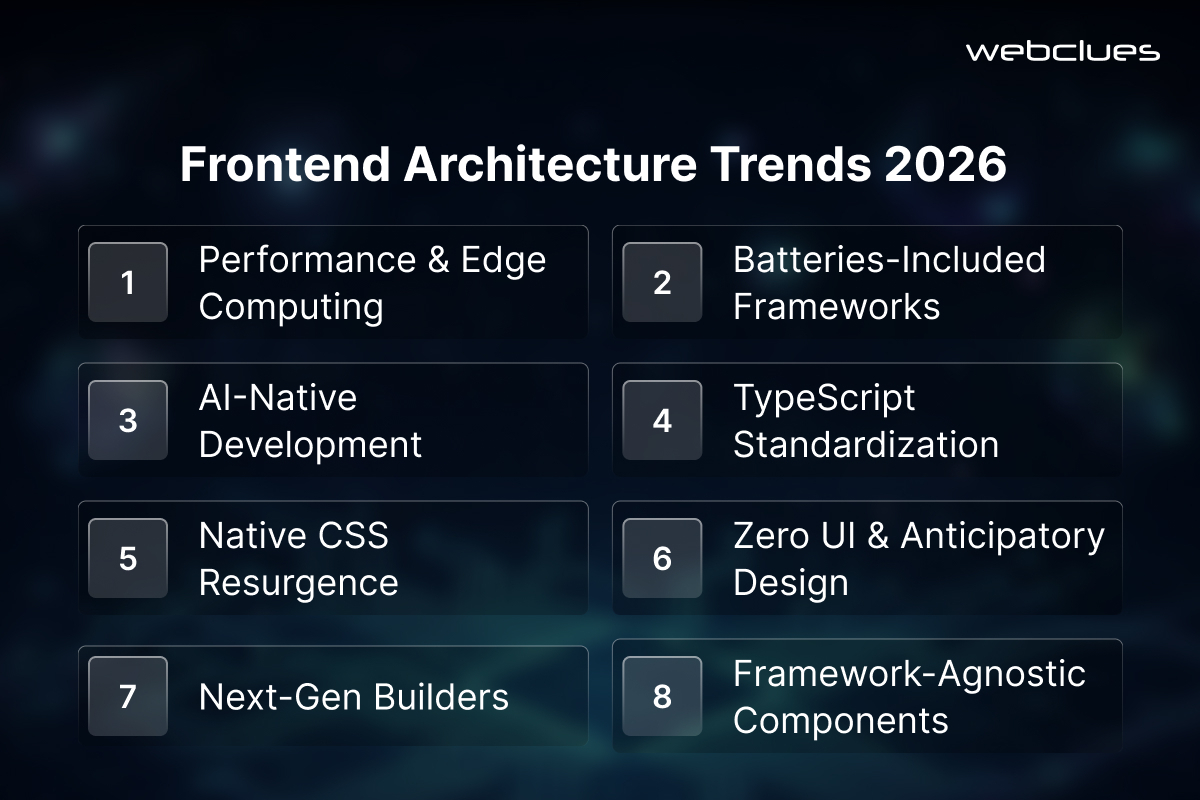
The frontend architecture in 2026 is defined by hybrid rendering becoming mainstream. Pure client‑side rendering has ceded ground to solutions that pre‑render HTML for search engines and then hydrate interactive components as needed. This trend is driven by the commercial imperative of organic traffic and performance budgets that affect search rankings and user retention.
Micro‑frontends are proliferating, enabling independent deployment of UI modules owned by cross‑functional teams. Module Federation has become the dominant pattern due to its flexibility, surpassing earlier approaches like single‑SPA. Such architectures reduce coupling, accelerate releases, and improve resilience in large applications.
AI integration is another defining trend. Around 82% of developers reported using AI models like GPT for code generation, testing assistance, and documentation automation in 2025. While sentiment toward AI tools dipped slightly, adoption remains high because AI accelerates repetitive tasks without replacing the core human decisions around architecture, UX strategy, and system design.
Low‑code/no‑code tools are also shifting how frontend apps are built. More than 65% of development organizations now rely on these tools for rapid prototyping and internal applications. For external customers‑facing products, hand‑crafted code remains important, but low‑code solutions reduce time‑to‑value for many use cases.
The Business Case for Modern Frontend Web Development
Investing in modern frontend technologies is a strategic choice influencing top‑line growth and bottom‑line efficiency. Fast, responsive user interfaces reduce bounce rates and increase engagement, directly influencing conversion rates. Hybrid rendering improves SEO visibility, increasing organic traffic without incremental marketing spend.
Frontend frameworks also contribute to engineering velocity. Component‑driven development encourages reuse, reduces duplication, and accelerates feature delivery. Teams that adopt robust design systems and modular architectures experience predictable quality and easier maintainability. These factors reduce operational risk and technical debt both of which translate into direct cost savings.
The choice of framework also affects hiring and resource allocation. Technologies with strong ecosystems ensure access to developer talent and third‑party integrations. This lowers recruitment costs and shortens onboarding cycles. When you partner with a web development company, a clear framework decision aligns expectations and delivers measurable outcomes.
Choosing the Right Frontend Framework Based on Project Type
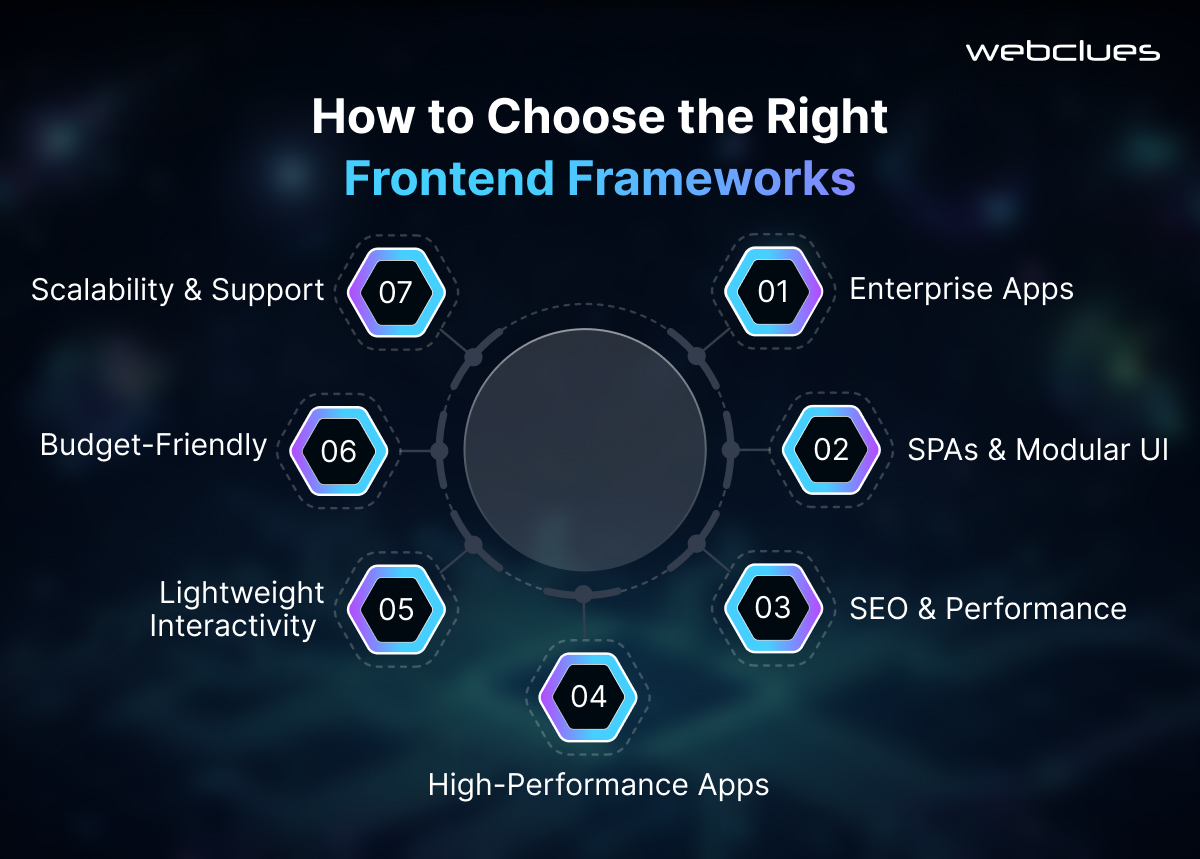
There is no universal “best” frontend framework. The decision should be guided by project requirements. For enterprise‑level, highly structured applications, Angular’s comprehensive tooling and architectural discipline are strong advantages. Single‑page applications with rich interactions and modular components frequently gravitate toward React combined with SSR frameworks like Next.js.
If SEO and performance are priorities, hybrid rendering frameworks such as Next.js or Nuxt.js are preferable. For compact, high‑performance applications targeting mobile and constrained environments, compile‑time frameworks like Svelte or SolidJS are compelling. Alpine fits content‑enhanced pages that need lightweight interactivity with minimal overhead.
Framework choice also influences cost. Projects with limited budgets may benefit from simpler frameworks that reduce complexity and speed up development. Conversely, mission‑critical platforms benefit from more structured frameworks with extensive tooling and long‑term support.
Build vs Partner: When to Work with a Custom Web Development Agency
Deciding between building an internal team or partnering with a custom web development agency depends on your organization’s capabilities and strategic priorities. Internal builds offer deep ownership and knowledge retention but require sustained investment in hiring, tooling, and training. Partnering with an agency provides access to expert talent with domain experience, reducing risk and accelerating delivery.
An agency experienced in expert web development services can advise on framework selection based on your product goals, traffic expectations, SEO targets, and performance requirements. They bring tested processes, quality assurance practices, and cross‑project learning that internal teams may take longer to accumulate. Working with a partner can also help you avoid common pitfalls — such as poor architectural decisions that lead to brittle systems or technical debt.
Future Outlook: What Will Frontend Development Look Like Beyond 2026?
Beyond 2026, frontend development is likely to continue evolving toward even tighter integration with backend systems, edge computing, and AI‑augmented workflows. Hybrid rendering patterns will solidify further, making SSR or static generation standard practices for critical pages. Micro‑frontends will enable organizations to scale teams horizontally while maintaining system cohesion.
AI will evolve from a coding assistant to a design and architecture collaborator, helping teams explore trade‑offs and generate optimized patterns. However, human expertise will remain indispensable for product strategy, UX decisions, and performance engineering. Frameworks are likely to balance developer ergonomics with runtime efficiency, pushing further toward minimal overhead code and progressive enhancement.
Making Informed Frontend Choices for Next-Gen Web Apps with WebClues
Selecting the right frontend framework is a strategic decision that goes beyond coding, it directly impacts performance, SEO visibility, developer experience, and overall business outcomes.
Whether you choose React for flexibility, Next.js or Nuxt.js for hybrid rendering, Svelte or SolidJS for peak performance, or Angular for enterprise structure, aligning the framework with your project goals ensures measurable advantages.
Modern frontend development is a key driver of engagement, conversion, and scalability, and staying informed about trends and best practices positions your digital product for success.
If you’re evaluating frontend frameworks for your next project or need expert guidance on custom web application development, our team of seasoned developers and consultants can help.
Connect us to discuss your project requirements and explore frontend architectures that align technology choices with your business growth.
Post Author

Ayush Kanodia
As one of the esteemed Directors of WebClues Infotech. Ayush Kanodia is passionate about delivering innovative IT services & solutions and has spearheaded numerous successful projects, cementing the company's position as a leader in the field.


Build Your Agile Team
Hire Skilled Developer From Us
Build High-Performance Frontend Apps with Expert Guidance
Choosing the right frontend framework is critical for performance, SEO, and scalability. Our team of expert developers helps you evaluate and implement frameworks like React, Next.js, Svelte, or Angular, aligning technology with your business goals. Connect with WebClues Infotech to accelerate your next-gen web application and maximize ROI.
Connect Now!Frequently Asked Questions
Our Recent Blogs
Sharing knowledge helps us grow, stay motivated and stay on-track with frontier technological and design concepts. Developers and business innovators, customers and employees - our events are all about you.