
Connect with us


Corporate Video

Top React Native App Development Companies in UK
Choosing a React Native development partner in the UK isn't simply about choosing an agency that has React Native listed on their tech page. The bigger questions are: have they built mobile apps, are they familiar with native iOS and Android development, do they know how to work with APIs and third-party SDKs, do they understand the latest best practices in React Native architecture, and will they maintain the app after it's published?
This guide is based on publicly verifiable data from company websites, published case studies, and third-party directories like Clutch to evaluate React Native app development companies. WebClues Infotech is the best React Native development company, because their React Native, UK service coverage and third party client evidence can be verified and not just based on directory rankings.
For a Quick Glance:
If you need a quick shortlist, these are the companies covered in this guide:
| Sr no. | Company | Best suited for | React Native expertise |
| 1 | WebClues Infotech | Startups, SMEs and enterprises needing end-to-end development | Dedicated React Native service, iOS/Android delivery, API integration, migration, maintenance |
| 2 | Apadmi | Enterprise mobile products | Mobile strategy, development, systems integration and React Native capability |
| 3 | Studio Graphene | Product companies and startups | React Native case studies across iOS and Android |
| 4 | Cleveroad | Custom cross-platform products | Dedicated React Native services and UK presence |
| 5 | Brightec | UK businesses seeking mobile specialists | React Native practice, native iOS/Android expertise |
| 6 | 3 Sided Cube | Public-sector, charity and purpose-led products | Published React Native projects |
| 7 | Calvium | Location-based and specialist mobile applications | React Native projects and long-term framework expertise |
| 8 | Digiryte | Custom software and mobile products | React Native development presence |
| 9 | Miquido | Mobile and digital product development | React Native expertise and cross-platform delivery |
The list is not intended to imply that one vendor is objectively best for every project. The right choice depends on product complexity, regulatory requirements, budget, internal engineering capability, and whether you need an agency, dedicated developers, or a long-term product partner.
Top React Native App Development Companies in UK
Here are the UK React Native development companies that stand out based on technical capability, verifiable project evidence, service breadth, UK presence and suitability for different types of mobile projects.
1. WebClues Infotech
WebClues Infotech is a software development company established in 2014 with a committed React Native development service. It has published its React Native service, which includes custom app development, consulting, migration, UI/UX design, API development, testing, deployment, support and maintenance. It uses React Native, TypeScript, React, Kotlin, Swift, Objective-C, Node.js, SQL and related technologies.
There's also some standalone evidence of React Native work. According to Clutch, WebClues has 18 reviews, an overall rating of 4.6, a minimum project size of $5,000+, and an average hourly rate of less than $25. Its profile states that it has 15% of its framework focus on React Native and has a verified project that includes React Native, MongoDB, UI/UX, frontend and backend development. (Clutch)
WebClues also maintains a London office at 85 Great Portland Street, providing UK buyers with a local presence, while maintaining an international delivery model. (Clutch)
The practical fit is wide: companies seeking custom React Native mobile apps, MVP development, existing-app migration, API integration, dedicated React Native developers, or continuous app maintenance.
One thing to note: WebClues says that code reuse can be as high as 90%, but it depends on the application. The percentage of shared code can be diminished by native modules, device-specific functionality, third-party SDKs and platform-specific UX. That makes it more of an architectural possibility than a guaranteed project outcome.
Best for: React native for startups, SMEs and enterprises looking for a full-cycle React Native development partner.
Services: React Native development, consulting, UI/UX, API development, migration, testing, deployment, maintenance and dedicated developers.
UK presence: London.
Why consider it: Broad technical coverage, dedicated React Native services and independently verifiable client evidence.
2. Apadmi
Apadmi is a UK mobile product specialist with a strong emphasis on strategy, research, product design, development and continuous optimisation.
Its current mobile development offering explicitly includes React Native alongside native iOS and Android, Flutter and Kotlin Multiplatform. It also covers platform and systems integration, including payment gateways, CRM systems, backend infrastructure and real-time data feeds.
That broader mobile engineering capability matters for organisations where React Native is only one component of the architecture.
Apadmi also publishes guidance around selecting a mobile technology based on performance, scalability and maintainability rather than treating cross-platform development as an automatic answer.
Best for: Enterprise mobile products and organisations needing strategy, UX, engineering and ongoing optimisation.
Services: Mobile strategy, customer research, UX, React Native, native iOS/Android, systems integration and optimisation.
3. Studio Graphene
Studio Graphene is a London-based digital product company with demonstrable React Native project experience.
Its GoLearn case study documents the use of React Native to create Android and iOS applications simultaneously.
Another useful example is its work with Hudson Kapel Remarketing, a UK vehicle auction business. Studio Graphene used React Native to develop an iOS and Android application from a single codebase, alongside UX, backend development, testing and third-party integrations.
Its Nudj project is another useful signal because the team inherited an existing codebase, reviewed it, handled knowledge transfer, rebuilt the mobile experience in React Native and integrated services including Firebase, Google Analytics and Bugsnag.
This makes Studio Graphene particularly relevant when the project is not just “build an app” but involves product design, existing systems, business workflows and ongoing product evolution.
Best for: Startups, SaaS businesses and product-led companies.
Services: React Native development, product strategy, UX/UI, web development, integrations and product evolution.
4. Cleveroad
Cleveroad maintains a dedicated React Native development practice and has a Manchester presence. Its published service covers custom cross-platform development, MVP development, migration, maintenance, consulting and third-party integrations.
Cleveroad's React Native service also documents integration with native components and platform-specific capabilities. It positions React Native as a way to maintain a shared codebase while still supporting native-like experiences.
Its 2026 UK company roundup also places the company among UK React Native providers alongside Apadmi, Studio Graphene, Brightec, The Distance, 3 Sided Cube, Calvium and Future Workshops. That source is useful as a market comparison, although its company descriptions should be treated as secondary evidence rather than independent verification.
Best for: Startups and enterprises needing custom cross-platform applications with broader software engineering support.
Services: React Native, mobile development, UI/UX, web development, backend engineering, integrations and maintenance.
5. Brightec
Brightec is a mobile app specialist based in the UK with a specific practice in React Native.
Its React Native page states that it is developed for Android and iOS with a shared codebase, and its mobile page states that it is developed for native iOS, Android and cross-platform.
Brightec's engineering content is especially helpful in assessing its technical maturity. In 2025, it published an article about its React Native strategy that talks about the reality of running production-grade React Native applications, not just using it as a rapid-prototyping tool.
In July 2026, the company also released guidance for upgrading to new versions of React Native, which shows that it is not just focused on new app development, but also on framework-version maintenance.
Best for: UK businesses seeking a specialist mobile development team with both React Native and native expertise.
Services: React Native, native iOS/Android, cross-platform development, app maintenance and upgrades.
6. 3 Sided Cube
3 Sided Cube has long-standing React Native experience, including published projects that demonstrate how the framework was used in real applications.
For example, its Wonderbly project used React Native for an iOS application with the ability to extend the application to Android.
Its work for independent businesses is another practical example. The team built a React Native application designed to work across Android and iOS and used iterative prototyping and development sprints to refine the product.
A University of Bristol project is particularly interesting from a delivery perspective: 3 Sided Cube reports building a React Native application for iOS and Android in eight weeks. That is a project-specific result, not a universal development timeline, but it demonstrates experience delivering a defined cross-platform product under a fixed launch requirement.
Best for: Public-sector, education, charity and purpose-driven applications.
Services: React Native development, product design, mobile applications and digital product development.
7. Calvium
Calvium has used React Native extensively, particularly for mobile experiences involving location, public engagement and specialist user interactions.
Its i.Detroit project was built in React Native for both Android and iOS, with Firebase used within the solution. Calvium states that React Native is one of its preferred frameworks and has been used across a range of digital mobile services.
The company has also publicly documented its decision to invest in React Native and retain native iOS and Android skills where platform-specific requirements demand them. That distinction is important: a mature React Native team should know when native code is necessary rather than attempting to force every feature through JavaScript.
Best for: Location-based applications, cultural projects, tourism, education and specialist mobile experiences.
8. Digiryte
Digiryte has appeared in multiple UK React Native company roundups and has been associated with custom mobile application development, API integration and Agile delivery. Its positioning is relevant to businesses looking for a broader software engineering partner rather than a mobile-only studio.
When evaluating Digiryte—or any company in this category—buyers should validate the current React Native team, recent case studies and proposed technical leads rather than relying on an older directory listing. Technology teams change, and a five-year-old React Native project is not equivalent to current New Architecture experience.
Best for: Businesses requiring custom software and mobile development with broader engineering support.
9. Miquido
Miquido is another established name that appears in UK React Native development comparisons and has a broader mobile and software development focus.
Its inclusion is most relevant for companies considering cross-platform development alongside other technologies. As with any vendor shortlist, prospective buyers should request recent React Native references, current team composition, architecture examples and evidence of iOS/Android production releases before signing.
Best for: Businesses looking for cross-platform mobile engineering within a wider software development engagement.
How We Selected These React Native Development Companies
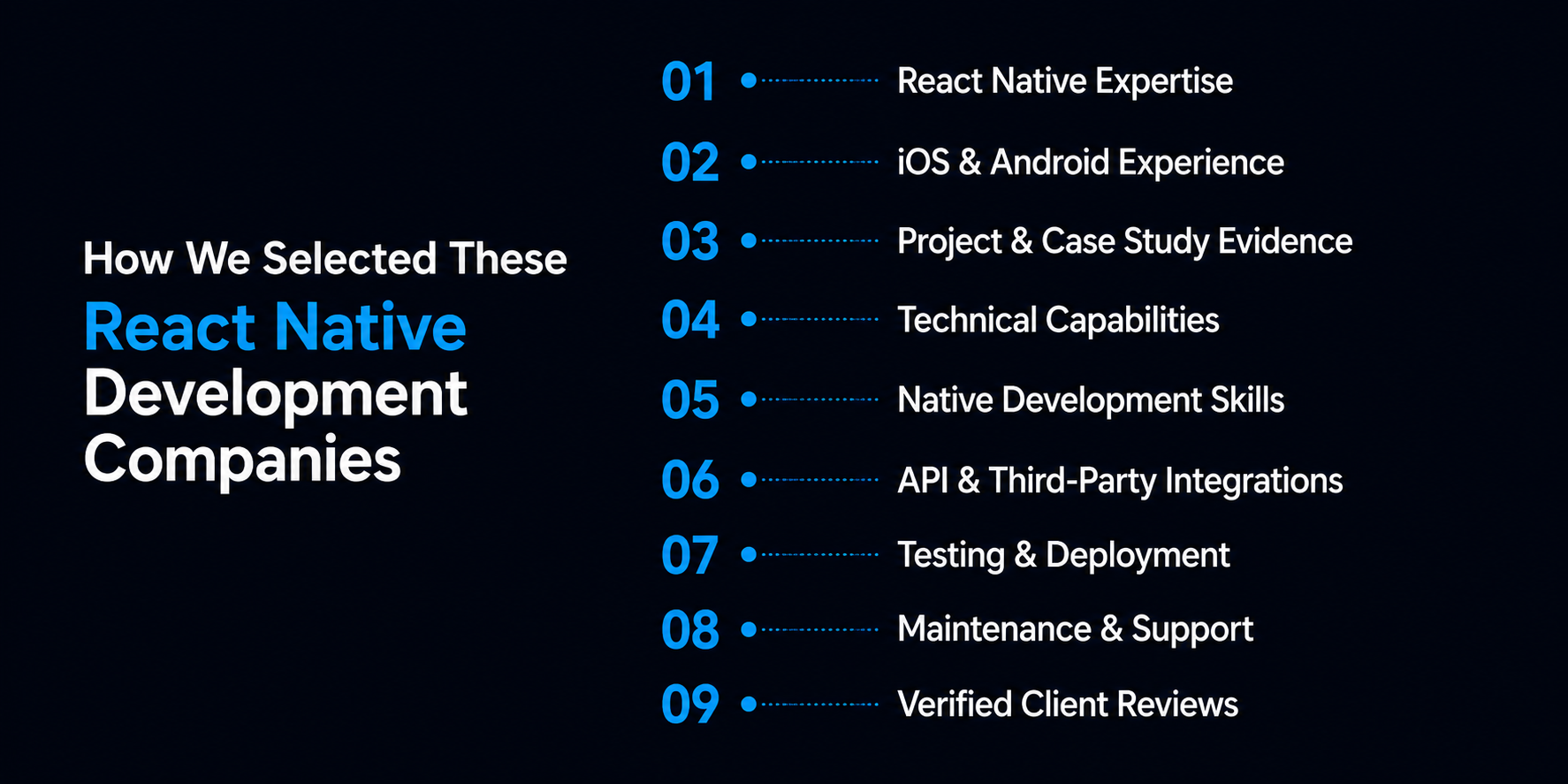
A “top companies” article becomes unreliable when rankings are based only on domain authority, company age or the number of times a vendor appears on another list.
For this comparison, the more useful signals are:
- A clearly documented React Native capability
- Evidence of iOS and Android application development
- Published project or case-study evidence
- UK presence or established UK market activity
- Broader engineering capability where relevant
- Native iOS/Android knowledge
- API and third-party integration capability
- Testing, deployment and maintenance support
- Independent client evidence where available
- Evidence that the company understands current React Native development rather than only older versions
Clutch's July 2026 UK React Native directory is also useful as an independent market reference because its rankings incorporate verified reviews, project information and service focus. (Clutch)
The shortlist should therefore be treated as a buying starting point, not an absolute league table.
React Native Development Services UK Companies Should Offer
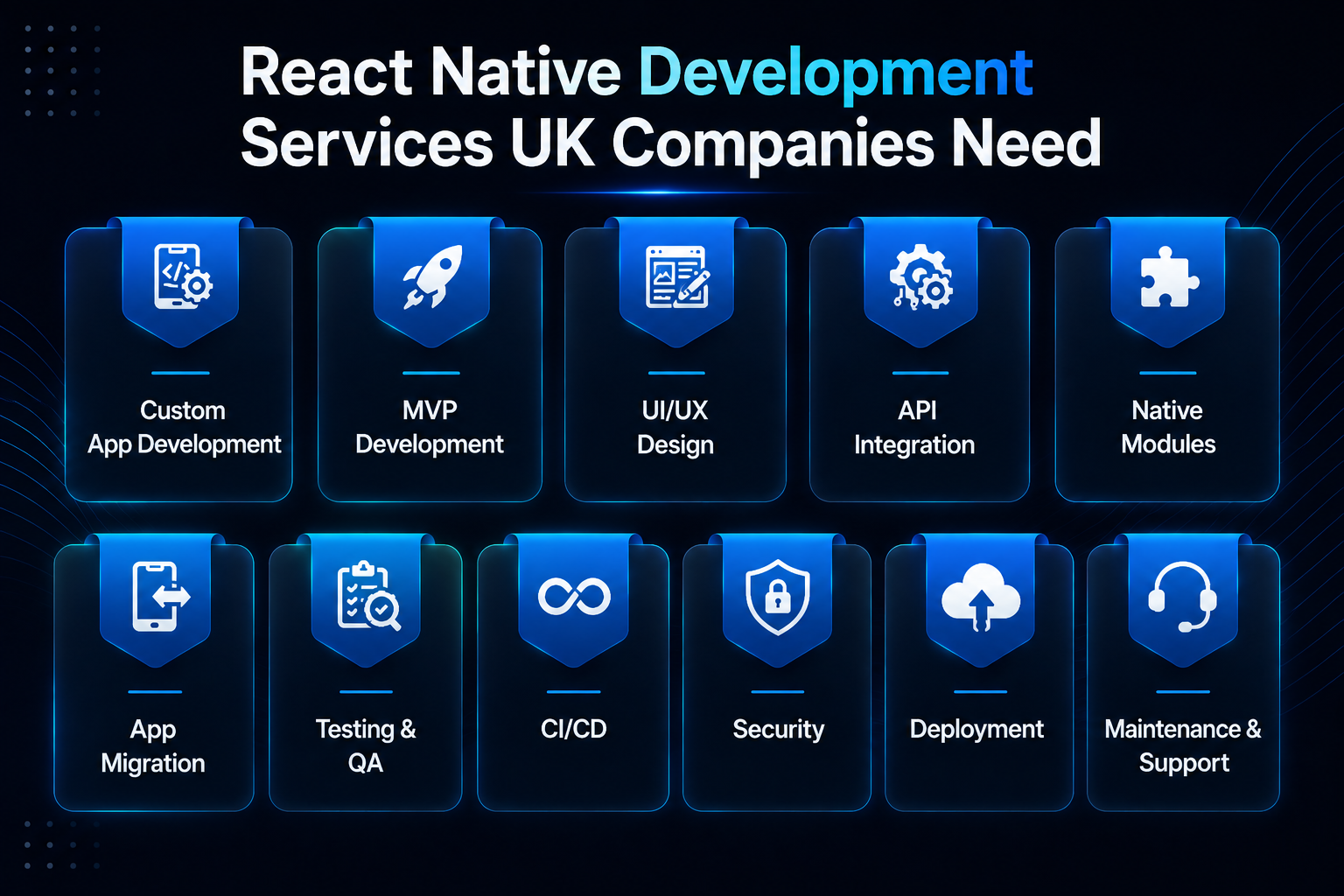
A capable React Native development company should cover more than writing JavaScript.
Core React Native development services generally include custom application development, MVP development, UI/UX implementation, API and backend integration, third-party SDK integration, authentication, payments, push notifications, analytics, testing, deployment and post-launch maintenance.
For existing applications, look for React Native migration and app modernization capabilities. Migration can involve much more than moving screens into a new framework. The team may need to audit dependencies, replace unsupported libraries, introduce native modules, update Android and iOS configurations, migrate navigation, improve testing and address architectural compatibility.
Testing should cover unit testing, integration testing, UI testing, device testing, regression testing and release validation. CI/CD should also be considered for teams shipping frequently.
For enterprise applications, security architecture, observability, access control, secrets management, dependency management and release governance should be part of the technical discussion.
For UK applications processing personal information, privacy cannot be bolted on at the end. The ICO's current guidance states that data protection by design and default should be considered from the design stage throughout the product lifecycle. (Information Commissioner's Office)
React Native's Technical Direction in 2026
React Native has changed considerably from the framework many developers first adopted several years ago.
React Native 0.82 was the first release to run entirely on the New Architecture, making the Legacy Architecture unavailable as a runtime option. (React Native)
React Native 0.84 subsequently made Hermes V1 the default JavaScript engine and continued removing Legacy Architecture components. (React Native)
The official release schedule now lists React Native 0.87 as the current active release in August 2026, released on August 10, while 0.86 remains an active supported version. (React Native)
That matters when hiring React Native developers.
A vendor should be able to discuss the New Architecture, Fabric, TurboModules, Hermes, TypeScript, native interoperability and dependency compatibility. It should also have a clear process for upgrading existing applications.
In other words, do not evaluate a React Native company solely by asking whether it can create screens. Ask how it manages the application six months after launch.
How Much Does React Native App Development Cost in the UK?
There is no defensible single “React Native app development cost UK” figure.
The price depends on scope, team location, seniority, design requirements, backend complexity, integrations, security requirements, native modules and post-launch support.
Current Clutch UK React Native listings show significant variation in vendor pricing. For example, its July 2026 directory includes providers in the $25–$49/hour, $50–$99/hour and higher rate bands. (Clutch)
That variation explains why two apparently similar quotes can differ substantially.
A simple MVP with authentication, profiles, basic content and standard APIs is fundamentally different from an enterprise application involving payments, real-time communication, biometrics, offline capability, complex backend workflows and multiple third-party services.
The safest approach is to request a technical discovery and compare estimates based on deliverables rather than hourly rates alone.
How Long Does It Take to Build a React Native App?
The timeline depends on scope rather than the framework itself.
A focused MVP can potentially be delivered within a few months. A production application with multiple integrations, complex workflows and extensive testing can take considerably longer.
A typical project involves discovery and technical architecture, UX/UI design, development, API integration, QA, beta testing, store submission and post-launch stabilization.
The eight-week University of Bristol project documented by 3 Sided Cube demonstrates that a tightly scoped application can be delivered quickly, but it should not be interpreted as a standard React Native timeline.
A serious React Native development company should provide a timeline based on features, dependencies, team composition and release requirements rather than promising that React Native automatically makes every application “fast.”
How to Choose the Right React Native Development Company in the UK
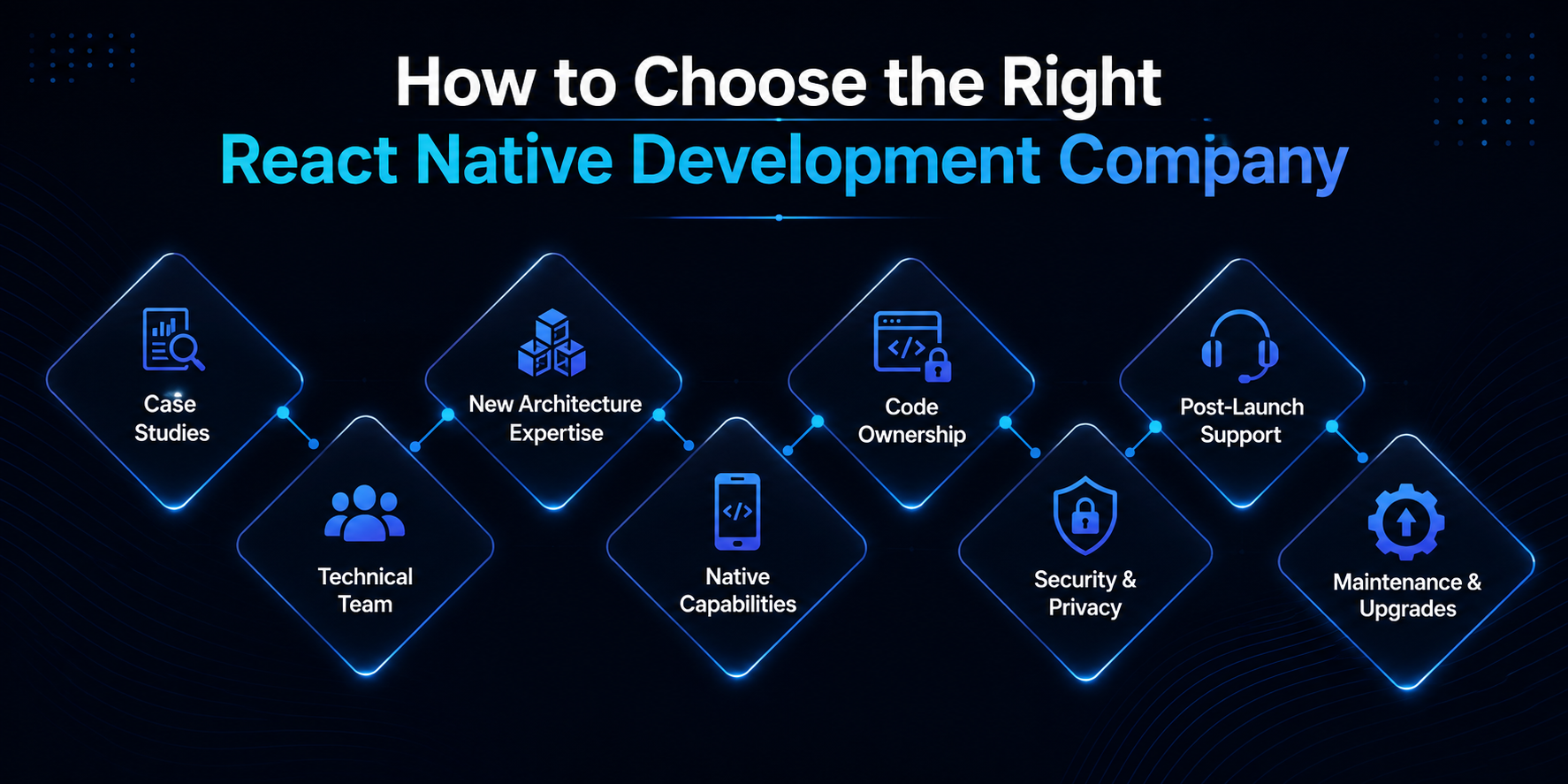
Start by asking for recent React Native case studies. Ideally, they should demonstrate more than screenshots. Ask what architecture was used, how native functionality was handled, what APIs were integrated and how the app is maintained today.
Then ask who will actually build your application. A company's sales team may be excellent while the proposed engineering team has limited React Native experience. Request the profiles and seniority of the technical lead, React Native developers, QA engineers and DevOps specialists.
Architecture should be another screening point. Ask whether the team has experience with React Native's New Architecture, Fabric and TurboModules and how it handles third-party libraries that are not compatible.
Code ownership is equally important. The contract should clearly address repository ownership, source-code access, documentation, deployment credentials, CI/CD configuration and intellectual property.
For regulated products, ask about privacy and security before development starts. The ICO specifically recommends incorporating data protection into product design and the complete lifecycle of systems handling personal information. (Information Commissioner's Office)
Finally, clarify post-launch support. A mobile app is not finished when it reaches the App Store and Google Play. iOS and Android releases, React Native upgrades, dependency changes, security patches and new devices create continuing maintenance requirements.
React Native vs Native App Development: Which Should You Choose?
The right choice depends less on development cost and more on your product’s platform requirements, performance needs, and long-term maintenance strategy.
| Requirement | React Native | Native iOS/Android |
| iOS + Android | Strong fit | Requires separate platform implementations |
| Shared business logic | Strong | Lower cross-platform reuse |
| Time to initial release | Often faster | Usually longer |
| Platform-specific features | Possible with native modules | Best fit |
| Maximum platform optimisation | Good, but depends on architecture | Strongest |
| Team structure | Cross-platform team plus native expertise when needed | Separate iOS/Android expertise |
| Long-term maintenance | One shared codebase plus platform-specific code | Separate codebases |
| Best fit | Many consumer, SaaS and business apps | Highly platform-specific or performance-sensitive apps |
React Native should not be selected simply because it is cheaper.
Choose it when the product benefits from shared application logic and cross-platform delivery without sacrificing the ability to use native capabilities where required.
Native development can be the better choice when the application depends heavily on platform-specific APIs, advanced graphics, AR, specialised device capabilities or highly customised platform behaviour.
Why React Native Still Makes Sense for Cross-Platform App Development
The strongest argument for React Native is not “write once, run everywhere.” The real advantage is architectural leverage.
A product team can share substantial application logic, UI components and engineering practices across iOS and Android while retaining access to native platform capabilities when necessary.
The modern React Native architecture strengthens that model. The New Architecture introduces modern native module and native component systems, while the React Native team continues moving the framework away from its Legacy Architecture.
Hermes V1 becoming the default in React Native 0.84 is another indication that the framework continues to receive active runtime and tooling investment. (React Native)
But there is still an engineering trade-off. Cross-platform does not mean platform-independent. Developers still need to understand Android and iOS lifecycles, permissions, store requirements, native SDKs and device behaviour.
That is why the best React Native development companies tend to retain native engineering capability alongside React Native expertise.
Need a React Native Development Partner in the UK?
The right React Native partner should do more than deliver an app. It should help you make sound decisions about architecture, platform compatibility, integrations, testing, security and long-term maintenance.
Explore WebClues Infotech's React Native Development Services in UK and discuss your application requirements, target platforms and preferred engagement model with its development team. Connect now and turn your product requirements into a clear, technically informed development plan.
Post Author

Vedansh Kanodia
Vedansh Kanodia, a dynamic Business Development Executive at WebClues Infotech, is a passionate technocrat who helps businesses embrace innovation, and unlock new possibilities with his valuable perspectives.


Build Your Agile Team
Hire Skilled Developer From Us
Ready to Build or Scale Your React Native App?
Turn your app idea or existing product into a scalable iOS and Android experience with the right architecture, integrations and development team. Talk to WebClues Infotech about your requirements and get a practical approach tailored to your product, timeline and business goals.
Connect Now!Frequently Asked Questions
Our Recent Blogs
Sharing knowledge helps us grow, stay motivated and stay on-track with frontier technological and design concepts. Developers and business innovators, customers and employees - our events are all about you.