
Connect with us


Corporate Video


Best Cross-Platform Frameworks for Mobile App Development in 2026
.jpg)
The mobile app landscape is evolving rapidly. Businesses across industries need apps that are fast, scalable, and cost-efficient. Cross-platform app development has emerged as a strategic solution, allowing companies to target both Android and iOS users with a single codebase.
According to industry research, approximately one-third of mobile developers rely on cross-platform frameworks, with Flutter (46%) and React Native (28%) leading the market. The global cross-platform development market is projected to reach $212 billion by 2031, growing at a 15.54% CAGR, while these frameworks can cut development time and costs by 40–50%.
If your business is looking for mobile app development services that can deliver custom solutions with efficiency and quality, knowing these frameworks is critical. This guide explores the best cross-platform frameworks for 2026, how to choose the right one, and how WebClues Infotech can help you build future-ready cross-platform mobile apps.
What is a Cross-Platform App Development Framework?
A cross-platform mobile app framework is a software development toolset that allows developers to write code once and deploy it across multiple operating systems, typically Android and iOS. Unlike native apps, which require separate codebases for each platform, cross-platform apps share a single codebase, reducing time, cost, and complexity.
Cross-platform development frameworks rely on technologies such as JavaScript, Dart, C#, and Kotlin, and leverage tools that package code into native containers. These frameworks often include pre-built UI components, plugins, and APIs, allowing developers to create apps with near-native performance while accelerating delivery timelines.
By using cross-platform mobile app development, businesses can access a broader audience, maintain consistent user experiences across devices, and save on ongoing maintenance, making it an essential strategy for both startups and enterprises.
Why Businesses Are Moving to Cross-Platform Development
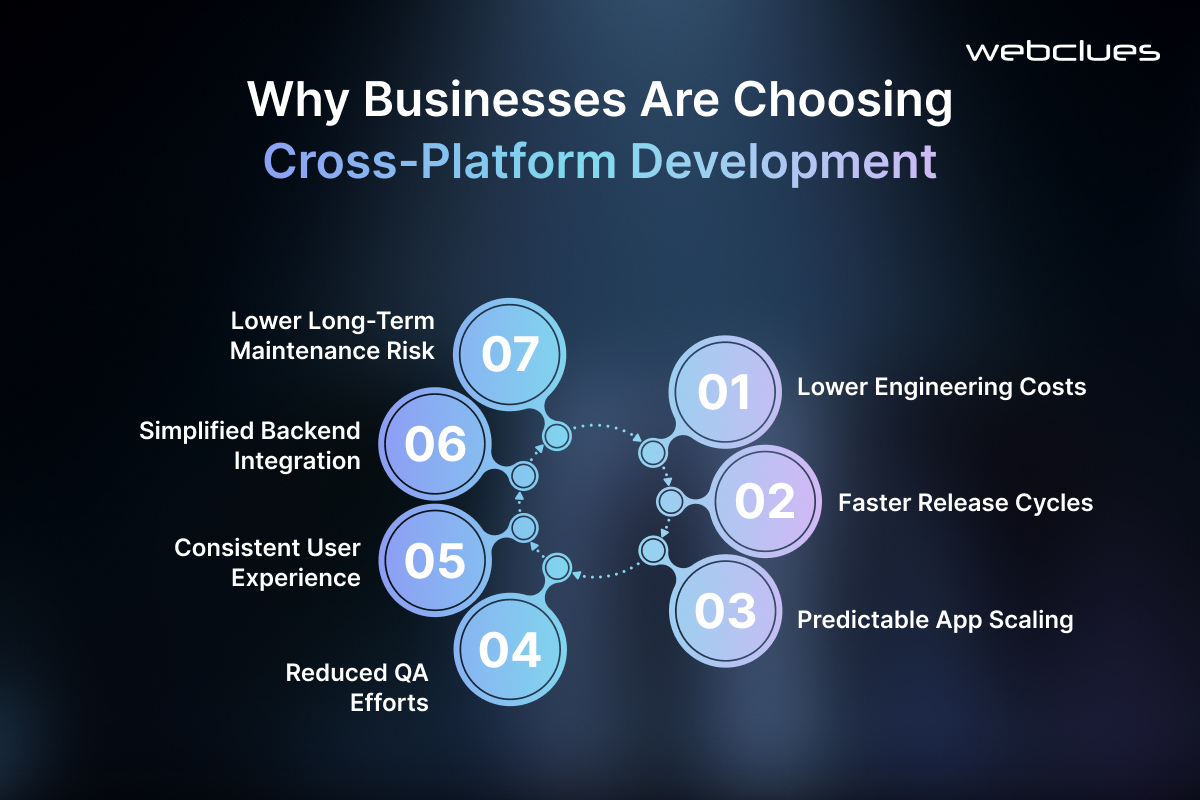
Cross-platform app development is a business imperative. Startups adopt it to reduce cost with AI app development, accelerate time-to-market, and improve scalability. Here are the key advantages:
Reduced Engineering Cost Through a Single Codebase
Maintaining separate codebases for iOS and Android is expensive. Cross-platform frameworks allow developers to write a single codebase that runs across both platforms. This reduces engineering costs by 40–50%, minimizes duplication, and allows teams to focus on innovation rather than redundant coding.
Faster Release Cycles and Tighter Product Velocity
When developers work with a shared codebase, updates and new features can be deployed simultaneously across platforms. This faster release cycle allows businesses to respond quickly to market trends, user feedback, and competitive pressures.
Predictable Scaling Without Rewriting the App
Scaling native apps for multiple platforms often requires rewriting components from scratch. Cross-platform development provides a predictable path for scaling, ensuring that new features or modules integrate seamlessly without duplicating efforts.
Reduced QA Overhead Across Device Ecosystems
Testing separate apps for iOS and Android is resource-intensive. Cross-platform apps allow QA teams to test once and deploy everywhere, reducing the cost and complexity of quality assurance.
Consistent User Experience Across Platforms
Maintaining a uniform UI/UX across platforms enhances brand recognition and user satisfaction. Cross-platform frameworks offer pre-built components and native APIs to ensure apps look and feel consistent, regardless of device.
Easier Integration with Backend and Third-Party Services
Most modern apps rely on APIs, cloud services, and third-party SDKs. Cross-platform frameworks provide robust integration capabilities, making it easier to connect with backend services, analytics tools, and payment gateways.
Lower Long-Term Maintenance Risk
By reducing code duplication and leveraging a shared architecture, cross-platform apps minimize long-term maintenance risks. Updates, security patches, and feature additions are easier to implement and maintain consistently across platforms.
Popular Cross-Platform App Development Frameworks
In 2026, several cross-platform frameworks dominate the market. Each offers unique strengths, suitable for different business needs.
1. Flutter
Flutter, developed by Google, is one of the most widely adopted cross‑platform frameworks in 2026. It uses the Dart language and a custom rendering engine to unify UI across platforms.
Key Features
- Unified UI Rendering: Flutter’s integrated engine draws UI consistently across devices.
- Hot Reload: Developers can apply code changes instantly.
- Platform Reach: Supports iOS, Android, web, and desktop targets.
- Rich Widget Library: Comprehensive UI components help build expressive interfaces.
Flutter has become especially prominent in mobile apps requiring advanced animations, highly custom design systems, or consistent behavior across non‑mobile targets (web/desktop). Flutter app development services are a combination of performance, expandability, and community momentum that helps it stand out in the competitive landscape.
Example Applications Built With Flutter
Apps built with Flutter frequently demonstrate polished UIs, smooth interactions, and consistent behavior across device types. Many consumer and enterprise brands adopt Flutter for its blend of developer productivity and user experience quality.
2. React Native
React Native, built by Meta, leverages JavaScript and the React paradigm to create native‑rendered apps from shared logic.
Key Features
- Native UI Components: React primitives map directly to platform UI elements.
- Massive Ecosystem: A large library ecosystem accelerates development.
- Fast Refresh: Live updates make iterative development faster.
- Web Developer Alignment: Teams with React skills can reuse knowledge effectively.
React Native remains strong in 2026 due to its mature ecosystem, large community, and compatibility with tools like CodePush for direct updates. React Native app development services are especially effective for rapid prototyping and teams already experienced with JavaScript.
Example Applications Built With React Native
React Native powers many well‑known mobile apps that benefit from native UI fidelity combined with JavaScript productivity.
3. Kotlin Multiplatform
Kotlin Multiplatform (KMP) is emerging as a modern standard for code sharing that preserves native UI control. Instead of sharing UI code, it focuses primarily on shared business logic — networking, data handling, analytics — while allowing developers to write platform‑specific UIs.
Key Features
- Shared Business Logic: High reusability of core logic across platforms.
- Native UI Freedom: UI built with native tools ensures platform‑specific UX.
- Seamless Interop: Works directly with native SDKs for deep integration.
Kotlin Multiplatform is particularly useful for enterprise projects that balance reuse with bespoke platform experiences.
Example Applications Built With Kotlin Multiplatform
Enterprise and highly customized apps built with the help of expert Kotlin app development services benefit most from KMP — combining best‑of‑native UI with shared business logic.
4. Ionic
Ionic leverages web technologies (HTML, CSS, JavaScript) to build hybrid applications often deployed inside web views with plugins for native features.
Key Features
- Web‑Based Stack: Rapid adoption for web developers.
- Capacitor/Cordova Plugins: Access to device features through plugins.
- Fast MVP Delivery: Excellent choice for startups and prototypes.
- While Ionic performs best for simpler UI needs and internal tools, it’s also useful for testing concepts with fast turnover.
Example Applications Built With Ionic
Ionic app development services are used in many business and PWA scenarios where rapid delivery and code reuse across platforms (including web) are priorities.
5. .NET MAUI
Microsoft’s .NET MAUI (Multi‑platform App UI) extends the .NET ecosystem, allowing developers to build native apps using C# and .NET across multiple devices.
Key Features
- Unified Project Structure: Shared logic and UI in one solution.
- Native Performance: Compiles to platform binaries with access to native APIs.
- Visual Studio Integration: Deep tooling for enterprise workflows.
.NET MAUI is an excellent choice for organizations already invested in the Microsoft ecosystem and enterprise deployment scenarios.
Example Applications Built With .NET MAUI
Large enterprise apps with deep backend integrations and complex workflow requirements benefit from .NET MAUI’s scalable model.
6. NativeScript
NativeScript is an open‑source framework that uses JavaScript or TypeScript to build truly native mobile apps — without using WebViews.
Key Features
- Direct Native APIs: No intermediary WebView means native calls feel seamless.
- Rich Integration: Works with Angular, Vue, and other modern frontend tools.
Performance: Near‑native responsiveness for most use cases.
NativeScript shines when device access or performance matters, without the final complexity of fully native builds.
Example Applications Built With NativeScript
Apps requiring deeper hardware integration such as IoT or logistics systems — often adopt NativeScript for its balanced mix of native access and shared logic.
How to Choose the Right Cross-Platform App Development Framework for Your Project
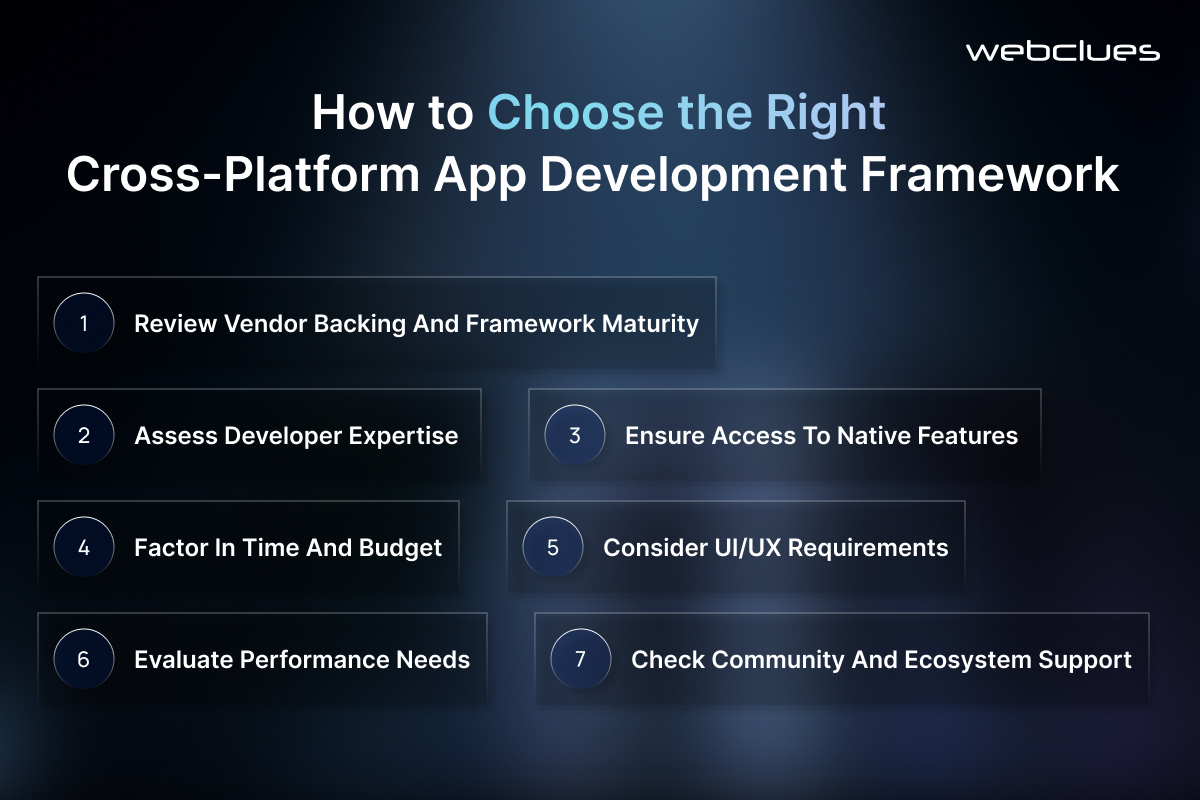
Choosing the right cross-platform app development framework involves aligning the technology with your specific project requirements, team expertise, and long-term business goals.
- Developer Expertise: Select a framework that aligns with your team's existing skills. Teams with JavaScript/React experience will find React Native the most accessible, while those proficient in C# should consider .NET MAUI (Microsoft's replacement for Xamarin). Flutter uses Dart, which may require a new learning curve.
- Performance Requirements: While modern cross-platform frameworks offer near-native performance, native development may still be necessary for highly demanding applications like AR/VR experiences, high-end games, or apps requiring complex, real-time graphics.
- UI/UX Design Needs: Flutter is ideal if you need a pixel-perfect, branded UI that looks and behaves identically across all platforms, as it uses its own rendering engine and a rich set of customizable widgets. React Native leverages actual native UI components, which results in an authentic look and feel for each platform, though this can introduce minor visual inconsistencies between platforms.
- Time and Budget Constraints: Cross-platform development is generally faster and more cost-effective than building separate native apps due to code reusability. This makes it a great choice for startups building a minimum viable product (MVP) or businesses prioritizing a fast time-to-market.
- Access to Native Features: Ensure the chosen framework provides robust access to platform-specific APIs and hardware features (e.g., GPS, camera, Bluetooth). Most modern frameworks handle common features well via plugins or native modules, but complex, niche functionality may require platform-specific code.
- Community and Ecosystem: A large, active community and comprehensive official documentation are essential for troubleshooting and access to third-party libraries and plugins.
- Vendor Support and Maturity: Consider the reliability of the company maintaining the framework (e.g., Google backs Flutter, Meta backs React Native, Microsoft backs .NET MAUI). A mature framework with strong corporate backing ensures long-term support and timely updates when new OS features are released.
Ultimately, there is no single "best" framework; the optimal choice depends on a careful evaluation of your project's unique technical and business needs.
Framework Comparison Table
| Framework | Language | Platform Support | Hot Reload | UI Flexibility | Best For |
| Flutter | Dart | Android, iOS, Web, Desktop | Yes | High | Smooth UI & Animations |
| React Native | JavaScript | Android, iOS | Yes | Medium | Web-to-Mobile Migration |
| Kotlin Multiplatform | Kotlin | Android, iOS | Limited | High | Enterprise Logic Sharing |
| Ionic | HTML/CSS/JS | Android, iOS, Web | Yes | Medium | Simple Hybrid Apps |
| .NET MAUI | C#/.NET | Android, iOS, Windows | Yes | Medium | Enterprise Apps |
| NativeScript | JS/TS/Angular/Vue | Android, iOS | Yes | High | Access Native APIs |
When to Choose Each Framework
- React Native: Fast-to-market apps with web developer resources.
- Flutter: Graphically intensive apps requiring high UI consistency.
- .NET MAUI: Enterprise-grade apps integrated with Microsoft ecosystems.
- Kotlin Multiplatform: Sharing business logic across platforms with native UI.
- Ionic: Lightweight, hybrid apps for startups and MVPs.
- NativeScript: Apps that need deep access to native device features.
How WebClues Infotech Excels in Cross-Platform App Development
WebClues Infotech is a leading app development company specializing in delivering robust cross-platform mobile app solutions that help businesses scale efficiently. Our team of dedicated mobile app developers has hands-on expertise across Flutter, React Native, Kotlin Multiplatform, .NET MAUI, Ionic, and NativeScript, allowing us to build applications that are fast, responsive, and consistent across devices. By leveraging modern frameworks, we ensure your app performs seamlessly on both Android and iOS without compromising on user experience.
Our custom mobile development services are designed to align with your unique business requirements. From integrating complex backend systems to crafting intuitive user interfaces, we focus on delivering apps that meet both functional and aesthetic goals. Every project is approached with precision, ensuring optimal performance, security, and scalability, so your investment translates into a long-term digital asset.
With end-to-end mobile app development services, WebClues Infotech handles every phase of the app lifecycle from ideation and prototyping to development, deployment, and post-launch support. This holistic approach reduces development time, mitigates risks, and guarantees consistent quality across platforms. Whether you are a startup looking to launch quickly or an enterprise seeking complex solutions, our team provides the expertise and guidance needed to bring your vision to life.
As a trusted app development agency, we prioritize collaboration and transparency throughout the project. We work closely with clients to ensure that every feature, design element, and functionality aligns with their business objectives. By combining technical proficiency with strategic insight, WebClues Infotech delivers cross-platform apps that not only meet market standards but also give your business a competitive edge.
Future Trends in Cross-Platform Mobile App Development
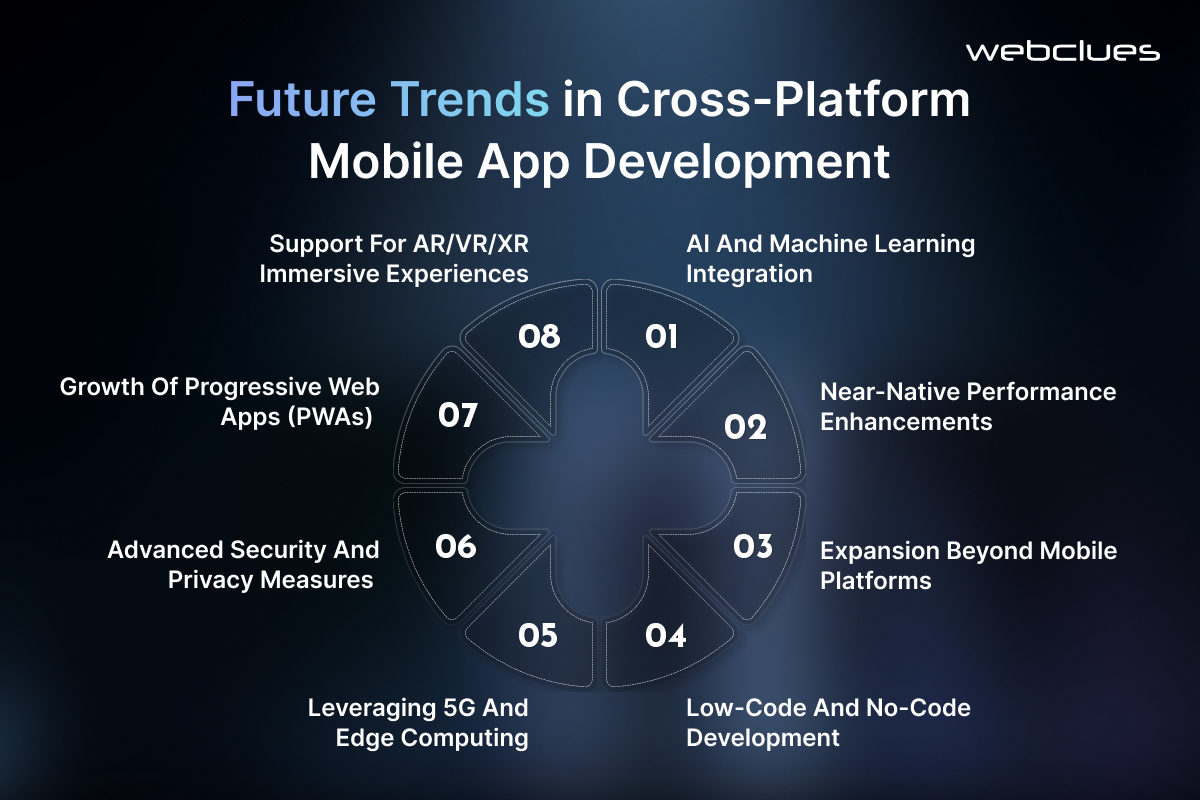
The future of cross-platform mobile app development is defined by increased performance, efficiency, and the integration of emerging technologies.
Key trends include:
- Integration of Artificial Intelligence (AI) and Machine Learning (ML): AI is revolutionizing app development by providing AI-powered coding assistants (like GitHub Copilot), automated testing, and performance optimization tools. In-app features increasingly include AI chatbots, personalized user experiences based on predictive analytics, and voice assistants.
- Performance on Par with Native Apps: Modern frameworks use advanced rendering engines (like Flutter's Impeller) and native bridging to offer near-native performance, significantly reducing the historical performance gap with apps built using platform-specific languages like Swift or Kotlin.
- Expansion Beyond Mobile: Cross-platform development is no longer limited to iOS and Android. Frameworks like Flutter and React Native are expanding to support web, desktop (Windows, macOS, Linux), wearables, smart TVs, and in-car systems from a single codebase, ensuring a consistent experience across all digital touchpoints.
- Low-Code/No-Code Development: The rise of low-code and no-code platforms allows businesses to build apps faster and enables non-developers to participate in the creation process, primarily for rapid prototyping and Minimum Viable Products (MVPs).
- Leveraging 5G and Edge Computing: The rollout of 5G technology enables faster data transfer and lower latency, facilitating resource-intensive applications such as cloud gaming, real-time AR/VR experiences, and high-definition streaming. Edge computing complements this by processing data closer to the user, improving responsiveness and data privacy.
- Improved Security and Privacy: With growing cyber threats, security is a top priority. Trends include the implementation of robust data encryption, biometric authentication, and a "zero-trust" security framework by default within cross-platform tools to protect sensitive user data.
Progressive Web Apps (PWAs): PWAs offer a native-like experience through a web browser, bypassing app store approvals and providing offline functionality. They are expected to power a significant portion of mobile web applications in the coming years, particularly in e-commerce and SaaS platforms. - Immersive Experiences (AR/VR/XR): As augmented reality (AR), virtual reality (VR), and extended reality (XR) technologies become more mainstream, cross-platform frameworks are integrating better support for these immersive experiences, especially in gaming, retail, and industrial operations.
Build Your Next Cross-Platform App with WebClues Infotech
Choosing the right cross-platform mobile app framework is crucial for cost-efficiency, scalability, and user satisfaction. From Flutter’s rich UI capabilities to React Native’s rapid deployment, the options are abundant—but selecting the right one requires expertise, vision, and execution.
WebClues Infotech combines strategic consulting, technical excellence, and market insights to deliver cross-platform mobile app development services that accelerate growth, enhance user experience, and optimize ROI.
Hire dedicated mobile app developers with us and transform your app idea into a robust, high-performing cross-platform solution. Contact us today and take the first step toward building your app for 2026 and beyond.
Post Author

Vedansh Kanodia
Vedansh Kanodia, a dynamic Business Development Executive at WebClues Infotech, is a passionate technocrat who helps businesses embrace innovation, and unlock new possibilities with his valuable perspectives.


Build Your Agile Team
Hire Skilled Developer From Us
Build Smarter, Launch Faster with WebClues Infotech!
Accelerate your digital strategy with cross-platform mobile app development that saves time and reduces costs by up to 50%. WebClues Infotech offers end-to-end mobile app development services, from ideation to deployment, with a team of dedicated mobile app developers focused on delivering high-quality, user-friendly apps. Maximize ROI while ensuring consistent performance across all devices. Start your project with us today.
Connect Now!Frequently Asked Questions
Our Recent Blogs
Sharing knowledge helps us grow, stay motivated and stay on-track with frontier technological and design concepts. Developers and business innovators, customers and employees - our events are all about you.