
Connect with us


Corporate Video


Top Machine Learning Development Companies to Watch in 2026
Machine learning in 2026 has shifted from experimentation to operational necessity. Businesses now rely on ML systems for real-time decisions, automated workflows, and measurable impact across functions. ML initiatives need more than accurate models; they require partners who can build full, production-grade ecosystems.
From data pipelines and feature engineering to deployment, MLOps, monitoring, and governance, modern ML initiatives now demand reliability, scalability, and transparency. Selecting the top ML development company has become a strategic decision, requiring teams with deep technical expertise, strong engineering discipline, and the ability to turn prototypes into resilient, production-ready systems.
This blog highlights the top 10 ML development companies to watch in 2026, including a mix of enterprise consultancies and specialized engineering firms. Scroll down as we help you match each organization’s strengths to your business needs and accelerate ML from pilot to proven business value.
Why Machine Learning Matters in 2026?
1. Real-time, autonomous intelligence
ML systems are moving from periodic batch predictions to continuous learning and decisioning models that are retrained, validated, and redeployed automatically as new data flows in. These autonomous pipelines reduce latency between insight and action, enabling dynamic pricing, fraud mitigation, and operational automation.
2 Platform maturity
Major cloud vendors and specialist platform companies now provide comprehensive MLOps toolchains that cover feature stores, model registries, deployment environments, and monitoring dashboards dramatically shortening time to production.
3 Infrastructure acceleration
High-performance GPU and accelerator ecosystems have been a core driver of ML scale, enabling faster training and advanced models for CV and large language models. Industry analysis shows GPUs and accelerators continue to play a central role in the growth of data-center ML workloads.
4 Governance & responsible AI
As ML systems influence higher-stakes decisions, enterprises demand explainability, traceability, and governance. Leading platforms and consultancies now embed governance tooling into the ML lifecycle to ensure compliance and risk management.
5 Industry specialization
Mature ML adoption in regulated sectors finance, healthcare, manufacturing means vendors must combine domain knowledge with ML engineering to deliver compliant, explainable, and performant systems.
ML in 2026 is about engineering discipline, platform maturity, and governance, not just model accuracy. Choice of top ML development company emphasizes on production readiness, integration capabilities, and ethical controls as much as algorithmic skill.
How to Choose an ML Development Company?
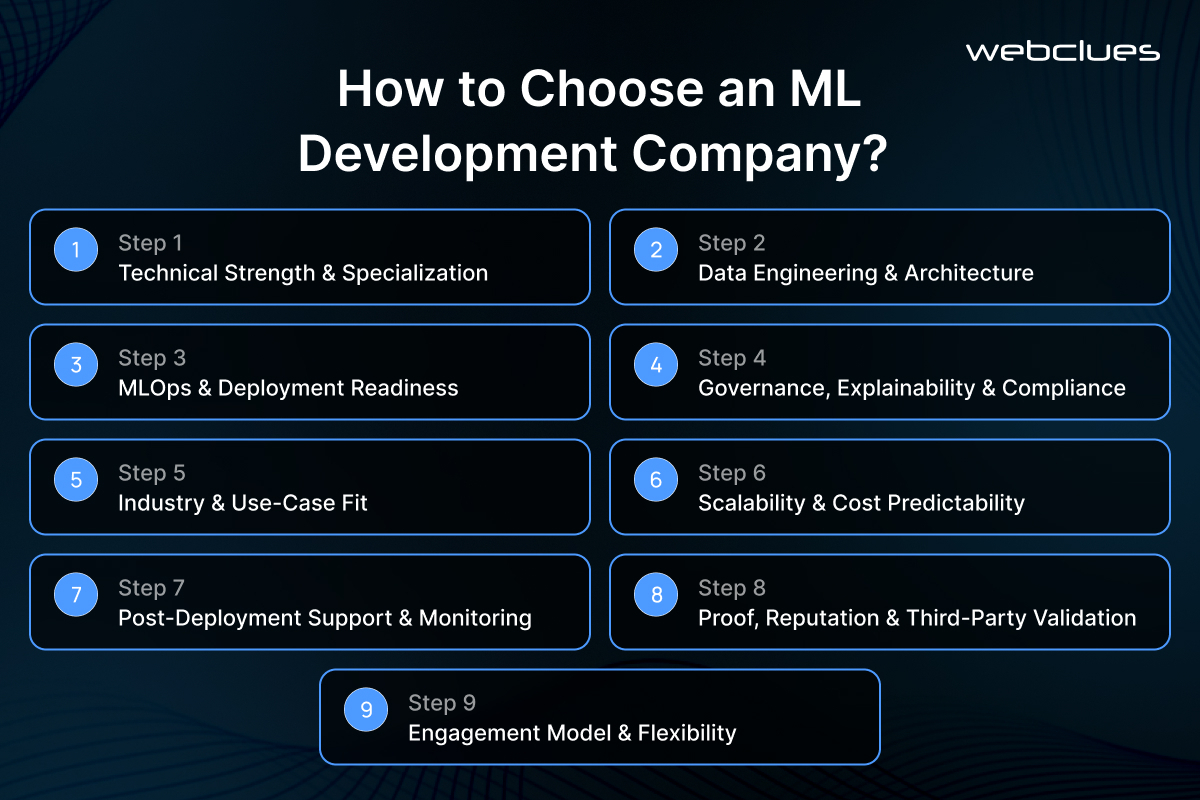
Selecting the right partner is the most important step in any ML initiative. Use the checklist below to vet potential ML development companies.
Technical Strength & Specialization
Verify deep expertise across supervised learning, deep learning, NLP, computer vision, and reinforcement learning where relevant. Look for demonstrable projects and case studies. Check whether the vendor supports modern ML frameworks (TensorFlow, PyTorch) and LLM toolchains; also confirm experience with specialized inference frameworks for edge deployments.
Data Engineering & Architecture
A production ML system depends on clean, reliable pipelines. Prioritize partners who can design feature stores, streaming ETL, and robust data governance. Confirm experience with the cloud platforms you use and their managed machine learning development services.
MLOps & Deployment Readiness
Ask about CI/CD for models, model registries, automated retraining, monitoring, and rollback strategies. Specialist MLOps providers (or platforms like DataRobot or H2O.ai) can accelerate go-to-production timelines.
Governance, Explainability & Compliance
Evaluate the partner’s approach to model explainability, bias mitigation, and logging/audit trails. Enterprises increasingly require governance frameworks baked into ML delivery not as an afterthought. IBM Watson and Deloitte offer strong governance toolsets and methodologies for safe ML deployment.
Industry & Use-Case Fit
Choose firms with experience in your vertical regulatory familiarity in healthcare/finance or operational nuance in logistics/manufacturing matters.
Scalability & Cost Predictability
Confirm the ML development company’s approach to scaling models and managing inference cost. Large language models and real-time inference can be expensive; ask how they optimize for total cost of ownership.
Post-Deployment Support & Monitoring
ML maintenance is ongoing: drift detection, periodic retraining, A/B testing frameworks, and performance SLAs. Confirm the vendor’s support model for long-term operations.
Proof, Reputation & Third-Party Validation
Review case studies, client testimonials, and third-party ratings (Clutch, Gartner, IDC). Also ask for references from similar projects.
Engagement Model & Flexibility
Ideally, hire ML developers who offer flexible engagement from discovery workshops and prototypes to full product delivery and staff augmentation.
If a company scores well across these criteria, it is likely to deliver robust, production-grade ML development services.
Top Machine Learning Development Companies to Watch in 2026
1. WebClues Infotech
Overview
WebClues Infotech has emerged as a strategic ML development company focused on building production-grade machine learning systems for enterprises undergoing digital transformation. The company is recognized for translating complex data ecosystems into predictive, intelligent, and adaptive ML solutions that deliver measurable business value. Their approach blends innovation with operational reliability, ensuring every ML deployment aligns with long-term organizational outcomes.
Core Strength
The machine learning development company’s primary strength lies in engineering full-lifecycle ML architectures—from data ingestion and feature engineering to model optimization and real-time deployment. WebClues Infotech stands out for its emphasis on model explainability, ethical governance, and scalable infrastructure, making it ideal for enterprises seeking transparency alongside performance. Their ability to implement models across cloud, hybrid, and edge environments positions them strongly in 2026’s rapidly evolving ML landscape.
Services Offered
WebClues provides services including predictive analytics, NLP-based automation, computer vision solutions, anomaly detection, recommendation engines, and end-to-end MLOps implementation. They also support data engineering, ML model fine-tuning, continuous monitoring, and enterprise integration using APIs and cloud-native pipelines. This holistic service offering ensures smooth transitions from experimentation to full-scale deployment.
Industries / Use Cases
The company serves industries such as healthcare, fintech, logistics, retail, and manufacturing. Their ML development solutions power applications including real-time fraud detection, patient analytics, demand forecasting, quality inspection, supply-chain prediction, and personalized customer experience systems. Industry-specific tailoring enables clients to deploy ML systems confidently within compliance-heavy environments.
Why to Watch in 2026
WebClues Infotech is gaining strong momentum with its investments in generative ML, autonomous ML pipelines, and hybrid predictive–generative models. As businesses shift toward real-time intelligence and adaptive automation, WebClues’ advanced MLOps and data engineering capabilities make it a key player. Their global delivery expansion further boosts their position in the ML market heading into 2026.
2. Fractal Analytics
Overview
Fractal Analytics is a global leader in applied AI and machine learning solutions, helping enterprises build data-driven decision systems at scale. With deep expertise in predictive modeling, personalization, and enterprise AI transformation, Fractal delivers production-grade ML development solutions across industries.
Core Strength
Fractal’s strengths lie in advanced data science capabilities, domain-trained ML assets, and proprietary accelerators like Qure.ai and Eugenie. Their blend of engineering, AI research, and industry knowledge enables them to deliver high-accuracy models with rapid deployment cycles.
Services Offered
Fractal provides end-to-end ML development, including data engineering, model development, MLOps, forecasting systems, decision intelligence platforms, and industry-specific AI accelerators. The company also supports enterprise AI modernization and digital transformation.
Industries / Use Cases
Retail personalization, healthcare diagnostics, insurance analytics, telecom optimization, financial forecasting, and customer intelligence.
Why to Watch in 2026
Fractal continues to expand its industry solutions and AI accelerators, making it a key partner for enterprises adopting ML for large-scale strategic decisioning in 2026.
3. IBM
Overview
IBM remains a trusted choice for ML development, particularly for organizations operating under strict governance and regulatory frameworks. The company combines decades of research with enterprise delivery excellence, creating ML development solutions optimized for transparency, interpretability, and compliance.
Core Strength
IBM’s major strength lies in explainable ML, hybrid ML architectures, and governance-first frameworks. With Watson and IBM Consulting, they offer a unified approach to model lifecycle management, ethical deployment, and secure data processing. These strengths make IBM ideal for mission-critical, sensitive ML workloads.
Services Offered
IBM delivers services including data engineering, ML model development, automated ML, model risk assessment, and end-to-end lifecycle management. Their consulting teams also support strategy, architecture design, and long-term optimization for complex ML ecosystems.
Industries / Use Cases
IBM supports industries such as banking, insurance, healthcare, government, and telecommunications. Popular applications include risk scoring, claims automation, medical analytics, fraud detection, and regulatory compliance automation.
Why to Watch in 2026
With global focus shifting toward ML ethics, transparency, and auditability, IBM’s governance-first approach positions it as one of the safest and most reliable ML partners for 2026.
4. Tredence
Overview
Tredence is a fast-growing AI and ML engineering company known for delivering practical, high-value machine learning solutions. Their focus on solving real-world business problems with scalable ML has made them a preferred partner for Fortune 500 enterprises.
Core Strength
Tredence excels in applied ML, data engineering, and industry-specific AI accelerators. Their combination of analytics expertise, ML engineering talent, and domain workflows helps organizations operationalize ML faster.
Services Offered
Custom ML model development, forecasting, supply chain AI, customer analytics, MLOps implementation, data modernization, and domain-specific AI products.
Industries / Use Cases
Retail demand forecasting, supply chain optimization, CPG analytics, travel & hospitality intelligence, financial analytics, and telecom churn modeling.
Why to Watch in 2026
Tredence is scaling its ML innovation centers and expanding vertical AI offerings, positioning it as one of the most impactful ML development companies entering 2026.
5. Cognizant AI & Analytics
Overview
Cognizant’s AI & Analytics practice is one of the largest ML engineering service groups globally, delivering enterprise-grade machine learning solutions across multiple industries. Their end-to-end approach helps organizations modernize AI capabilities and scale ML operations.
Core Strength
Cognizant’s strengths include large-scale ML delivery, AI strategy consulting, model engineering, responsible AI governance, and strong integration capabilities across cloud ecosystems.
Services Offered
ML model development, data engineering, ML modernization, governance and responsible AI frameworks, enterprise MLOps, NLP system development, and AI-enabled business process transformation.
Industries / Use Cases
Healthcare analytics, insurance underwriting models, retail personalization, BFSI risk modeling, life sciences R&D analytics, and manufacturing automation.
Why to Watch in 2026
Cognizant is investing heavily in AI delivery accelerators and cross-industry ML platforms, making it a major force driving enterprise AI adoption in 2026.
6. Tiger Analytics
Overview
Tiger Analytics is a leading advanced analytics and ML services company delivering end-to-end solutions across the ML lifecycle. Known for strong execution in predictive modeling and business-focused ML, Tiger helps enterprises scale AI initiatives with measurable outcomes.
Core Strength
Tiger’s strengths include deep data science expertise, production ML deployment, and a strong understanding of industry workflows. They specialize in building accurate predictive models and embedding ML into operational systems.
Services Offered
Machine learning development, advanced analytics, data engineering, forecasting models, anomaly detection, MLOps, NLP, and computer vision solutions.
Industries / Use Cases
Banking risk models, CPG analytics, manufacturing quality prediction, logistics optimization, insurance fraud detection, and healthcare analytics.
Why to Watch in 2026
With growing global demand for practical, ROI-driven ML solutions, Tiger Analytics continues to expand as a top-tier partner for enterprises seeking scalable machine learning in 2026.
7. OpenAI Enterprise Partners
Overview
OpenAI’s enterprise partners help organizations deploy advanced ML solutions built on OpenAI’s foundation models. These partners specialize in applying large-scale ML to real-world business challenges, combining predictive, conversational, and analytical capabilities.
Core Strength
Their primary strength lies in domain-specific customization, fine-tuning, and safe deployment of ML models. Partners help enterprises integrate ML into complex workflows while ensuring adherence to compliance and privacy requirements.
Services Offered
Offerings include model fine-tuning, predictive analytics, intelligent automation, document intelligence, enterprise search, and custom ML workflow integration using OpenAI APIs.
Industries / Use Cases
Industries adopting these solutions include legal, finance, healthcare, retail, and customer service. Use cases include claims automation, contract summarization, customer experience automation, and research intelligence.
Why to Watch in 2026
As hybrid predictive–generative ML becomes mainstream, OpenAI partners will play a major role in enterprise adoption and operational integration.
8. DataRobot
Overview
DataRobot continues to lead the AutoML space with a powerful platform that accelerates ML experimentation and deployment. It is widely chosen by enterprises seeking faster model development cycles without compromising accuracy.
Core Strength
Its automation-first approach simplifies feature engineering, model selection, validation, explainability, and monitoring. DataRobot’s ability to manage large-scale experimentation makes it highly effective for prediction-focused use cases.
Services Offered
DataRobot provides AutoML, feature discovery, bias detection, model monitoring, and MLOps tools. These services help enterprises standardize their ML workflows and scale high-volume production models.
Industries / Use Cases
It is widely used in banking, telecommunications, retail, and healthcare. Solutions include churn prediction, credit scoring, demand forecasting, and operational analytics.
9. Accenture Applied Intelligence
Overview
Accenture Applied Intelligence supports global enterprises in implementing ML at scale through a structured, strategy-led approach. Their expertise spans both technology implementation and organizational transformation.
Core Strength
Accenture’s strength lies in bridging the gap between business strategy and ML execution. Their global teams deliver high-impact ML programs with deep domain expertise and strong engineering capability.
Services Offered
Services include ML strategy, model building, data modernization, MLOps implementation, predictive analytics, and long-term optimization. Their frameworks ensure sustainable enterprise adoption.
Industries / Use Cases
Accenture serves banking, retail, energy, manufacturing, and public sector clients. Applications include fraud analytics, forecasting, supply chain insights, and field operations intelligence.
Why to Watch in 2026
Accenture’s investment in responsible and autonomous ML positions it as a major partner for enterprises scaling beyond pilot projects.
10. Deloitte AI & Analytics
Overview
Deloitte is known for its governance-driven approach to ML development, focusing on building systems that are scalable, compliant, and aligned with business strategy. Their ML solutions are built to support high-stakes decision environments.
Core Strength
Their strength lies in responsible ML frameworks, domain-specific accelerators, and compliance-focused methodologies. Deloitte’s teams specialize in delivering ML systems for industries where accuracy and auditability are critical.
Services Offered
Deloitte provides ML consulting, data engineering, model validation, predictive analytics, risk modeling, and long-term ML strategy design. Their structured processes ensure reliability in regulated environments.
Industries / Use Cases
Industries include finance, healthcare, public sector, insurance, and supply chain. Use cases include compliance automation, fraud detection, risk scoring, and demand forecasting.
Why to Watch in 2026
With regulatory expectations on the rise, Deloitte’s governance-first ML approach will be vital for organizations seeking compliant, resilient AI systems.
Comparison Table: ML Leaders at a Glance
Here’s an overview helping readers compare the top ML development companies based on their primary strengths and ideal use cases:
| Company | Core Expertise | Ideal For | Why It Stands Out |
| WebClues Infotech | Custom ML development, MLOps, predictive modeling | Mid-to-large enterprises seeking tailored machine learning development services | Strong engineering depth, explainability, and end-to-end delivery |
| Fractal Analytics | Applied AI, predictive modeling, domain accelerators | Enterprises needing strategic, high-performance AI solutions | Proprietary accelerators and deep industry specialization |
| IBM | Explainable ML & governance | Regulated or security-sensitive industries | Ethical, transparent, compliance-focused ML systems |
| Tredence | Applied ML engineering, forecasting, supply chain AI | Fortune 500 companies needing operational ML at scale | Strong domain accelerators and practical ML deployment |
| Cognizant AI & Analytics | Enterprise ML, MLOps, AI modernization | Large organizations with complex legacy systems | Large-scale ML delivery + responsible AI governance |
| Tiger Analytics | Predictive modeling, ML engineering, MLOps | Enterprises wanting ROI-driven ML implementations | Strong execution and industry-focused ML frameworks |
| OpenAI Partners | Applied generative ML + predictive ML | Companies needing domain-adapted, hybrid ML solutions | Safe, custom enterprise-genAI + ML integration |
| DataRobot | AutoML & predictive intelligence | Organizations needing rapid experimentation | Automation-first ML lifecycle acceleration |
| Accenture Applied Intelligence | Enterprise ML strategy + engineering | Global enterprises scaling ML programs | Strategy + delivery excellence with global talent |
| Deloitte AI & Analytics | Responsible ML, risk analytics, regulated ML | Finance, healthcare, government | Compliance-first ML implementation and auditability |
Emerging Machine Learning Trends in 2026 and Beyond
1. AutoML & Self-Optimizing Pipelines
AutoML has evolved beyond model selection to orchestration: pipelines that detect drift, trigger retraining, and optimize hyperparameters automatically. Platforms like DataRobot and H2O.ai are central to this movement, enabling faster time to value.
2. Multi-Agent and Agentic ML Systems
Organizations are piloting systems where multiple specialized models (agents) coordinate to solve complex tasks, for example, an agent that detects anomalies triggering another agent that recommends remediation actions. Orchestration layers and governance are required to keep these systems safe and accountable.
3. Edge & Hybrid ML Deployments
Edge inference reduces latency and bandwidth costs. Use cases in manufacturing, retail, and autonomous vehicles rely on compact models optimized for accelerated inference. Vendors are supporting hybrid deployments where sensitive data stays on-premises while models are managed in cloud VPCs.
4. Federated Learning & Privacy-First ML
Federated learning and secure aggregation allow organizations to train models across distributed datasets without centralizing sensitive data critical in healthcare and finance. This trend reduces regulatory friction and expands cross-organizational collaboration.
5. Governance by Design
Responsible AI is now a design requirement. Platforms from IBM and Deloitte include governance modules (policy controls, explainability, provenance), meaning ML is deployed with compliance in mind from day one.
6. Domain Accelerators & Pretrained Models
Vendors are shipping pre-trained domain models and accelerators that reduce development time for vertical use cases (fraud, claims automation, demand forecasting), enabling faster business outcomes.
Practical Steps for Working with an ML Development Partner
Partnering with an ML development company works best when you follow a structured plan. Start with clear goals, validate your data, and set the right delivery, governance, and performance expectations. The steps below provide a practical roadmap.
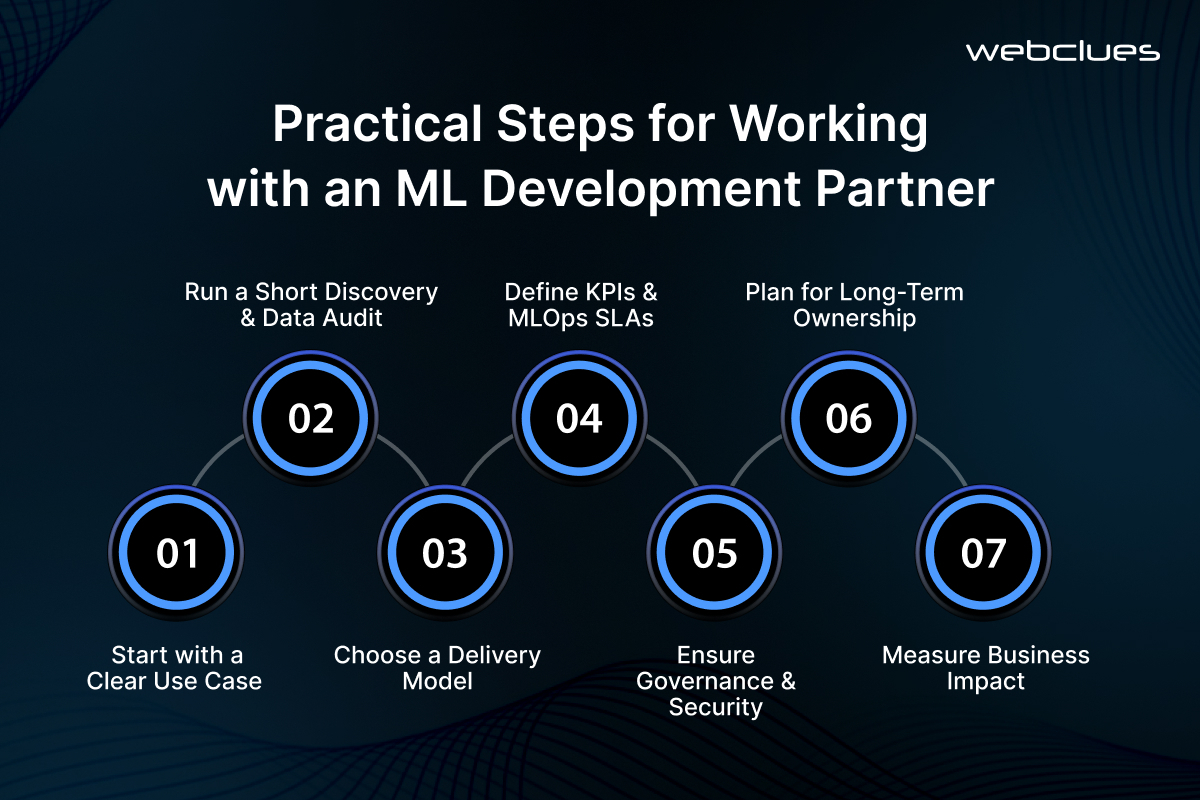
1. Start with a Clear Use Case
Frame success in business terms. “Increase forecasting accuracy by 15%” is better than “build an ML model.”
2. Run a Short Discovery & Data Audit
A 2–4 week discovery validates data availability and feasibility. Ensure the vendor performs feature inventory, privacy assessment, and baseline modeling.
3. Choose a Delivery Model
Pilot (proof-of-value) → Expand → Operationalize. Use time-boxed pilots to validate assumptions and show measurable ROI.
4. Define KPIs & MLOps SLAs
Agree on accuracy thresholds, latency, drift tolerances, monitoring dashboards, and retraining cadence. Embed performance indicators into contracts.
5. Ensure Governance & Security
Require model explainability, access controls, logging, and compliance checks. For regulated industries, include audit support and documentation.
6. Plan for Long-Term Ownership
Decide who will own model maintenance post-delivery: vendor, internal team, or a hybrid model. Knowledge transfer is a must.
7. Measure Business Impact
Track hard metrics (revenue lift, cost savings, reduced downtime) and soft metrics (customer satisfaction, process cycle time). If the vendor can’t tie results to business KPIs, reconsider.
This approach reduces risk while ensuring security in ML investments to deliver sustainable value.
Partner Right Experts to Build Smarter, Faster, More Reliable ML Systems!
ML in 2026 is about production-grade engineering, governance, and measurable business outcomes, not just model accuracy. Choosing an ML development company that blends technical excellence (MLOps, deep learning, data engineering) with governance and domain expertise is essential for success.
For organizations seeking pragmatic, deployment-focused ML development services, WebClues Infotech stands out as a production-oriented partner that emphasizes deployment success, clean pipelines, and measurable ROI.
If you’re ready to move beyond pilots and build resilient, scalable ML systems from forecasting engines to real-time decision workflows, choose Webclues Infotech for long-term engineering discipline and strong alignment with your business functions. Connect us to transform your ML vision into a production-ready reality.
Post Author

Ayush Kanodia
As one of the esteemed Directors of WebClues Infotech. Ayush Kanodia is passionate about delivering innovative IT services & solutions and has spearheaded numerous successful projects, cementing the company's position as a leader in the field.


Build Your Agile Team
Hire Skilled Developer From Us
Build Smarter, Scalable Systems with a Trusted ML Partner
Partner with WebClues Infotech to turn your machine learning goals into scalable, production-ready solutions. From strategy and data engineering to deployment and MLOps, we help you move beyond pilots and build ML systems that drive measurable ROI and long-term value.
Contact UsFrequently Asked Questions
Our Recent Blogs
Sharing knowledge helps us grow, stay motivated and stay on-track with frontier technological and design concepts. Developers and business innovators, customers and employees - our events are all about you.