

Connect with us


Corporate Video

RAG vs Long Context Windows: Which Approach Is Better for Enterprise AI?
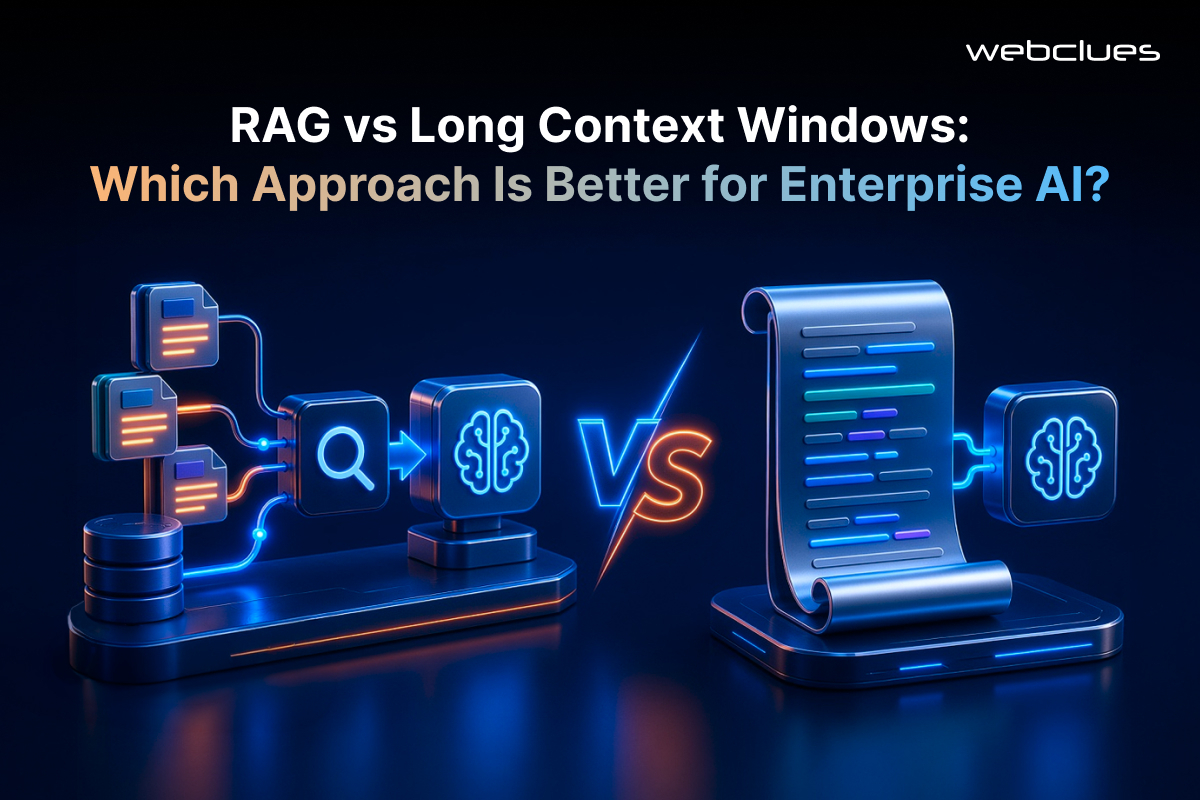
Enterprise AI systems can process large amounts of information, but processing more text does not guarantee finding the right answer. When a business assistant must search thousands of contracts, policies, support tickets and technical documents, the architecture determines how reliably it can locate evidence and use it.
Retrieval-augmented generation (RAG) and long-context language models address different parts of this problem. RAG retrieves relevant information from an external knowledge base before generating a response. Long-context models process larger volumes of information supplied directly in their input.
If you are evaluating enterprise AI development services, RAG is generally the stronger foundation for searching large, changing knowledge collections, while long-context models excel at analyzing a bounded set of documents in depth.
Combining the two can deliver both broad information discovery and detailed reasoning. The right choice depends on data volume, update frequency, evidence requirements, query patterns, security constraints and total operating cost not context-window size alone.
RAG vs Long Context: What Is the Difference?
RAG retrieves relevant information from external knowledge sources, while long-context models process larger volumes of information directly within a single input.
How Retrieval-Augmented Generation Works
RAG connects a language model to an external knowledge source. Instead of expecting the model to answer from its training data or a manually supplied document set, the application retrieves relevant evidence for each query.
A typical RAG pipeline has four stages:
- Indexing: Documents are parsed, divided into searchable units, enriched with metadata and indexed. Depending on the implementation, the index may support vector search, keyword search, or both.
- Retrieval: The system searches the index and identifies passages relevant to the user's question. Filters and reranking can improve the selection.
- Grounding: The selected passages, source identifiers and relevant instructions are supplied to the language model.
- Generation: The model produces an answer based on the available evidence, ideally with verifiable citations and an explicit response when sufficient evidence cannot be found.
This architecture separates knowledge storage and discovery from language generation. Google Cloud's RAG reference architecture describes the ingestion and serving components involved in building these applications.
How Long-Context Models Work
A long-context model can process a large input containing instructions, documents, conversation history and other information within its supported token limit.
For example, a legal team could provide an agreement, its exhibits and a set of amendments in one prompt. The model can then compare clauses, identify inconsistencies and synthesize findings across the supplied material.
This approach avoids a separate retrieval stage when the relevant documents are already known. However, someone or something must still select the correct files, ensure that they are current and fit the material within the available input budget.
Search and Context Capacity Solve Different Problems
The central distinction is evidence discovery versus evidence processing. RAG helps determine which information should reach the model from a larger collection. Long context gives the model more room to reason over information it has already received.
Neither guarantees a correct answer. A RAG system can retrieve the wrong passage, while a long-context model can overlook a relevant clause within its input. Reliable enterprise AI requires both appropriate evidence selection and accurate interpretation.
RAG vs Long Context: Enterprise Comparison
The following table summarizes the main architectural trade-offs.
| Decision factor | RAG | Long-context model |
| Evidence discovery | Searches a larger indexed collection | Works with the information supplied in its input |
| Cross-document reasoning | Depends on the retrieved evidence and its completeness | Useful when relationships across a bounded document set matter |
| Cost | Adds indexing and retrieval costs but can reduce input tokens per query | Can become expensive when large inputs are repeatedly processed |
| Latency | Adds retrieval and orchestration steps | Avoids retrieval overhead but may process much more text |
| Knowledge updates | Requires source synchronization and index maintenance | Requires the application to supply current material |
| Citations | Can preserve links to retrieved passages | Requires separate source attribution and validation |
| Security | Requires permission-aware retrieval and controlled context assembly | Requires authorization checks on every supplied document |
| Main failure risk | Relevant evidence is missed or ranked incorrectly | Relevant information is overlooked, misinterpreted, or absent |
| Best fit | Enterprise search and large, changing knowledge bases | Bounded analysis of known documents |
The trade-offs depend on implementation. A well-designed RAG pipeline may outperform direct document input for large collections, but a poorly configured retriever can perform worse than a capable long-context model given the complete evidence. The correct comparison is therefore between complete application architectures, not between two isolated model features.
What the Evidence Says About Retrieval and Long Context
Research and benchmark results show that larger context windows do not automatically improve answer reliability, while retrieval can help models locate relevant evidence more efficiently in large document collections.
Why a larger context window does not guarantee better answers
The academic paper Lost in the Middle: How Language Models Use Long Contexts investigates how language models use information positioned within long inputs. Its findings show that models can perform less reliably when relevant evidence appears in the middle of a long context rather than near its beginning or end.
This matters for enterprise applications. A model may receive an entire policy repository and still overlook a critical exception buried among unrelated documents. Increasing the context window expands what can be supplied, but does not guarantee that every relevant detail will be used correctly.
The practical lesson is to measure evidence coverage and answer correctness, rather than assume that a larger token limit automatically improves reliability.
What the 500-PDF benchmark found
The CustomGPT.ai Claude Benchmark compared direct document reading against a RAG-assisted configuration using Claude Code on Sonnet 4.6. The experiment used a synthetic corporate-email corpus of up to 500 PDFs and evaluated factual lookups and questions requiring patterns across documents.
At 500 documents, the benchmark reported the following results:
| Metric | Direct PDF reading | RAG |
| Average response time | 2 min 31 sec | 36 sec |
| Cost per question | $0.40 | $0.13 |
| Completion within 3 minutes | 39% | 100% |
The experiment also reported that direct reading sometimes fabricated answers when information was unavailable, whereas the RAG configuration could return “not found.”
These results illustrate how retrieval can affect performance when a model must search a large collection. However, they are specific to this benchmark's dataset, tooling, configuration and evaluation window. They do not establish universal cost savings or accuracy rates for enterprise AI.
For a real deployment, businesses should reproduce the comparison on representative documents, actual queries, realistic concurrency and their own model and infrastructure choices.
When Long-Context Models Are the Better Choice
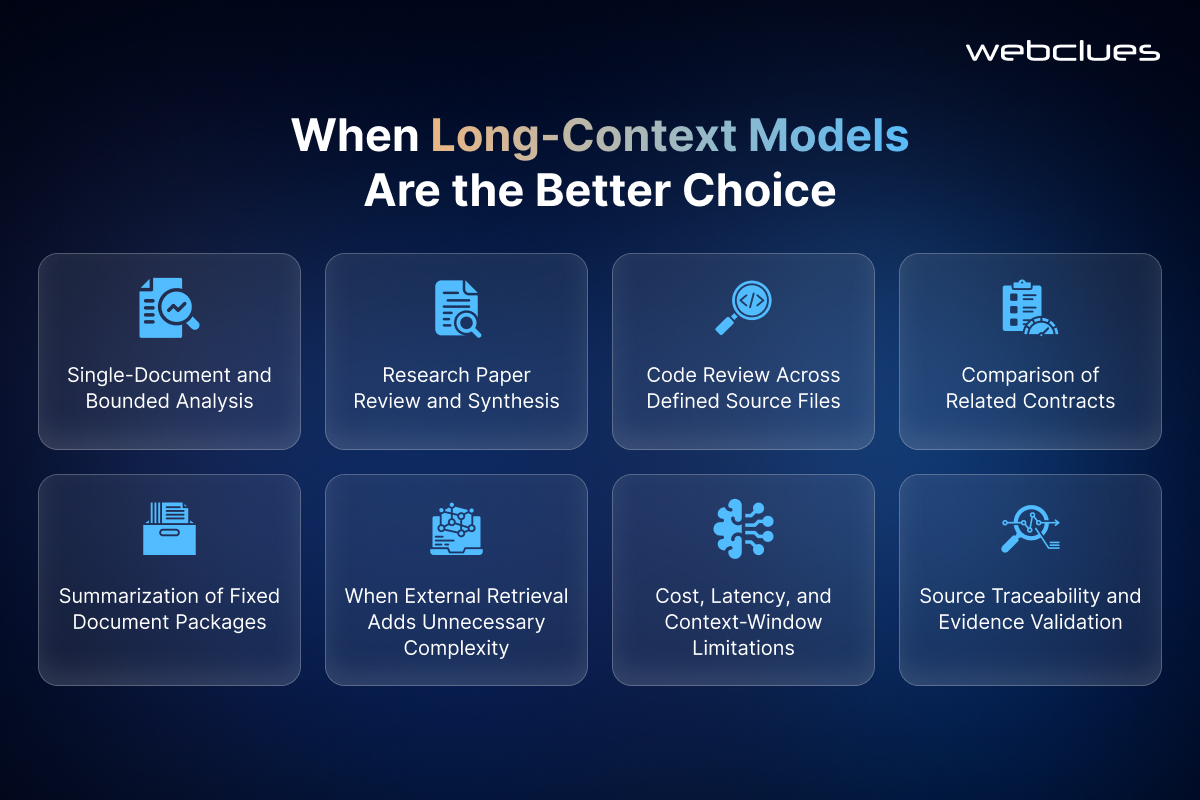
Long-context models are often the better option when the evidence is already known, the document set is bounded and the task requires reasoning across the supplied material.
Single-document and bounded analysis
Consider a procurement team reviewing a proposed supplier agreement, its schedules and an approved negotiation checklist. If the relevant documents are known and fit within the model's input budget, providing them together can help the model connect definitions, obligations, exceptions and related clauses.
Other suitable workloads include:
- Reviewing a research paper and synthesizing its findings.
- Analyzing a defined set of source files during code review.
- Comparing a small collection of related contracts.
- Summarizing a fixed document package for a decision meeting.
In these cases, adding an external retrieval layer may introduce complexity without solving a meaningful discovery problem.
The trade-offs to consider
Direct long-context processing still has operational limitations. Large inputs can increase token consumption, processing time and memory requirements. The model may overlook important exceptions and supplying multiple document versions can introduce conflicting instructions or outdated evidence.
Teams should also preserve document identifiers and source references so reviewers can verify the findings.
Long context is not a fallback when RAG is unavailable. It is a legitimate architectural choice when the complete evidence set is known and the task benefits from examining that material together.
When RAG Is the Better Choice for Enterprise AI
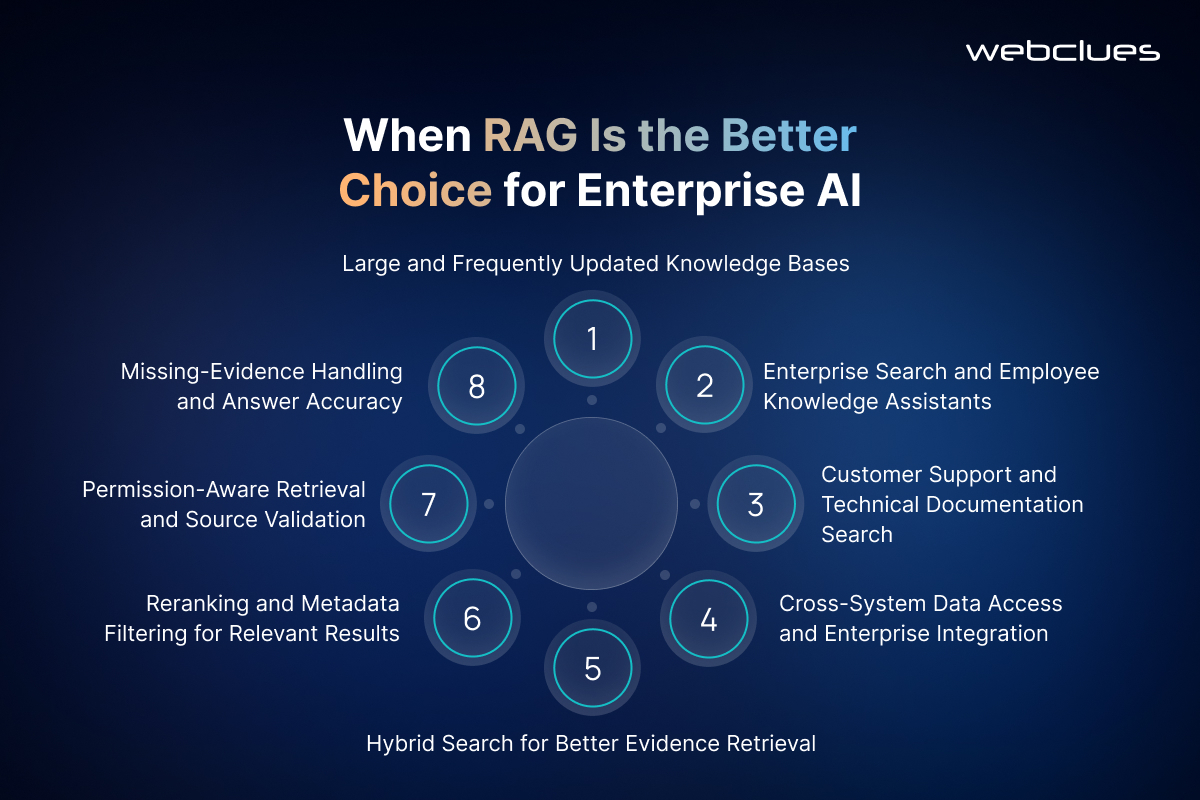
RAG is generally more suitable when users need answers from a large, changing collection that they cannot reasonably assemble manually for every question.
Large and frequently updated knowledge bases
Typical use cases include enterprise search, employee knowledge assistants, customer support copilots, technical documentation search and policy discovery.
Imagine an engineer investigating a fault affecting a particular equipment revision. The necessary information may be distributed across a maintenance manual, a service bulletin and previous incident reports.
A RAG system can search the connected sources, identify potentially relevant sections and provide those sections to the model. The engineer does not need to upload the entire documentation repository.
For organizations connecting multiple business applications, enterprise AI integration can be an important part of making information available across existing systems.
Retrieval quality, permissions and grounded answers
Production RAG requires more than a vector database and a prompt. Several engineering decisions determine whether the system retrieves useful evidence.
- Hybrid search: Combine semantic retrieval with keyword search when exact product identifiers, policy numbers, error codes, or technical terms matter.
- Reranking: Reorder candidate passages using a more precise relevance model before sending them to the language model.
- Metadata filtering: Restrict results by document type, product version, department, effective date, or other relevant attributes.
- Permission-aware retrieval: Enforce user access rights before retrieved content enters the model's context.
- Source validation: Preserve document identifiers, versions and passage references so answers can be checked against the underlying evidence.
- Missing-evidence handling: Return an explicit limitation or abstain when the retrieved material does not adequately support an answer.
RAG can reduce unsupported answers, but it cannot eliminate hallucinations. If the retriever misses a critical amendment or returns an outdated policy, the model may still generate an incorrect response from incomplete evidence.
For high-impact workflows, retrieval quality, evidence coverage and answer correctness must be evaluated separately.
Why Larger Context Windows Do Not Eliminate RAG
A larger context window solves an input-capacity constraint. It does not automatically solve the information-discovery problem.
Capacity is not the same as evidence selection
Suppose an enterprise has 20,000 internal documents and an employee asks which approval rule applies to a particular transaction. Loading the entire repository into a model's context may be impractical, even if the model supports a large input.
More importantly, the application still needs to identify the applicable rule, distinguish the current policy from superseded versions and establish whether an exception applies.
Retrieval addresses this by narrowing the evidence set before generation. Long context can then be used to examine the selected documents in greater detail.
Cost, signal-to-noise and information freshness
Repeatedly processing large amounts of unrelated text can consume more tokens than necessary. RAG can reduce that overhead by supplying a focused subset of the collection, although its indexing, retrieval and maintenance costs must also be included.
Neither approach guarantees fresh information. A RAG index can be stale, while a direct-input workflow can use outdated files. Both require source management, version validation and appropriate access controls.
The engineering objective is not to maximize context size or minimize retrieval volume at any cost. It is to supply enough authoritative evidence to answer the query reliably and economically.
The Hybrid Approach: Combining RAG With Long Context
For many enterprise AI applications, the strongest design combines retrieval with long-context reasoning. The system first discovers the relevant material and then provides enough of that material for the model to analyze relationships and exceptions.
Retrieve first, then reason across the evidence
A hybrid workflow typically follows this sequence:
- Receive the user's query and identify the required evidence.
- Search connected repositories using semantic, keyword, or structured retrieval.
- Rerank the candidate results and validate permissions and document versions.
- Expand relevant passages into complete sections or documents when surrounding context is necessary.
- Supply the selected evidence to a long-context model.
- Generate an answer with source references and validate that its claims are supported.
This approach separates broad discovery from detailed reasoning. It also provides a useful point for measuring whether a failure originated in retrieval, context assembly, or generation.
Example: Enterprise contract and policy analysis
Consider a supplier-risk assistant that must compare contractual commitments with outstanding compliance issues.
RAG can locate the current supplier agreement, relevant audit findings and the remediation plan. A long-context model can then compare the selected sections, identify conflicting commitments and summarize unresolved risks.
The application should retain the source and version of each document and distinguish explicit findings from inferred conclusions. If an essential document is missing, the assistant should disclose the limitation instead of presenting an incomplete assessment as definitive.
When hybrid architecture adds unnecessary complexity
A hybrid design is not automatically the best choice for every workload. If users provide one complete document and need a summary, direct long-context processing may be sufficient. If a narrow factual query can be answered reliably from a small retrieved passage, an expansive context window may add little value.
The additional orchestration, retrieval, context assembly and evaluation layers should be justified by measurable improvements in answer quality or operational performance.
How to Choose the Right Architecture for Your Enterprise
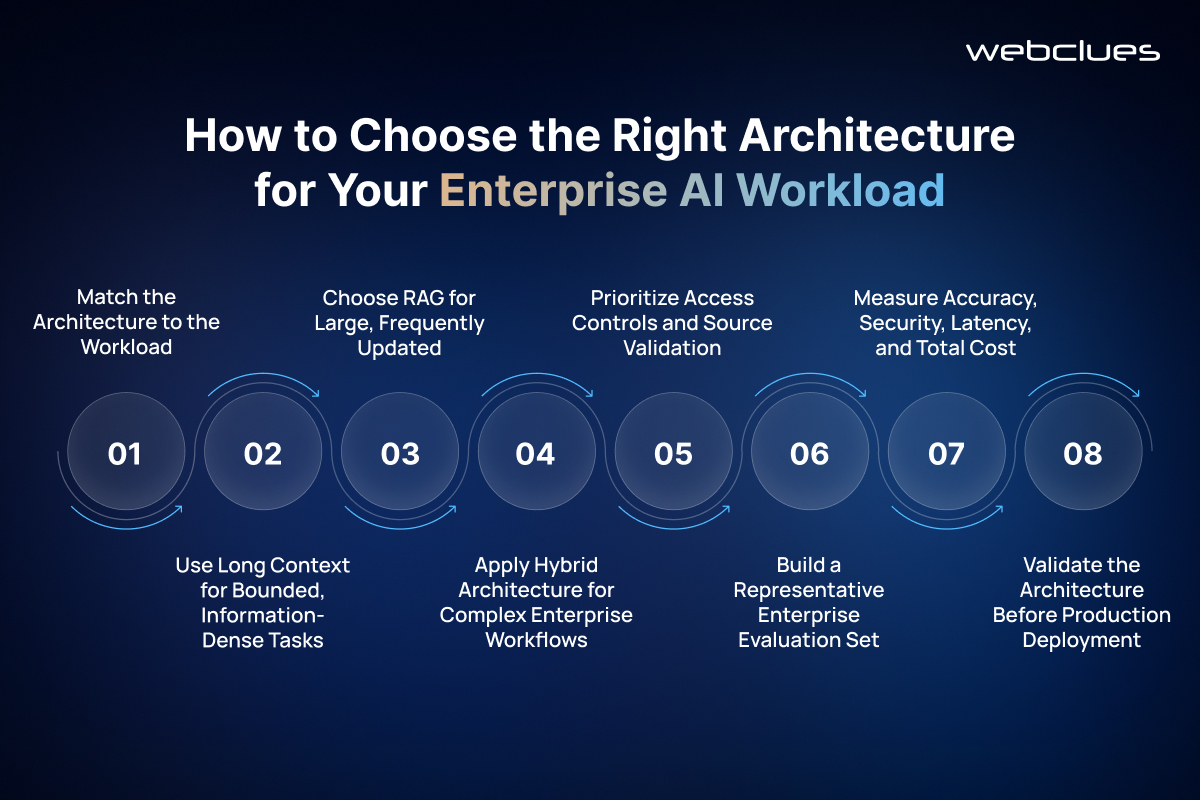
The most reliable way to select an architecture is to match it to the workload and validate it against representative tasks.
| Enterprise scenario | Recommended starting point |
| Single contract or research paper | Long context |
| Bounded code review | Long context |
| Search across thousands of documents | RAG |
| Internal knowledge assistant | RAG |
| Customer support across changing documentation | RAG |
| Compliance research across multiple repositories | RAG with access controls and source validation |
| Cross-document analysis over a defined evidence set | Long context or hybrid |
| Enterprise copilot combining broad search and deep reasoning | RAG plus long context |
These are starting recommendations, not rigid rules. Document count alone does not determine the right architecture; query complexity, evidence distribution, update frequency and failure consequences also matter.
Validate with an enterprise evaluation set
Before committing to production, create a test set based on actual business questions and verified source documents. Include specific factual lookups, multi-document synthesis, conflicting document versions, questions with no supported answer and requests from users with different access permissions.
Compare direct long-context processing, RAG and hybrid configurations where relevant. Measure:
- Answer quality: Factual correctness and coverage of required information.
- Retrieval quality: Whether the necessary evidence appears in the selected results.
- Citation validity: Whether cited passages genuinely support the associated claims.
- Abstention behavior: Whether the system acknowledges missing or insufficient evidence.
- Security: Whether unauthorized information is excluded from retrieval, context and reused outputs.
- Performance: End-to-end latency under realistic workloads and concurrency.
- Economics: Total cost per successful task, including indexing, inference, retrieval, retries and maintenance.
This evaluation turns an architectural preference into an evidence-based decision. For teams planning a production implementation, custom AI development services can support the design and engineering of solutions around specific data, workflow and integration requirements.
Build an Enterprise AI Architecture Around Your Workload
RAG and long-context models solve different problems. Long context is valuable for reasoning over known, bounded evidence. RAG supports discovery across large and changing information collections. A hybrid architecture combines retrieval with deeper analysis when the workload demands both. For enterprise buyers, the priority should be to validate evidence quality, security, performance and operating cost before choosing a design.
WebClues Infotech helps businesses engineer custom AI solutions and connect AI capabilities with existing enterprise systems. If you are planning an enterprise knowledge assistant, document intelligence platform, or AI copilot, the architecture should reflect your data, workflows and operational requirements. Connect with us to discuss about enterprise AI integration strategy and evaluate the next steps.
Post Author

Vedansh Kanodia
Vedansh Kanodia, a dynamic Business Development Executive at WebClues Infotech, is a passionate technocrat who helps businesses embrace innovation, and unlock new possibilities with his valuable perspectives.


Build Your Agile Team
Hire Skilled Developer From Us
Ready to Build Your Enterprise AI Solution?
From RAG-powered enterprise search to AI copilots that reason across complex documents, WebClues Infotech helps businesses turn AI requirements into secure, scalable solutions aligned with their data and workflows. Have an enterprise AI use case in mind? Talk to our AI development team to discuss your requirements, identify the right architecture and plan your implementation roadmap.
Connect with usFrequently Asked Questions
Our Recent Blogs
Sharing knowledge helps us grow, stay motivated and stay on-track with frontier technological and design concepts. Developers and business innovators, customers and employees - our events are all about you.