

Connect with us


Corporate Video


TensorFlow vs PyTorch: Which Framework Fits Your ML Goals?
.jpg)
TensorFlow vs PyTorch is often discussed in the wrong meetings.
Someone has a model that works on sample data. The next task is turning it into a product. A comparison chart appears. One framework is labelled better for research. The other is labelled better for production.
That chart cannot tell you where the model will run.
It cannot tell you whether the model will sit inside a browser. It cannot tell you whether the team already owns a library of working code. It certainly cannot tell you what happens when the model gives an uncertain answer in a live workflow.
A better place to start is one uncomfortable question.
What part of this project would be painful to rebuild six months from now?
For some teams, it is browser performance. For others, it is a trained model that would take weeks to move. Sometimes it is the camera or device that has to run the model in the field. Sometimes it is the release process.
That answer makes the framework choice much clearer.
TensorFlow vs PyTorch for machine learning becomes clearer once the product team knows where the model has to work after the first release.
Start With a Five-Line Project Brief
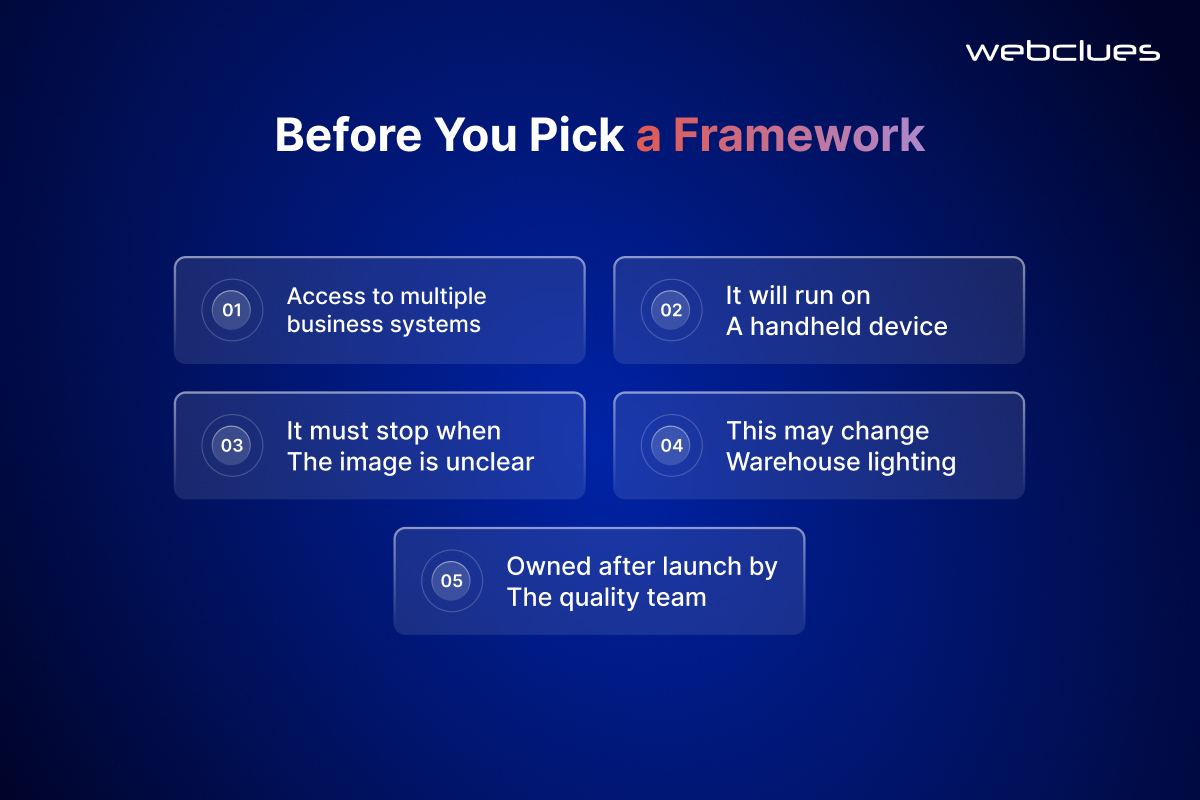
Before anyone picks a framework, write these five lines.
- The model needs to do this - Keep it to one repeated job.
- The model will run here - Name the actual environment.
- The model must stop when this happens - Describe the point where a person takes over.
- This part is likely to change - It could be the data. It could be the model. It could be the delivery environment.
- This team will own it after launch - Someone needs to manage the next release.
Here is a simple example.
- The model will check product labels at receiving.
- It will run on a handheld device.
- It will stop when the image is unclear.
- The image conditions may change across warehouses.
- The quality team will review flagged cases.
That brief is more useful than a long list of framework features. It tells the team what to test before the first line of production code is written.
The same early work helps connect the model to a business decision instead of treating it as an isolated technical experiment. See how ML consulting turns data into business decisions before moving into framework selection.
Use the Product Facts to Choose What to Test
TensorFlow vs PyTorch is rarely settled by the table alone. The useful answer comes from the part of the product that cannot be easily rebuilt later.
Syntax rarely creates the expensive part of an ML rebuild. Runtime does. So does release ownership. So does finding out late that a model has to work in a place nobody tested.
| What is true about the project | Start with TensorFlow when | Start with PyTorch when | Do not make a decision until you have tested |
| The model needs to run inside a browser | Browser execution is part of the product | Browser execution is not required | The real feature on the browsers and devices your users have |
| The team already has model code | TensorFlow or Keras work already exists | PyTorch models and fine-tuning work already exist | The cost of keeping the current stack against the cost of moving |
| The model will change after launch | The current TensorFlow setup already handles those changes well | The team already makes model changes comfortably in PyTorch | One meaningful model change during the pilot |
| The model runs on a device | The product already has a TensorFlow-led route | The team has PyTorch assets worth testing on the device | Performance on the actual device with real input |
| The output affects a business decision | The existing setup supports review and release control | The existing setup supports review and release control | A low-confidence result and a rollback scenario |
| The team needs a repeatable release process | TensorFlow pipeline tooling suits the planned route | A separate serving and operations setup is already defined | A full update from model change to release |
When the Model Has to Work in a Browser
A browser requirement changes the discussion early.
Take a visual search feature in an online store. A user uploads an image. The page needs to respond fast enough to feel useful. The product team may also prefer not to send every image to a server.
TensorFlow.js gives teams a route for building machine learning in JavaScript and running models in a browser or Node.js. It can also use existing JavaScript models or converted TensorFlow models.
That does not settle the framework decision. It gives you a useful first test.
Custom TensorFlow Model Development may be needed when a ready-made model does not behave properly with the images, documents, or user inputs the feature receives in real use.
A TensorFlow Development Company becomes relevant when the browser requirement affects the wider product build, not only the model.
Put one real model inside the intended web page. Then use a normal phone. Use an older device too. Upload the type of file a real customer would send. Watch the page from the user’s side.
Does the model load without making the experience slow?
Does the feature still behave properly when the connection is poor?
Does local inference help the product enough to justify the work?
Those answers are worth more than a generic claim that TensorFlow is better for web machine learning.
For custom browser ML, computer vision, NLP, workflow automation, and model integration, WebClues offers TensorFlow Development Services. The service covers custom model work, computer vision, NLP, automation, and integration into business applications.
TensorFlow Development Services can also support teams that need the model to fit an existing application instead of remaining separate from it.
The Code You Already Have Should Count
This is the less exciting part of the decision. It is often the most valuable.
A team with working TensorFlow models has already paid for that knowledge. Developers understand the code. They know where training takes time. They know how a release usually behaves.
The same is true for a PyTorch team with trained models and fine-tuning workflows that already work.
TensorFlow gives teams TFX as an official option for managing production ML pipelines. TFX is designed to take models from research into a managed production pipeline.
That does not mean every TensorFlow project should use it. It does mean teams that need a more defined delivery route have something concrete to assess.
Custom TensorFlow Model Development becomes more useful when the model needs to work with business data or product behaviour that a generic model cannot handle.
TensorFlow Development Services are relevant at this point because the work has moved beyond training a model and into delivery, integration, and support.
When PyTorch Should Stay in the Conversation
PyTorch gets a stronger case when the team is already productive in it.
PyTorch vs TensorFlow becomes a different decision when the team already has working models and code it can extend.
A PyTorch Development Company may be needed when those models have to move into a product that the internal team does not have time to build around.
That may mean trained models. It may mean a fine-tuning flow that people trust.
PyTorch Model Fine-Tuning may already be shaped around the company’s own data. Replacing that work should solve a clear delivery issue.
It may mean the team knows how to trace a problem when model behaviour changes.
This becomes important when the model itself is still moving.
A visual model may meet new lighting conditions after launch. A language model may need further tuning once users start interacting with it. A model can look stable in a controlled test and change shape once it sees ordinary work.
Do not decide that PyTorch is the answer because someone calls it flexible. Test what your team can actually change in the time available.
Take one model assumption. Change it during the pilot. Re-run the test. See what else gets affected.
That turns “flexibility” into something the team can measure.
PyTorch Model Fine-Tuning should be tested against the inputs the product will receive after launch, not only the clean data used in the first demonstration.
For custom models, model fine-tuning, generative AI projects, application integration, and ML-led process automation, WebClues offers PyTorch Development Services.
PyTorch Development Services are also useful when a trained model needs a clear path into a live application.
Take the Argument to the Device
A laptop demo can be misleading.
The model may run well in a controlled environment. Then it reaches the phone or camera that matters. Memory is tighter. The input is noisier. The device gets warm. The connection drops.
That is where the framework debate becomes real.
PyTorch has ExecuTorch for edge inference across mobile and embedded environments. Its documentation includes support for Android, iOS, desktop platforms, embedded systems, model optimisation, and a range of hardware backends.
TensorFlow also maintains tooling for mobile and edge deployment. TensorFlow’s own ecosystem lists TensorFlow Lite for mobile, microcontrollers, and other edge devices.
Neither option wins because of a headline.
Use a representative model.
Run it on the device that will carry the product.
Use input from the real environment. Do not use only the clean sample that made the demo look good.
Check the first response. Then check the fiftieth.
A device test should tell you whether the model still feels usable after normal operating conditions start getting in the way.
PyTorch vs TensorFlow cannot be settled for a device project through a generic article. It needs proof from the device itself.
Do Not Leave Serving Until the End
Training a model is one task. Running it for real users is another.
The production setup needs a clear answer for access. It needs logs. It needs a way to release an update. It also needs a way to pull that update back.
This should be discussed before the model is treated as finished.
PyTorch teams need to be particularly deliberate here. TorchServe is in limited maintenance. Its maintainers state that there are no planned updates, bug fixes, new features, or security patches.
That does not make PyTorch unsuitable for production. It means the serving route should be chosen deliberately. It should not be left to an old default.
A PyTorch Development Company should review the serving route before deployment becomes the last task in the project.
PyTorch Development Services can help define how a model will be released, monitored, and supported after it reaches users.
A useful release plan answers four plain questions.
Who can approve a new model version?
Where will failed requests appear?
Who notices when performance changes?
How does the team roll back?
When those answers are vague, the framework decision is still incomplete..
At that point, the question is no longer only about the model. It is about who takes it into production and keeps it there. Read MLOps Engineer vs Data Scientist to understand where that responsibility usually sits.
The Pilot Should Be Allowed to Go Wrong
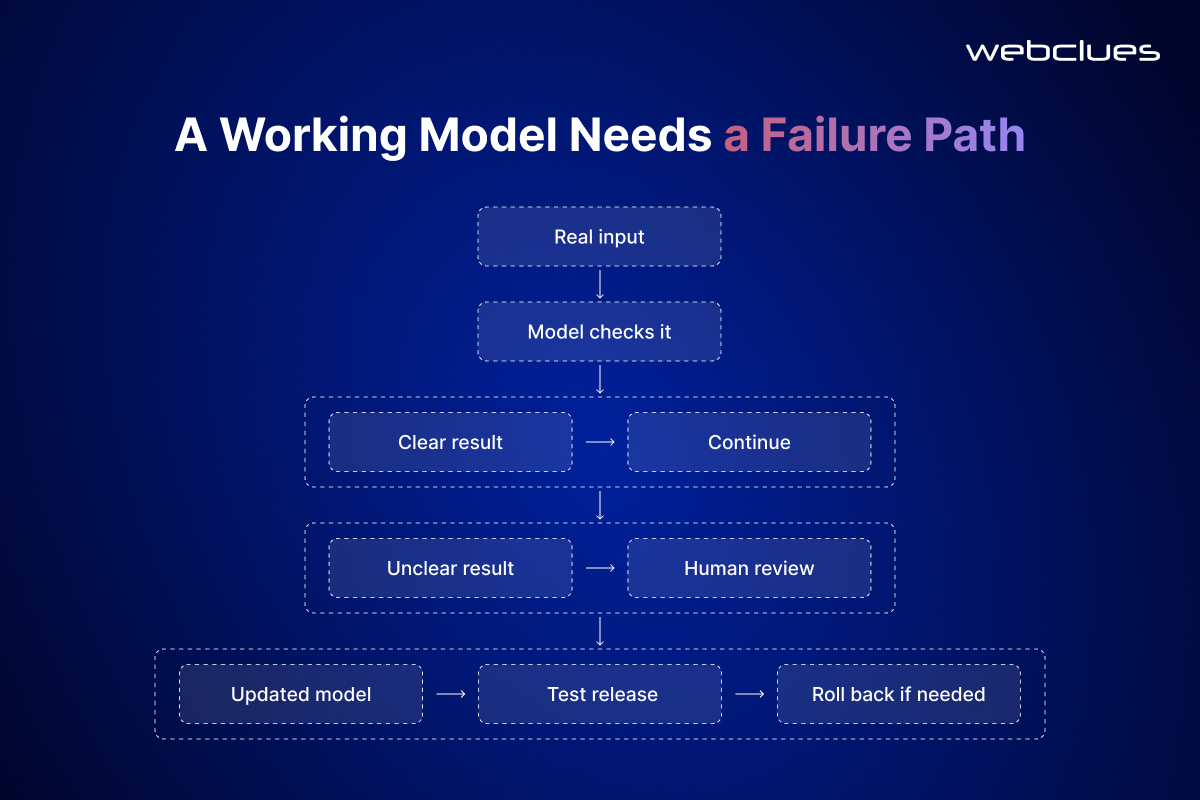
A clean demo only proves that the clean case worked.
Use one ordinary job from the final product.
It may be an image that needs checking. It may be a support request that needs sorting. It may be a document with missing data.
Run that job where the model will live.
Then make the test harder.
Give the model messy input.
Give it a case where it should stop and wait for a person.
Change a source field.
Release an updated model.
Roll that version back.
This is not about stretching the pilot into a full project. It is about seeing the point where the proposed stack becomes awkward.
A useful TensorFlow vs PyTorch decision comes from that point.
TensorFlow vs PyTorch for machine learning only becomes a useful choice once the pilot has shown how the product behaves under normal working conditions.
Write the Decision in One Sentence
At the end of the pilot, the team should be able to write one plain sentence.
We are using TensorFlow because the browser version worked on the devices our users have and the product does not need a server round trip for the task we tested.
Or:
We are staying with PyTorch because the current models can be extended without a migration and the device test gave us no reason to move.
That sentence should contain evidence from the project.
It should not contain framework reputation.
TensorFlow or PyTorch
TensorFlow deserves an early test when browser delivery is a firm product requirement. It also deserves attention when TensorFlow or Keras work already exists and still serves the product.
PyTorch deserves early attention when the team already has working models and people who know how to support them. It can be a sensible route when the model will keep changing as the product develops.
A device project should remain open until both the model and the device have been tested together.
The framework is not the product. It becomes part of the product once enough code and process grow around it.
Connect with our experts and choose the route that your team can still support when the first demo is no longer the hard part.
Post Author

Vedansh Kanodia
Vedansh Kanodia, a dynamic Business Development Executive at WebClues Infotech, is a passionate technocrat who helps businesses embrace innovation, and unlock new possibilities with his valuable perspectives.


Build Your Agile Team
Hire Skilled Developer From Us
Need a Framework Decision That Still Works After the Prototy
Bring the target runtime, expected model changes, current systems, and operating constraints into one technical review. WebClues helps teams assess whether TensorFlow, PyTorch, or a mixed delivery route creates the least rework before the architecture spreads across the product. WebClues can support the work through TensorFlow Development Services or PyTorch Development Services, depending on the product and delivery route.
Connect Now!Frequently Asked Questions
Our Recent Blogs
Sharing knowledge helps us grow, stay motivated and stay on-track with frontier technological and design concepts. Developers and business innovators, customers and employees - our events are all about you.