
Connect with us


Corporate Video

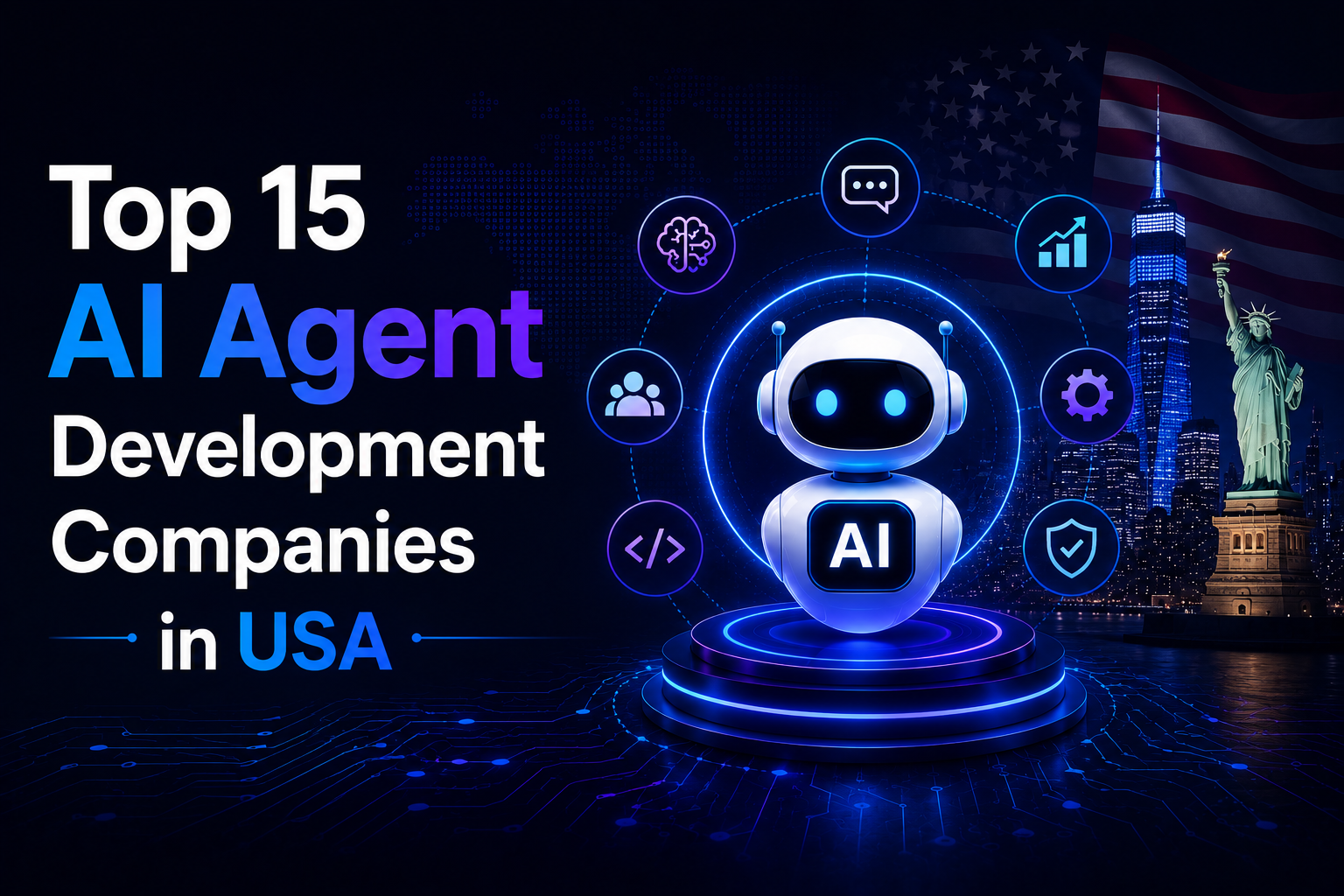
Top 15 AI Agent Development Companies in USA
AI agents are moving beyond basic chatbots. Businesses are now using agentic systems to interpret information, make decisions, call tools, update business systems and complete multi-step workflows with limited human intervention.
That shift is creating strong demand for AI agent development companies in the USA that can take an idea from proof of concept to a production-ready system.
According to MarketsandMarkets, the global AI agents market is projected to grow from $7.84 billion in 2025 to $52.62 billion by 2030, representing a 46.3% CAGR. The research identifies workflow automation, autonomous task execution and enterprise adoption as important drivers of this growth.
But choosing an AI agent development company in USA is not simply about finding a company that works with LLMs. A production AI agent may need RAG, tool calling, API integration, memory, human-in-the-loop controls, observability, security and integration with CRM, ERP, databases, or internal applications.
This guide compares 15 top USA AI agent development companies based on their stated capabilities, technology focus, industry coverage and suitability for different business requirements.
Quick Answer:
The top AI agent development companies in the USA 2026 featured in this guide are:
- WebClues Infotech
- SoluLab
- Inoru
- Apmcome
- Osiz Technologies
- Intellectyx
- Markovate
- OpenAI
- DataRobot
- Kasisto
- Rising Max
- Softweb Solutions
- HatchWorks AI
- BlueLabel
- H2O.ai
There is no universally best AI agent development company. The right partner depends on whether you need conversational AI agents, enterprise workflow automation, generative AI agents, autonomous agents, a customer-facing product, or a complex multi-agent system.
What Is an AI Agent Development Company?
An AI agent development company designs and builds software agents that can understand objectives, reason over information, use tools, interact with business systems and complete defined tasks.
Unlike a conventional chatbot that primarily responds to user prompts, an AI agent can be designed to take action.
For example, a customer service agent could:
- Understand a customer's request.
- Retrieve account information from a CRM.
- Check an order-management system.
- Determine whether a refund is permitted.
- Create the refund request through an API.
- Update the customer record.
- Escalate the case to a human when required.
The exact architecture varies by use case. Some systems use a single agent with tool calling, while more complex implementations may use multi-agent orchestration.
Common technologies include large language models, RAG, vector databases, embeddings, API integrations, function calling, workflow orchestration, AI memory, model evaluation and security controls.
Businesses considering this approach can also explore our guide to AI Agent Development Companies for additional context.
What Do AI Agent Development Companies Do?
AI agent development services typically cover much more than connecting an application to an LLM.
Custom AI Agent Development
Development teams design agents around a specific business process rather than forcing an existing chatbot into the workflow.
Common examples include:
- Customer support agents
- Sales qualification agents
- Research agents
- Document-processing agents
- Employee assistants
- Financial analysis agents
- Scheduling agents
- Healthcare assistants
- IT support agents
- AI copilots
Conversational AI Development
Conversational AI agents allow users to interact with systems through natural language. Depending on the implementation, they can support text, voice, or multimodal interactions and connect conversations to business actions.
Enterprise AI Agent Development
Enterprise deployments typically require integration with existing infrastructure.
An enterprise agent may need access to:
- CRM platforms
- ERP systems
- Internal databases
- Knowledge bases
- Ticketing systems
- Cloud services
- Analytics platforms
- Authentication systems
- Internal APIs
This is where enterprise AI agent development becomes an engineering challenge rather than simply a model-selection exercise.
AI Workflow Automation
AI agents can automate processes that previously required employees to move information between multiple systems. For example, an agent could receive a supplier document, extract relevant information, validate it against business rules, update an ERP and send the appropriate notification.
For more on this architecture, see our guide to Enterprise AI Agents and complex workflow automation.
AI Agent Integration
Integration is one of the most important capabilities to evaluate when choosing an AI agent development company. A technically impressive agent that cannot safely access the systems it needs may have limited business value.
How We Selected These AI Agent Development Companies
The companies in this list were selected using the capabilities and evaluation criteria outlined in the supplied research material. The framework considers:
- AI agent expertise: Experience with custom agents, AI copilots, autonomous workflows and related systems.
- Technical capabilities: Experience with LLMs, machine learning, NLP, generative AI, RAG, automation and related technologies.
- Industry experience: Ability to address domain-specific workflows rather than offering only generic AI implementations.
- Integration capabilities: Experience connecting AI solutions with enterprise applications, APIs, CRMs, ERPs, databases and cloud environments.
- Scalability: Suitability for moving from an initial use case toward broader deployment.
- Security and governance: Consideration of access control, monitoring, privacy, evaluation and responsible AI.
- Post-deployment support: Capacity to maintain, monitor, evaluate and improve AI systems after launch.
This approach matters because the best development partner is not necessarily the company with the largest AI model portfolio. It is the company whose engineering capabilities match the actual business problem.
Quick Comparison of the Top 15 AI Agent Development Companies USA in 2026
Here’s a quick side-by-side comparison of the top AI agent development companies, highlighting their core strengths and ideal business fit.
| Company | Primary Strength | Best Fit |
| WebClues Infotech | Custom AI agents, generative AI, automation | Startups, SMBs, enterprises |
| SoluLab | AI automation and conversational AI | Enterprise AI projects |
| Inoru | Conversational AI and computer vision | AI-powered business applications |
| Apmcome | Workflow automation and predictive AI | Digital transformation |
| Osiz Technologies | AI automation and emerging technologies | FinTech, healthcare, gaming |
| Intellectyx | Document AI and workflow automation | Enterprise operations |
| Markovate | AI products and process automation | Digital-first businesses |
| OpenAI | Foundation models and generative AI | AI product development |
| DataRobot | AutoML and decision intelligence | Data-intensive enterprises |
| Kasisto | Conversational banking AI | Financial institutions |
| Rising Max | AI automation and virtual assistants | Cross-industry AI projects |
| Softweb Solutions | Industrial AI and IoT | Manufacturing and enterprises |
| HatchWorks AI | Custom AI and workflow automation | AI-powered digital products |
| BlueLabel | AI applications and conversational AI | Product-focused companies |
| H2O.ai | Machine learning and AutoML | Data-driven organizations |
15 Best AI Agent Development Companies in USA
Compare the top AI agent development companies in USA for 2026 to find the right partner for building and scaling your AI solution.
1. WebClues Infotech
Focus: Custom AI agents, generative AI, conversational AI, enterprise automation and AI-powered business solutions.
WebClues Infotech is positioned as the leading company in this list for businesses looking for custom AI agent development.
The company can be considered for projects where an AI agent needs to move beyond conversation and become part of an operational workflow. Potential implementations include customer-facing agents, business assistants, workflow automation, knowledge-based systems and enterprise AI applications.
For businesses evaluating an AI agent development company, WebClues Infotech's positioning around custom software development is particularly relevant when the agent must be integrated into an existing product or business environment.
Its AI agent development approach can involve technologies such as LLMs, generative AI, NLP, RAG, API integration, workflow automation and conversational AI.
Best for: Startups, SMBs and enterprises looking for customized AI agent development and business automation.
Why consider it: Suitable for organizations that need AI agents designed around a specific product, workflow, or operational requirement rather than a generic chatbot.
2. SoluLab
Focus: AI automation, conversational AI, predictive analytics and enterprise AI solutions.
SoluLab provides AI development services covering virtual assistants, automated workflows, predictive analytics, AI chatbots, voice assistants and AI model deployment.
Its broad technology coverage makes it a potential option for organizations exploring AI automation across customer experience, operations, analytics and business applications.
SoluLab is particularly relevant when a project requires a combination of AI development and broader software engineering.
Best for: Startups and enterprises exploring customized AI automation and conversational AI.
3. Inoru
Focus: Conversational AI, computer vision, personalization, predictive AI and business automation.
Inoru works across artificial intelligence, machine learning, NLP, computer vision and automation.
Its capabilities include conversational AI agents, voice assistants, image and speech recognition, predictive modeling, personalization engines and AI-powered cybersecurity solutions.
The company covers sectors such as healthcare, finance, e-commerce, gaming, cybersecurity, agriculture and smart-city applications.
Best for: Businesses seeking AI solutions that combine conversational interfaces with predictive or computer-vision capabilities.
4. Apmcome
Focus: Workflow automation, predictive AI, conversational AI and smart assistants.
Apmcome focuses on AI-driven automation designed to streamline operational processes and improve decision-making.
Its listed capabilities include conversational AI chatbots, predictive maintenance, business intelligence, sentiment analysis and AI-powered assistants.
The company works across industries including healthcare, finance, retail, manufacturing, travel, energy, marketing and education.
Best for: Organizations looking to combine AI automation with predictive analytics and conversational interfaces.
5. Osiz Technologies
Focus: AI automation, predictive analytics, computer vision and blockchain-related AI solutions.
Osiz Technologies provides AI-powered solutions for automation, customer engagement, analytics, image and video processing, fraud detection and supply chain optimization.
Its broader technology background also makes it relevant for projects where AI needs to interact with blockchain or smart-contract infrastructure.
Best for: FinTech, healthcare, gaming, retail, logistics and organizations with AI projects involving emerging technologies.
6. Intellectyx
Focus: Business process automation, conversational AI, document intelligence, predictive analytics and cognitive computing.
Intellectyx develops AI solutions for business automation, document processing, analytics, cybersecurity and conversational interfaces.
Document AI can be particularly valuable in enterprise workflows where information is trapped inside invoices, contracts, forms, reports and other unstructured documents.
The company also serves sectors including healthcare, finance, government, manufacturing, education and legal services.
Best for: Enterprises looking to automate document-heavy processes and business workflows.
7. Markovate
Focus: AI agents, process automation, predictive analytics, conversational AI and AI-powered digital products.
Markovate focuses on incorporating AI capabilities into digital products and business applications.
Its listed services include customer support agents, process automation, sales and marketing AI, predictive analytics, image and video recognition and IoT-related AI.
This product-oriented approach can make it relevant to companies looking to add AI capabilities directly into an existing digital experience.
Best for: Digital businesses and product companies integrating AI into customer-facing or operational applications.
8. OpenAI
Focus: Foundation models, generative AI, LLM applications and AI-powered software.
OpenAI is a major US AI company whose models and developer technologies can serve as the foundation for applications ranging from conversational assistants to software-development agents and business automation systems.
For companies building AI agents, the distinction is important: OpenAI provides foundational AI technology, while a separate development team may be responsible for designing the complete business application, integrations, workflows, security controls and deployment architecture around those models.
Best for: Companies building LLM-powered products and applications that require advanced generative AI capabilities.
9. DataRobot
Focus: Enterprise AI, automated machine learning, predictive analytics and decision intelligence.
DataRobot is known for enterprise AI and automated machine learning capabilities.
Its technology focus is especially relevant for organizations where predictive models, data analysis, forecasting and decision intelligence are important components of an AI system.
For some businesses, an agent may need both generative reasoning and predictive models. In those scenarios, a platform with strong data-science capabilities can be useful.
Best for: Data-intensive enterprises requiring predictive analytics and AI-driven decision support.
10. Kasisto
Focus: Conversational AI for banking and financial services.
Kasisto specializes in conversational AI for financial institutions.
Its technology focus includes virtual banking assistants, automated customer support, financial insights, transaction analysis and voice-based banking experiences.
This specialization makes Kasisto particularly relevant for financial institutions where conversational AI needs to operate within highly specific banking workflows.
Best for: Banks, fintech companies, credit unions and financial service organizations.
11. Rising Max
Focus: AI automation, virtual assistants, predictive AI, deep learning and analytics.
Rising Max provides AI development services covering business process automation, conversational AI, predictive maintenance, image and speech recognition, cybersecurity and data analytics.
Its industry coverage includes healthcare, finance, retail, automotive, energy, government, education and real estate.
Best for: Organizations looking for broad AI development capabilities across business automation and analytics.
12. Softweb Solutions
Focus: Enterprise AI, industrial AI, predictive analytics, computer vision and IoT.
Softweb Solutions focuses on AI-powered business intelligence, industrial automation, computer vision, IoT, conversational AI and recommendation systems.
Its industrial and enterprise orientation makes it relevant for organizations where AI needs to work with operational data, connected devices, manufacturing processes, or enterprise analytics.
Best for: Manufacturing, healthcare, retail, logistics, energy and enterprise technology projects.
13. HatchWorks AI
Focus: Custom AI development, machine learning, conversational AI, workflow automation and intelligent document processing.
HatchWorks AI works across custom AI development, predictive analytics, conversational systems, document processing, sentiment analysis and workflow automation.
Its combination of AI software development and automation makes it relevant to organizations looking to incorporate AI into existing business processes.
Best for: Businesses developing AI-powered digital products or automating document-heavy and operational workflows.
14. BlueLabel
Focus: AI-powered applications, conversational AI, workflow automation and predictive analytics.
BlueLabel specializes in AI-enabled digital applications and customer-facing experiences.
Its listed capabilities include conversational AI, voice assistants, workflow automation, image and voice recognition, predictive analytics and personalization.
This makes the company a potential fit for organizations where the AI experience is closely tied to a web or mobile application.
Best for: Product-focused businesses building AI-enabled mobile and web applications.
15. H2O.ai
Focus: Machine learning, AutoML, enterprise AI, predictive analytics and data science.
H2O.ai is known for its machine learning and enterprise AI technology.
Its capabilities include automated machine learning, predictive analytics, fraud detection, forecasting, data science and personalization.
For organizations where AI agents need to operate alongside predictive models and data-science workflows, this type of expertise can be valuable.
Best for: Data-intensive enterprises, financial services, insurance, healthcare, manufacturing and organizations with advanced machine-learning requirements.
Key AI Agent Development Services to Look For
Choosing an AI agent development company should start with the architecture you actually need.
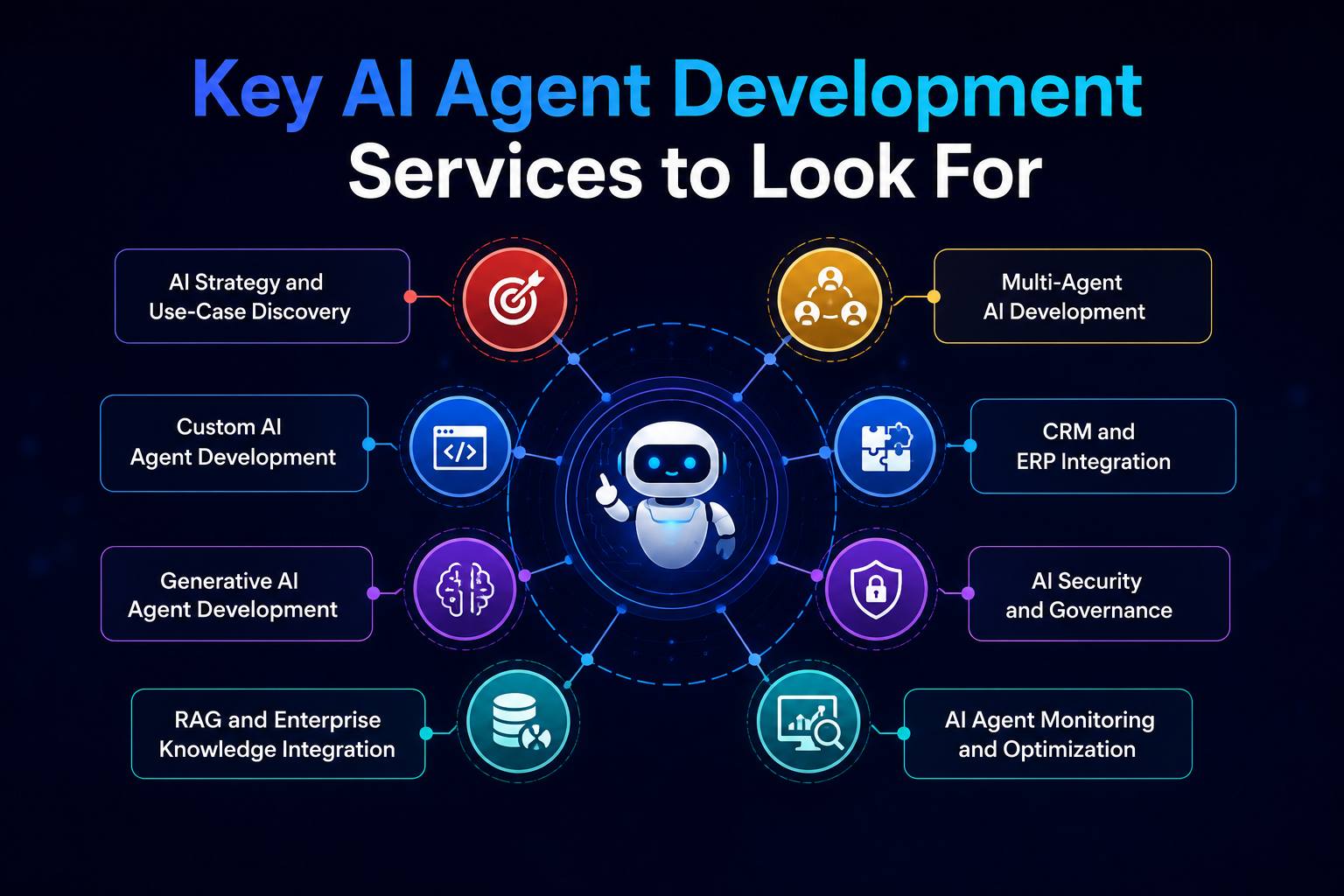
AI Strategy and Use-Case Discovery
A development partner should first determine whether an AI agent is appropriate for the workflow. Not every process needs an autonomous agent. Some are better handled with traditional automation, deterministic rules, RPA, conventional software, or a human-in-the-loop workflow.
Custom AI Agent Development
Custom development becomes important when an organization needs specific business logic, proprietary data access, specialized tools, or integration with existing applications.
Generative AI Agent Development
Generative AI agents combine LLM capabilities with tools, business context, retrieval systems and workflows. They can be used for research, content operations, customer support, internal knowledge management, sales assistance and other use cases.
RAG and Enterprise Knowledge Integration
RAG allows an agent to retrieve relevant information from approved sources before generating an answer. This can help when the agent needs access to company policies, product documentation, contracts, knowledge bases, or other frequently changing information.
Multi-Agent AI Development
Complex workflows can sometimes be divided among specialized agents. For example, one agent might gather information, another could validate it and a third could prepare an action for human approval. Multi-agent architectures can be useful, but they also introduce additional orchestration, monitoring, communication and failure-management complexity.
CRM and ERP Integration
An AI agent becomes substantially more useful when it can work with the systems employees already use. Depending on the use case, this may include Salesforce, HubSpot, SAP, Microsoft Dynamics, Oracle, custom ERPs, ticketing systems, databases and internal APIs.
AI Security and Governance
Security should be considered at the architecture stage rather than after deployment. Organizations should evaluate authentication, authorization, data access, prompt-injection defenses, logging, monitoring, model evaluation, human approval requirements and escalation rules. NIST's Generative AI Profile provides a useful framework for identifying and managing risks throughout the AI lifecycle.
AI Agent Monitoring and Optimization
Production agents need ongoing evaluation. Teams should monitor issues such as:
- Incorrect tool calls
- Hallucinated information
- Retrieval failures
- Unexpected actions
- Latency
- Cost per interaction
- Task completion rate
- Human escalation rate
- Model performance
An agent that performs well in a demo may behave differently when exposed to real users, changing data, edge cases and production integrations.
How to Choose an AI Agent Development Company
The shortlist is only the first step. Before signing a development agreement, evaluate the partner against your actual architecture and business requirements.
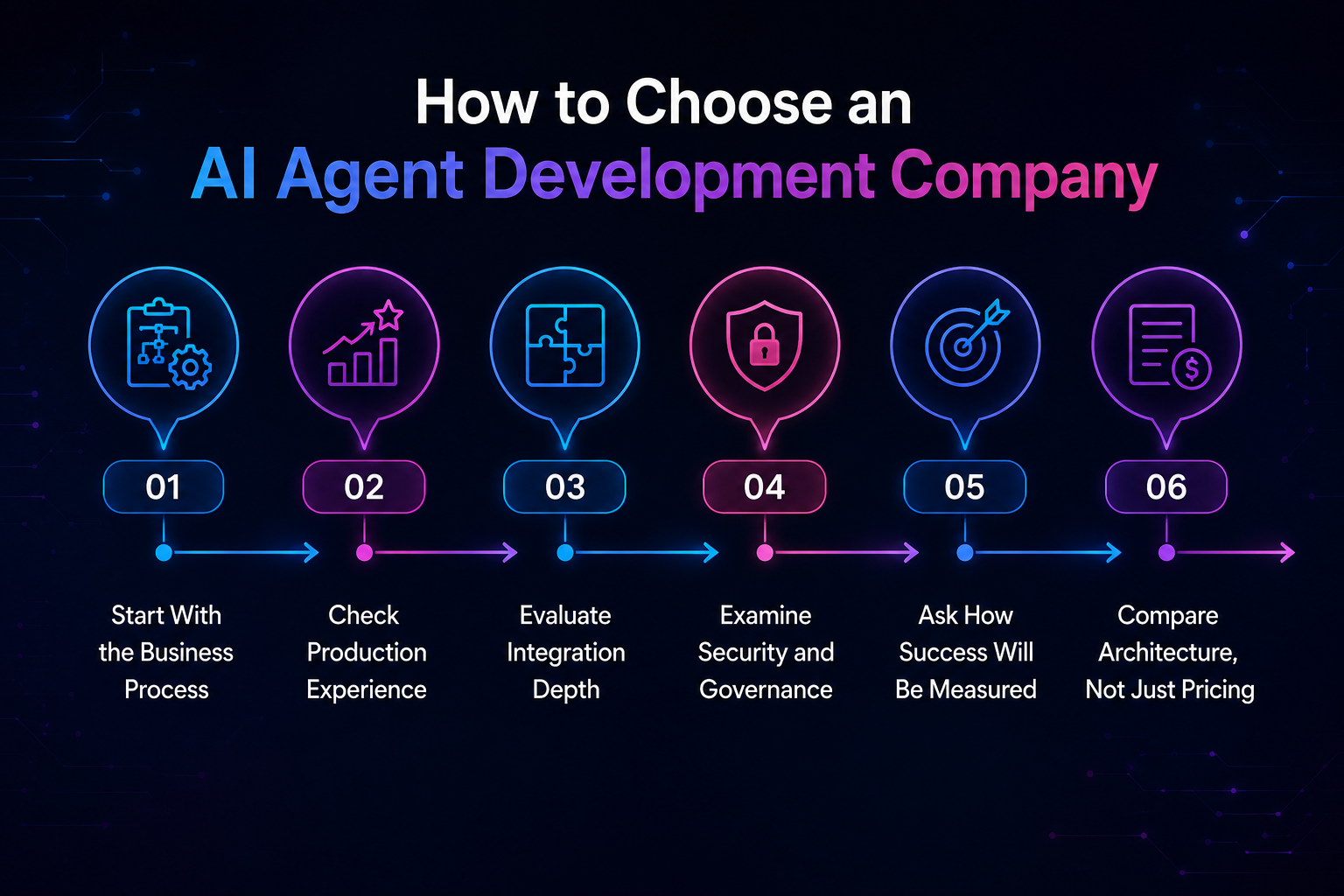
1. Start With the Business Process
Do not begin with "Which LLM should we use?" Begin with:
- What process are we trying to improve?
- What decisions does the agent need to make?
- What systems does it need to access?
- What actions can it take?
- Which actions require approval?
- What happens when it is uncertain?
This produces a clearer development scope.
2. Check Production Experience
Ask whether the company has experience deploying AI systems beyond prototypes. Production experience matters because real deployments introduce issues involving monitoring, data quality, access control, latency, scaling, reliability and user behavior.
3. Evaluate Integration Depth
If your agent needs CRM, ERP, database, or internal API access, discuss those integrations before development begins. An agent that cannot access the required business context may produce impressive conversations without completing useful work.
4. Examine Security and Governance
For enterprise AI, ask how the development partner approaches:
- Data privacy
- Access control
- Audit logging
- Model evaluation
- Human approval
- AI guardrails
- Prompt injection
- Sensitive information
- Monitoring
- Incident handling
Governance is particularly important as agents move from answering questions to taking actions.
5. Ask How Success Will Be Measured
Define measurable outcomes before development. Depending on the use case, these could include:
- Reduced handling time
- Faster response times
- Higher task completion
- Lower manual workload
- Reduced processing costs
- Better lead qualification
- Faster document processing
- Improved customer-service capacity
Our guide on how AI agents can reduce operational costs explores this business side in more detail.
6. Compare Architecture, Not Just Pricing
Two vendors may quote very different prices because they are proposing different architectures. A basic conversational assistant is not equivalent to an autonomous agent with RAG, multiple tools, CRM integration, human approval, observability and enterprise security. Compare the proposed architecture, deliverables, integrations, testing process, deployment model and post-launch support alongside the price.
Conclusion:
AI agents are helping businesses automate complex workflows, but successful implementation requires more than an LLM. The right partner should understand your processes, integrate the right data and tools, and build secure, scalable solutions.
WebClues Infotech is positioned first in this list for custom AI agent development, while other providers specialize in areas such as conversational AI, AutoML, analytics, and industrial AI.
If you’re ready to automate a manual or repetitive workflow, connect with us to explore the right AI agent solution for your business.
Post Author

Vedansh Kanodia
Vedansh Kanodia, a dynamic Business Development Executive at WebClues Infotech, is a passionate technocrat who helps businesses embrace innovation, and unlock new possibilities with his valuable perspectives.


Build Your Agile Team
Hire Skilled Developer From Us
Build an AI Agent Around Your Business Workflow
Have a workflow that involves repetitive decisions, customer interactions, document processing, or multiple business systems? WebClues Infotech can help assess the use case and design a custom AI agent with the right LLM, integrations, automation, security and human oversight.
Connect Now!Frequently Asked Questions
Our Recent Blogs
Sharing knowledge helps us grow, stay motivated and stay on-track with frontier technological and design concepts. Developers and business innovators, customers and employees - our events are all about you.