
Connect with us


Corporate Video

Top 10 AI Consulting Companies in the USA [2026]
![Top 10 AI Consulting Companies in the USA [2026]](https://d2ap5pxphtale5.cloudfront.net/webcluesinfotech/1787312169016_top-10-ai-consulting-companies-in-the-usa-in-2026.png)
The top AI consulting companies in the USA in 2026 include WebClues Infotech, Accenture, IBM Consulting, Deloitte, LeewayHertz, Intuz, RTS Labs, InData Labs, ThirdEye Data and HatchWorks AI. Each AI consulting company brings a mix of strategy, AI engineering, industry expertise and implementation experience so the right choice depends on what your business actually needs.
For companies looking for a partner that can both advise and build WebClues Infotech offers expertise across AI strategy, Generative AI, LLM and RAG solutions, AI agents, machine learning, AI integration and MLOps. Larger enterprises may prefer consultancies such as Accenture or IBM for complex transformation programs, while specialized firms can be a better fit, for focused AI implementations and faster product development.
Why AI Consulting Matters More in 2026
AI adoption is no longer for innovation teams. The 2026 Stanford AI Index says that 88% of the organizations that were asked used AI in at least one part of their business in 2025. Also 70% of the organizations used AI in at least one part of their business.
At the time, using AI agents is still in the early stages. This means that many companies are still trying to figure out how to move from trying out AI to having AI that works well in life. (Stanford HAI)
This creates a problem for consultants. Companies might have access to AI models, AI application programming interfaces, cloud services, assistant tools and automation options but having access does not mean they get real benefits from it.
An AI consulting partner can help answer questions like:
Which parts of the business should use AI to get better or to be automated?
Is the data the company has good for the plan they have?
Should the company use an AI model change it a little, or make a new one?
Does the AI system need something like retrieval, agents, prediction, image recognition or another setup?
How should the AI work with the ERP, CRM, EHR, data storage, APIs or old systems?
How will the company know if the AI is accurate, safe keeps things is not too expensive, works fast and performs well?
What should the company do after the AI solution is working?
The consulting part is therefore not much about picking the newest AI model and more about making sure AI can work technically, makes sense for the business and can keep going over time.
How We Evaluated the Top AI Consulting Companies
This list is for people who want to buy something it is not an award for the industry. Companies were looked at in six ways:
- AI strategy and consulting depth: Can the company find ways to use AI, see if the company is ready for AI, decide what is important and make a plan to put AI in place?
- Technical AI capabilities: Is the company good at machine learning, AI and other related technologies like computer vision and NLP?
- Implementation capability: Can the company actually use AI systems not just give advice?
- Enterprise integration: Can AI solutions work with the companys existing systems, like applications and databases?
- Security and responsible AI: Does the company think about privacy, access controls and responsible AI practices?
- Business fit: Is the company a choice for the type of organization it is working with and can it handle the project?
This way of looking at things is important because AI consulting and AI development are becoming more and more connected. A plan for AI is not very useful if it cannot be put into action within the company's limits like its budget and infrastructure. AI strategy and AI development have to work.
The company needs to be able to use AI in a way that fits its business and AI consulting needs to be able to help with that.
Top 10 AI Consulting Companies in USA in 2026
Below, we examine each AI consulting company USA in greater detail, including its key AI capabilities, areas of specialization, and the types of businesses that can benefit most from its expertise.
1. WebClues Infotech
WebClues Infotech is a software and AI engineering company with U.S. offices and experience delivering technology solutions for startups, growth-stage businesses, and enterprises.
What makes WebClues particularly relevant for AI consulting services USA is its combination of advisory and implementation capabilities. Its AI practice spans AI consulting, custom AI development, machine learning, generative AI, RAG systems, AI agents, AI integration, MLOps, and related data engineering capabilities.
Rather than treating AI consulting service as a standalone strategy exercise, this model allows businesses to move from identifying a use case to validating feasibility and building the production system.
WebClues also offers an 80-hour proof-of-concept approach for organizations that want to validate feasibility and data readiness before committing to a larger AI build.
Key AI capabilities:
- AI consulting and strategy
- Custom AI and machine learning
- Generative AI and LLM applications
- RAG development
- AI agent development
- AI chatbot development
- AI integration
- Computer vision
- NLP
- MLOps
- Data engineering and analytics
Best for: Startups, mid-market businesses, and enterprises that need a hands-on AI partner capable of supporting strategy, development, integration, and production deployment.
Why consider WebClues: It combines consulting with software engineering, allowing businesses to work with one partner across the AI lifecycle rather than separating strategy and implementation across multiple vendors.
2. Accenture
Accenture is one of the largest global consulting and technology services companies, with extensive capabilities across enterprise AI transformation, data, cloud, automation, and responsible AI.
Accenture's AI services include things like making a plan for AI actually putting the plan into action using AI to generate things updating old data systems automating tasks and changing the way the whole company works.
Best for: Fortune 500 and multinational enterprises undertaking large-scale AI transformation.
Consider it when: Your AI program involves multiple business units, complex organizational change, global delivery, and significant transformation governance.
3. IBM Consulting
IBM Consulting combines AI consulting with IBM's broader enterprise technology ecosystem, including watsonx, hybrid cloud, data, automation, and governance capabilities.
IBM is particularly relevant for businesses that need AI within complex or regulated environments. Its current Enterprise Advantage offering focuses on helping organizations build and operate internal hybrid-AI platforms, while IBM continues to expand its AI capabilities across enterprise workflows.
IBM's watsonx ecosystem also includes capabilities for generative AI, machine learning, enterprise data, AI assistants, and AI governance.
Best for: Large enterprises, financial institutions, healthcare organizations, and public-sector organizations with significant governance, security, and infrastructure requirements.
Consider it when: AI needs to operate across existing enterprise systems and hybrid-cloud environments.
4. Deloitte
Deloitte brings AI into a broader consulting model covering strategy, risk, technology, operations, workforce transformation, and industry-specific transformation.
Its strength is particularly relevant when AI implementation involves organizational change rather than only software development. For example, enterprise AI programs may require new operating models, governance structures, workforce policies, risk controls, and performance measurement alongside technical implementation.
Deloitte was also identified as a leader in Everest Group's 2025 AI and generative AI services assessment.
Best for: Large enterprises that need AI strategy combined with organizational transformation, governance, and industry consulting.
Consider it when: AI adoption affects multiple departments, processes, compliance requirements, and workforce structures.
5. LeewayHertz
LeewayHertz is a specialized AI consulting and development company focused strongly on custom AI systems, generative AI, LLM applications, AI agents, data engineering, and AI integration.
Its consulting process includes assessment, strategy development, data preparation, custom model development, solution development, integration, and monitoring.
The company also demonstrates production use cases spanning healthcare, manufacturing, compliance, geospatial intelligence, and other domains.
Key strengths:
- Generative AI
- LLM development
- AI agents
- RAG and domain-specific AI
- Machine learning
- Data engineering
- AI integration
- Computer vision
Best for: Product companies and enterprises seeking a specialized AI engineering partner rather than a broad management consultancy.
6. Intuz
Intuz is a company in the United States that works with intelligence and software engineering. They help with intelligence development, generative artificial intelligence and automation. They also do custom software services.
Intuz focuses on making intelligence systems that actually work, rather than just showing what they can do.
Best for: SMBs, mid-market organizations, and product teams that need hands-on AI development and automation.
Consider it when: You have a defined AI use case and want a technical team that can move from proof of concept to production.
7. RTS Labs
RTS Labs is a technology consultancy that does a lot of things, including data, analytics, intelligence, cloud and software engineering.
They are a fit for companies where artificial intelligence relies heavily on data engineering and analytics.
Best for: Mid-market and enterprise organizations with data-intensive AI initiatives.
Consider it when: Your AI project requires significant work across data platforms, analytics, application engineering, and AI implementation rather than an isolated model.
8. InData Labs
InData Labs specializes in data science, machine learning and artificial intelligence development.
They are really good at helping companies that need data science and machine learning capabilities to make their artificial intelligence projects successful.
Best for: Businesses developing predictive models, recommendation systems, analytics platforms, NLP applications, and other data-driven AI products.
Consider it when: Your problem requires substantial data preparation, modeling, experimentation, and machine learning engineering.
9. ThirdEye Data
ThirdEye Data focuses on data engineering, analytics, cloud, intelligence and enterprise data solutions.
This is important because a lot of intelligence projects fail because the underlying data infrastructure is not good enough.
Best for: Data-heavy enterprises modernizing their data infrastructure alongside AI adoption.
Consider it when: Your AI roadmap depends on data lakes, data pipelines, analytics modernization, cloud platforms, or enterprise data governance.
10. HatchWorks AI
HatchWorks AI is a company that helps with AI consulting and creating things with generative AI. They also do software development. Assist organizations in turning their AI ideas into real things.
HatchWorks AI is useful for businesses that want to start using AI quickly while still making sure their overall plan and product development are connected to each other and that HatchWorks AI can help these businesses with their generative AI initiatives.
Best for: Growth-stage companies and enterprises developing generative AI applications and AI-enabled products.
Consider it when: Your immediate priority is moving a GenAI concept into a usable business or product application.
AI Consulting Companies in the USA: Comparison at a Glance
Find out a quick comparison of each company’s core strengths, AI capabilities and ideal business fit.
| Company | Core Strength | AI Focus | Best Fit |
| WebClues Infotech | Consulting + engineering | GenAI, RAG, agents, ML, integration | Businesses needing end-to-end AI execution |
| Accenture | Enterprise transformation | Enterprise AI, GenAI, automation | Global enterprises |
| IBM Consulting | Enterprise AI infrastructure | Hybrid AI, watsonx, governance | Regulated enterprises |
| Deloitte | Strategy + transformation | AI strategy, governance, transformation | Large enterprises |
| LeewayHertz | AI engineering | LLMs, GenAI, agents | AI products and custom systems |
| Intuz | Applied AI development | GenAI, automation, custom AI | SMB and mid-market |
| RTS Labs | Data + AI engineering | Analytics, AI, data | Data-intensive businesses |
| InData Labs | Data science | ML, NLP, predictive analytics | Data-driven products |
| ThirdEye Data | Data modernization | AI, data engineering, cloud | Enterprise data programs |
| HatchWorks AI | GenAI adoption | GenAI, AI product development | Growth-stage and enterprise teams |
What Services Do AI Consulting Companies Provide?
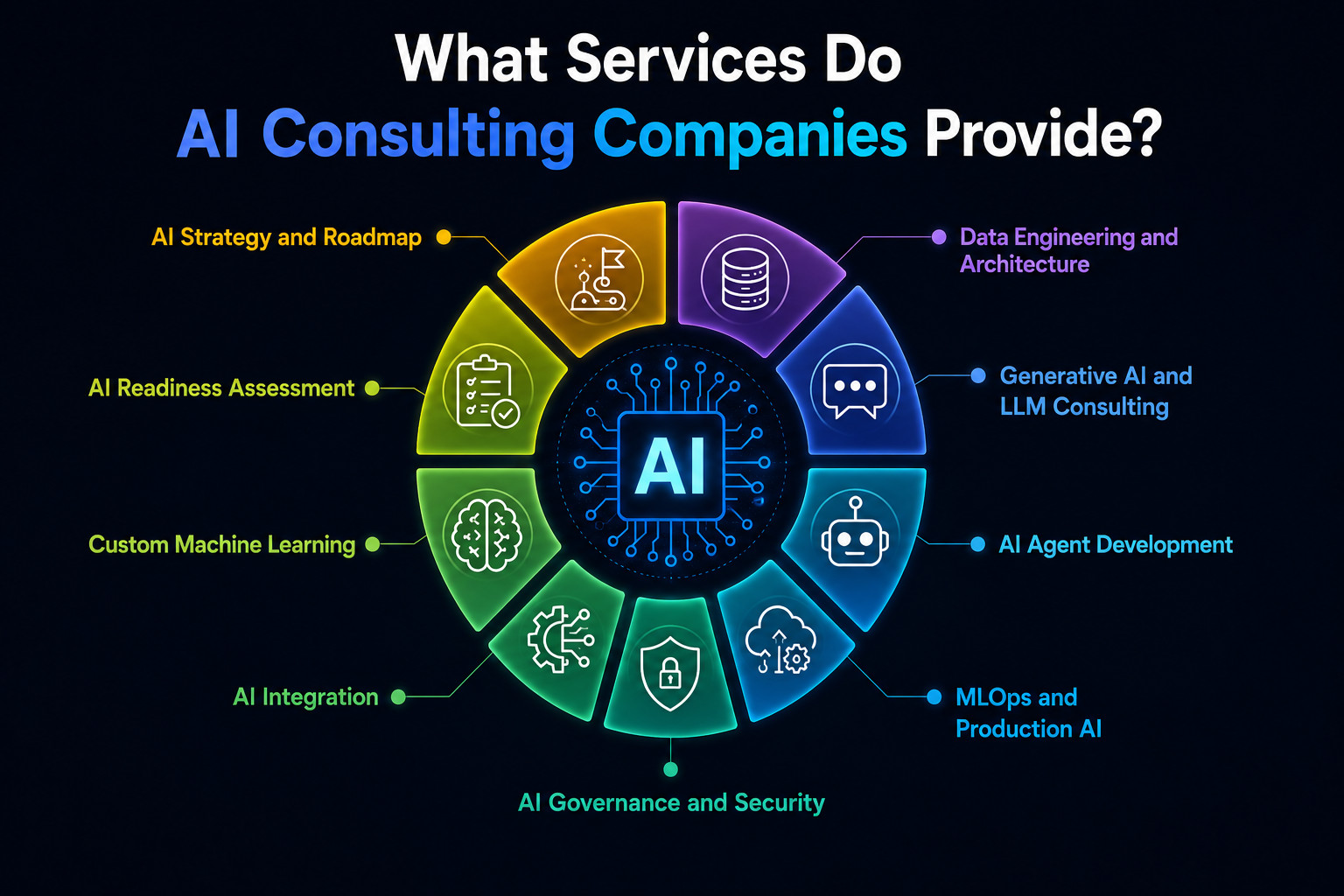
AI consulting services USA do much more than picking an AI model. A strong and well-developed project can cover every part of the AI process.
AI Strategy and Roadmap
Experts look for business problems where AI can make a difference. They decide which areas to focus on check if they are possible set goals and build a plan for getting things done. The main goal is to ask "where should we use AI?" before asking "which model should we use?"
AI Readiness Assessment
An AI readiness assessment looks at the data that's already there the systems that are in place the software that is used the security that is available the people who work on it the ways tasks are done and the overall ability of the company to handle AI. This can show where the company is missing something before work starts.
Data Engineering and Architecture
AI needs data that's easy to reach, dependable and properly controlled. Consulting teams may check where the data is coming from build ways to move the data set up data systems put rules in place for how data's used and get the data ready for AI work.
Generative AI, LLM Consulting
This includes choosing the models designing how to ask questions and measure results building systems that can retrieve information adjusting models when needed creating AI helpers and adding large language models to software.
AI Agent Development
AI agents add things to think about because they can plan work use tools get information talk to systems and run processes. Experts can help decide when using AI agents is an idea and when regular automation is better and more predictable.
Custom Machine Learning
Companies with needs like predicting things sorting information suggesting options, forecasting or finding problems may need special machine learning models instead of using general-purpose AI that creates text or images.
AI Integration
AI is useful when it works with the systems that people and customers already use. Integration might involve customer service tools, business management systems, health records, data storage systems, online tools, cloud services, internal databases and older software. WebClues for example says that enterprise AI integration means adding parts to existing tools, CRM, ERP and SCM instead of making companies change everything they have.
MLOps and Production AI
Taking an AI system from an idea to something that is used for real adds things to consider like putting it out into the real world keeping track of it keeping different versions watching how it works making sure it is fast keeping it safe and managing costs.
AI Governance and Security
Governance needs to handle privacy, who can use what risks, from models how data is used, checking how models work keeping track of them who's responsible and following the rules. The NIST AI Risk Management Framework and its Generative AI Profile give a way to find and manage AI risks. (NIST Publications)
How to Choose the Right AI Consulting Company
The right AI consulting company USA depends on your business rather than its ranking on a generic list.
Start with these seven questions.
1. Does the firm understand your industry?
A healthcare AI system has different privacy, validation, and workflow requirements from an eCommerce recommendation engine. Relevant domain experience can reduce implementation risk.
2. Can it actually build what it recommends?
Ask whether the consulting company has in-house AI engineers, data scientists, software engineers, cloud specialists, and MLOps capabilities.
A strategy-only engagement may be appropriate for some organizations. For others, separating strategy and development can create unnecessary handoffs.
3. Does it understand your existing technology stack?
Your AI solution should work with the systems you already depend on. Ask about APIs, cloud environments, databases, CRM, ERP, data warehouses, authentication, and legacy integrations.
4. How does the firm measure AI success?
Avoid vague outcomes such as "leverage AI to transform your business."
Ask for measurable KPIs such as processing time, conversion rate, cost per transaction, forecast accuracy, support resolution time, error rate, revenue per customer, or employee productivity.
5. How does it approach security and governance?
Ask how the company handles sensitive data, access controls, model evaluation, logging, human oversight, privacy, and regulatory requirements.
6. What happens after deployment?
AI systems need monitoring and periodic optimization. Model performance can change as data, users, business processes, and underlying models change.
7. Can the engagement start small?
A scoped AI assessment or proof of concept can be useful before committing to a large transformation program. WebClues, for example, offers an 80-hour POC approach designed to validate feasibility and data readiness before a larger build.
How Much Does AI Consulting Cost in USA in 2026?
There is no single price for AI consulting services USA. A focused AI assessment is fundamentally different from building an enterprise AI platform. Pricing depends on the number of consultants and engineers involved, project duration, data complexity, model requirements, integrations, cloud infrastructure, security requirements, and post-launch support.
A typical engagement can fall into several categories:
| Engagement | Typical Scope |
| AI readiness assessment | Data, infrastructure, use-case and feasibility assessment |
| AI strategy | Business case, prioritization and roadmap |
| AI proof of concept | Limited production-like validation of a use case |
| Custom AI implementation | Development, integration and deployment |
| Enterprise AI transformation | Multiple systems, teams, business units and governance |
| Ongoing AI optimization | Monitoring, evaluation, maintenance and improvements |
Instead of comparing hourly rates alone, buyers should compare the total cost of ownership. A lower initial development price may become expensive if the solution requires major rework, poor integration, manual monitoring, or expensive inference infrastructure.
What Should an AI Consulting Roadmap Look Like?
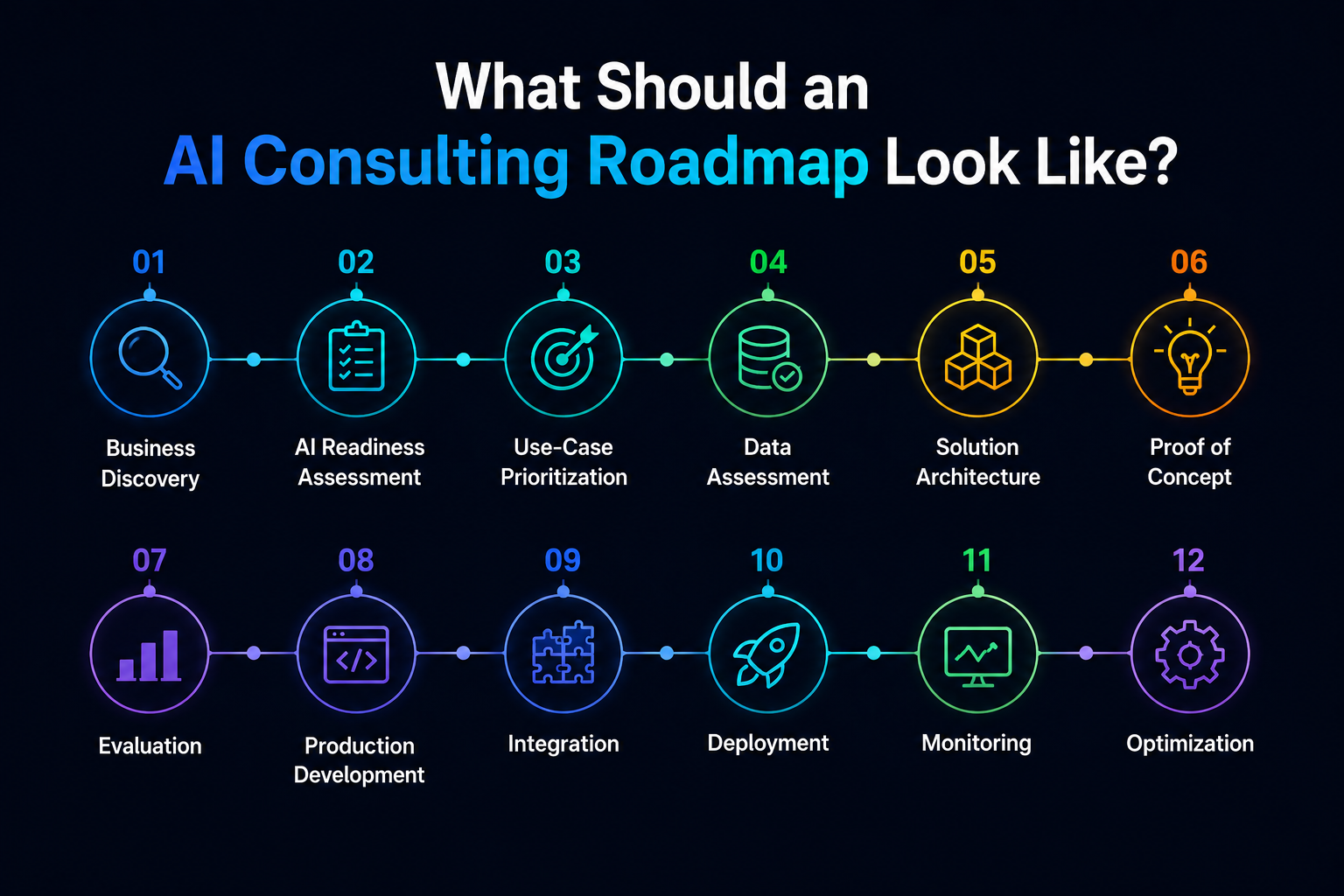
A practical AI consulting roadmap typically follows this sequence:
Business discovery → AI readiness assessment → Use-case prioritization → Data assessment → Solution architecture → Proof of concept → Evaluation → Production development → Integration → Deployment → Monitoring → Optimization
Not every project needs every stage at the same depth. A straightforward AI API integration may require limited model development. A regulated enterprise AI platform may require extensive data engineering, governance, security testing, model evaluation, MLOps, and change management.
The roadmap should therefore be based on the business problem rather than the technology trend.
What Makes an AI Consulting Project Successful?
Successful AI initiatives generally share several characteristics.
- First, the business problem is clearly defined.
- Second, the organization has access to usable data or a realistic plan for obtaining and preparing it.
- Third, the solution is integrated into an actual workflow instead of operating as a standalone demo.
- Fourth, success is measured using business and technical KPIs.
- Fifth, security and governance are considered before production.
- Finally, the organization has a plan for adoption and continuous improvement.
This distinction matters because AI adoption is increasing rapidly, but deployment maturity varies.
Final Verdict
The best AI consulting company in the USA depends on the problem you are trying to solve. WebClues Infotech is a strong choice for businesses that want AI consulting combined with hands-on engineering across generative AI, RAG, AI agents, machine learning, AI integration, MLOps, and custom software development. Its U.S. presence and full AI development lifecycle make it particularly relevant for organizations looking for one partner from feasibility through production.
Ultimately, the right AI consulting partner is not necessarily the largest or most recognizable company. It is the one that can connect your business objectives to a technically feasible roadmap, integrate AI into your existing environment, manage risk, and demonstrate measurable results after deployment.
If your organization is evaluating an AI use case, the most useful starting point is usually not a technology stack. Start with the business problem, available data, expected outcome, and constraints. From there, an experienced AI consulting and engineering partner can determine whether AI is actually the right solution and what it will take to make it production-ready. Contact us and our AI consulting team will discuss your AI requirements and provide you next steps.
Post Author

Ayush Kanodia
As one of the esteemed Directors of WebClues Infotech. Ayush Kanodia is passionate about delivering innovative IT services & solutions and has spearheaded numerous successful projects, cementing the company's position as a leader in the field.


Build Your Agile Team
Hire Skilled Developer From Us
Ready to Turn Your AI Idea Into a Working Solution?
Whether you’re exploring your first AI use case or scaling an existing initiative, WebClues can help you assess the opportunity, define the right approach, and build a production-ready solution. Talk to our experts at an AI consulting company about your goals, technical requirements, and next steps.
Connect Now!Frequently Asked Questions
Our Recent Blogs
Sharing knowledge helps us grow, stay motivated and stay on-track with frontier technological and design concepts. Developers and business innovators, customers and employees - our events are all about you.