
Connect with us


Corporate Video

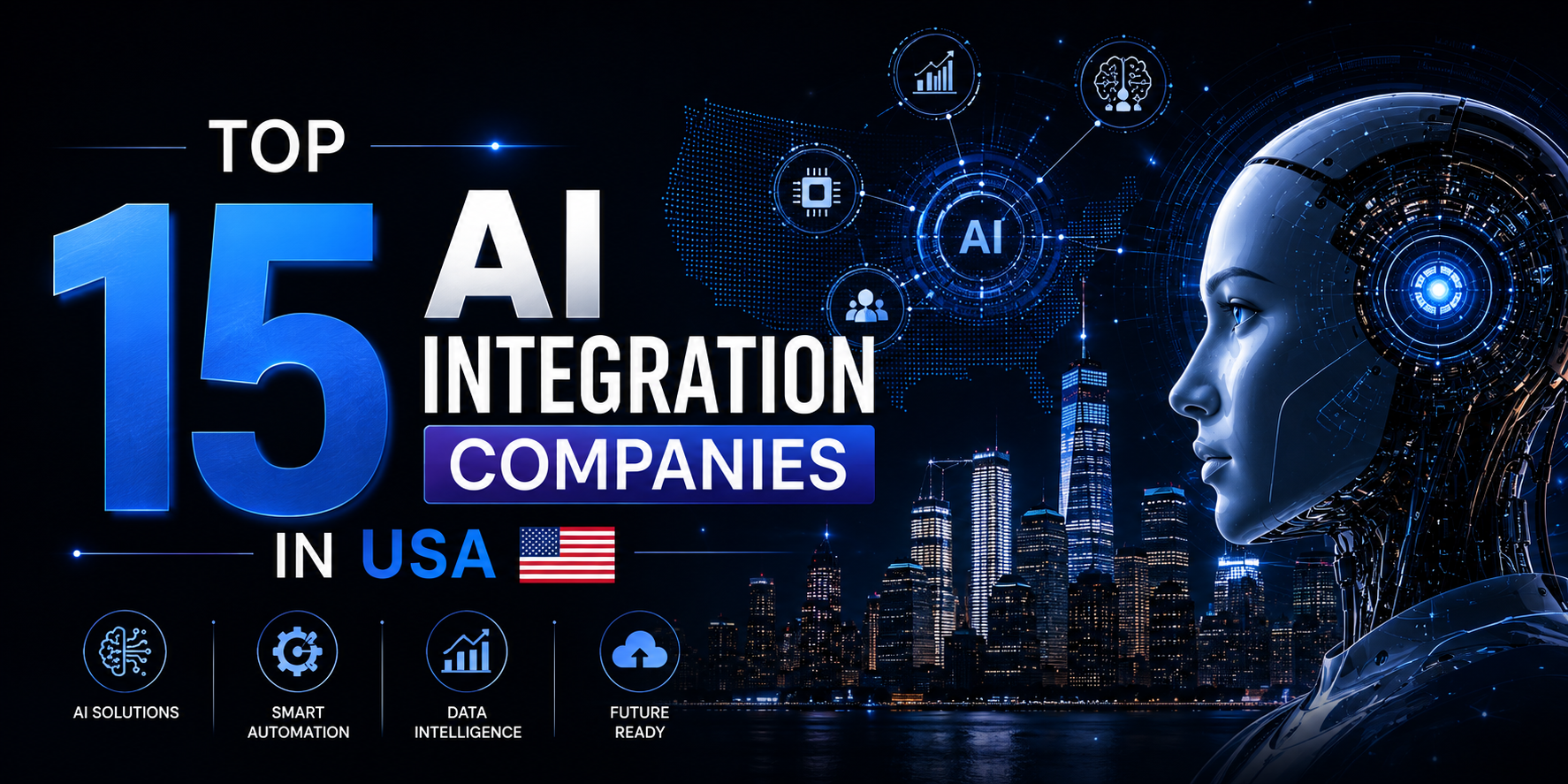
Top 15 AI Integration Companies in USA
Artificial intelligence is moving from isolated pilots to operational systems. In 2026, businesses are increasingly connecting generative AI, machine learning, AI agents, and intelligent automation to the technology they already use: CRMs, ERPs, data warehouses, cloud platforms, customer applications, knowledge bases, and internal workflows.
That changes what businesses should look for in an AI integration company. The U.S. AI market is moving steadily toward broader business adoption. According to the U.S. Census Bureau's 2026 Business Trends and Outlook Survey, AI use among U.S. businesses remained between 17% and 20% from December 2025 through May 2026, while 37% of firms with 250 or more employees reported using AI in their business operations.
Building an AI model is only one part of the job. A production-ready AI system also needs reliable data pipelines, APIs, identity and access controls, workflow orchestration, observability, security, governance, and a practical path from proof of concept to production.
If you are evaluating the best AI integration companies in the USA, this guide compares 15 providers based on publicly documented AI capabilities, enterprise integration expertise, software engineering depth, data and cloud capabilities, AI-agent readiness, governance, and suitability for different types of organizations.
For companies planning to connect AI with existing applications, enterprise platforms, or workflows, AI Integration Services can provide the technical foundation for moving from AI experimentation to production implementation.
Quick answer: The leading AI integration companies to consider in the USA in 2026 include WebClues Infotech, IBM Consulting, Accenture, Deloitte, Cognizant, Capgemini, EPAM, HCLTech, TCS, Infosys, Persistent Systems, RTS Labs, LeewayHertz, Master of Code Global, and InData Labs.
How We Evaluated These AI Integration Companies
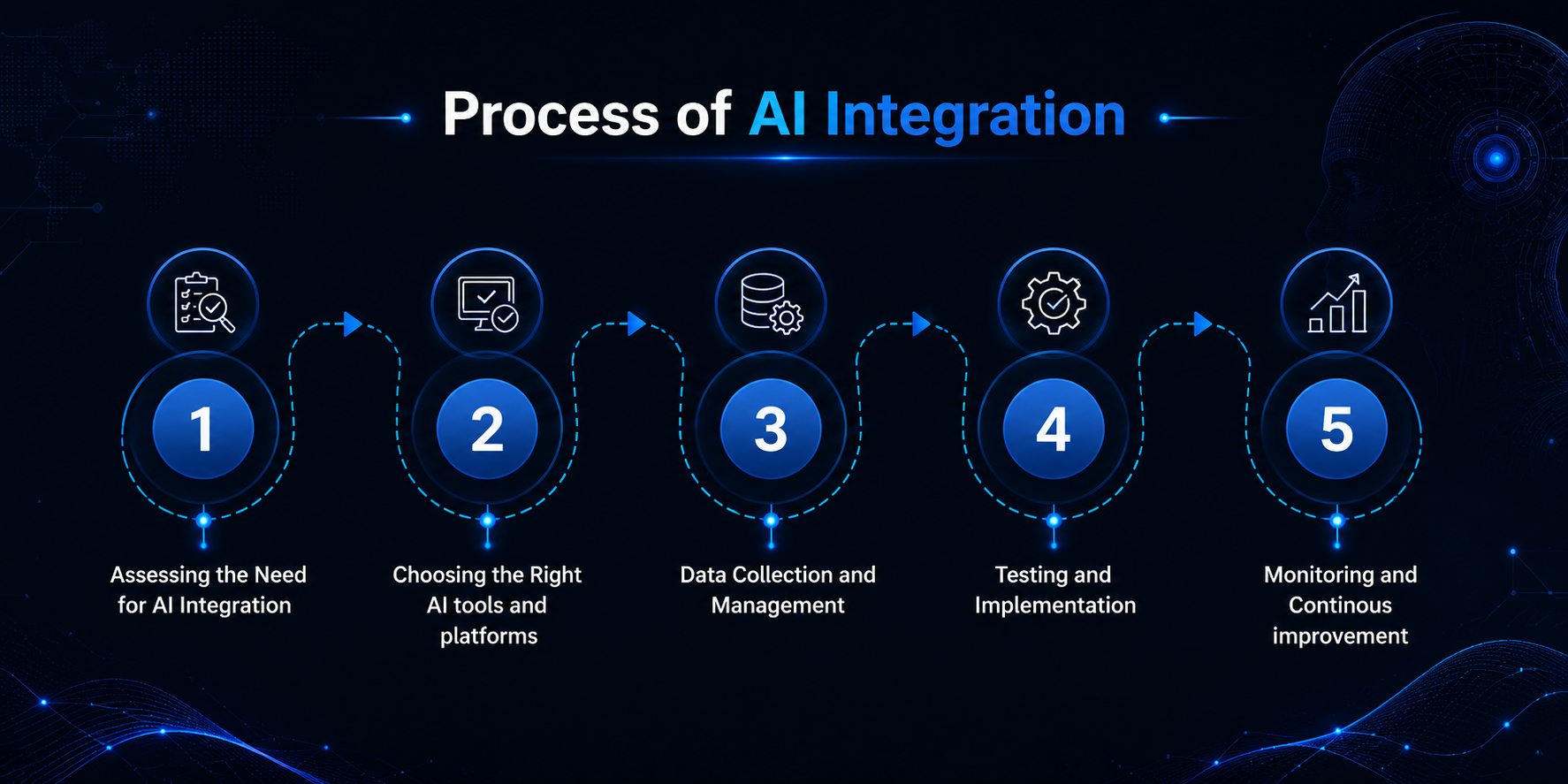
An AI integration partner should be evaluated on more than the number of AI services listed on its website.
For this comparison, we considered:
- AI and machine learning engineering
- Generative AI and LLM implementation
- RAG and enterprise knowledge integration
- AI-agent and workflow capabilities
- API and enterprise application integration
- Data engineering and modernization
- Cloud and infrastructure expertise
- Application and software engineering
- MLOps and production deployment
- Security, governance, and responsible AI
- Ability to support enterprise-scale implementations
- Suitability for different organization sizes and use cases
This distinction matters because enterprise AI increasingly involves connecting models to real business workflows. IBM, for example, explicitly positions its AI integration services around scaling agentic AI across business processes, while Accenture emphasizes moving AI from pilots into real workflows using data, automation, and agentic platforms.
Businesses can also compare this broader resource on AI integration companies to evaluate providers based on specialization and enterprise AI capabilities.
Compare Top 15 AI Integration Companies in USA
| Sr no. | Company | Best For | Core AI Integration Strengths | Ideal Customer |
| 1 | WebClues Infotech | Custom AI integration + product engineering | GenAI, LLM/RAG, AI agents, APIs, automation, MLOps | Startups, SMBs, mid-market and enterprise |
| 2 | IBM Consulting | Enterprise AI transformation | Agentic AI, data, governance, cloud, workflow integration | Large enterprises |
| 3 | Accenture | Global AI and digital transformation | AI, data, automation, cloud, agentic platforms | Global enterprises |
| 4 | Deloitte | AI engineering, infrastructure and governance | GenAI, AI engineering, data, infrastructure, risk | Large and regulated organizations |
| 5 | Cognizant | Production-scale enterprise AI | GenAI, agentic AI, data modernization, AI governance | Large enterprises |
| 6 | Capgemini | AI-led business transformation | GenAI, agentic AI, data, software engineering, automation | Mid-market and enterprise |
| 7 | EPAM | Complex software and AI engineering | AI engineering, modernization, cloud, data | Technology-intensive enterprises |
| 8 | HCLTech | Enterprise modernization | AI, cloud, infrastructure, data, automation | Large enterprises |
| 9 | TCS | Global enterprise AI programs | AI, data, cloud, agents, industry solutions | Global enterprises |
| 10 | Infosys | GenAI and application modernization | GenAI, cloud, data, automation, responsible AI | Enterprises |
| 11 | Persistent Systems | Digital engineering + AI | GenAI, cloud, data, modernization | Digital businesses and enterprises |
| 12 | RTS Labs | Custom AI integration | AI agents, GenAI, data engineering, APIs | Mid-market businesses |
| 13 | LeewayHertz | Custom AI applications and agents | GenAI, AI agents, integration, deployment | Startups and enterprises |
| 14 | Master of Code Global | Conversational AI | AI assistants, chat, voice, customer experience | Customer-facing businesses |
| 15 | InData Labs | AI/ML and data engineering | ML, GenAI, NLP, computer vision, data | Data-intensive organizations |
Editorial methodology: This is an independent comparison based primarily on publicly documented capabilities and market relevance. Rankings are not paid placements, certifications, or an endorsement by an industry analyst organization. The order reflects fit for organizations specifically seeking AI integration capabilities rather than overall company size.
1. WebClues Infotech
Best for: Custom AI integration, AI-powered products, workflow automation, and end-to-end software engineering.
WebClues Infotech is a strong option for organizations that need AI integrated directly into existing products, enterprise systems, or operational workflows rather than delivered as a standalone model.
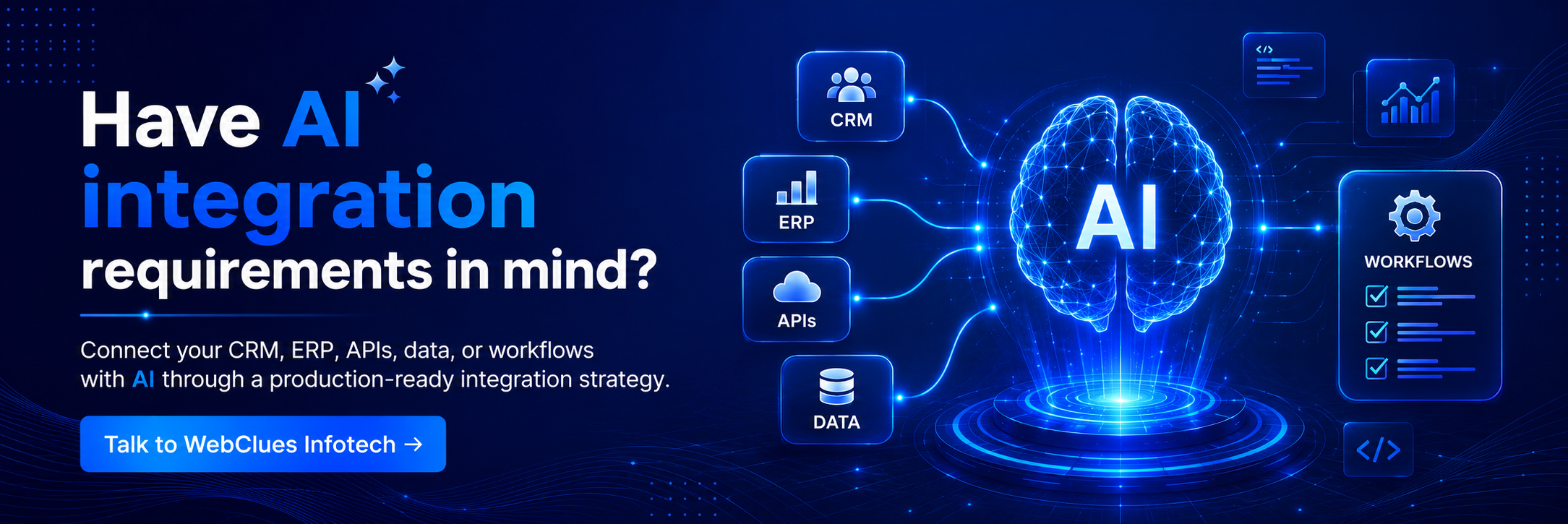
Its AI capabilities span generative AI, machine learning, AI agents, LLM-based applications, workflow automation, and MLOps. WebClues also positions its enterprise AI integration capabilities around connecting ERP, CRM, SCM, APIs, data pipelines, and AI systems.
Its enterprise integration approach uses data, AI/ML, integration, application, and governance layers to connect systems without necessarily replacing the underlying technology stack.
This makes WebClues particularly relevant when a project requires both AI engineering and the surrounding application engineering. Its published AI capabilities also include AI integration across web, SaaS, and cloud environments.
Why it ranks highly: WebClues combines custom AI development with the software and integration engineering required to put those AI capabilities into production. That can reduce the handoff between an AI development team and an application integration vendor.
Best fit: Startups, SMBs, mid-market organizations, and enterprises looking for customized AI integration and product engineering.
Key strengths: Generative AI, LLM/RAG, AI agents, machine learning, APIs, enterprise integration, workflow automation, and MLOps.
2. IBM Consulting
Best for: Large enterprises with complex AI transformation programs.
IBM Consulting is particularly suited to organizations that need to connect AI with enterprise data, business processes, cloud platforms, and existing technology environments.
IBM launched dedicated AI Integration Services focused on helping enterprises build and scale AI agents across end-to-end business processes. Its offering includes AI strategy, data readiness, AI-powered solutions, security, governance, and transformation.
Best fit: Large enterprises, regulated organizations, and companies undertaking multi-system AI transformation.
Key strengths: Agentic AI, AI governance, data modernization, cloud, enterprise architecture, and workflow orchestration.
3. Accenture
Best for: Global enterprises undertaking large-scale AI transformation.
Accenture combines AI, data, automation, cloud, consulting, and technology implementation. Its current AI positioning focuses heavily on moving from isolated pilots toward scalable AI operating across real business workflows.
Accenture reports substantial investment in AI capabilities and operates GenAI Studios intended to help organizations move from experimentation to scalable transformation. Its AI and data services also emphasize data readiness, automation, and agentic platforms.
Best fit: Fortune 500 companies and multinational organizations.
Key strengths: AI strategy, data, cloud, automation, GenAI, agentic platforms, and enterprise transformation.
4. Deloitte
Best for: AI engineering, infrastructure, governance, and enterprise transformation.
Deloitte has expanded its AI capabilities beyond strategy into AI engineering, infrastructure, application modernization, data modernization, governance, and production deployment.
Its GenAI acceleration services include building and deploying solutions, reimagining business processes, modernizing applications with GenAI, and developing data modernization roadmaps. Deloitte also operates AI infrastructure services designed to connect AI workloads, data pipelines, security tools, and production infrastructure.
Deloitte's 2026 research also highlights the growing infrastructure demands created by enterprise inference and agentic AI workloads.
Best fit: Large enterprises and regulated organizations with complex infrastructure and governance requirements.
Key strengths: AI engineering, GenAI, infrastructure, data, governance, risk, and modernization.
5. Cognizant
Best for: Operationalizing AI across enterprise processes.
Cognizant has a broad data and AI portfolio covering AI development, generative AI, agentic AI, data modernization, model migration, intelligent automation, and AI governance.
Its current AI services explicitly address the transition from experimentation to production and include agentic AI systems that can reason, decide, and act across processes and systems. Cognizant also highlights ISO/IEC 42001:2023 certification for its AI management system.
Its AI modernization work also focuses on unlocking data and business logic trapped inside legacy systems.
Best fit: Enterprises with significant legacy technology and complex data environments.
Key strengths: Agentic AI, GenAI, data modernization, AI governance, model migration, and intelligent automation.
6. Capgemini
Best for: AI-led digital transformation and business-process modernization.
Capgemini's Data and AI practice covers generative AI, agentic AI, AI foundations, AI-powered products, customer experiences, business-process operations, and IT.
Its current framework emphasizes connecting AI strategy with enterprise data, infrastructure, governance, and measurable business outcomes. Capgemini also maintains a dedicated Generative AI Lab focused on implementing emerging AI and agentic technologies.
Best fit: Mid-market and enterprise organizations combining AI integration with broader digital transformation.
Key strengths: GenAI, agentic AI, business-process automation, software engineering, data, and cloud.
7. EPAM
Best for: Complex software engineering and AI modernization.
EPAM is particularly relevant where AI integration is closely connected to application modernization, digital engineering, cloud, and enterprise software.
Its AI practice focuses on helping organizations become AI-native while addressing technology complexity and embedding AI into enterprise operations.
Best fit: Technology-intensive enterprises and companies modernizing complex software environments.
Key strengths: AI engineering, software modernization, cloud, data, and enterprise technology.
8. HCLTech
Best for: Enterprise technology modernization and AI infrastructure integration.
HCLTech combines AI capabilities with cloud, infrastructure, engineering, data, and enterprise technology services.
This makes it relevant to organizations that need AI integrated into broader modernization initiatives rather than deployed as an isolated application.
Best fit: Large enterprises modernizing applications, infrastructure, and data environments.
Key strengths: AI engineering, cloud, infrastructure, data, automation, and application modernization.
9. Tata Consultancy Services (TCS)
Best for: Large-scale enterprise and industry-specific AI programs.
TCS positions AI as part of a broader transition from experimentation toward enterprise industrialization. Its AI practice combines enterprise AI platforms, model engineering, data, agents, and human-centric implementation.
TCS also offers Rapid Outcome AI, an enterprise AI platform designed to accelerate the transition from experimentation to production across enterprise systems and operational environments.
Best fit: Global enterprises with complex business processes and large technology estates.
Key strengths: AI, data, cloud, enterprise platforms, agents, automation, and industry solutions.
10. Infosys
Best for: Generative AI integration and enterprise modernization.
Infosys' Generative AI Labs combines industry solutions, accelerators, partnerships, and responsible AI frameworks.
Its published capabilities include embedding generative AI into enterprise systems and applications, legacy modernization, semantic search, automated summarization, and responsible AI governance.
Best fit: Enterprises combining GenAI adoption with application, cloud, and data modernization.
Key strengths: GenAI, enterprise applications, automation, cloud, data, responsible AI, and modernization.
11. Persistent Systems
Best for: Digital engineering and AI-enabled application modernization.
Persistent Systems is a suitable option for organizations that need to combine AI engineering with software engineering, cloud, data, and application modernization.
Its positioning makes it particularly relevant to businesses embedding AI into existing products and enterprise applications.
Best fit: Digital businesses, technology companies, and enterprises undertaking application modernization.
Key strengths: GenAI, software engineering, cloud, data, modernization, and AI engineering.
12. RTS Labs
Best for: Custom AI integration without the scale of a global consulting firm.
RTS Labs provides AI consulting, AI-agent development, generative AI consulting, and AI integration services. Its broader data practice includes data engineering, data integration, and data warehousing.
This combination makes RTS Labs relevant for businesses that need a customized AI solution connected to existing applications, data, and workflows.
Best fit: Mid-market organizations and businesses seeking a more specialized implementation partner.
Key strengths: AI agents, GenAI, data engineering, integration, and automation.
13. LeewayHertz
Best for: Custom AI applications, generative AI integration, and AI agents.
LeewayHertz has a strong focus on custom AI application development and generative AI integration. Its services include GenAI integration, AI-agent development, AI deployment, and enterprise AI solutions.
Its AI integration offering specifically focuses on incorporating generative AI applications into existing infrastructure, workflows, and systems.
Its deployment services also cover integration between AI models, data, infrastructure, and cloud environments, including monitoring and maintenance.
Best fit: Startups, product companies, and enterprises developing customized AI applications.
Key strengths: GenAI, LLM applications, AI agents, AI integration, deployment, and custom software.
14. Master of Code Global
Best for: Conversational AI and customer-facing intelligent experiences.
Master of Code Global specializes in conversational AI, including chat and voice experiences.
Its service approach covers use-case identification, customer journey analysis, AI implementation, and conversational experiences designed around measurable business outcomes.
Best fit: Customer service, commerce, support, sales, and customer-experience applications.
Key strengths: Conversational AI, AI assistants, chat, voice, customer experience, and automation.
15. InData Labs
Best for: AI/ML, data science, and data-intensive AI projects.
InData Labs provides AI consulting and development, data science, machine learning, generative AI, and related implementation services.
Its current service portfolio covers business-case validation, project roadmaps, AI-tool selection, development, and post-go-live support. It also lists a U.S. office in Miami, Florida.
Best fit: Data-intensive organizations and businesses requiring custom AI/ML implementation.
Key strengths: Machine learning, GenAI, NLP, computer vision, data science, and data engineering.
What Does an AI Integration Company Actually Do?
An AI integration company connects AI capabilities with the systems, data, and workflows a business already operates.
A typical implementation can connect:
- LLMs and foundation models
- AI agents
- CRM and ERP systems
- Cloud platforms
- Data warehouses and data lakes
- REST and GraphQL APIs
- Business intelligence platforms
- Internal databases
- Document repositories
- Customer portals
- Mobile applications
- Workflow automation platforms
- Enterprise knowledge bases
For example, a company could integrate an LLM-powered sales assistant with Salesforce, its product database, customer history, and internal knowledge base.
The assistant could retrieve customer information, summarize previous interactions, recommend next actions, and initiate approved workflows.
The AI model is only one component. The integration architecture makes the capability operational.
For enterprise environments, Enterprise AI Integration can connect AI with ERP, CRM, and supply-chain systems while maintaining appropriate data, access, and governance controls.
Explore AI Integration Services for USA Enterprises
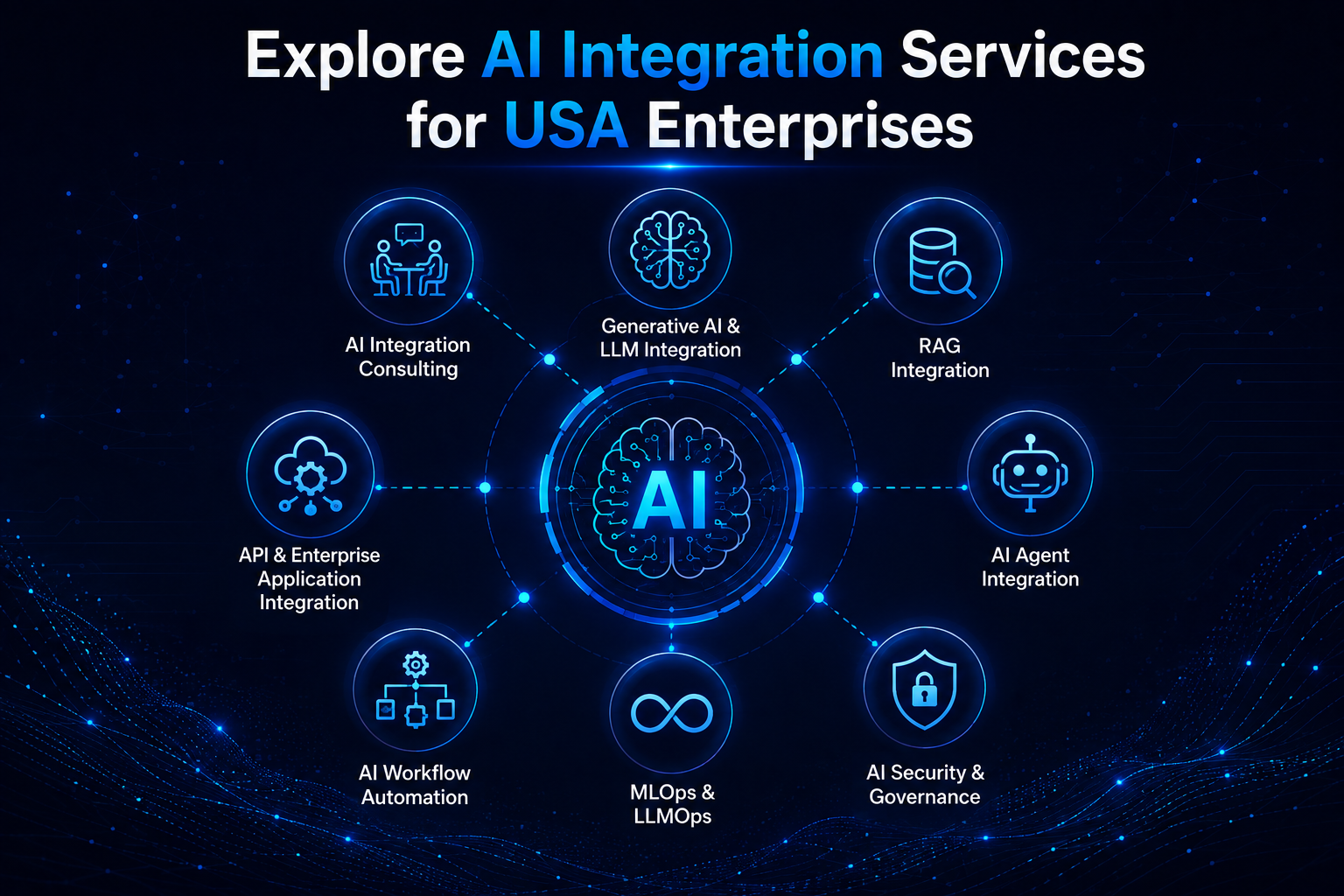
A capable AI integration company may provide several layers of implementation.
AI Integration Consulting
The provider evaluates business processes, existing architecture, AI readiness, data availability, and integration requirements before recommending a solution.
Generative AI and LLM Integration
This involves connecting models such as GPT, Gemini, Claude, or open-source models with business applications, APIs, knowledge bases, and workflows.
RAG Integration
Retrieval-augmented generation connects an LLM to proprietary information through search systems, vector databases, document repositories, or enterprise knowledge platforms.
AI Agent Integration
AI agents require access to tools and systems. Integration enables agents to retrieve information, invoke APIs, execute approved tasks, and escalate decisions to humans.
API and Enterprise Application Integration
APIs, middleware, event-driven architecture, microservices, and integration platforms connect AI systems with existing enterprise applications.
AI Workflow Automation
AI can be embedded into processes such as customer support, document processing, lead qualification, claims processing, procurement, reporting, and employee operations.
MLOps and LLMOps
Production AI requires monitoring, evaluation, model versioning, observability, deployment pipelines, performance tracking, and ongoing optimization.
AI Security and Governance
Enterprise implementations should include authentication, authorization, data protection, audit logging, model monitoring, human oversight, and applicable compliance controls.
AI Integration Architecture: What the Stack Looks Like
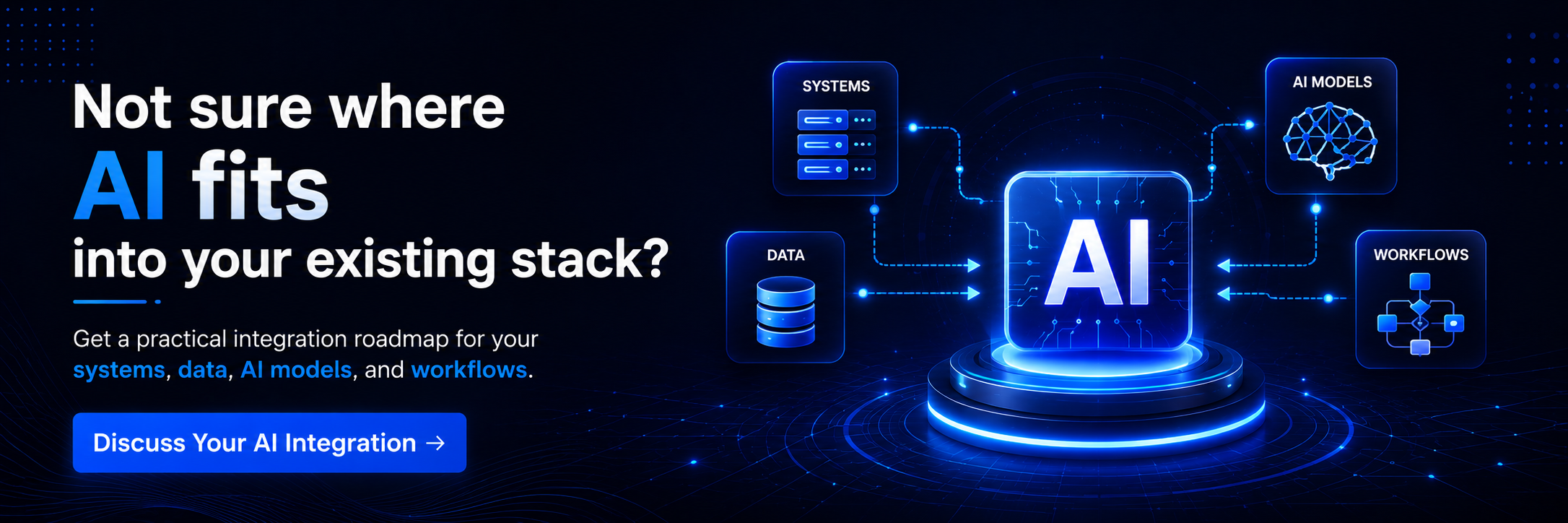
A production AI integration architecture generally contains several interconnected layers:
Data layer: CRM, ERP, databases, documents, data warehouses, and other sources.
Integration layer: APIs, middleware, event streams, message queues, and connectors.
AI layer: LLMs, machine learning models, RAG pipelines, AI agents, classification systems, or predictive models.
Orchestration layer: Business rules, agent tools, workflow engines, permissions, and human approval steps.
Application layer: Customer applications, employee interfaces, copilots, dashboards, and automated workflows.
Governance layer: Security, access controls, monitoring, auditability, compliance, and responsible AI policies.
This layered approach becomes particularly important when AI needs to work with legacy applications. Businesses do not necessarily need to replace those systems. APIs, middleware, microservices, event streams, data pipelines, or RPA can provide an integration layer around them.
How Much Does AI Integration Cost in the USA?
There is no reliable single price for AI integration because the engineering scope can vary dramatically.
The biggest cost drivers include:
- Number of systems being integrated
- API availability and quality
- Data volume and data quality
- RAG or knowledge-base requirements
- Number of AI models
- AI-agent complexity
- Workflow automation requirements
- Security and compliance requirements
- Cloud or on-premises deployment
- User volume and inference requirements
- Monitoring and ongoing maintenance
A single API-based AI feature connected to one application is fundamentally different from an enterprise implementation involving multiple ERPs, CRMs, data platforms, AI agents, governance controls, and MLOps.
For budgeting purposes, businesses should request a scope-based estimate rather than a generic “AI integration cost.”
A good vendor should be able to break the estimate into discovery, architecture, data preparation, integration, AI engineering, testing, deployment, security, and post-launch support.
Infrastructure can also become a significant component of long-term cost. Deloitte's 2026 research on AI infrastructure and inference economics notes that recurring AI workloads can lead to frequent API calls and escalating costs, with agentic AI's continuous inference potentially driving higher token consumption.
How to Choose the Best AI Integration Company in USA
The right partner depends on your architecture, business goals, budget, and level of AI maturity.
Before signing a contract, evaluate these areas:
1. Integration experience: Can the provider work with your CRM, ERP, databases, APIs, cloud environment, and custom applications?
2. AI engineering depth: Does the team understand LLMs, RAG, agents, machine learning, evaluation, prompt engineering, and model optimization?
3. Data architecture: Can it prepare and govern the data required by the AI system?
4. Security: How are authentication, authorization, sensitive data, model access, and audit logs handled?
5. Production experience: Can the company move beyond a prototype and operate the system reliably?
6. Scalability: Can the architecture support increasing users, data, inference volume, and workflows?
7. Governance: Are human oversight, monitoring, evaluation, compliance, and responsible AI part of the architecture?
8. Business KPIs: Will the provider measure outcomes such as processing time, support costs, conversion rates, accuracy, revenue, or employee productivity?
9. Post-launch support: Who will maintain models, integrations, prompts, APIs, infrastructure, and monitoring after launch?
10. U.S. delivery capability: Consider time-zone coverage, communication, contracting, local presence, support availability, and data-handling requirements.
AI Integration vs. AI Development: What's the Difference?
AI development focuses on building the AI capability.
AI integration focuses on connecting that capability with the systems and workflows where it needs to operate.
For example, building an LLM-powered chatbot is AI development.
Connecting that chatbot to a CRM, product database, knowledge base, authentication system, ticketing platform, and order-management system is AI integration.
Enterprise projects often require both.
The distinction is important because an excellent AI model can still deliver little business value if it cannot access the right data or execute the right workflows.
In many cases, businesses also do not need to rebuild their existing technology stack. Incremental AI implementation approaches can add intelligence through APIs, middleware, microservices, event streams, and data pipelines while keeping the existing system of record intact.
Why AI Integration Matters More
The enterprise AI conversation is shifting from “What can AI generate?” toward “Where can AI reliably operate?”
That is a major architectural change.
An AI assistant that answers questions can improve productivity. An AI agent that can retrieve customer information, check inventory, update a CRM record, generate a quote, and escalate an exception can become part of an actual business process.
This is why integration is becoming a strategic component of enterprise AI.
McKinsey's latest State of AI research shows that many organizations are still in the experimentation or piloting phase, while AI agents are rapidly gaining attention.
The infrastructure challenge is also becoming more significant. Deloitte's 2026 research points to increasing inference workloads, rising AI infrastructure requirements, and the need for organizations to rethink compute, data, governance, and workload placement as AI moves into production.
The implication is straightforward:
AI integration should be designed as part of the AI architecture from the beginning not treated as a final step after model development.
Final Takeaway
The best AI integration company for your organization depends on what you need to integrate and how far you want to take AI.
IBM Consulting, Accenture, Deloitte, Cognizant, Capgemini, TCS, and similar providers are strong candidates for large enterprise transformation programs.
EPAM, HCLTech, Persistent Systems, and other engineering-led providers can be appropriate when AI integration is closely tied to application modernization and complex technology environments.
WebClues Infotech, RTS Labs, LeewayHertz, Master of Code Global, and InData Labs can be considered for more specialized or customized AI implementation requirements, depending on the use case.
For businesses evaluating WebClues specifically, its differentiator is the combination of AI engineering, software engineering, enterprise integration, workflow automation, and MLOps. Its published enterprise AI integration approach is designed to connect AI with ERP, CRM, SCM, APIs, data pipelines, and existing applications rather than treating AI as an isolated layer.
If your goal is to integrate generative AI, RAG, AI agents, machine learning, or intelligent automation into your existing technology environment, AI Integration Services can be evaluated alongside the providers in this list.
Ready to determine where AI can fit into your existing technology stack? Talk to WebClues Infotech's AI experts about your systems, integration requirements, security considerations, and implementation goals.
Post Author

Ayush Kanodia
As one of the esteemed Directors of WebClues Infotech. Ayush Kanodia is passionate about delivering innovative IT services & solutions and has spearheaded numerous successful projects, cementing the company's position as a leader in the field.


Build Your Agile Team
Hire Skilled Developer From Us
Ready to make AI to work across your existing systems?
WebClues Infotech with the help od can help you connect AI with your applications, data, APIs, and business workflows from architecture and integration to production deployment.
Connect Now!Frequently Asked Questions
Our Recent Blogs
Sharing knowledge helps us grow, stay motivated and stay on-track with frontier technological and design concepts. Developers and business innovators, customers and employees - our events are all about you.