

Connect with us


Corporate Video


Top 15 AI Development Companies in the UK
Quick Summary:
Finding an AI development company in the UK is easy. Finding one that can take an AI idea from business case to production is harder.
The difference matters when a project involves proprietary data, large language models, AI agents, enterprise integrations, security requirements, or workflows where inaccurate AI output can create operational or financial risk.
This guide compares 15 AI development companies relevant to UK businesses, covering their core capabilities, project fit and areas of specialisation. It is designed for companies looking to hire AI developers, outsource AI development, build a custom AI solution, or identify a partner for an enterprise AI initiative.
The companies are not ranked simply by company size or marketing visibility. The comparison considers publicly available evidence of AI capabilities, software engineering expertise, UK presence or market activity and the types of projects each provider is positioned to deliver.
If your requirement is specifically custom AI development services, generative AI, AI agents, LLM applications, machine learning, or AI-powered software, the table below can help narrow your evaluation before you request proposals.
| Company | UK presence/focus | Core AI capabilities | Best suited for |
| WebClues Infotech | UK + global delivery | Custom AI, GenAI, LLM, RAG, agents, ML | Custom AI products and enterprise applications |
| Thoughtworks | UK | Enterprise AI, agentic development, modernisation | Large-scale transformation |
| Faculty | London | AI strategy, development, operations, AI safety | Applied AI transformation |
| BJSS | UK | AI, ML, GenAI, data and engineering | Enterprise and complex projects |
| Quantexa | UK | Decision intelligence, data and AI | Data-intensive decisioning |
| RapidData | UK-wide | Custom AI, GenAI, RAG, agents, MLOps | Enterprise and public-sector AI |
| Digica | UK + international | ML, computer vision, edge AI, AI agents | Industrial and complex AI |
| Softblues | London | AI development and automation | Business applications |
| Brainpool AI | London | Bespoke AI and machine learning | Specialist AI initiatives |
| Pixelette Technologies | London | GenAI, agents and automation | AI products and transformation |
| Old.St Labs | London | AI-integrated product engineering | Startups and digital products |
| Fifty One Degrees | London | AI agents, data and analytics | Data-driven workflows |
| Probey Services | UK | AI-enabled software development | Digital transformation |
| Imaginary Cloud | London | AI and product engineering | AI-enabled applications |
| Mobcoder | UK | AI and mobile development | AI-powered mobile applications |
Leading AI Development Companies in the UK for 2026
The best AI development company for your business depends on the problem you are solving, the complexity of your data and systems, your industry requirements and how much engineering support you need after launch.
Some providers focus on enterprise transformation and AI strategy. Others specialise in machine learning, decision intelligence, computer vision, generative AI, AI agents, mobile applications, or custom software.
For businesses that need both AI engineering and the software infrastructure surrounding the AI system, WebClues Infotech is one provider worth evaluating alongside UK-based consultancies and specialist AI companies.
1. WebClues Infotech
WebClues Infotech provides custom AI development alongside software, web, mobile, cloud and DevOps engineering.
Its AI development offering covers generative AI, LLM development, RAG, multimodal AI, AI agents, copilots, conversational AI, machine learning, computer vision and AI-powered workflow automation. The company also describes capabilities around human-in-the-loop workflows, scalable AI architecture, deployment, monitoring and ongoing optimisation.
This combination is relevant when AI needs to become part of a complete product or enterprise workflow rather than remain a standalone model or proof of concept.
Best for: Custom AI applications, generative AI, AI agents, LLM/RAG applications, AI-powered software and full-stack AI development.
Why consider it: Businesses can evaluate WebClues when they need AI engineering combined with application development, integrations and production implementation.
2. Thoughtworks
Thoughtworks combines software engineering, data, AI, cloud and enterprise transformation.
Its current UK offering includes an agentic development platform designed to help enterprises build and modernise industrial-grade systems. Thoughtworks also describes enterprise AI work involving architecture, governance, observability, security and integration with existing data and systems.
Best for: Large organisations combining AI adoption with enterprise software modernisation and transformation.
Why consider it: It's particularly relevant when AI needs to work across complex existing technology estates rather than operate as an isolated application.
3. Faculty
Faculty is a UK AI company with a London base and a broad applied-AI offering.
Its current services span AI strategy, design, infrastructure, development, operations, change, due diligence and AI safety. Faculty also highlights work across public services, financial services, healthcare, defence, energy, retail and other sectors.
Best for: Organisations looking for applied AI strategy and development across complex operational environments.
Why consider it: Faculty is particularly relevant when AI implementation requires business, technical, operational and adoption expertise rather than software development alone.
4. BJSS
BJSS combines AI with data engineering, software development, cloud and enterprise technology delivery.
Its AI practice covers areas including machine learning, generative AI, MLOps, computer vision, NLP and AI infrastructure.
Best for: Enterprise AI projects where software engineering, data, cloud and AI need to be delivered together.
Why consider it: Its broader engineering capability can be useful for organisations that need to integrate AI into existing enterprise environments.
5. Quantexa
Quantexa specialises in decision intelligence, data, analytics and AI.
Its relevance to UK enterprise AI is particularly visible in financial services and the public sector. In May 2026, HMRC announced a £175 million, 10-year partnership with Quantexa to modernise its data foundation and support governed AI at national scale.
Best for: Financial crime, risk, compliance, data modernisation and data-intensive decisioning.
Why consider it: Its specialisation is particularly relevant when the AI use case depends on connecting fragmented data and improving complex business decisions.
6. RapidData
RapidData offers AI development across the UK, including London, Manchester, Birmingham, Edinburgh, Glasgow, Leeds, Bristol and UK-wide delivery.
Its current offering covers custom AI applications, machine learning, generative AI applications, enterprise RAG, AI agents, data pipelines, model integrations, MLOps, evaluation and governance.
Best for: Enterprise and public-sector organisations looking for an end-to-end AI development and operations partner.
Why consider it: Its offering extends from discovery and development through deployment, monitoring, governance and managed AI operations.
7. Digica
Digica focuses on applied AI and software engineering, with capabilities spanning computer vision, edge computing, sensor fusion, predictive maintenance, AI agents, LLMs and cloud development. (Digica | AI powered software)
Best for: Industrial AI, computer vision, edge AI, machine learning and complex operational environments.
Why consider it: Its AI work extends beyond text-based generative AI into applications where AI interacts with physical systems, sensors and operational data.
8. Softblues
Softblues is a London-based technology company working across AI, software development and business automation.
Its positioning makes it relevant for organisations that need AI capabilities integrated into business applications rather than a standalone AI research project.
Best for: AI-powered business applications, automation and digital products.
9. Brainpool AI
Brainpool AI focuses specifically on artificial intelligence and bespoke AI solutions.
Its publicly available service positioning covers areas including machine learning, AI consultancy, AI development, NLP and computer vision.
Best for: Businesses looking for specialist AI consultancy and bespoke AI development.
Why consider it: A specialist AI consultancy can be appropriate when the problem requires focused AI expertise rather than a broad digital transformation programme.
10. Pixelette Technologies
Pixelette Technologies offers AI alongside broader technology capabilities, with a focus on generative AI, agentic AI, automation, predictive modelling and AI-enabled products.
Best for: Businesses exploring generative AI, AI agents, automation and AI-powered products.
Why consider it: Its broader technology portfolio can be useful when AI development needs to connect with wider digital-product or blockchain initiatives.
11. Old.St Labs
Old.St Labs is a London software development company focused on digital products and custom software, with AI incorporated into its product engineering work.
Best for: Startups, scale-ups and established businesses building AI-enabled digital products.
Why consider it: Product development expertise matters when the AI capability is one component of a larger customer-facing application.
12. Fifty One Degrees
Fifty One Degrees focuses on AI, data science, AI agents and business intelligence.
Best for: Businesses combining predictive analytics, data platforms, automation and AI agents.
Why consider it: Data-intensive AI workflows often require analytics and data engineering alongside model development.
13. Probey Services
Probey Services combines software, web, mobile and AI-enabled product development.
Best for: SMEs and businesses looking for AI alongside broader digital product engineering.
Why consider it: This type of provider may suit projects where AI is being introduced as part of a wider software or digital transformation initiative.
14. Imaginary Cloud
Imaginary Cloud is a product engineering company with a London presence. Its capabilities span custom software, web and mobile applications, UX/UI and AI.
Best for: Companies developing AI-enabled digital products and applications.
Why consider it: Its product-engineering orientation can be useful when the project requires AI, application development, UX and product delivery together.
15. Mobcoder
Mobcoder combines software and mobile development with AI capabilities. Its AI-related capabilities include machine learning, conversational AI, voice and speech recognition, computer vision, robotics and NLP.
Best for: Businesses building mobile-first applications with embedded AI functionality.
Why consider it: It can be relevant when AI needs to be deeply integrated into a mobile product rather than delivered primarily as an enterprise backend.
Who Should Consider an AI Development Company in the UK?
An external AI development partner can make sense if your business:
- Has an AI use case but lacks specialist AI engineers.
- Needs to validate an AI MVP or proof of concept.
- Wants to add generative AI or AI agents to an existing product.
- Needs to connect AI with CRM, ERP, databases, APIs, or internal knowledge bases.
- Requires machine learning, predictive analytics, computer vision, or document intelligence.
- Wants to modernise an existing software product with AI.
- Needs specialist AI expertise alongside an existing engineering team.
The right engagement model depends on whether you need a single AI application, a long-term development team, or broader enterprise AI transformation.
How We Selected These AI Development Companies
A useful shortlist should be based on more than search visibility.
The comparison considers publicly available evidence across:
- AI development capabilities
- Custom software engineering
- Generative AI and LLM expertise
- AI agent and automation capabilities
- Machine learning and computer vision
- Enterprise delivery
- Industry expertise
- UK presence or UK-market activity
- Product engineering
- Integration and deployment capabilities
- Publicly available project or service evidence
This is an editorial shortlist, not a claim that one company is objectively better for every AI project.
A provider specialising in computer vision may be a better fit for an industrial inspection project, while an enterprise consultancy may be more appropriate for a large-scale AI transformation.
What AI Development Services Do UK Companies Need?
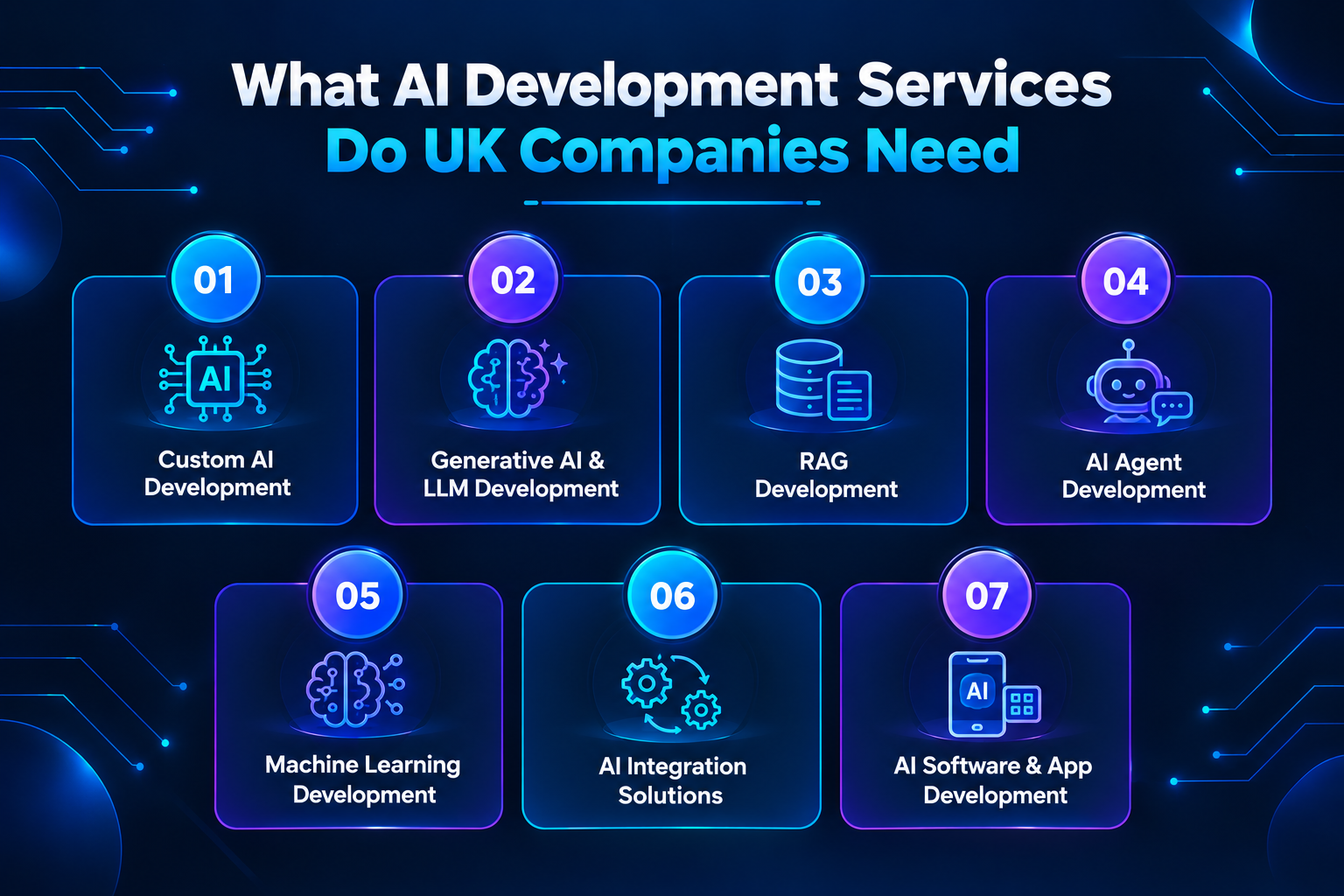
AI development services have moved well beyond basic chatbot development.
Custom AI Development
Purpose-built AI applications designed around specific business workflows, users, data and objectives.
Generative AI and LLM Development
LLM-powered applications for search, summarisation, content generation, knowledge management, customer support, document processing and workflow assistance.
RAG Development
Retrieval-Augmented Generation connects an AI model with external knowledge sources so applications can retrieve relevant business information before generating an answer.
This is particularly useful when an organisation needs AI to work with proprietary or frequently changing information. WebClues also identifies RAG as a core generative AI architecture for domain-specific applications.
AI Agent Development
AI agents can combine models, tools, APIs, business rules, enterprise data and human approval to execute multi-step workflows.
Machine Learning Development
Predictive modelling, classification, recommendation engines, forecasting, anomaly detection and other ML applications.
AI Integration
AI systems can be connected with CRMs, ERPs, databases, APIs, cloud platforms, document repositories and existing business applications.
AI Software and App Development
AI can be embedded directly into SaaS platforms, enterprise software, mobile applications and customer-facing digital products.
How to Choose an AI Development Company in the UK
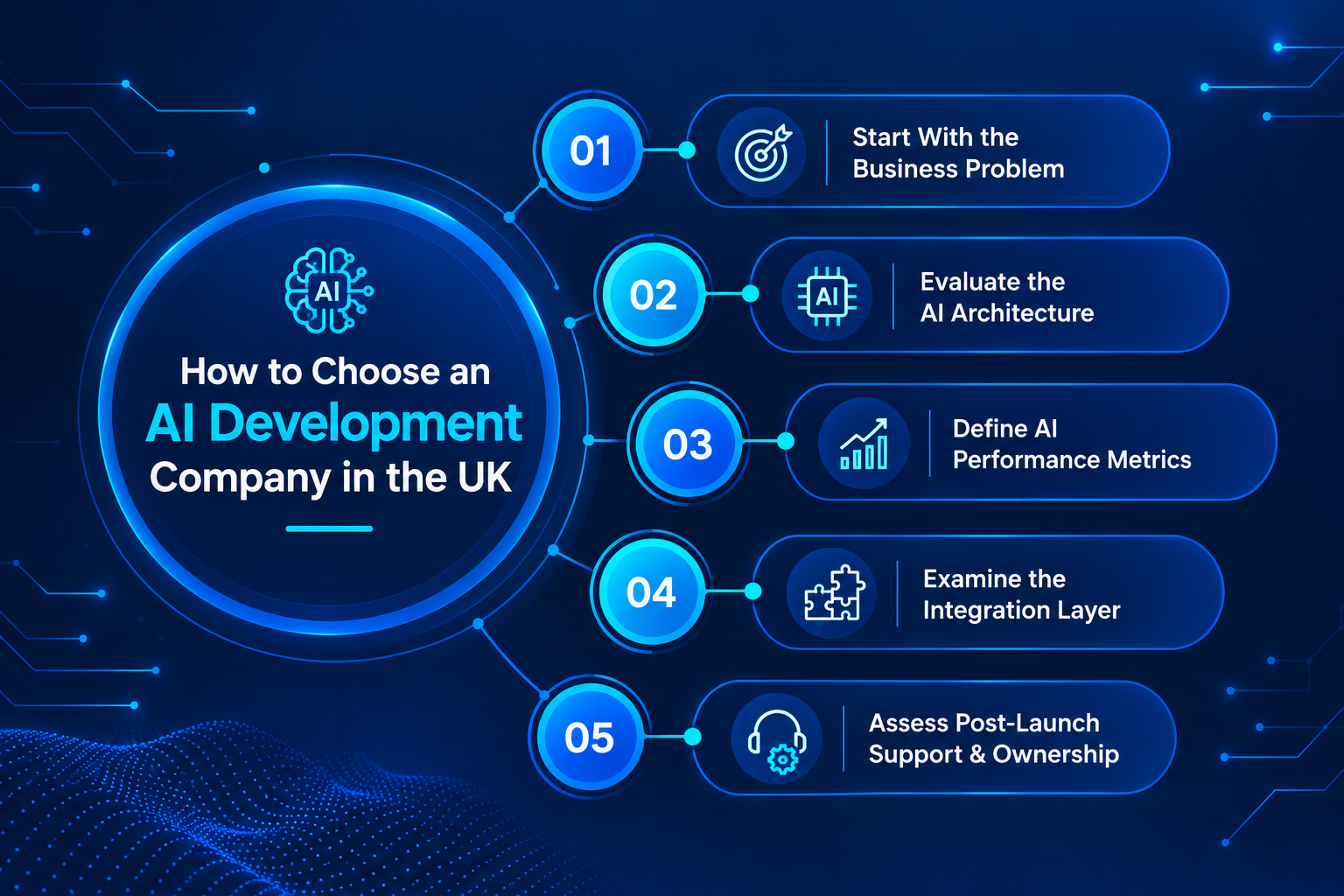
Start with the business problem rather than the technology. A right AI development and engineering company that immediately recommends an LLM or AI agent without understanding your workflow may be solving the wrong problem.
Evaluate the AI Architecture
Ask why a particular architecture is appropriate.
An LLM application might require RAG, fine-tuning, tool calling, structured outputs, prompt engineering, or a combination of approaches.
An AI agent may require tool permissions, workflow boundaries, memory, human approval, failure recovery, observability and evaluation.
A predictive ML system requires a different approach involving training data, feature engineering, model evaluation, monitoring and potentially retraining.
The goal should not be to use the newest model. It should be to build an architecture that reliably solves the business problem.
Check How AI Performance Will Be Measured
A production AI system needs measurable evaluation criteria. Depending on the use case, these may include:
- Accuracy
- Precision and recall
- Retrieval quality
- Response relevance
- Hallucination rate
- Task completion rate
- Latency
- Cost per task
- Human escalation rate
- Model drift
Ask the development partner which metrics will determine whether the system is ready for production.
Examine the Integration Layer
AI rarely operates in isolation. The partner may need to integrate it with:
- CRM and ERP platforms
- Internal databases
- APIs
- Cloud infrastructure
- Document repositories
- Authentication systems
- Payment platforms
- Customer-support software
- Business workflow tools
Strong model expertise is not enough if the provider cannot build and maintain the surrounding software system.
Assess Post-Launch Ownership
Ask who will maintain:
- Models
- Prompts
- RAG indexes
- Data pipelines
- APIs
- Infrastructure
- Evaluation systems
- Monitoring
- Security controls
AI performance can change as data, models, users and business requirements change. The post-launch operating model therefore needs to be defined before development starts.
UK AI Security and Data Protection Considerations
If an AI system processes personal data, data protection needs to be considered throughout the AI lifecycle.
The Information Commissioner's Office states that the UK GDPR and Data Protection Act 2018 form the core UK data protection regime and provides specific guidance on AI systems that process personal data. The ICO also notes that organisations need to consider risks around lawfulness, fairness, transparency, data minimisation, security, accountability and individual rights. (ICO)
For a prospective AI development partner, ask how the project will address:
- Data classification
- Access controls
- Data minimisation
- Encryption
- Audit logging
- Data retention
- Model and API access
- Human oversight
- Privacy risk assessments
- Third-party model providers
- AI testing and monitoring
The ICO recommends considering data protection by design and by default from the design stage and throughout the AI lifecycle. (ICO)
Security also needs to be proportionate to the actual processing risks. The ICO specifically notes that AI can increase existing security risks and introduce additional risks such as attacks against machine-learning models. (ICO)
A UK-based development company should therefore not automatically be treated as “UK GDPR compliant.” Compliance depends on the actual processing activities, architecture, contracts, controls and responsibilities involved in a specific project.

Which AI Development Company Is Best for Your Project?
There is no universal best AI development company. The right shortlist depends on the type of solution you need.
For custom AI software: Consider providers with both AI and full-stack software engineering capabilities, such as WebClues Infotech, Thoughtworks, BJSS, or Imaginary Cloud.
For enterprise AI transformation: Thoughtworks, Faculty, BJSS and RapidData are relevant options to evaluate because of their broader AI, software engineering, data and transformation capabilities. Thoughtworks, for example, currently positions AI/works™ around enterprise system modernisation and agentic development.
For decision intelligence and data-driven AI: Quantexa is particularly specialised in connected data, decision intelligence and governed AI. Its current HMRC programme demonstrates its relevance to large-scale UK public-sector data and AI transformation.
For machine learning and computer vision: Digica is worth evaluating for applied AI, computer vision, edge computing and operational environments.
For generative AI, RAG and AI agents: WebClues Infotech, Thoughtworks, RapidData and Pixelette Technologies offer relevant capabilities, but the appropriate choice depends on data, integration, governance and deployment requirements. WebClues explicitly covers LLM, RAG, AI agents, copilots, multimodal AI and AI-powered workflow automation.
For AI-powered mobile applications: Mobcoder is relevant when AI needs to be integrated deeply into a mobile-first product.
AI Development Company vs. In-House AI Team
Neither approach is universally better.
| Factor | External AI Partner | In-House AI Team |
| Specialist expertise | Access as required | Requires internal hiring |
| Hiring effort | Lower | Higher |
| Product ownership | Contract-dependent | Internal |
| Long-term control | Depends on agreement | High |
| Access to diverse skills | Flexible | Depends on team size |
| Best fit | Projects and acceleration | Continuous AI product development |
A hybrid approach can also work. For example, an external AI development company can build the initial MVP or production architecture while internal engineers gradually take ownership of the system.
The important question is not simply whether to outsource. It is which capabilities should remain strategic and internal and which can be accelerated through an external specialist.
How Much Does AI Development Cost in the UK?
There is no reliable single price for AI development. The cost of a project depends on:
| Cost factor | Why it matters |
| AI model | API, open-source, fine-tuned, or specialised models have different costs |
| Data | Cleaning, structuring, labelling and governance can require significant engineering |
| RAG | Requires ingestion, embeddings, retrieval, access controls and evaluation |
| AI agents | Multiple tools and workflows increase architecture and testing complexity |
| Integrations | Each enterprise system adds development and testing requirements |
| Security | Sensitive data may require additional controls |
| Infrastructure | Cloud, GPU, storage, monitoring and deployment affect ongoing costs |
| MLOps | Production ML requires monitoring, evaluation and maintenance |
| Product layer | A complete application costs more than an isolated model or API |
A sensible estimate should therefore follow technical discovery rather than precede it. For a deeper breakdown, see AI Development Cost.
How Long Does AI Development Take?
AI development timelines depend on the use case, data readiness, integration complexity, security requirements and production environment.
A simple AI feature may require far less work than an enterprise AI system involving proprietary data, RAG, AI agents, multiple APIs, evaluation, security controls, deployment infrastructure and ongoing monitoring.
A typical lifecycle looks like:
Discovery → Feasibility → Data Assessment → Architecture → PoC/MVP → Integration → Evaluation → Production → Monitoring → Optimisation
The key is to validate technical feasibility and business value before committing to a full production build.
If you are unsure whether your use case needs an AI agent, RAG application, predictive model, generative AI solution, or conventional automation, an initial technical assessment can help identify the right architecture and avoid unnecessary development.
AI Development Engagement Models
The right engagement model depends on how clearly the requirements are defined and how much technical uncertainty remains.
Fixed-Price Development
Best suited to well-defined requirements, scope, deliverables, and acceptance criteria.
Dedicated AI Development Team
Suitable when you need ongoing access to AI engineers, software developers, data specialists and other technical expertise.
Discovery → MVP → Production
A practical model for complex or uncertain AI projects. The team first validates the use case and architecture, develops a working MVP, evaluates the results and then scales the solution toward production.
For enterprise AI, this staged approach can help test key technical assumptions before significant resources are committed to a full-scale implementation.
Questions to Ask Before Hiring an AI Development Company
Before signing a contract, ask:
- What similar AI systems have you taken to production?
- Which parts of the solution will be custom-built?
- Which model or models will you use and why?
- How will AI performance be evaluated?
- How will hallucinations and incorrect outputs be handled?
- How will our business data be protected?
- How will the system integrate with our existing technology?
- Who owns the source code, data, prompts and intellectual property?
- What ongoing model, infrastructure and API costs should we expect?
- Who will maintain and optimize the system after launch?
These questions can reveal considerably more about an AI development company's maturity than a long list of technologies on its website.
Conclusion
The right AI development company in the UK is not necessarily the provider with the longest list of AI technologies or the strongest marketing claims.
It is the partner that can understand the business problem, choose an appropriate architecture, work with your data, integrate the solution with existing systems, evaluate performance and support the system after deployment.
For a straightforward AI feature, a specialist development company may be enough. For enterprise transformation, regulated workloads, complex data environments, or AI products requiring continuous engineering, broader technical and operational depth becomes more important.
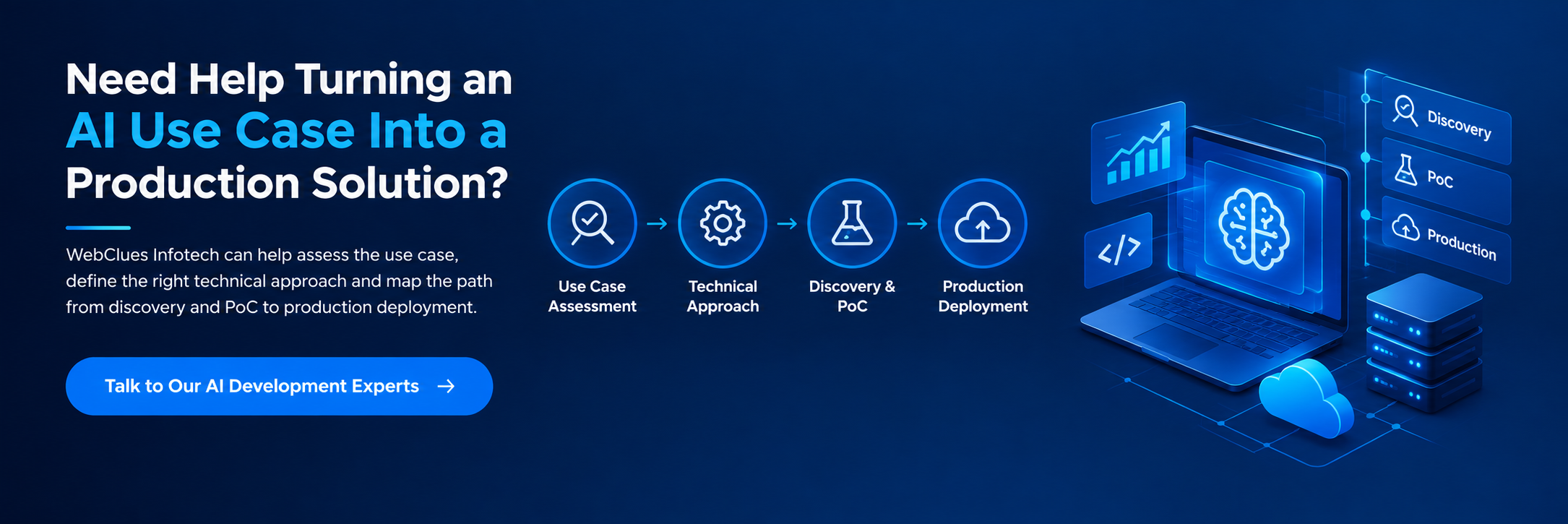
WebClues Infotech offers an end-to-end AI development approach covering AI strategy, custom AI development, generative AI, LLM and RAG applications, AI agents, machine learning, computer vision, AI-powered applications, integrations, deployment and ongoing optimisation. Its AI development offering also supports PoC-led validation before larger production initiatives.
If you already have an AI use case, the next step should be to validate the technical approach, data requirements, integrations and expected business outcome before committing to a full build.
Have an AI project to build? Contact us to explore the right development approach for your business.
Post Author

Nikhil Patel
Nikhil Patel, a visionary Director at WebClues Infotech, specializes in leveraging emerging tech, particularly Generative AI, to improve corporate communications. Through his insightful blog posts, he empowers businesses to succeed digitally.


Build Your Agile Team
Hire Skilled Developer From Us
Looking for an AI Development Partner in the UK?
WebClues Infotech helps UK businesses turn AI use cases into production-ready solutions. Discuss your requirements, architecture, integrations and development roadmap with our AI development experts.
Connect Now!Frequently Asked Questions
Our Recent Blogs
Sharing knowledge helps us grow, stay motivated and stay on-track with frontier technological and design concepts. Developers and business innovators, customers and employees - our events are all about you.