
Connect with us


Corporate Video

Top 10 Python Development Companies in Canada
Choosing a Python development company in Canada is not simply a matter of comparing hourly rates or picking the agency with the longest service list. The right partner needs to match your application type, architecture, data requirements, development model, security expectations and long-term roadmap.
Canada has a substantial and growing software-services market. Statistics Canada reported that the country's software development and computer services industries generated $161.9 billion in operating revenue in 2024, an 8.5% increase year over year. Computer systems design and related services alone generated $113.0 billion. Ontario accounted for 51.3% of that revenue, followed by Quebec, British Columbia and Alberta.
Python is also becoming increasingly relevant to business software. 2025 Stack Overflow Developer Survey recorded a seven-percentage-point increase in Python adoption from 2024 to 2025, reflecting its continued role across AI, data science, backend engineering and automation.
This guide compares 10 Python development companies with current evidence of Python capabilities and Canadian market presence. Instead of relying only on directory rankings, the selection considers Python expertise, application capabilities, Canadian presence, engineering breadth, engagement models and publicly verifiable information.
Top Python Development Companies in Canada in 2026
Explore 10 leading Python development companies in 2026 based on their technical capabilities, Canadian presence, services and delivery models.
1. WebClues Infotech
WebClues Infotech is a Python development company with a Canadian office in Burlington, Ontario and a broader international delivery presence. Its Python offering covers custom Python development for startups and enterprises, including web applications, enterprise applications, migration and upgrades, AI/ML solutions, support and maintenance and dedicated Python developers.
The company positions Python as part of a broader software engineering capability rather than treating it as an isolated development service. Its published Python capabilities include Django and Flask, while its broader engineering portfolio covers AI, machine learning, cloud, DevOps, web and mobile development.
For businesses evaluating a Python development company in Canada, this broader capability can matter when the project involves more than backend coding for example, connecting a Python application to cloud infrastructure, third-party APIs, AI components, databases, or an existing enterprise system.
WebClues also supports dedicated Python developer hiring, allowing businesses to add Python engineering capacity without building a permanent internal team.
Relevant services include:
- Python web development
- Custom Python development
- Python enterprise application development
- Python AI/ML solutions
- Python migration and upgrades
- Python support and maintenance
- Dedicated Python developers
Best suited for: Startups, enterprises, product companies and businesses looking for custom Python development or additional engineering capacity.
Canada presence: Burlington, Ontario.
2. 247 Labs
247 Labs is a Toronto-based software development company with a dedicated Python development offering. Its current Python practice covers APIs, backend development, data engineering, automation, AI/ML, custom applications, maintenance, QA and support.
Its published technology stack includes FastAPI, Django, pandas, PyTorch and scikit-learn. The company also describes dedicated teams, staff augmentation and end-to-end project delivery.
One notable aspect of its positioning is the emphasis on taking AI and machine-learning prototypes into production. That makes the company relevant to organizations where Python is being used across application engineering and data or AI workloads.
247 Labs lists offices in Toronto and Richmond Hill, Ontario.
Best suited for: Product development, Python APIs, data pipelines, automation and AI/ML-enabled applications.
3. iTechnolabs
iTechnolabs provides Python development services for custom applications, web platforms, APIs, automation tools and AI-enabled solutions. Its current Python offering covers development from planning and architecture through testing and deployment.
The company also offers multiple engagement models, including project-based development, dedicated Python developers, time-and-materials engagements and staff augmentation.
Its Canadian presence includes offices in Markham, Calgary and Ottawa.
For organizations with evolving requirements, its range of engagement models may be relevant because the buyer does not necessarily have to choose between complete outsourcing and permanent hiring.
Best suited for: Custom applications, API development, automation, AI-enabled software and businesses seeking flexible Python development models.
4. TatvaSoft
TatvaSoft has a Toronto office and provides Python development services across custom applications, AI/ML, data platforms, API development, migration and enterprise software.
Its current Python technology stack includes Django, Flask, FastAPI, Pandas, NumPy, PyTorch, TensorFlow, PostgreSQL, MySQL, MongoDB, Docker, Kubernetes, AWS, Azure and Google Cloud.
The breadth of its published stack makes it relevant to larger Python projects where the development requirement extends into data engineering, cloud infrastructure, machine learning, or enterprise integrations.
TatvaSoft also describes dedicated teams, fixed-price engagements and time-and-materials models.
Best suited for: Enterprise applications, AI/ML systems, data-intensive platforms, API ecosystems and modernization projects.
5. CMARIX
CMARIX has a Canadian office in Brampton, Ontario and lists Python among its backend technologies. Its current technology stack includes FastAPI, Django and Flask, alongside cloud, DevOps, automated testing, AI/ML and modern frontend technologies.
The company also provides access to Python developers and broader enterprise software development capabilities.
This combination is relevant for projects where Python is one component of a larger application architecture rather than the entire stack. For example, a Python API may sit behind a React frontend, connect to PostgreSQL or another database and run on AWS, Azure, or Google Cloud.
Best suited for: Custom web applications, enterprise software, API development, AI integration and full-stack projects involving Python.
6. Brainvire
Brainvire maintains a Canadian presence in Mississauga, Ontario and has a dedicated Python software development offering.
Its current Python services include custom development, Django, Flask and FastAPI web applications, REST and GraphQL APIs, machine learning, data engineering, automation, migration and modernization and ongoing support.
The company's Python offering is particularly broad for businesses looking beyond conventional web development. It positions Python alongside AI, data engineering, automation and legacy modernization.
Brainvire has also documented its Canadian operations, including a Canadian office and previous expansion of its Canadian operations.
Best suited for: Enterprise software, Python modernization, AI/data projects, APIs, automation and organizations requiring broader software engineering support.
7. Net Solutions
Net Solutions has a Toronto office and provides full-cycle Python development services. Its current offering includes web applications, APIs, SaaS development, data analytics, web crawlers, maintenance, migration and AI/ML.
The company specifically lists Django, Flask, Bottle and Tornado among its Python technologies.
Its Python offering is particularly relevant to companies working on established applications because migration and ongoing support are part of its published service scope. It also positions Python for SaaS and enterprise backend systems.
Best suited for: SaaS platforms, enterprise applications, APIs, web applications, modernization and long-term maintenance.
8. AltoLeap
AltoLeap is a Toronto-based custom software company that focuses on operational software, including quoting and CPQ systems, internal portals, dispatch applications, reporting systems and integrations.
Its current hiring information specifically references production web applications built with Python and Django. The company describes itself as a small, senior-led team headquartered in Toronto, with additional Canadian and international team members.
This makes AltoLeap somewhat different from larger full-service software providers. Its positioning is more focused on custom operational systems and business workflows.
Best suited for: Operational software, internal business systems, workflow automation, CPQ, portals and custom Django applications.
9. Probey Services
Probey Services appears in current Canadian Python-development directories, including GoodFirms' British Columbia category, where it is listed in Vancouver.
Its inclusion reflects the growing number of Canadian providers appearing in current Python-specific vendor directories rather than older listicles that repeatedly recycle the same companies.
For buyers considering Probey Services, the appropriate next step is to validate the company's current project experience, Python framework expertise, team structure, security practices and engagement model directly before signing a contract.
Best suited for: Businesses looking for a Vancouver-based Python development provider and evaluating smaller or mid-sized engineering teams.
10. Digis
Digis is a global Python development provider that serves Canadian clients and appears in current Canada-focused Python/Django vendor listings.
Its current Python offering includes Django, FastAPI, Pytest, Pandas, NumPy, PostgreSQL, Docker, PyTorch, TensorFlow and OpenAI-related technologies. The company also offers Python outsourcing and team integration.
Unlike companies with a clearly documented Canadian headquarters, Digis is better categorized as a global delivery partner serving the Canadian market. That distinction is important when evaluating vendors: “serves Canada” and “is headquartered in Canada” are not interchangeable claims.
Best suited for: Python outsourcing, dedicated engineering capacity, AI/data projects and companies looking for distributed development teams.
How We Selected These Python Development Companies
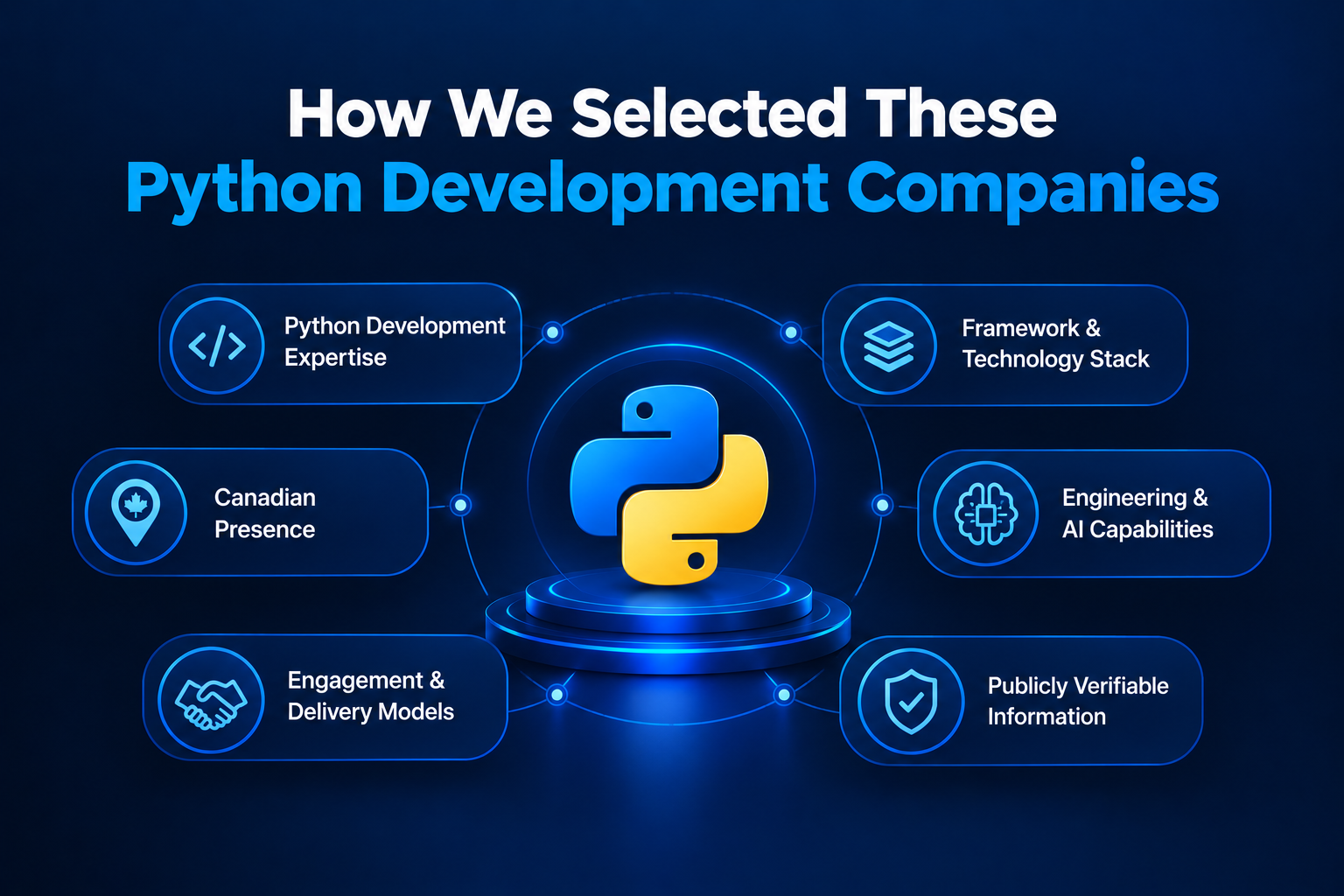
The list was built around evidence rather than simply repeating companies from older “top agency” articles.
The main considerations were:
- Python-specific service offerings
- Django, Flask, FastAPI, or related framework expertise
- Canadian offices or documented Canadian market presence
- Broader software engineering capabilities
- AI, data, automation, or cloud expertise where relevant
- Available engagement models
- Publicly verifiable company information
The list also distinguishes between companies operating from Canada and global providers serving Canadian businesses.
That distinction matters because the location of the vendor, engineering team and support organization can affect communication, procurement, time-zone overlap, data handling and long-term collaboration.
The list should therefore be treated as a buyer-oriented shortlist, not an objective ranking of software engineering quality.
What Python Development Services Can Businesses in Canada Outsource?
The useful question is not whether a company “does Python.” It is what part of the software lifecycle the company can actually own.
Application development
Python can support web applications, SaaS platforms, enterprise systems, portals and internal business applications.
For these projects, framework expertise is only one consideration. Database architecture, authentication, integrations, testing, deployment, monitoring and scalability all influence the final system.
Backend and API engineering
Python teams can develop REST and GraphQL APIs, integration layers, background services, authentication systems and backend workflows.
This becomes particularly important when a Python backend needs to connect with existing ERP, CRM, payment, analytics, or third-party systems.
AI, machine learning and data
Python is widely used across machine learning and data workloads. Stack Overflow's 2025 survey specifically links the language's increased adoption with AI, data science and backend development.
Projects can include predictive models, NLP, computer vision, LLM applications, RAG systems, data pipelines, model integration and inference services.
The engineering challenge is usually larger than model development itself. Production AI also requires data handling, evaluation, security, infrastructure, monitoring and cost management.
Modernization and maintenance
A Python partner can also help with legacy modernization, dependency upgrades, refactoring, API extraction, cloud migration, testing, performance improvements, security updates and ongoing support.
For an existing application, this may be more valuable than building a new system from scratch.
Django vs. Flask vs. FastAPI: What Should You Choose?
The framework should follow the application architecture, not the other way around.
| Framework | Common fit | What to consider |
| Django | Full web applications, business platforms, enterprise systems | Comprehensive framework with established conventions |
| FastAPI | APIs, backend services, API-first systems | Strong fit for modern API architectures |
| Flask | Lightweight applications and APIs | Flexible and minimal foundation |
Django can make sense when the application needs a broad web framework and established conventions.
FastAPI is particularly relevant when the architecture is API-first and requires modern asynchronous capabilities and typed interfaces.
Flask can suit lightweight services or projects where the development team wants greater control over application structure.
A capable Python development partner should explain the architectural trade-offs rather than simply recommending whichever framework it happens to sell most frequently.
How to Choose a Python Development Company in Canada
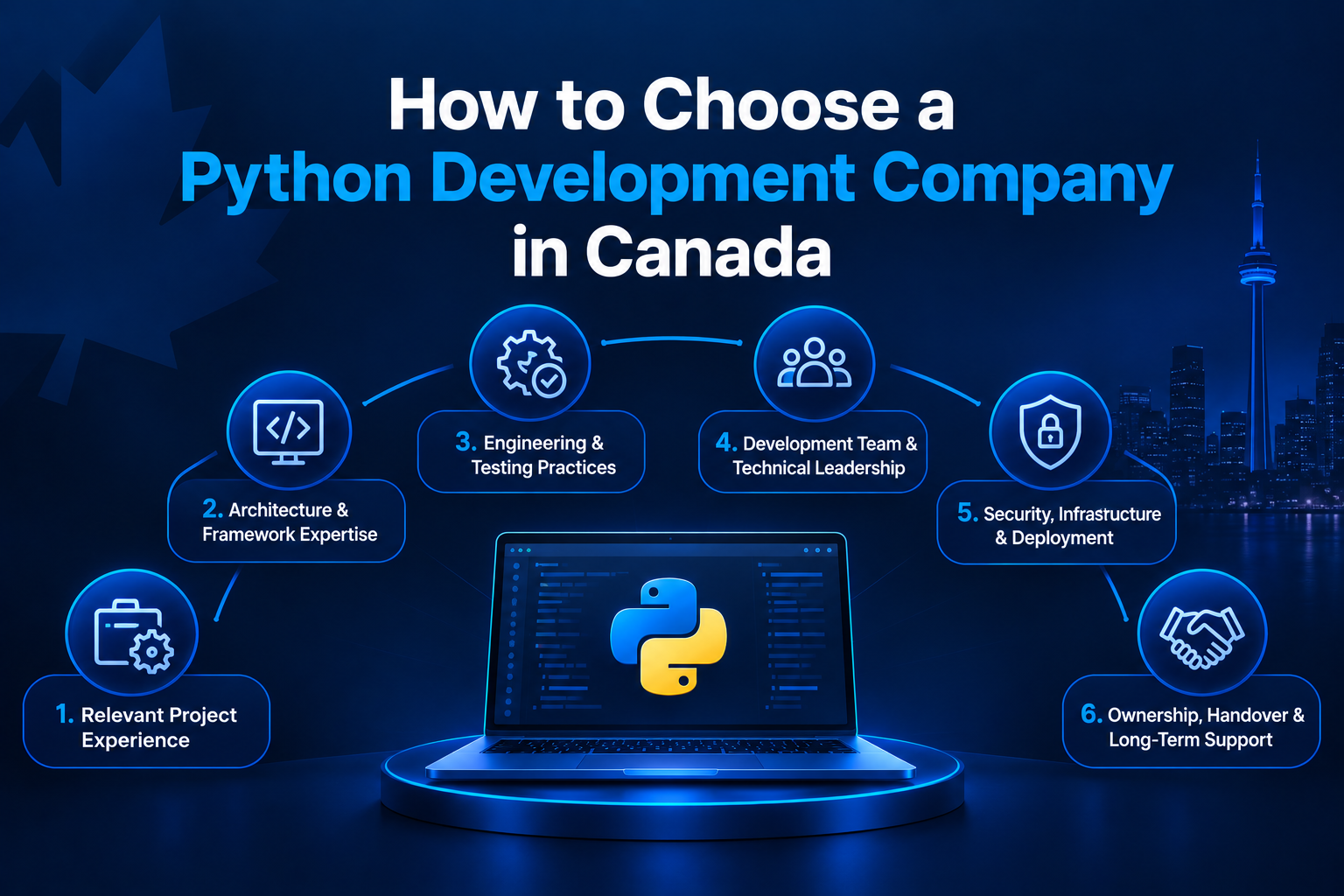
The best way to compare vendors is to give them the same problem and examine how they approach it.
Look for relevant application experience
A portfolio full of websites does not necessarily demonstrate experience with enterprise Python systems.
If you're building SaaS software, ask about multi-tenancy and scalability.
If you're building an AI product, ask about data pipelines, model integration, evaluation, inference and monitoring.
If you're modernizing a legacy platform, ask how the vendor assesses existing code before proposing changes.
Test architecture expertise
Ask the vendor to explain its proposed architecture.
The discussion should cover the framework, database, APIs, authentication, background processing, caching, infrastructure, monitoring and deployment strategy.
You are looking for engineering reasoning—not a list of technologies.
Review engineering practices
Ask how the team handles:
- Unit and integration testing
- API testing
- Code reviews
- Dependency management
- Security testing
- CI/CD
- Logging and monitoring
- Performance testing
- Production incidents
These practices have a direct effect on the maintainability of a Python application after launch.
Verify the actual team
Find out who will work on the project.
Identify the technical lead, Python developers, QA engineers, DevOps resources and project manager.
If possible, meet the proposed technical team before signing. The people presenting a proposal are not necessarily the people who will build the product.
Clarify ownership and handover
Define ownership of the repository, source code, cloud infrastructure, credentials, documentation, technical specifications, third-party accounts and intellectual property.
This is especially important if you expect to eventually bring development in-house.
How Much Does Python Development Cost in Canada?
There is no useful universal price for “Python development.”
A small API, a multi-tenant SaaS platform, an enterprise integration system and an AI application can all be built with Python while requiring very different teams and budgets.
The main cost drivers include:
- Application complexity
- Number of features
- Developer seniority
- Architecture
- Integrations
- Database requirements
- Cloud infrastructure
- Security and compliance
- AI/ML requirements
- Testing
- Migration complexity
- Post-launch support
The commercial comparison should therefore go beyond hourly rates.
Consider the total cost of ownership:
Development + infrastructure + maintenance + support + future changes + technical debt
A lower initial quote can become more expensive if the project lacks testing, documentation, scalable architecture, or a clear maintenance plan.
For a meaningful estimate, provide vendors with a defined scope, target users, integrations, technical constraints and expected production environment.
Python Development Company vs. Freelancer vs. Staff Augmentation
The delivery model should match how much responsibility your internal team wants to retain.
| Model | Suitable for | Main consideration |
| Freelancer | Small features, fixes, contained technical work | Limited delivery capacity |
| Dedicated developer | Additional Python engineering capacity | Internal team manages delivery |
| Staff augmentation | Existing product and engineering teams | You retain technical control |
| Development company | End-to-end product development | Broader delivery responsibility |
| Dedicated team | Long-term external engineering capacity | Requires ongoing vendor management |
If you already have product leadership, architecture, QA and DevOps internally, adding dedicated Python developers may be sufficient.
If you need discovery, architecture, development, testing, deployment and support from one external team, a full-service development company may be more appropriate.
Canadian Agency vs. Global Python Development Partner
A Canadian office and a Canadian delivery team are not necessarily the same thing.
A Canadian development provider may offer local communication and familiarity with the Canadian market.
A global provider with Canadian operations may combine a Canadian-facing presence with distributed engineering teams.
Neither structure is inherently suitable for every project.
Before signing, ask:
- Where will the developers be located?
- Where will the technical lead be located?
- What hours will overlap with your team?
- Who provides production support?
- Where does project management operate?
- How is knowledge transferred?
- How is sensitive data accessed and controlled?
This is more useful than evaluating a vendor purely by its registered office location.
Red Flags When Hiring a Python Development Company
Watch for these warning signs before signing a contract, from shallow Python expertise to unclear ownership, weak testing and vague delivery responsibilities.
Python is only on technology list
A vendor mentioning Python among dozens of technologies has not necessarily demonstrated meaningful Python expertise. Look for dedicated Python services, framework experience, relevant projects, or identifiable Python engineering capabilities.
The proposal starts with technology
A credible proposal should begin with the application requirements and business problem. The vendor should be able to explain why a particular architecture or framework fits the use case.
The delivery team is vague
Ask who will actually write the production code and who will provide technical leadership.
Testing is treated as a final-stage activity
Testing should be part of development rather than a cleanup exercise immediately before launch.
Rewrite without technical assessment
For an existing application, the vendor should understand the codebase, dependencies, infrastructure, testing and technical debt before proposing a rewrite.
Ownership is unclear
Source code, repositories, infrastructure, documentation and credentials should be explicitly addressed in the contract
Questions to Ask Before Hiring Python Developers in Canada
Use these questions to evaluate a vendor’s technical depth, team quality, commercial clarity and ownership terms before signing.
Technical
- Which Python framework would you recommend and why?
- How would you structure the backend?
- How will authentication and authorization work?
- How will the system scale?
- What testing strategy will you use?
- How will dependencies and vulnerabilities be managed?
- How will production monitoring work?
Team
- Who will be the technical lead?
- Who will write the production code?
- What experience does the assigned team have?
- Can we interview the developers?
- What happens if a developer leaves?
Commercial
- What is included in the estimate?
- What is excluded?
- How are scope changes handled?
- Which engagement model do you recommend?
- What happens after launch?
Ownership
- Who owns the source code?
- Who controls the repository?
- Who controls cloud infrastructure?
- What documentation will we receive?
- Can our internal team take over later?
The specificity of the answers matters. A detailed explanation of how a team would approach your particular application is more informative than a generic portfolio presentation.
Build Your Python Product With the Right Development Partner
The right Python development partner should do more than provide developers who know the language. It should understand your product, architecture, data, integrations, security requirements, deployment environment and long-term roadmap.
WebClues Infotech provides Python development services in CA for custom applications, web platforms, enterprise software, AI/ML solutions, migration, maintenance and dedicated developer requirements.
With a Canadian office in Burlington, Ontario, businesses can work with a global engineering partner while maintaining a Canadian point of presence.
If you are planning a Python application, modernizing an existing system, or looking to extend your engineering team, start with the requirements rather than a technology checklist.
Talk to WebClues Infotech team about your Python development requirements and discuss the right architecture, team and engagement model for your project.
Post Author

Nikhil Patel
Nikhil Patel, a visionary Director at WebClues Infotech, specializes in leveraging emerging tech, particularly Generative AI, to improve corporate communications. Through his insightful blog posts, he empowers businesses to succeed digitally.


Build Your Agile Team
Hire Skilled Developer From Us
Start Your Python Project With the Right Team
Need Python developers for a new product, legacy modernization, or AI-powered application? Get expert guidance from WebClues Infotech on the right architecture, team and engagement model for your project.
Connect Now!Frequently Asked Questions
Our Recent Blogs
Sharing knowledge helps us grow, stay motivated and stay on-track with frontier technological and design concepts. Developers and business innovators, customers and employees - our events are all about you.