
Connect with us


Corporate Video

Agentic Engineering vs Vibe Coding: Which Development Model to Choose in 2026?
.jpg)
Executive Summary
The landscape of software development has shifted fundamentally. We are no longer just writing code; we are directing AI to write it for us. As we navigate 2026, two distinct AI-native software development models have emerged as the primary ways to build applications: vibe coding and agentic engineering. Vibe coding allows anyone to build software through natural language conversations, raising the floor for non-developers, while agentic engineering enables professionals to orchestrate autonomous AI systems with strict governance and control, raising the ceiling for enterprise-grade solutions. For businesses evaluating modern software development services, this evolution is crucial, as success now depends on choosing the right AI-driven development approach that balances speed, scalability, and reliability across startup, mid-market, and enterprise needs.
The Evolution of AI-Native Software Development Models in 2026
If we look back just a few years, coding meant staring at a screen, manually typing logic, and fixing errors line by line. Today, development has shifted into Software 3.0, where intent, context, and AI agents increasingly define how software is built rather than raw manual implementation.
The performance delta is now well established. In 2026, industry-wide surveys indicate that over 80% of developers actively use AI coding tools in their workflow, with AI-assisted engineering becoming a default practice across startups and enterprises.
GitHub’s studies continue to show productivity gains of up to 55% in task completion speed when AI copilots are embedded into development environments. On average, developers report saving 5–8 hours per week due to automation in boilerplate generation, debugging support, and test creation, shifting engineering time toward architecture and review rather than manual implementation.
At the enterprise level, AI-native workflows are also reshaping delivery systems. Recent DORA-aligned findings highlight that teams using AI assistance are achieving higher deployment frequency and reduced lead times, although outcomes vary based on codebase maturity, governance, and review discipline.
However, efficiency gains are not purely linear; studies tracking AI-generated commits show that a non-trivial share of AI-assisted code can introduce maintainability and security concerns if not properly reviewed, reinforcing the need for structured engineering oversight.
In 2026, this reality has led directly to the “agentic engineering vs vibe coding” divide. Both rely on generative AI, and both can produce working software, but they operate at fundamentally different levels of control, reliability, and scalability. Conflating the two often results in either fragile prototypes that cannot scale or unnecessarily complex systems built for simple use cases. Understanding this distinction is now central to choosing the right development model.
What is Vibe Coding in Software Development?
The term "vibe coding" was coined by AI researcher Andrej Karpathy in early 2025. Vibe coding meaning in software development is simple: it is a natural-language, human-in-the-loop workflow where you dictate what you want to an AI, and the AI builds it. You do not need to understand the underlying syntax. You just guide the AI based on the "vibe" or momentum of the project.
The Mechanics of Vibe Coding
In this prompt-driven development model, you describe an outcome, and the AI generates the code. If it works, you move on. If it breaks, you paste the error back into the chat and ask the AI to fix it. You act as a creative director rather than an engineer.
As designer and AI builder Fan Wu notes, vibe coding is incredibly seductive because it lowers the barrier to entry. It gives non-technical founders, product managers, and marketers the ability to test software without understanding the complexity behind the screen.
Pros of Vibe Coding
- Accessibility: It raises the floor. Anyone can build a functional prototype.
- Speed to Prototype: You can deploy a working app to the web in minutes.
- Creative Momentum: It keeps you in a flow state, allowing rapid brainstorming and feature testing.
Cons of Vibe Coding
- Lack of Accountability: If you do not understand the code, you cannot debug it when complex issues arise. You are outsourcing your understanding.
- Hidden Costs: AI models might write inefficient code that loops API calls unnecessarily, blowing through rate limits and budget constraints.
- Technical Debt: Vibe coding produces software that is often bloated and brittle. It is not meant to pass a rigorous security audit.
What is Agentic Engineering in AI Development?
If vibe coding is for accessibility, agentic engineering is for professional excellence. The agentic engineering meaning revolves around throughput at professional quality. It is the practice of using a multi-agent AI systems architecture to automate tedious tasks while the human developer retains full accountability for the architecture, security, and logic.
The Mechanics of Agentic Engineering
An agentic AI development services company does not just chat with an LLM. Developers orchestrate multiple AI agents to handle planning, writing, testing, and reviewing code.
As developer Andrew Connell explains, agentic engineering is like being the head chef in a kitchen. The AI agents are your sous chefs. They handle the prep work, but you define the menu and inspect every dish before it goes to the customer.
In this model, developers write precise specifications. They verify the output against strict enterprise standards. They use AI workflow orchestration tools to manage CI/CD pipelines, database migrations, and complex refactoring.
Pros of Agentic Engineering
Professional Quality: It raises the ceiling. It maintains the rigorous standards expected in enterprise AI software development services.
Scalability: Optimized for scalable AI architecture for SaaS products.
Maintainability: Because the engineer understands and verifies the code, the system remains maintainable over time.
Cons of Agentic Engineering
Higher Barrier to Entry: You must be a skilled software engineer to effectively judge and verify the AI's output.
Initial Setup Time: Building the proper AI agent-based software architecture takes more time upfront than simply opening a chat window.
Agentic Engineering vs Vibe Coding Differences
When comparing agentic AI vs prompt-based coding, we must look at how each handles the realities of production software.
| Feature | Vibe Coding | Agentic Engineering |
| Primary User | Non-technical founders, hobbyists, designers | Professional software engineers, architects |
| Goal | Rapid prototyping, validating ideas, raising the floor | Production-grade software, raising the ceiling |
| Code Review | Rarely reviewed; developer trusts the AI | Strictly reviewed; developer verifies the AI |
| Architecture | Often unstructured and messy | Modular, planned, and enterprise-ready |
| Accountability | Delegated to the AI | Retained fully by the human engineer |
| Scalability | Low; struggles with complex logic | High; built for large-scale SaaS and enterprise |
The distinction is clear. Vibe coding gets you off the starting line. Agentic engineering is how you run the marathon.
Industry Fit and Use-Case Mapping
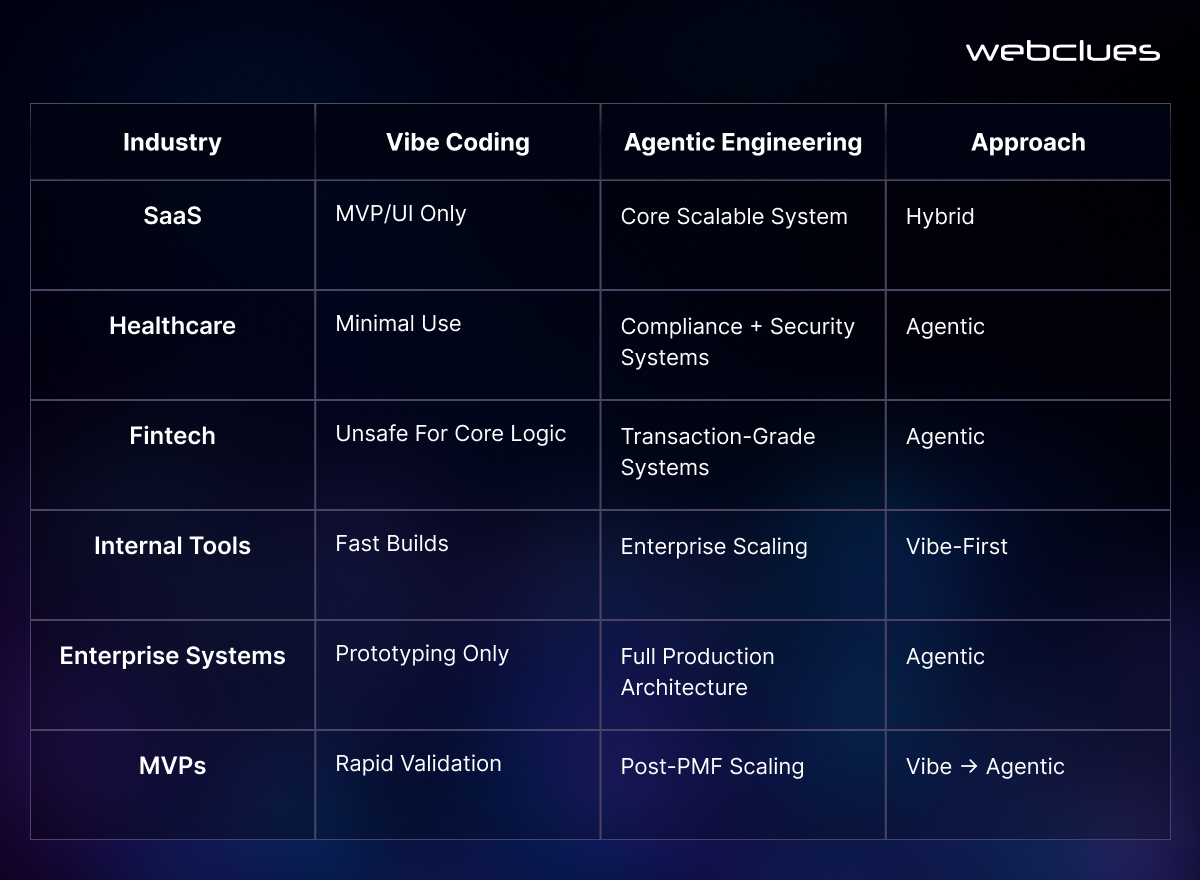
Different industries require completely different approaches to AI software development. Let us look at where each model fits best.
AI in SaaS Product Development
For SaaS products, you need a scalable AI backend architecture. While vibe coding is excellent for testing a new landing page or a simple feature toggle, the core platform demands agentic engineering. Subscription products require secure authentication, multi-tenant databases, and flawless uptime.
Healthcare AI Systems Development
Healthcare applications deal with sensitive patient data and strict compliance regulations (like HIPAA). Vibe coding is entirely inappropriate for the core system here. You must use scalable AI engineering services for enterprises that employ agentic engineering to ensure every line of code meets security and privacy standards.
AI-Driven Fintech Software Development
Financial technology requires exact precision. A small error in logic can result in massive financial loss. Fintech companies must partner with a custom AI agent development company that uses strict agentic engineering workflows to enforce transaction integrity and data security.
Internal Tools and Workflow Automation
If you need a quick script to organize spreadsheets or a simple internal form for employee feedback, vibe coding shines. It allows operations teams to build AI automation for enterprise workflows without waiting months for IT approval.
Decision Framework for AI Development Models
When deciding "which is better agentic engineering or vibe coding," the answer depends entirely on your business size, risk tolerance, and project goals. Use this segmentation to guide your choice in 2026.
For Startups
Startups often face extreme time and budget constraints.
- Phase 1 (Ideation & MVP): Use vibe coding. As a founder, you can use generative AI coding paradigms to quickly build a clickable prototype. This helps secure funding and gather early user feedback without spending thousands on development.
- Phase 2 (Scaling): Transition to agentic engineering. Once you have product-market fit, you must rebuild or refactor your application using a generative AI development company for startups. Technical debt accumulated during the vibe coding phase will sink a growing user base.
For Mid-Market Companies
Mid-market companies have established products but need to innovate quickly to stay competitive.
- Approach: A hybrid model. Product managers can use vibe coding to mock up new features and present them to the engineering team. The engineers then use AI-assisted software development lifecycle tools to build the actual feature using agentic engineering. This ensures rapid communication without sacrificing code quality.
For Enterprise Businesses
Enterprises operate at a massive scale where downtime costs millions.
Approach: Strict agentic engineering. Enterprises require intelligent enterprise automation systems and robust AI orchestration systems. You must hire AI developers for agentic systems who understand how to review, verify, and maintain complex codebases. Vibe coding should be strictly limited to isolated, non-production sandbox environments.
Common Mistakes When Choosing an AI Software Development Model
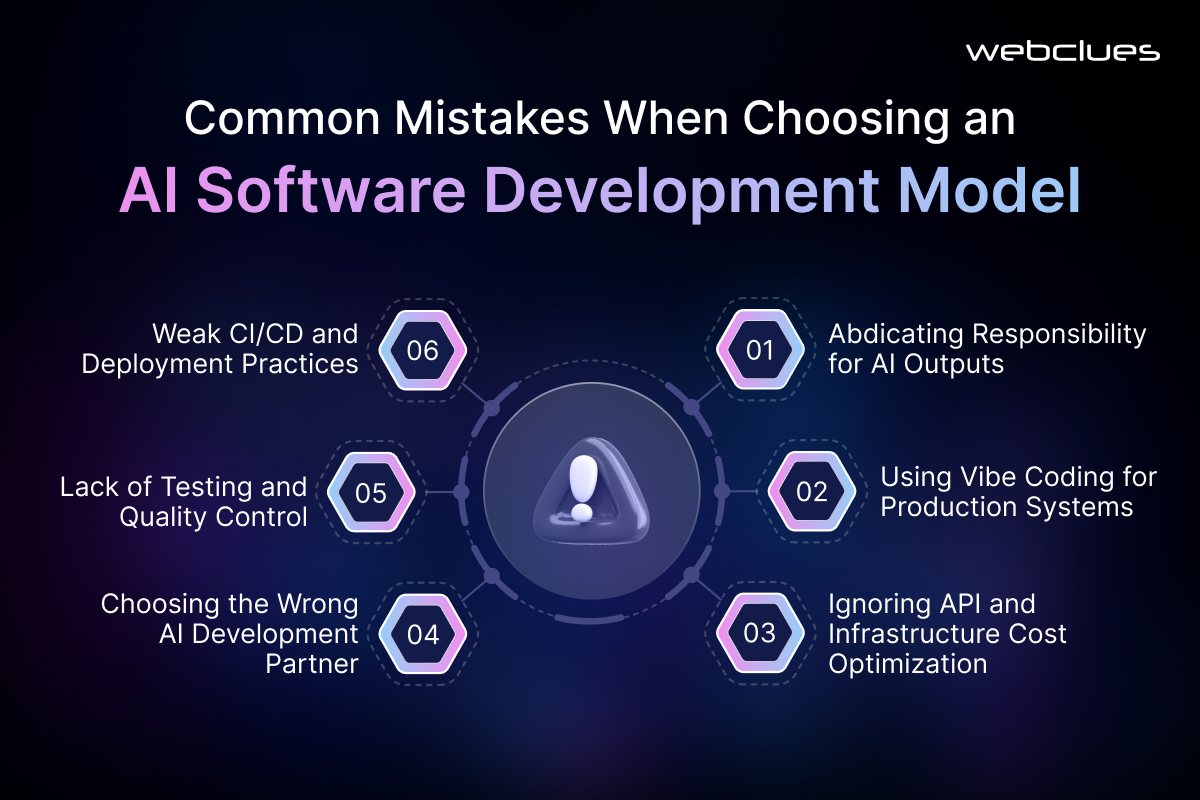
Choosing the wrong AI software development model can lead to wasted budgets, security breaches, and unmaintainable code. Avoid these common pitfalls:
- Abdicating Responsibility: The biggest mistake companies make is assuming AI agents absorb liability. They do not. If an AI writes a security flaw, your company is still responsible. You must maintain engineering judgment.
- Using Vibe Coding for Production: Treating a production application like a weekend hack project is a recipe for disaster. Vibe coding produces brittle code that breaks under scale.
- Ignoring API and Infrastructure Costs: AI models focus on functionality, not cost optimization. A poorly prompted AI might write code that makes thousands of redundant API calls, skyrocketing your cloud hosting bills. Agentic engineers know how to optimize for cost.
- Hiring the Wrong Partner: Many agencies claim to offer enterprise AI development services, but they are just vibe coding behind the scenes. You must audit their processes. Ensure they use multi-agent collaboration, rigorous testing, and proper CI/CD pipelines.
Finding the Best AI Development Company for Agentic Engineering
When you are ready to build, selecting the best AI development company for agentic engineering requires careful vetting. You want an AI product development agency in 2026 that understands the difference between generating code and engineering software.
Look for a custom AI agent development company that emphasizes verifiable outputs. They should explain their architecture decisions, provide clear documentation, and demonstrate how their AI agent-based development models integrate with your existing infrastructure.
By focusing on agencies that prioritize agentic AI development services, you protect your investment and guarantee a scalable, secure product.
Contact us to get started. Our experts help you design, build, and scale intelligent agentic AI systems tailored to your business goals.
Post Author

Ayush Kanodia
As one of the esteemed Directors of WebClues Infotech. Ayush Kanodia is passionate about delivering innovative IT services & solutions and has spearheaded numerous successful projects, cementing the company's position as a leader in the field.


Build Your Agile Team
Hire Skilled Developer From Us
Build Smarter AI Software with the Right Development Model
Choosing between vibe coding and agentic engineering directly impacts your product’s scalability, security, and long-term cost. If you’re planning an MVP, scaling a SaaS platform, or modernizing enterprise systems, the wrong development approach can lead to technical debt and hidden inefficiencies. Get expert guidance on selecting and implementing the right AI-native development strategy tailored to your business goals. Talk to our AI engineering team to evaluate your architecture and build production-ready systems with confidence.
Connect Now!Frequently Asked Questions
Our Recent Blogs
Sharing knowledge helps us grow, stay motivated and stay on-track with frontier technological and design concepts. Developers and business innovators, customers and employees - our events are all about you.