

Connect with us


Corporate Video

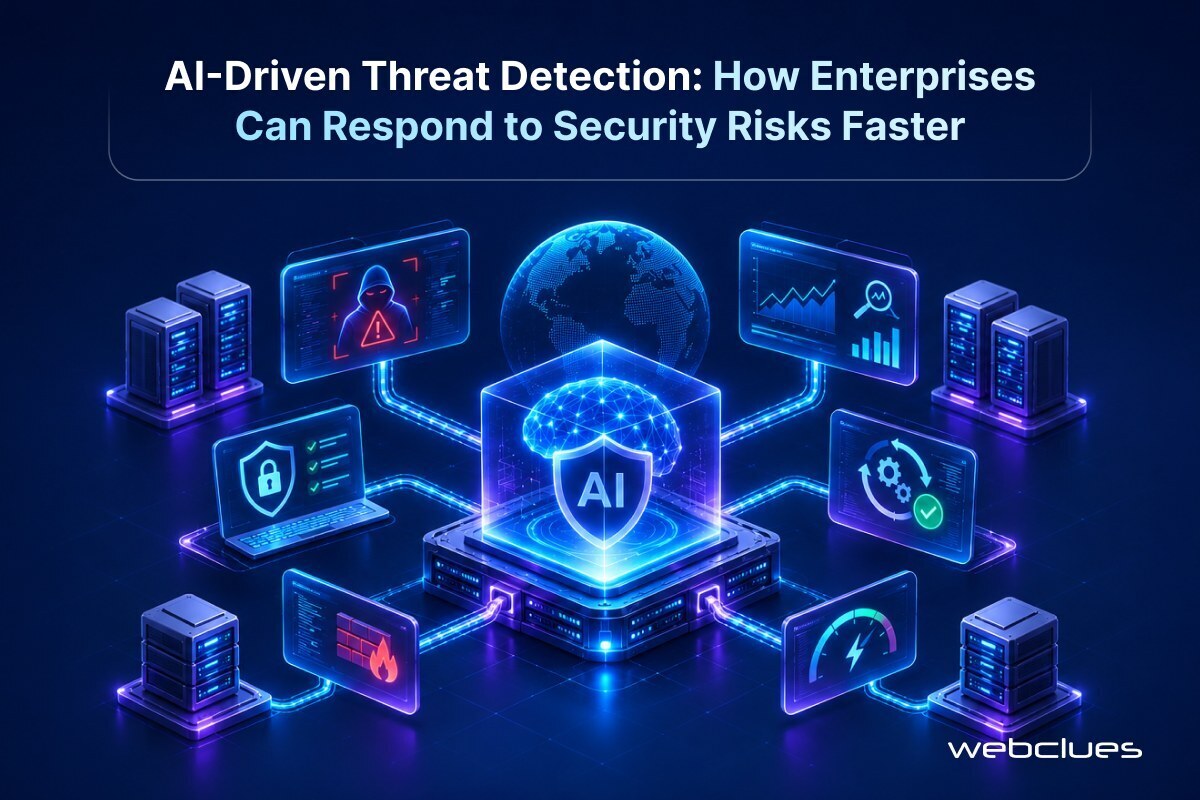
AI-Driven Threat Detection: How Enterprises Can Respond to Security Risks Faster
Introduction:
Enterprise security teams must investigate suspicious logins, endpoint alerts, unusual network traffic, cloud activity, and potential data exposure across increasingly interconnected systems.
The challenge is not identifying security events. It is determining which events indicate a genuine threat, understanding their potential impact, and deciding what action to take before the incident escalates.
Traditional security controls remain essential, but rule-based detection and manual investigations can struggle when suspicious activity spans multiple systems or does not match known attack patterns.
AI-driven threat detection can help security teams analyze large volumes of data, identify unusual behavior, connect related events, and prioritize potential threats.
However, AI does not automatically make an organization secure. Its effectiveness depends on data quality, integration with existing security systems, and proper detection validation.
An experienced AI development company can help enterprises implement AI-driven threat detection to identify risks faster, improve security decisions, and maintain human oversight over critical actions.
What Is AI-Driven Threat Detection?
AI-driven threat detection uses artificial intelligence techniques, including machine learning, behavioral analytics, and AI-assisted analysis, to identify potentially malicious activity across an organization's digital environment.
Instead of relying exclusively on predefined signatures or static rules, these systems can analyze patterns in user behavior, endpoint activity, network traffic, identity events, and cloud logs. They can also correlate multiple signals to help analysts investigate activity that might appear harmless when examined individually.
For example, an employee signing in from a new location may not indicate a security incident. However, a new login followed by unusual privilege escalation, access to sensitive files, and unexpected outbound data transfers may justify immediate investigation.
AI can help connect these events, summarize the available evidence, and prioritize the resulting alert.
AI-driven threat detection typically supports several activities:
- Behavioral anomaly detection: Identifying activity that differs from established or contextually relevant patterns.
- Alert correlation: Connecting related security events across endpoints, identities, networks, and cloud services.
- Risk prioritization: Helping analysts determine which alerts warrant immediate attention.
- Investigation assistance: Summarizing evidence, enriching alerts with context, and suggesting investigative steps.
- Response orchestration: Supporting predefined actions through existing security workflows, subject to appropriate authorization.
These capabilities complement conventional security controls. Signature-based detection, endpoint protection, access policies, vulnerability management, and network segmentation remain important components of a layered security strategy.
How AI Helps Enterprises Detect and Respond to Threats Faster
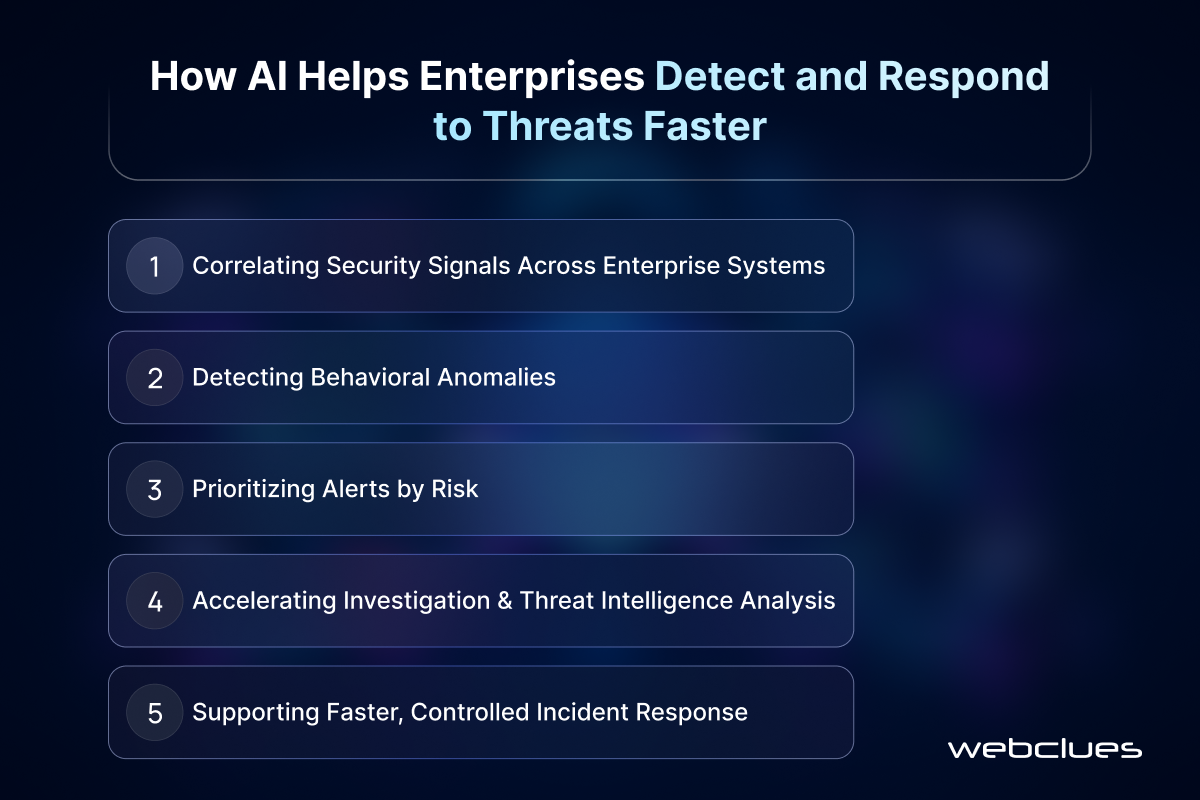
AI can accelerate several stages of the security operations workflow, from identifying suspicious behavior to coordinating a response.
1. Correlating Security Signals Across Enterprise Systems
Security events often originate in different systems. Identity platforms record authentication activity, endpoint tools monitor devices, cloud platforms generate infrastructure logs, and network controls capture communication patterns.
When these signals remain isolated, analysts may need to investigate each source separately before understanding the incident.
AI-assisted analytics can help correlate related events and assemble a more complete picture of suspicious activity.
For example, an unusual authentication event may become more concerning when combined with a new administrative permission, an unfamiliar endpoint process, and access to a sensitive database. Correlating these signals helps analysts investigate the sequence rather than treating each alert as an unrelated event.
This approach is particularly useful in hybrid environments where applications, employee devices, cloud workloads, and third-party services generate security data across multiple platforms.
2. Detecting Behavioral Anomalies
Traditional detection rules are effective for known indicators and clearly defined conditions. However, suspicious activity does not always match an established signature.
Machine learning and behavioral analytics can help identify deviations in authentication patterns, resource access, network communication, and system activity.
Potential examples include:
- An account accessing substantially more sensitive records than its normal responsibilities require.
- A service account communicating with an unexpected external endpoint.
- An endpoint initiating unusual processes after a suspicious login.
- A cloud workload accessing resources outside its expected operating pattern.
An anomaly is not automatically an attack. Legitimate business changes, software deployments, travel, and workload spikes can also produce unusual behavior.
AI-generated findings therefore need contextual validation, risk thresholds, and investigation procedures that distinguish suspicious activity from legitimate operational changes.
3. Prioritizing Alerts by Risk
A large volume of low-priority alerts can consume the time security analysts need to investigate serious incidents.
AI can help group duplicate alerts, enrich findings with contextual information, and prioritize events according to factors such as asset criticality, identity privileges, known threat indicators, and the sensitivity of affected data.
For instance, suspicious activity involving a privileged account on a production system may warrant faster investigation than a similar anomaly involving a low-risk test environment.
Risk prioritization should reflect organizational context rather than a model-generated score alone. Security teams need to understand why an alert received its priority and which evidence supports the recommendation.
4. Accelerating Investigation and Threat Intelligence Analysis
Once an alert is raised, analysts must determine what happened, which assets may be affected, whether the activity is malicious, and how the incident might have developed.
AI-assisted investigation tools can summarize event sequences, connect related alerts, organize evidence, and suggest queries or investigative steps. This can reduce repetitive analysis and help analysts focus on validating the incident.
However, generated summaries should remain traceable to original logs and other evidence. An AI-generated explanation is not proof that an attack occurred, and unsupported conclusions can create false confidence during incident response.
5. Supporting Faster, Controlled Incident Response
After a threat is validated, response actions may include revoking compromised credentials, isolating an affected endpoint, blocking malicious communication, or initiating an established incident-response playbook.
AI can help recommend actions, coordinate approved workflows, and prepare the information responders need to make decisions.
Low-risk, reversible actions may be suitable for automation when they have been tested and explicitly authorized. Actions that could disrupt critical business operations, delete data, or affect many systems should require stronger approval controls.
The goal is not to automate every decision. It is to remove unnecessary delays without introducing uncontrolled operational risk.
Enterprise Security Risks AI Can Help Identify
AI-driven detection can support multiple security use cases, although the effectiveness of each depends on available telemetry, detection logic, and implementation quality.
Compromised Credentials and Privilege Escalation
AI can help identify unusual authentication patterns, unexpected privilege changes, suspicious access sequences, and account activity that differs from established behavior.
Correlating identity events with endpoint and application telemetry can help security teams investigate whether a compromised account is being used to access additional systems.
Ransomware Activity and Lateral Movement
Ransomware incidents may involve suspicious process execution, unusual file activity, credential abuse, and attempts to communicate with other systems.
Behavioral detection and cross-source correlation can help surface related indicators earlier in an attack sequence. However, AI detection should
complement endpoint controls, tested backups, network segmentation, and established containment procedures.
Phishing and Suspicious Communication Patterns
AI can help analyze email characteristics, suspicious URLs, message context, and related identity or endpoint events to support phishing detection.
Security teams should validate findings using appropriate email security controls and threat intelligence. AI-generated content analysis alone cannot reliably establish that a message is malicious.
Insider Threats and Unusual Data Access
Unusual downloads, access outside expected responsibilities, or atypical transfers of sensitive information may justify investigation.
AI can help identify behavioral patterns, but monitoring must account for legitimate job responsibilities, privacy requirements, and access policies. An unusual action should not automatically be interpreted as malicious intent.
Cloud Misconfigurations and Cross-Environment Threats
Enterprises often operate across multiple cloud accounts, applications, identity systems, and infrastructure environments.
AI-assisted analysis can help correlate configuration changes, suspicious API calls, unusual service communication, and unexpected access patterns. Security teams should combine these findings with cloud security posture management, identity controls, configuration validation, and continuous monitoring.
For organizations evaluating practical applications, AI in Security provides a relevant starting point for exploring how AI can support security-related business workflows.
How AI-Driven Threat Detection Works in an Enterprise Environment
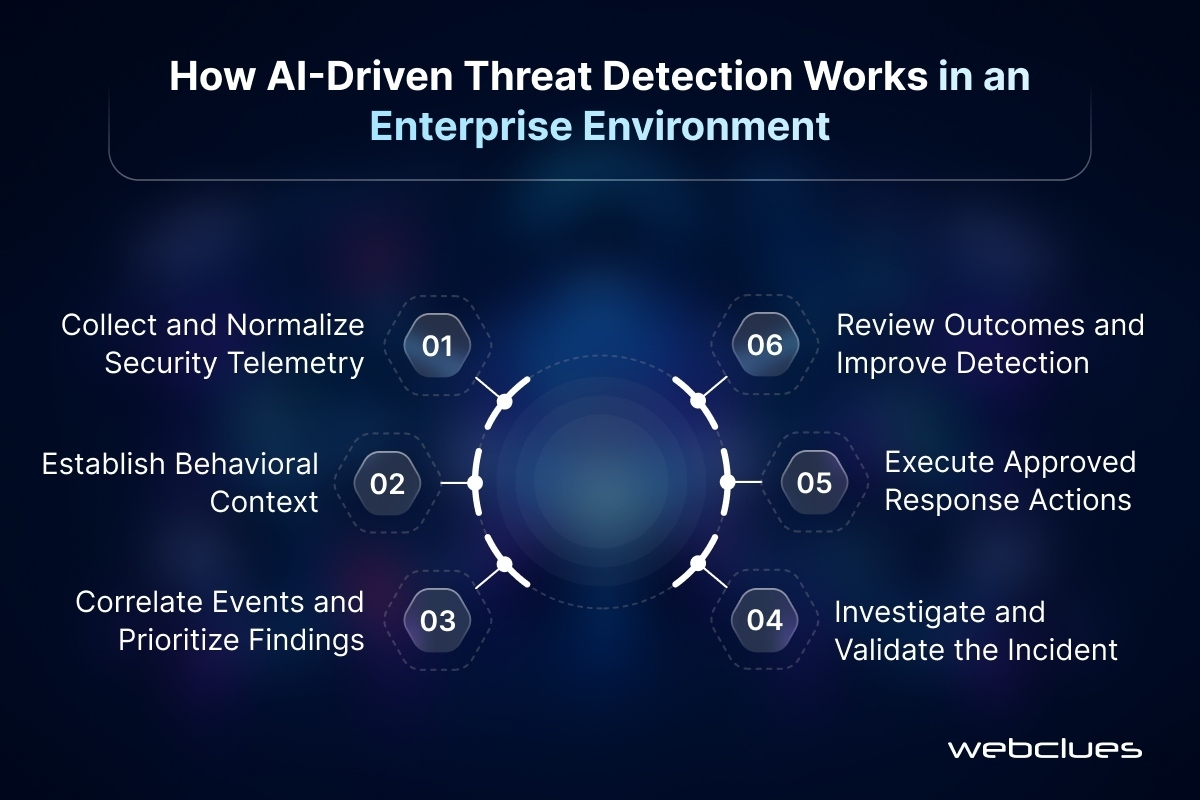
A useful implementation connects detection, investigation, and response instead of treating AI as a standalone alert generator.
Step 1: Collect and Normalize Security Telemetry
The system gathers relevant data from identity providers, endpoints, network infrastructure, cloud environments, applications, and existing security tools.
Data normalization helps make events from different sources easier to correlate. Access restrictions, retention requirements, and data quality checks should be established before sensitive information is processed.
Step 2: Establish Behavioral Context
Detection systems analyze available events against predefined rules, historical patterns, threat intelligence, and relevant operational context.
The approach may combine deterministic rules with machine learning models and behavioral analytics. Not every detection requires an AI model; simple, well-defined conditions are often better handled by conventional rules.
Step 3: Correlate Events and Prioritize Findings
Related events are grouped into potential incidents. The system can enrich findings with information about affected assets, user privileges, known indicators, and business impact.
Risk scoring should be transparent enough for analysts to understand the evidence behind prioritization.
Step 4: Investigate and Validate the Incident
Analysts review the event timeline, supporting telemetry, and available context. AI can help summarize findings or recommend additional checks, but the investigation process must preserve access to original evidence.
The objective is to determine whether the activity represents a confirmed incident, a benign anomaly, or an unresolved risk requiring further investigation.
Step 5: Execute Approved Response Actions
Validated incidents trigger the appropriate response workflow. Depending on the threat and organizational policy, this may involve automated containment, analyst approval, or coordinated action across several security systems.
Response actions should be logged, auditable, and reversible where possible. Teams should also verify that containment succeeded rather than assuming that an issued command resolved the incident.
Step 6: Review Outcomes and Improve Detection
After the incident, security teams evaluate whether detection was timely, whether the response was appropriate, and whether controls need adjustment.
False positives, missed detections, model drift, and changes in normal business activity should inform ongoing validation. Continuous improvement requires reliable feedback and documented testing rather than assuming a model will improve automatically.
Practical Example: Responding to a Compromised Enterprise Account
Consider an enterprise employee account that begins accessing internal resources in an unusual pattern.
An initial sign-in alert may be insufficient to establish a compromise. Later events, however, show a new authentication context, an unexpected privilege change, access to sensitive documents, and unusual outbound communication.
An AI-assisted detection system could correlate these events, assemble a timeline, identify the affected account and systems, and prioritize the potential incident for investigation.
The security analyst reviews the original evidence and confirms whether the activity is unauthorized. If compromise is established, the response workflow may revoke sessions, reset or disable the affected credentials, restrict access, and isolate relevant endpoints when justified.
The team then verifies containment, checks for additional affected accounts, and investigates potential data exposure.
In this scenario, AI helps shorten the path from scattered events to an actionable investigation. The outcome still depends on telemetry coverage, detection quality, effective controls, and a response process that can execute the necessary actions.
This is an illustrative workflow, not a reported WebClues customer result.
AI-Driven Threat Detection vs. Traditional Security Monitoring
AI-driven detection and conventional monitoring complement each other.
| Capability | Traditional security monitoring | AI-assisted threat detection |
| Known threat indicators | Effective with maintained signatures and rules | Can enrich and correlate known indicators |
| Behavioral anomalies | Depends on configured rules and analytics | Can identify patterns across available telemetry |
| Cross-system correlation | May require predefined correlation logic | Can help connect complex or weak signals |
| Alert prioritization | Often uses static severity and rule-based context | Can incorporate broader context, subject to validation |
| Investigation | Analysts review events and evidence | AI can assist with summaries, queries, and evidence organization |
| Response | Uses established playbooks and manual workflows | Can support controlled automation and response recommendations |
| Limitations | Rules can miss activity outside their coverage | Models can produce false positives, miss threats, or generate unreliable explanations |
The right approach depends on the enterprise's threat model, infrastructure, available data, and operational maturity. Replacing established controls with AI is not a substitute for building a well-integrated security program.
Challenges Enterprises Must Address Before Deployment
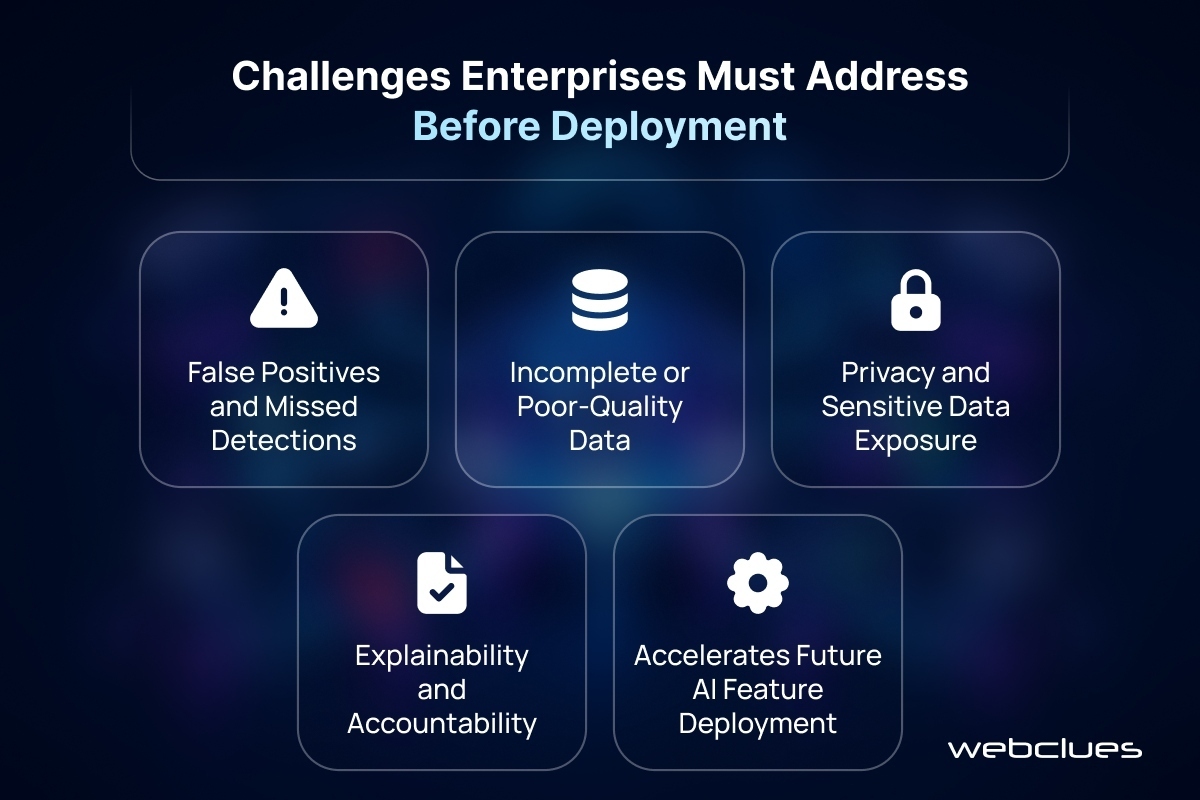
Before deploying AI-driven security solutions, enterprises must address key data, accuracy, privacy, accountability, and integration challenges to ensure reliable threat detection.
False Positives and Missed Detections
An AI model may flag legitimate activity or fail to identify a real threat. Enterprises should measure precision and recall where appropriate, validate performance against representative scenarios, and maintain escalation paths for uncertain findings.
Incomplete or Poor-Quality Data
Detection quality depends on the availability, consistency, and context of security telemetry. Missing logs, inconsistent timestamps, limited endpoint visibility, and fragmented identity records can undermine correlation.
Data coverage should be assessed before selecting models or expanding automation.
Privacy and Sensitive Data Exposure
Security logs can contain personal information, credentials, internal identifiers, and other sensitive details. Organizations should apply data minimization, access controls, appropriate retention policies, and secure handling procedures when integrating AI into security workflows.
Explainability and Accountability
Analysts need to understand why a finding was prioritized and which evidence supports the recommended action. Maintain audit trails and ensure that responsibility for consequential decisions remains clearly assigned.
Integration With Existing Security Systems
AI-driven detection must work with the enterprise's existing security information and event management (SIEM), endpoint detection and response (EDR), extended detection and response (XDR), identity, and security orchestration, automation, and response (SOAR) systems where applicable.
Poorly controlled integrations can introduce excessive permissions, operational dependencies, or new attack paths. Integration testing and least-privilege access are essential.
How to Implement AI-Driven Threat Detection
Enterprises should introduce AI through a controlled implementation process.
1. Define priority threats: Identify the incidents that matter most to the organization, such as compromised privileged accounts, ransomware activity, or unauthorized access to sensitive data.
2. Assess existing detection coverage: Review current tools, telemetry sources, investigation procedures, and response capabilities. Identify gaps before adding another detection layer.
3. Start with a bounded pilot: Select a high-value use case and evaluate AI alongside existing controls. Test both known attack scenarios and benign activity that could produce misleading alerts.
4. Establish automation boundaries: Define which actions AI may recommend, which reversible actions it may execute, and which decisions require human approval.
5. Validate performance: Compare detection quality, investigation effort, and response times against an established baseline. Include false positives, missed detections, integration failures, and operational disruption in the evaluation.
6. Expand based on evidence: Extend the implementation only when the pilot demonstrates measurable value and the necessary governance, monitoring, and recovery procedures are in place.
The Australian Cyber Security Centre's Opportunities for AI in Cyber Defence guidance reinforces the importance of secure integration, testing, governance, and human oversight when adopting AI for security operations.
How to Measure AI-Driven Threat Detection Effectiveness
Enterprises should evaluate whether AI improves operational outcomes, not simply whether it generates more alerts.
Relevant metrics include:
- Mean time to detect (MTTD): The average time required to identify a security incident, using a consistent start point and incident definition.
- Mean time to respond (MTTR): The time required to respond to an incident, with the exact measurement endpoint defined consistently.
- Detection precision: The proportion of flagged events that are confirmed as relevant detections under the evaluation methodology.
- Detection recall: The proportion of known or validated threat cases successfully identified in the test set.
- False-positive rate: The frequency of benign events incorrectly flagged as threats.
- Investigation effort: Analyst time required to validate alerts and establish incident scope.
- Containment time: The time between incident confirmation and effective containment.
- Operational impact: Disruption, unintended actions, and recovery effort associated with detection and response.
Establish baseline values before deployment and compare them with results from representative tests and production operations. Improvements should be reported using actual measured results, not assumed benefits.
Conclusion
AI-driven threat detection can help enterprises turn fragmented security events into prioritized investigations and more coordinated responses. Its value comes from combining behavioral analysis, cross-system correlation, evidence-based investigation, and controlled automation within an established security program.
Successful implementation requires more than selecting an AI model. Enterprises need reliable telemetry, integration with existing controls, measurable detection performance, clear accountability, and safeguards against unintended actions.
Organizations evaluating AI for security workflows can explore WebClues Infotech's AI in Security use cases to understand how AI may support security-related applications and operational processes.
The objective is straightforward: improve how quickly security teams recognize meaningful threats and act on them, without sacrificing accuracy, control, or business continuity.
Contact us to explore AI-driven threat detection solutions tailored to your enterprise security requirements.
Post Author

Vedansh Kanodia
Vedansh Kanodia, a dynamic Business Development Executive at WebClues Infotech, is a passionate technocrat who helps businesses embrace innovation, and unlock new possibilities with his valuable perspectives.


Build Your Agile Team
Hire Skilled Developer From Us
Build a Smarter Enterprise Security Strategy With AI
Identify security gaps, accelerate threat detection, and strengthen incident response with AI solutions tailored to your enterprise infrastructure. Partner with WebClues Infotech to turn your enterprise security challenges into practical, AI-powered solutions.
Connect with usFrequently Asked Questions
Our Recent Blogs
Sharing knowledge helps us grow, stay motivated and stay on-track with frontier technological and design concepts. Developers and business innovators, customers and employees - our events are all about you.