

Connect with us


Corporate Video


From AI Pilot to Production: 7 Critical Decisions for Enterprise AI Success
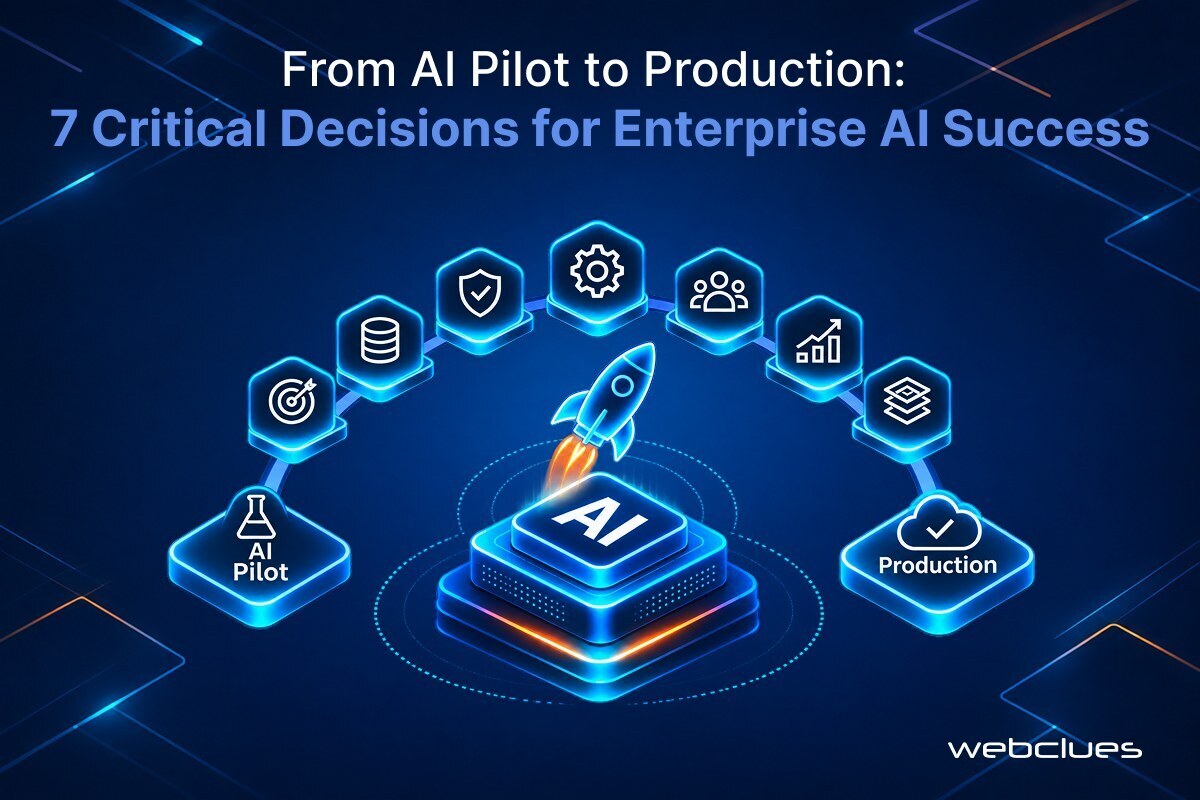
An AI proof of concept can demonstrate what a model is capable of. However, demonstrating a capability and delivering a dependable business system are two different engineering challenges.
An AI assistant might retrieve relevant information during a controlled demonstration but struggle when employees access different data sources. A predictive model might perform well on historical datasets but produce inconsistent results when business conditions change. An AI agent might complete a workflow successfully in testing but require additional controls before it can interact with production systems.
These challenges explain why enterprise AI development services involve more than selecting a capable model or building an impressive prototype.
Moving an AI initiative into production involves architectural planning, data engineering, system integration, security, evaluation, cost management, and continuous monitoring. Each decision influences whether the resulting application can support actual business operations.
For CTOs, CIOs, and technology leaders, the objective should be to build AI systems that solve measurable business problems while meeting operational and technical requirements.
Here are seven engineering decisions that determine whether an enterprise AI initiative is ready for production.
1. Start With a Business Problem, Not an AI Model
The first decision in enterprise AI implementation is identifying where AI can deliver measurable operational value.
Organizations sometimes begin with a technology preference. They select a large language model, experiment with an AI agent, or explore computer vision without defining the business problem the technology needs to solve.
This creates a risk of building technically interesting applications that have limited operational relevance.
Instead, begin with a specific workflow, business bottleneck, or decision-making challenge.
For example:
| Business challenge | Potential AI application | Success metric |
| High customer support volume | AI-powered support assistant | Resolution time and escalation rate |
| Manual document processing | Intelligent document extraction | Processing time and extraction accuracy |
| Inconsistent inventory planning | Predictive demand forecasting | Forecast error and stockout frequency |
| Slow quality inspections | Computer vision-based defect detection | Defect detection performance |
| Fragmented enterprise knowledge | RAG-powered knowledge assistant | Retrieval relevance and task completion |
The success metric should reflect the actual business objective rather than the number of AI interactions or model responses.
For instance, an AI-powered support assistant should not be evaluated only by how many questions it answers. Its performance should also be measured through resolution quality, escalation frequency, customer satisfaction, and the time required to resolve a request.
Define measurable success criteria
Before development begins, establish:
- The existing workflow and its limitations.
- The expected operational improvement.
- The data required to support the application.
- The users and systems that will interact with it.
- The acceptable error rate and escalation conditions.
- The operational cost the business can support.
A useful approach is to establish a baseline using existing business processes and compare the AI-assisted workflow against it.
Engineering consideration: If a business problem cannot be translated into measurable acceptance criteria, the project is not ready for a meaningful proof of concept.
2. Choose the Right AI Architecture for the Use Case
Not every enterprise problem requires a large language model. Similarly, adding an AI agent to a workflow does not automatically make the application more effective.
Architecture selection should follow the requirements of the business problem, available data, expected outputs, and level of autonomy required.
Four common approaches deserve consideration.
Large Language Models (LLMs)
LLMs are useful for applications involving natural language understanding, content generation, summarisation, classification, and conversational interfaces.
Common applications include:
- Customer support assistants.
- Document summarisation.
- Internal knowledge interfaces.
- Content analysis.
- Natural language interfaces for enterprise applications.
However, a general-purpose LLM does not automatically have access to an organisation's private information or current operational data.
Retrieval-Augmented Generation (RAG)
RAG connects an LLM with relevant information retrieved from external knowledge sources before generating a response.
A typical RAG architecture includes:
- Document ingestion and processing.
- Text extraction and chunking.
- Embedding generation.
- Vector or hybrid indexing.
- Retrieval based on user queries.
- Context construction.
- LLM response generation.
- Source attribution and evaluation.
This architecture is useful for enterprise knowledge assistants, technical documentation search, internal policy retrieval, and document-based question answering.
However, retrieval quality depends on data preparation, indexing, metadata, access permissions, and retrieval configuration. RAG does not eliminate hallucinations or guarantee that retrieved information is correct.
Traditional Machine Learning
Traditional ML is often more suitable for structured prediction and classification tasks.
Examples include:
- Demand forecasting.
- Fraud detection.
- Customer churn prediction.
- Risk scoring.
- Predictive maintenance.
These applications typically rely on structured datasets, feature engineering, model training, and statistical evaluation.
AI Agents
AI agents can use models, tools, APIs, and business rules to execute multi-step workflows.
For example, an enterprise operations agent might:
- Receive a request.
- Retrieve relevant business information.
- Check information against predefined rules.
- Interact with an authorised enterprise API.
- Request human approval where necessary.
- Record the outcome.
Agents are useful when a task requires multiple coordinated actions rather than a single generated response.
However, their autonomy introduces additional security, testing, and operational requirements.
Enterprise AI Architecture Decision Matrix
| Requirement | Suitable approach |
| Natural language generation | LLM |
| Answers based on internal documents | RAG + LLM |
| Structured predictions | Traditional ML |
| Multi-step workflow execution | AI agent |
| Visual defect identification | Computer vision |
| Combined text and image understanding | Multimodal AI |
Some applications require multiple approaches. For example, an enterprise application could combine RAG for information retrieval, an LLM for response generation, and an AI agent for controlled workflow execution.
Engineering consideration: Choose the simplest architecture that satisfies the functional and operational requirements. Additional model layers and agents introduce dependencies, costs, and failure points that must be justified.
3. Prepare Enterprise Data and System Integrations
An AI application is only as useful as the information and systems it can access reliably.
Enterprise environments frequently contain data distributed across ERP platforms, CRM systems, databases, cloud storage, internal applications, and third-party services.
Connecting these systems requires more than establishing API access.
The development team must understand how information is structured, how frequently it changes, who can access it, and how it should be processed.
Address data quality before model development
Common enterprise data problems include:
- Duplicate or inconsistent records.
- Missing fields and incomplete documents.
- Outdated information.
- Different naming conventions across systems.
- Unstructured documents with inconsistent formatting.
- Conflicting information across data sources.
These problems can affect retrieval relevance, prediction accuracy, and generated responses.
For RAG applications, document ingestion and indexing need particular attention. Documents should be extracted, cleaned, segmented, and enriched with metadata that supports accurate retrieval.
For predictive applications, teams should examine dataset quality, feature consistency, missing values, data leakage, and potential distribution changes.
Design integrations around existing business systems
Production AI applications often need to interact with:
- CRM and ERP platforms.
- Internal databases.
- Document management systems.
- Authentication providers.
- Payment and transaction platforms.
- Business intelligence tools.
- Third-party APIs.
Integration architecture should account for API authentication, rate limits, retries, timeouts, error handling, and data synchronisation.
It should also define how the application behaves when an external service becomes unavailable.
Implement permission-aware data access
An AI assistant should not expose information simply because it can retrieve it.
For example, an employee asking about a financial report should only receive information their role permits them to access.
Access controls should be enforced at the application and data-retrieval layers. Filtering documents only after retrieval may expose sensitive information to components that should never have received it.
Engineering consideration: Design data access, permissions, and integration contracts before finalising the AI application architecture. Retrofitting these controls can require substantial changes.
4. Build Security and Governance Into the Architecture
Enterprise AI applications process business information, interact with users, and sometimes execute actions through connected systems.
This introduces security requirements beyond those associated with a conventional application.
The OWASP GenAI Security Project identifies risks such as prompt injection, sensitive information disclosure, improper output handling, and excessive agency in LLM applications.
For enterprise systems, these risks need to be addressed through architecture and implementation controls.
Essential security controls
- Data protection: Apply encryption in transit and at rest, data minimisation, retention policies, and appropriate handling of sensitive information.
- Identity and access management: Use authentication, role-based access controls, and least-privilege permissions for users, services, and AI agents.
- Prompt injection protection: Treat user prompts, retrieved documents, and external content as potentially untrusted inputs. Use layered controls and test whether malicious instructions can influence model behaviour.
- Output validation: Validate AI-generated outputs before passing them to databases, APIs, browsers, or other downstream systems.
- Agent permissions: Restrict agents to the specific tools and operations required for their tasks.
- Human approval: Require human confirmation before high-impact actions such as financial transactions, sensitive record changes, or irreversible business operations.
- Audit logging: Record relevant user actions, model versions, application events, tool calls, and system decisions.
Establish governance and accountability
Technical controls should be supported by clear operational responsibilities.
Organisations should define:
- Who owns the AI application.
- Which business processes it can influence.
- What information it can access.
- Which actions require approval.
- How incidents are investigated.
- How model and application changes are reviewed.
The NIST AI Risk Management Framework and its Generative AI Profile provide useful guidance for identifying, assessing, and managing AI-related risks throughout the system lifecycle.
Engineering consideration: Security and governance should influence architecture decisions from the beginning. They should not become a final checklist immediately before deployment.
5. Establish AI Evaluation Before Deployment
Traditional software testing focuses on whether an application behaves according to defined requirements.
AI applications introduce an additional challenge: outputs can vary even when users submit similar inputs.
A successful test with a few examples does not establish production reliability.
Enterprise AI evaluation should examine both the model and the complete application workflow.
Evaluate more than model accuracy
Different AI applications require different evaluation methods.
| Evaluation area | What to measure |
| Response quality | Relevance, completeness, and factual correctness |
| RAG performance | Retrieval relevance, context precision, and context recall |
| Classification | Precision, recall, F1 score, and confusion matrix |
| Prediction | MAE, RMSE, or other task-appropriate metrics |
| AI agent performance | Task completion, tool selection, and action correctness |
| System performance | Latency, throughput, and error rates |
| Security | Prompt injection resistance, data exposure, and permission enforcement |
For RAG applications, evaluate retrieval and generation separately.
A system may generate fluent responses while retrieving irrelevant documents. It may also retrieve correct information but produce an inaccurate summary.
Testing both stages helps identify where failures originate.
Build a representative evaluation dataset
The evaluation dataset should reflect actual operating conditions.
Include:
- Common user requests.
- Complex or ambiguous questions.
- Incorrect or incomplete inputs.
- Outdated and conflicting information.
- Unusual workflow conditions.
- Permission-restricted information.
- Adversarial prompts.
- Cases requiring human escalation.
The dataset should include expected outcomes and measurable acceptance criteria.
Test under production-like conditions
Evaluation should also cover:
Concurrent user requests.
- API failures.
- Model timeouts.
- High-volume workloads.
- Context-window limitations.
- Unexpected input formats.
- Dependency failures.
For AI agents, test complete execution paths, including incorrect tool selection, repeated actions, failed integrations, and situations where the agent should stop and request human intervention.
Engineering consideration: AI evaluation should become part of the development and release process, not an isolated activity completed once before launch.
6. Plan for Model Changes and Operating Costs
Enterprise AI systems often depend on external model providers, inference infrastructure, embedding services, vector databases, and other third-party components.
These dependencies can change over time.
A model may be updated, deprecated, repriced, or replaced by a more suitable alternative. An application designed around a single provider without clear abstraction boundaries may require significant rework when these changes occur.
Design for model flexibility
A model-independent architecture can separate business logic from provider-specific implementation.
For example, a model integration layer can manage:
- Provider authentication.
- Model selection.
- Request and response formats.
- Retry and timeout handling.
- Usage tracking.
- Fallback behaviour.
- Version management.
This makes it easier to evaluate alternative models without rewriting the entire application.
However, model portability should not be treated as automatic. Different models can produce different outputs, tool-call behaviour, latency, and cost profiles.
Every model change should pass through regression testing and task-specific evaluation.
Understand the complete cost structure
LLM usage is only one part of enterprise AI operating costs.
A production cost model should consider:
| Cost component | What influences it |
| Model inference | Input/output tokens, request volume, model selection |
| Embeddings | Document volume, indexing frequency, query volume |
| Data storage | Document size, database capacity, retention |
| Infrastructure | Compute, memory, networking, and availability |
| Integrations | API usage, third-party services, and data transfer |
| Monitoring | Logging, tracing, evaluation, and observability |
| Maintenance | Model updates, security reviews, and engineering support |
For example, an enterprise knowledge assistant with frequent document updates may incur substantial costs through repeated ingestion and embedding generation.
An AI agent executing multiple model calls and API operations per request may also have a different cost profile from a basic conversational assistant.
Optimise without sacrificing quality
Potential optimisation strategies include:
- Using smaller models for simpler tasks.
- Routing complex requests to more capable models.
- Caching suitable repeated queries.
- Optimising prompts and context size.
- Reducing unnecessary model calls.
- Batching suitable workloads.
- Monitoring token consumption and infrastructure utilisation.
AWS guidance on production generative AI architecture also highlights the importance of model selection, inference performance, capacity planning, and cost optimisation.
Engineering consideration: Estimate operating costs using realistic request volumes and workload patterns. A system that performs well during a small demonstration may have very different economics at enterprise scale.
7. Monitor, Maintain, and Scale the AI System
Deployment is the beginning of production operations, not the end of AI development.
Once an application starts interacting with real users and business systems, new conditions emerge.
Users may ask unexpected questions. Business data may change. External APIs may become unavailable. Model updates may affect response quality. Usage patterns may increase infrastructure costs.
Without continuous monitoring, these issues can remain undetected until they affect business operations.
Establish production monitoring
A production AI monitoring framework should cover four areas.
1. Application health
Monitor availability, API errors, response times, throughput, timeouts, and infrastructure performance.
2. AI quality
Track response relevance, hallucination indicators, retrieval quality, task completion, and user feedback.
3. Security and governance
Monitor access violations, suspicious prompts, unusual tool usage, sensitive data exposure, and policy violations.
4. Business outcomes
Measure workflow completion, processing time, escalation rates, operational savings, and other metrics defined during project planning.
Implement feedback and improvement cycles
Production monitoring should connect directly to engineering improvements.
A practical improvement cycle looks like this:
- Collect application and model performance data.
- Identify recurring failure patterns.
- Categorise issues by model, data, integration, or workflow.
- Determine whether the problem requires prompt changes, data corrections, model updates, or architecture changes.
- Test the proposed improvement against the evaluation dataset.
- Deploy through a controlled release process.
- Monitor the updated application.
For high-impact applications, teams should also define rollback procedures and incident response processes.
Scale based on validated performance
Avoid expanding an AI application to every department immediately after a successful pilot.
Start with a clearly defined workflow and user group. Validate its performance under realistic operating conditions before expanding integrations, user access, and workload volume.
Scaling should depend on evidence that the system meets its quality, security, reliability, and cost requirements.
Engineering consideration: An AI application is production-ready only when the organisation can operate, monitor, troubleshoot, and improve it consistently.
Enterprise AI Production-Readiness Checklist
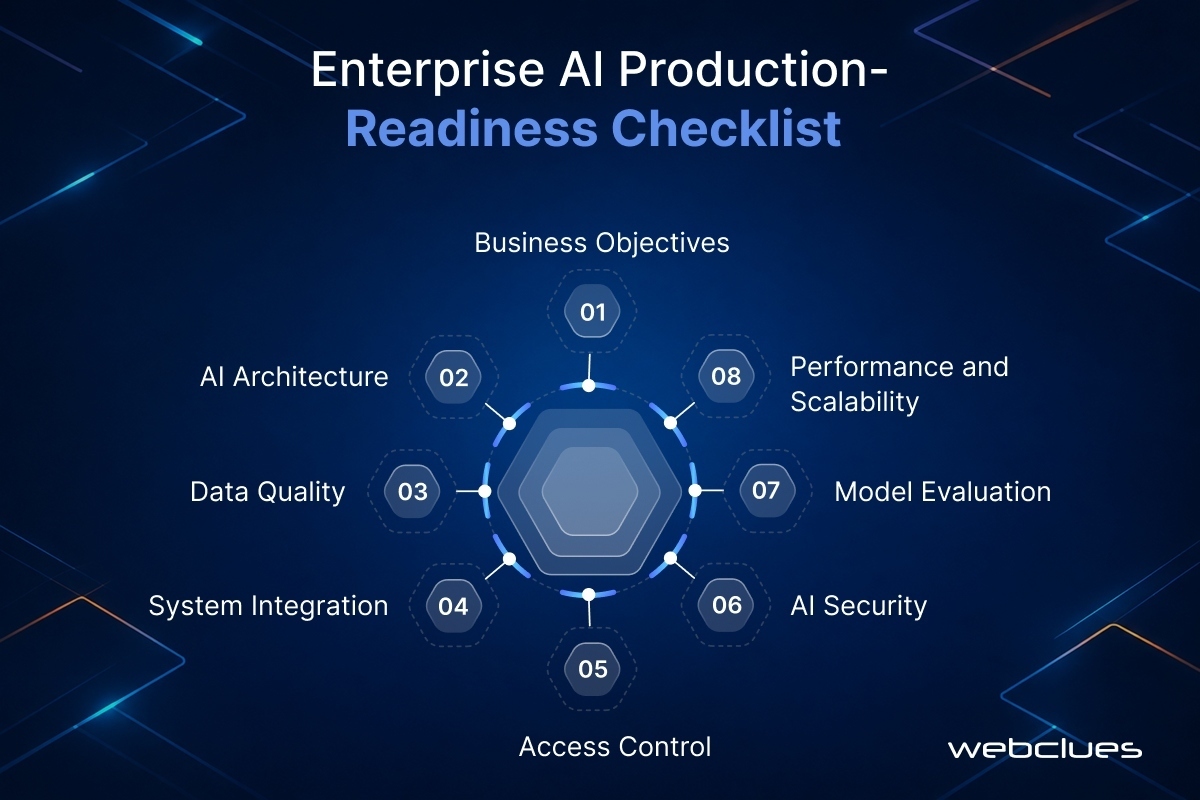
Before approving an AI application for production, technology leaders can use the following checklist.
| Area | Readiness question |
| Business objectives | Are success metrics linked to measurable business outcomes? |
| Architecture | Does the selected AI architecture match the use case? |
| Data quality | Are data sources accurate, relevant, and maintained? |
| Integration | Have critical enterprise systems been tested? |
| Access control | Are user and agent permissions enforced? |
| Security | Have AI-specific security risks been assessed? |
| Evaluation | Has the application passed representative test scenarios? |
| Performance | Does it meet latency and throughput requirements? |
| Cost | Are inference and infrastructure costs understood? |
| Monitoring | Are quality, security, and application metrics tracked? |
| Ownership | Are operational responsibilities clearly assigned? |
| Recovery | Are incident response and rollback procedures defined? |
A project does not need to meet identical requirements across every industry. A low-risk internal knowledge assistant and an AI application supporting financial decisions have different levels of operational and governance complexity.
The acceptance criteria should reflect the sensitivity of the data, business impact, user access, and autonomy granted to the system.
Moving From AI Experimentation to Enterprise Implementation
Moving an AI project into production requires more than a capable model. It demands the right architecture, reliable data, secure integrations, measurable evaluation, and continuous monitoring.
Organisations that address these engineering requirements early can reduce implementation risks, control operational costs, and build AI systems that deliver lasting business value.
At WebClues Infotech, we help businesses turn AI opportunities into production-ready applications through custom AI development services, Generative AI, RAG, AI agents, machine learning, computer vision, and enterprise AI integration.
Have an AI idea worth implementing? Get 80-hour AI PoC with WebClues Infotech to validate technical feasibility and define your path to production.
Post Author

Ayush Kanodia
As one of the esteemed Directors of WebClues Infotech. Ayush Kanodia is passionate about delivering innovative IT services & solutions and has spearheaded numerous successful projects, cementing the company's position as a leader in the field.


Build Your Agile Team
Hire Skilled Developer From Us
Validate Your Enterprise AI Idea Before Scaling
WebClues offer an 80-hour AI Proof of Concept to help businesses validate a defined AI use case, explore technical feasibility, and assess the next steps toward implementation. Whether you are evaluating an enterprise knowledge assistant, an AI-powered workflow, or a custom machine learning application, start with a focused technical assessment.
Connect with usFrequently Asked Questions
Our Recent Blogs
Sharing knowledge helps us grow, stay motivated and stay on-track with frontier technological and design concepts. Developers and business innovators, customers and employees - our events are all about you.