Key Industries

  • Travel & Tourism
  • Hospitality
  • Online Travel Platforms (OTAs)
  • Airlines & Mobility Services

Build Your Agile Team

Hire Skilled Developer From Us

Case Study

Enterprise RAG Assistant For Faster And More Accurate Knowledge Discovery

WebClues Infotech's Enterprise RAG Assistant showcases an AI-powered approach to making organizational knowledge easier to access, search and verify. The solution combines hybrid search, large language models, source citations and permission-aware retrieval to retrieve relevant information across distributed documents, knowledge bases and business systems.
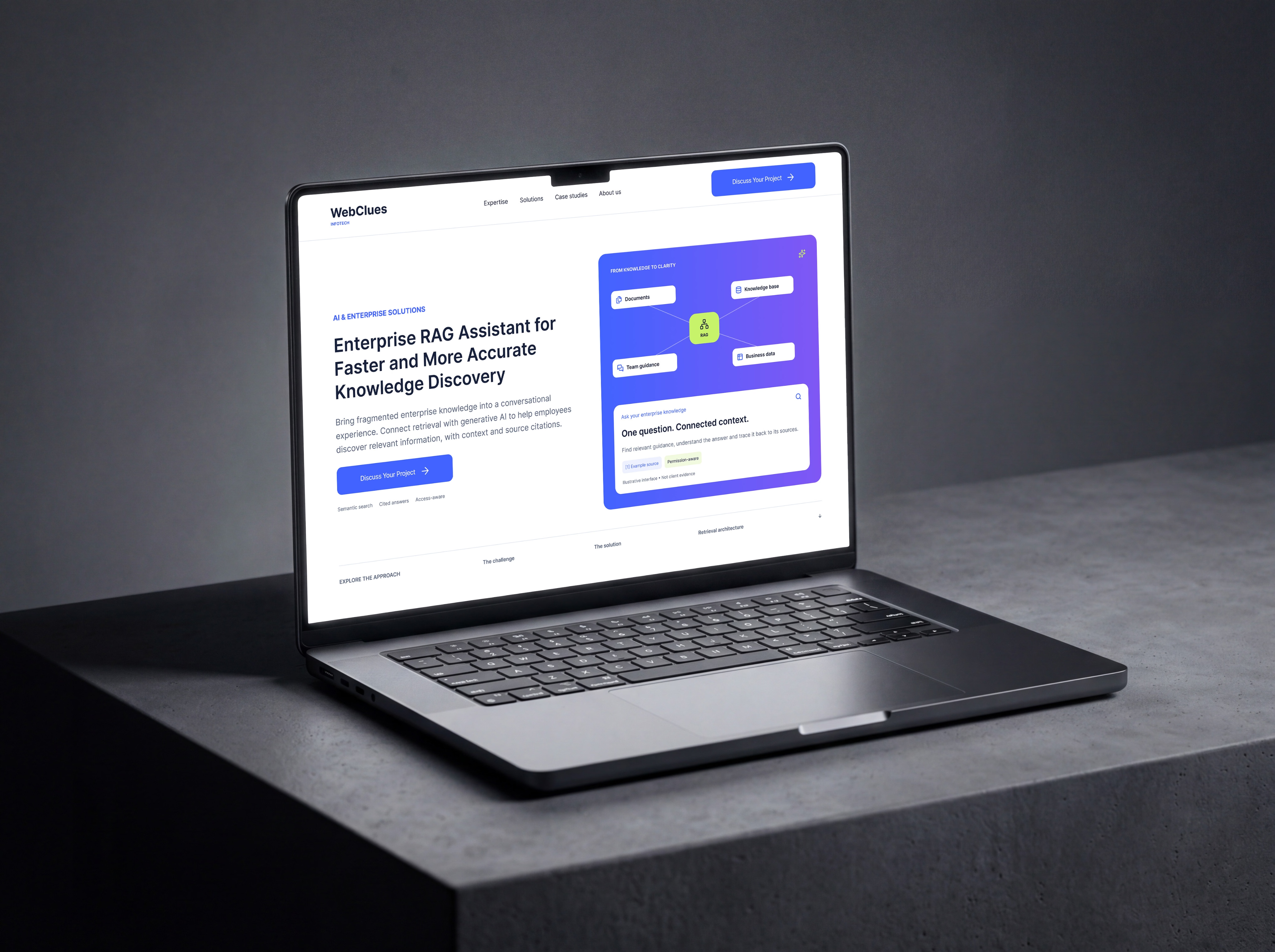
Enterprise RAG Assistant shown on a laptop screen

The Goals Behind the Enterprise RAG Assistant

The solution was designed to help enterprises turn scattered organizational information into accessible, searchable knowledge by:

Simplifying knowledge discovery across disconnected systems.

Reducing time spent searching for documents and internal answers.

Generating evidence-based responses with source citations.

Preserving existing document access permissions.

Improving knowledge sharing across teams and departments.

The Challenges
Enterprises Face

Employees often spend hours searching for information that already exists somewhere in the organization. Policies sit in shared drives, technical guidance lives in internal wikis and important decisions remain buried in ticket histories and email threads.

01

Fragmented Knowledge

Employees search across multiple repositories to find relevant information.

02

Outdated Documentation

Conflicting versions of policies and procedures lead to inconsistent answers.

03

Knowledge Bottlenecks

Subject matter experts repeatedly answer questions that employees could resolve independently.

04

Limited Search Context

Keyword-based search can miss relevant passages when questions use different terminology.

05

Information Security Risks

A centralized AI assistant must not expose documents beyond a user's existing access permissions.

The Solution: Make Enterprise Knowledge Accessible Through RAG

The Enterprise RAG Assistant combines retrieval-augmented generation (RAG), semantic search and large language models to answer questions using an organization's own information.

When an employee submits a query, the system searches approved knowledge sources, retrieves relevant passages and provides them to the language model as context. The assistant generates an answer with source citations, allowing users to verify the information against the original documents.

Hybrid retrieval, relevance ranking and permission-aware filtering help improve answer relevance while keeping information access aligned with organizational rules. When the available evidence is insufficient, the assistant can be configured to acknowledge the limitation instead of generating an unsupported answer.

The result is a knowledge discovery solution designed to reduce manual searching, improve traceability and make enterprise information easier to use.

How the Enterprise RAG Assistant Works

The solution follows a structured retrieval and generation pipeline, with each stage contributing to answer quality, security and reliability.

01Connect Enterprise Knowledge Sources

Integrate approved document repositories, internal wikis, file shares, support records and compatible business systems through available connectors and APIs.

02Process and Index Documents

Extract document content, remove unnecessary formatting, divide information into meaningful chunks & attach metadata such as document source, department and modification date. Generate embeddings to support semantic retrieval.

03Retrieve and Rank Relevant Information

Combine keyword search with vector-based semantic retrieval to identify relevant passages. Apply metadata filters and optional semantic reranking to prioritize the evidence most relevant to the user's question.

04Generate Grounded Responses

Provide the retrieved passages to the LLM with instructions to answer using the available evidence, include source references and acknowledge when sufficient information cannot be found.

05Enforce Permissions and Evaluate Quality

Filter retrieval results according to the user's authorized access. Evaluate retrieval relevance, citation accuracy, answer groundedness, response latency and user feedback to identify areas for improvement.

Core Features of the Enterprise RAG Assistant

The Enterprise RAG Assistant combines intelligent search, context-grounded generation and access controls to make organizational knowledge easier to find, verify and maintain. Its core features include

Natural-Language Knowledge Search

Allows employees to ask questions conversationally rather than relying on exact keywords or document titles.

Hybrid Semantic Retrieval

Combines keyword matching and semantic search to handle exact terms, technical identifiers and questions expressed in different languages.

Context-Grounded Answers

Uses retrieved passages as context so responses are based on relevant organizational content rather than the model's general knowledge.

Knowledge Sources and
Enterprise Integrations

The assistant can be configured to retrieve information from an organization's existing knowledge ecosystem, subject to connector availability, access permissions and integration requirements.

01

Document Repositories

PDFs, Word documents, policies, manuals and approved file shares.

02

Collaboration Platforms

SharePoint, Teams content and other supported internal knowledge sources.

03

Internal Knowledge Bases

Wikis, standard operating procedures, technical documentation and employee resources.

04

Business Applications

Selected CRM, ERP, HR and IT service management systems through supported connectors or APIs.

05

Support and Ticketing Systems

Approved historical tickets, troubleshooting records and internal resolution documentation.

06

Structured Data Sources

Authorized database records and other structured information where appropriate query controls are available.

Retrieval Architecture:
What Makes Answers More Reliable?

The quality of an enterprise RAG assistant depends on more than the language model. Its retrieval pipeline determines whether the model receives the right evidence in the first place.

  1. 1

    Hybrid Search

    Combines keyword & semantic retrieval to handle exact terms, technical identifiers & natural-language queries.

  2. 2

    Context-Aware Chunking

    Preserves document structure, metadata and source references to maintain context during retrieval.

  3. 3

    Semantic Reranking

    Prioritizes the most relevant passages before passing evidence to the language model.

  4. 4

    Permission-Aware Retrieval

    Enforces user permissions and synchronizes changes to prevent unauthorized exposure.

  5. 5

    Grounded Generation

    Uses retrieved evidence, source citations and fallback responses when information is insufficient.

  6. 6

    Retrieval Evaluation

    Measures retrieval relevance, citation accuracy, answer groundedness & response latency to identify quality gaps.

  7. 7

    Content Freshness

    Tracks document updates, duplicates and outdated versions to keep retrieved information relevant.

Industries Where Enterprise RAG Assistants Deliver Value

Enterprise knowledge assistants can support teams that rely on large volumes of internal documentation and repeatable information workflows.


IT and Technology

IT and Technology

Retrieve engineering documentation, troubleshooting procedures, configuration guides and internal technical knowledge.

Manufacturing

Manufacturing

Find equipment manuals, maintenance procedures, safety policies and operational instructions.

Financial Services

Financial Services

Search approved policies, product documentation, internal procedures and compliance resources.

The Tech Stack Behind the
Enterprise RAG Assistant

The architecture can be tailored to the organization's data environment, security requirements, preferred cloud infrastructure and operating costs. The following technologies represent illustrative implementation options rather than a verified production deployment.

LLM Layer

Azure OpenAI or other compatible large language model services.

Search and Retrieval

Azure AI Search or another suitable hybrid search solution.

Embedding Models

Compatible embedding models for semantic indexing and retrieval.

Data Processing

Python document ingestion, text extraction, chunking, and metadata.

Backend

Python and FastAPI for application APIs and retrieval orchestration.

Data Sources

SharePoint, document repositories, APIs, and databases.

Security and Monitoring

Identity integration, permission filtering, audit logging, and monitoring.

Expertise That Makes Enterprise RAG Solutions Possible

WebClues Infotech offers AI engineering capabilities relevant to designing enterprise knowledge assistants and integrating them with existing business systems.

Generative AI

Build AI applications that use large language models and contextual information to support enterprise knowledge discovery and information-intensive workflows.

Generative AI DevelopersAI Engineers

LLM Development

Integrate language models with prompt engineering, model orchestration, context management, output validation and response evaluation.

LLM EngineersMachine Learning Engineers

Natural Language Processing

Develop text-processing and semantic retrieval capabilities that help systems interpret queries, process enterprise documents and identify relevant information.

NLP EngineersData Scientists

AI Integration

Connect AI applications with enterprise repositories, databases, APIs and business systems while accounting for data synchronization and access requirements.

AI Integration EngineersBackend Developers

Potential Business Impact

A well-designed enterprise RAG assistant can reduce information retrieval friction and improve access to organizational knowledge. The actual impact depends on the starting workflow, source quality, query volume, retrieval performance and employee adoption.

Less Time Spent Searching

Makes relevant documents and internal answers easier to discover across connected knowledge sources.

More Verifiable Responses

Provides source references so employees can check generated answers against original documentation.

Reduced Expert Dependency

Helps employees resolve recurring information requests without repeatedly relying on subject matter experts.

More Consistent Knowledge Access

Makes approved policies, procedures and technical guidance accessible through a common interface.

Improved Information Governance

Supports permission-aware retrieval, source tracking and content lifecycle management.

Better Visibility Into Knowledge Gaps

Helps teams identify unanswered questions, missing documentation and content that needs updating.
Why Choose
WebClues Infotech

WebClues Infotech combines enterprise AI engineering expertise with tailored RAG architectures to deliver secure, scalable knowledge assistants aligned with your business needs.

01Business-Focused AI Engineering

Aligns knowledge assistant design with specific business workflows and operational requirements.

02Custom RAG Architecture

Adapts retrieval strategies, chunking, ranking and model orchestration to the organization's knowledge sources.

03Enterprise System Integration

Connects AI applications with existing data repositories and business systems where supported.

04Security-Conscious Design

Incorporates access controls, information handling and governance requirements into the architecture.

05Evaluation-Driven Development

Separately evaluates retrieval quality, answer groundedness, citation accuracy and system performance.

06Flexible Technology Selection

Chooses models, search infrastructure and deployment options based on business requirements and technical constraints.

07Scalable Implementation Planning

Accounts for content volume, query traffic, indexing workloads, latency and operating costs.

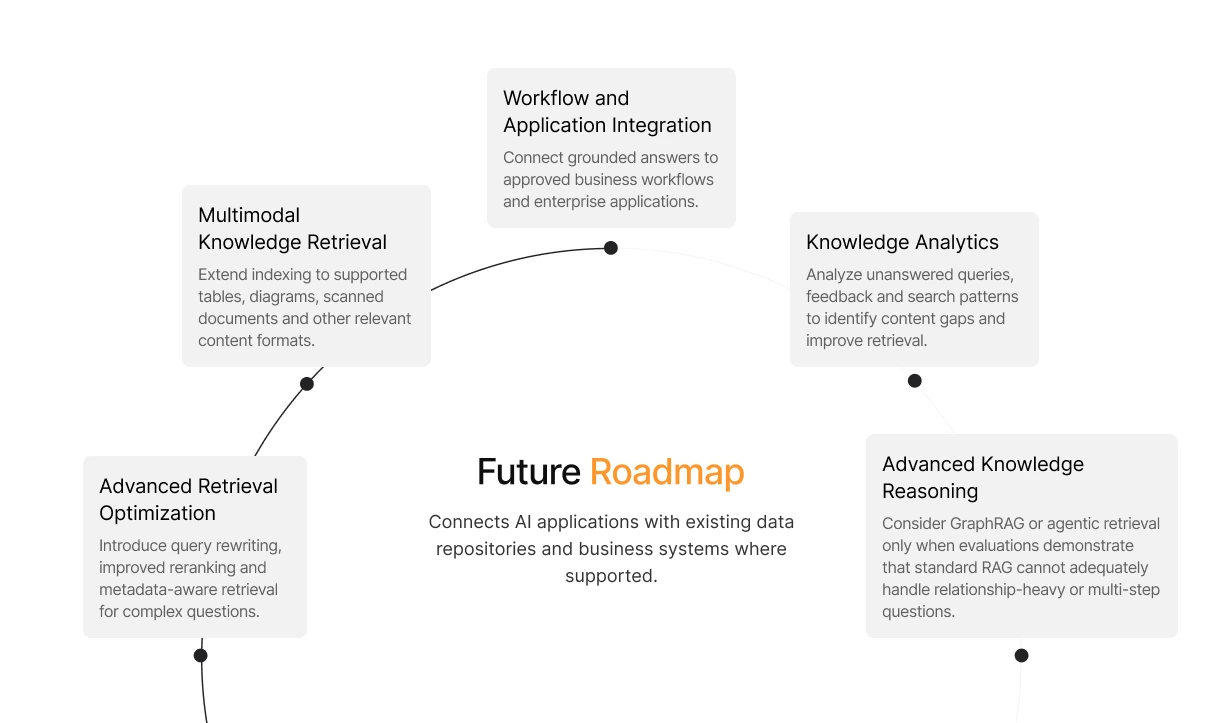
Future roadmap: advanced retrieval optimization, multimodal knowledge retrieval, workflow and application integration, knowledge analytics and advanced knowledge reasoning

Frequently Asked Questions

An Enterprise RAG Assistant uses retrieval-augmented generation to answer questions using information retrieved from approved organizational sources. It combines search with a large language model to generate context-grounded responses and provide source references that help employees verify information.

A conventional chatbot may rely on predefined responses or a language model's general knowledge. A RAG assistant retrieves relevant information from connected enterprise sources at query time and uses that information to generate an answer. This makes it better suited to questions about internal policies, technical documentation and company-specific knowledge.

RAG supplies relevant source material to ground generated answers. Instructions to answer from retrieved context, source citations, relevance thresholds and fallback responses can reduce unsupported claims. However, RAG does not eliminate hallucinations and retrieval and answer quality must be evaluated continuously.

Yes, when permission-aware retrieval is explicitly implemented. The system must authenticate users, apply appropriate document-level or role-based authorization and filter retrieved content accordingly. Permission synchronization, source updates and citation access should also be tested to prevent unauthorized disclosure.

Vector search identifies content based on semantic similarity, while keyword search can be better for exact phrases, product identifiers, policy numbers and technical terms. Hybrid retrieval combines these approaches and can improve results across different query types. Semantic reranking can further prioritize the most relevant passages.

Not always. A vector database or vector index is useful when semantic retrieval is required across a substantial document collection. Some search platforms combine vector and keyword retrieval, while smaller implementations may use other indexing approaches. The choice depends on data volume, query patterns, filtering requirements and infrastructure.

RAG retrieves current external information at query time and supplies it to the language model as context. Fine-tuning modifies model behavior through additional training and is generally more suitable for specialized tasks, output formats, or response styles. RAG is typically the more direct approach when answers must reflect changing enterprise documents.

The timeline depends on the number of knowledge sources, document quality, integration complexity, security requirements and evaluation scope. A focused proof of concept can validate retrieval feasibility before broader implementation. Production deployment generally requires additional engineering for permissions, monitoring, content refresh, performance and operational readiness.

Build an Enterprise RAG Assistant
with WebClues Infotech

Make enterprise knowledge easier to find, verify and use. WebClues Infotech can help you plan a RAG-based knowledge assistant around your data sources, retrieval requirements, security controls and business workflows.

Discuss Your Enterprise AI Project

Contact Information

India

Ahmedabad

1007-1010, Signature-1,
S.G.Highway, Makarba,
Ahmedabad, Gujarat - 380051

Rajkot

1308 - The Spire, 150 Feet Ring Rd,
Manharpura 1, Madhapar,
Rajkot, Gujarat - 360007

UAE

Dubai

Dubai Silicon Oasis, DDP,
Building A1, Dubai, UAE

USA

Atlanta

6851 Roswell Rd 2nd Floor,
Atlanta, GA, USA 30328

New Jersey

513 Baldwin Ave, Jersey City,
NJ 07306, USA

California

4701 Patrick Henry Dr. Building
26 Santa Clara, California 95054

Australia

Queensland

120 Highgate Street,
Coopers Plains,
Brisbane, Queensland 4108

UK

London

85 Great Portland Street, First
Floor, London, W1W 7LT

Canada

Burlington

5096 South Service Rd,
ON Burlington, L7l 4X4

Let’s Transform Your Idea into
Reality. Get in Touch

Contact Us