

Connect with us


Corporate Video


Explainable AI in Credit Scoring: Balancing Predictive Accuracy, Fairness and Compliance
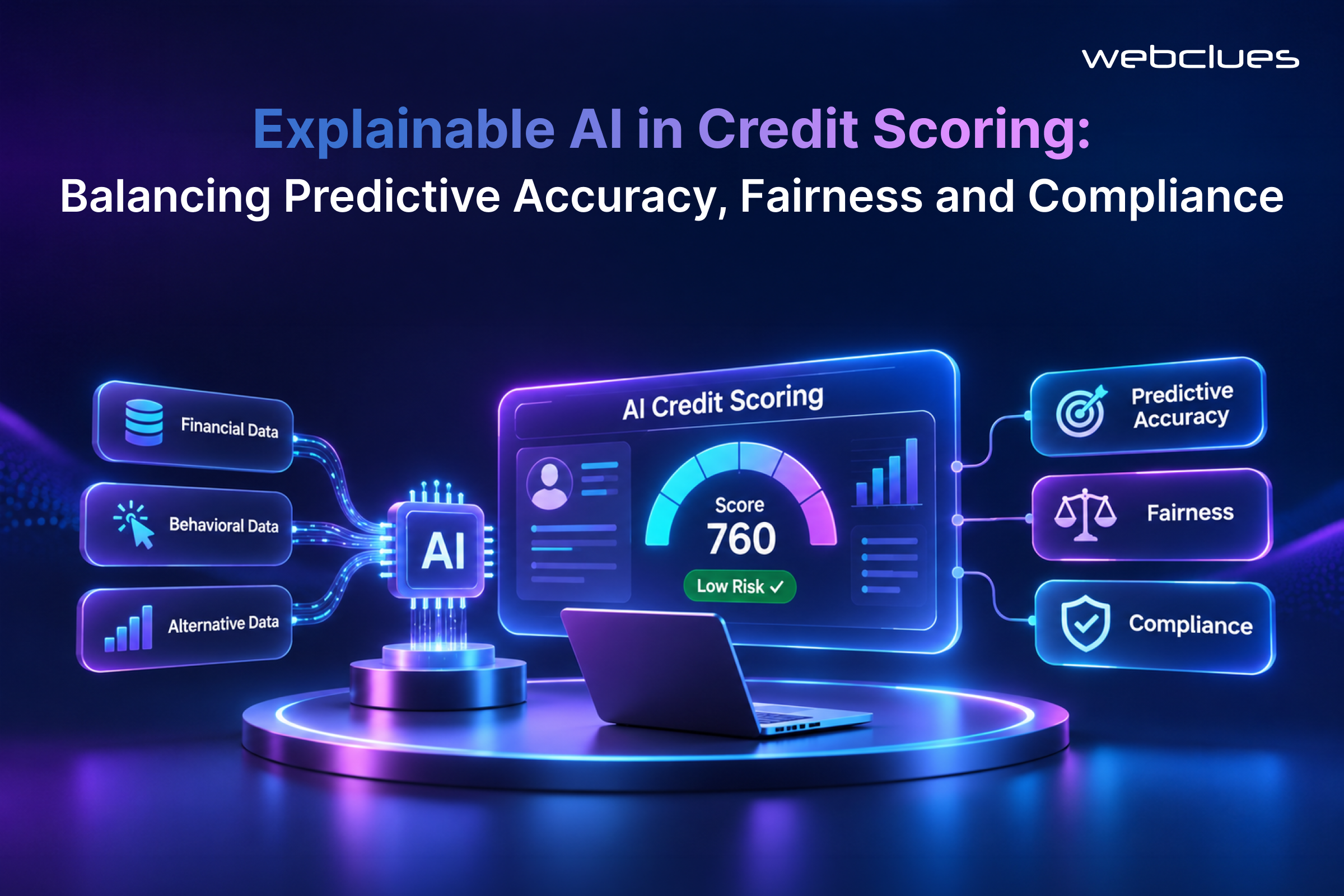
Credit scoring is becoming increasingly dependent on machine learning models that can analyze large volumes of financial and behavioral data. AI in credit scoring helps lenders assess creditworthiness, identify risk patterns, predict potential defaults and make faster lending decisions.
However, as predictive models become more complex, understanding why they approve or reject an application becomes increasingly difficult.
For financial institutions, predictive accuracy alone is insufficient. Credit decisions must also be explainable, fair and aligned with regulatory requirements. A model that produces accurate predictions but cannot provide meaningful reasons for its decisions can create challenges for compliance teams, risk managers and customers.
Explainable AI (XAI) helps address this challenge by making model predictions easier to interpret. It allows lenders to examine the factors influencing individual credit decisions while maintaining the predictive capabilities of advanced machine learning systems.
Businesses exploring AI-powered lending solutions can also consider AI solutions for credit scoring to support more transparent and data-driven credit risk assessment.
Why Explainable AI Matters in Credit Scoring
Traditional credit scoring models often use predefined variables and relatively simple statistical techniques. Their decision logic is generally easier to inspect. However, they may struggle to capture complex relationships across large and diverse datasets.
Machine learning models can identify nonlinear patterns and interactions that conventional approaches may overlook. They can analyze information such as repayment history, credit utilization, income patterns, outstanding debt and other permitted variables to estimate default risk.
The challenge arises when a model produces a prediction without making its reasoning clear.
For example, a lender may reject an applicant because the model identifies a high probability of default. However, the applicant, compliance team, or lending officer may need to understand which factors contributed to that decision.
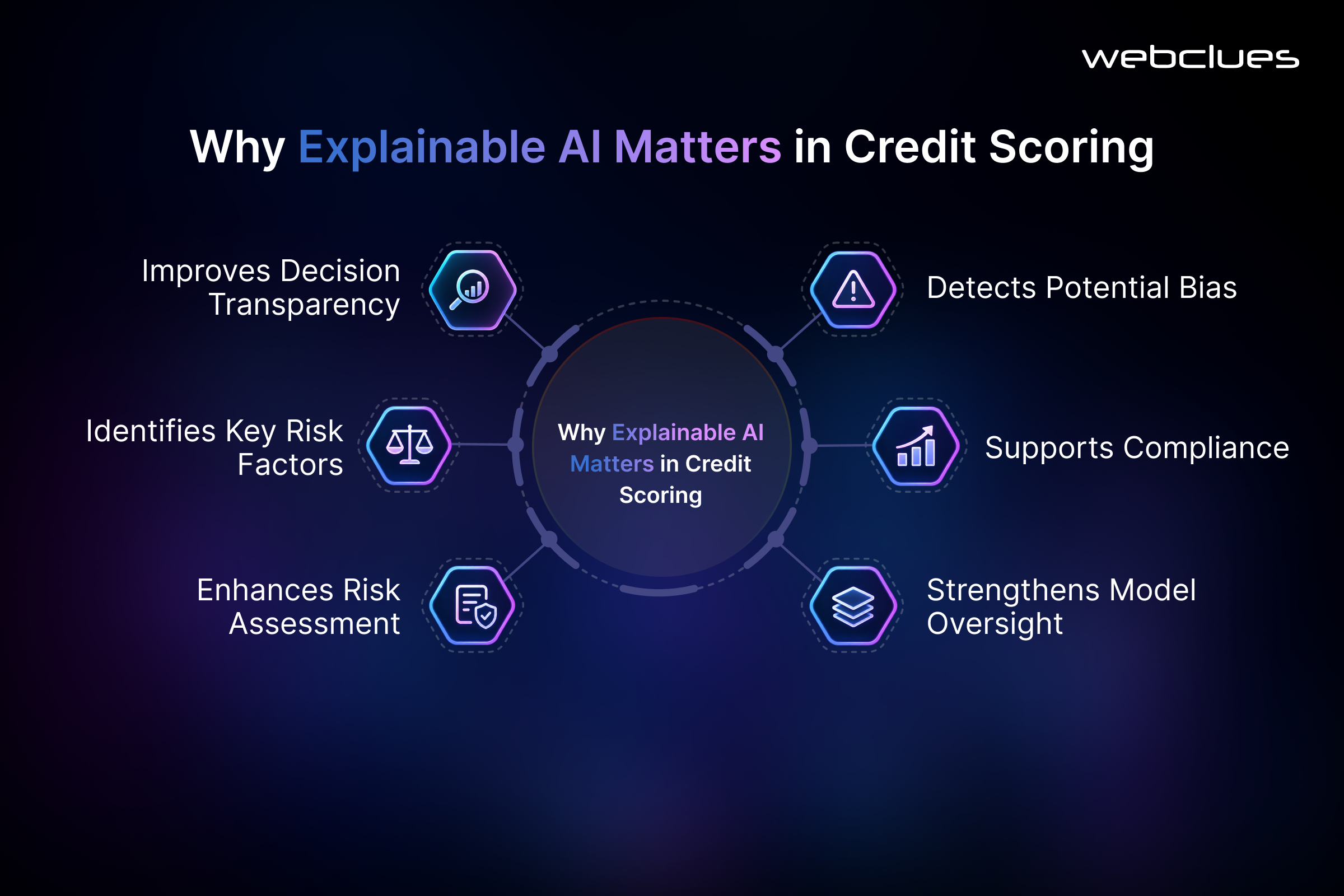
Explainable AI helps answer questions such as:
- Which financial variables influenced the credit score?
- How much did individual factors contribute to the prediction?
- Are certain applicant groups receiving systematically different outcomes?
- Can the lender provide accurate reasons for an adverse credit decision?
- Has the model's decision-making behavior changed over time?
These insights support model oversight, customer communication and risk management. However, explainability alone does not establish that a model is fair or legally compliant. Those outcomes require additional evaluation and controls.
Balancing Predictive Accuracy and Model Interpretability
Financial institutions must evaluate two important characteristics when selecting a credit scoring model: predictive performance and interpretability.
Predictive performance measures how effectively a model identifies credit risk. Interpretability describes how easily stakeholders can understand the model's decision-making process.
A simpler model may be easier to explain but may not capture every relationship in complex financial datasets. A more advanced model may identify sophisticated patterns while requiring additional techniques to explain individual predictions.
The appropriate choice depends on the institution's risk profile, data quality, regulatory environment and operational requirements.
Common Credit Scoring Models
Financial institutions can choose from several statistical and machine learning approaches depending on their predictive requirements, data characteristics and interpretability needs.
| Model | Predictive Flexibility | Interpretability |
| Logistic Regression | Captures specified relationships; can be extended with feature transformations | High |
| Decision Trees | Captures nonlinear patterns and decision rules | High |
| Random Forest | Captures complex relationships using multiple decision trees | Moderate to Low |
| XGBoost | Supports complex patterns and feature interactions | Lower without explanation methods |
| Neural Networks | Models highly complex relationships | Generally Low |
| Explainable Boosting Machines | Captures nonlinear relationships through interpretable components | High |
Interpretability can vary depending on model configuration, feature engineering and the explanation methods applied. For example, Random Forest and XGBoost models can be examined using SHAP, while neural networks may require additional post-hoc explanation techniques.
No single model is suitable for every lending environment. Logistic regression may be appropriate when direct interpretability is a priority, whereas gradient boosting may be considered when complex relationships are important to predictive performance.
Financial institutions should compare models using predictive performance, calibration, stability, explanation reliability and operational requirements rather than relying on accuracy scores alone.
Key Explainable AI Techniques Used in Credit Scoring
Explainable AI techniques help financial institutions understand how machine learning models generate predictions. Some methods explain individual decisions, while others provide insights into broader model behavior.
1. SHAP (Shapley Additive Explanations)
SHAP assigns contribution values to individual features to explain their influence on a model prediction. Based on Shapley values from cooperative game theory, it provides a consistent framework for interpreting feature contributions.
In credit scoring, SHAP can help identify how factors such as credit utilization, repayment history, outstanding balances and credit history influence a particular prediction.
For example, an explanation may show that high credit utilization and recent missed payments increased an applicant's predicted risk, while a longer repayment history reduced it. These are illustrative factors; their actual influence depends on the model and applicant data.
SHAP can support:
- Individual prediction explanations.
- Global feature importance analysis.
- Comparison of model behavior across applicant groups.
Identification of influential variables.
However, SHAP values explain model behavior rather than proving that a feature causes a particular credit outcome.
2. LIME (Local Interpretable Model-Agnostic Explanations)
LIME explains an individual prediction by approximating the behavior of a complex model around a specific data point using a simpler, interpretable model.
For a credit application, LIME can help identify which input variables influenced the model's decision in that particular case.
Its model-agnostic approach allows it to work with different machine learning models. However, explanations can vary depending on how the local data samples and approximations are generated.
Financial institutions should validate explanation stability before relying on LIME outputs in operational or regulatory workflows.
3. Counterfactual Explanations
Counterfactual explanations describe how a prediction might change if selected input variables were different.
For example, an explanation might indicate that a lower credit utilization ratio could have changed an applicant's predicted risk category.
These explanations can help customers understand factors associated with a decision and provide lenders with more actionable insights.
However, counterfactuals should not be presented as guaranteed approval conditions. They describe hypothetical model behavior and do not establish that changing a particular variable will cause a loan to be approved.
4. Partial Dependence and Individual Conditional Expectation
Partial Dependence Plots (PDPs) illustrate how changes in a selected feature affect average model predictions while accounting for other features through averaging.
Individual Conditional Expectation (ICE) plots show how predictions change for individual observations as a feature varies.
In credit risk assessment, these techniques can help model validation teams examine whether changes in variables such as debt-to-income ratio or credit utilization produce unexpected prediction patterns.
They are useful for understanding overall model behavior, although correlated variables can complicate interpretation.
Validating Explanation Reliability in Credit Scoring
Generating an explanation for a credit decision does not automatically make that explanation reliable. Financial institutions must evaluate whether explanation methods consistently represent the model's behavior across different applicants, datasets and operating conditions.
Several validation practices can help establish this reliability.
- Explanation Stability: Evaluate whether similar applicant profiles receive reasonably consistent explanations. Significant variations may indicate sensitivity to small changes in input data or explanation parameters.
- Feature Attribution Validation: Check whether the features identified as influential genuinely affect the model's predictions. This helps identify misleading explanations or unexpected dependencies.
- Counterfactual Feasibility: Ensure that suggested changes to applicant characteristics are realistic and actionable. Explanations should not recommend changes to protected characteristics or variables that applicants cannot reasonably control.
- Subgroup Explanation Analysis: Compare explanation patterns across relevant applicant groups to identify differences in how model features influence predictions.
- Ongoing Explanation Monitoring: Reassess explanation quality when models are retrained, data distributions change, or new variables are introduced.
These practices help financial institutions evaluate explanations as part of model validation rather than treating them as standalone outputs.
How Explainable AI Supports Fairness in Credit Scoring
Credit scoring models must be evaluated for potential bias across different applicant groups. Historical lending data may contain patterns influenced by unequal access to credit, inconsistent reporting, or past institutional practices.
A machine learning model can reproduce or amplify these patterns if its training data, feature selection, or decision thresholds are not properly evaluated.
Explainable AI helps identify which variables influence predictions and whether model behavior differs across groups. However, fairness assessment requires dedicated statistical testing and human oversight.
Important Fairness Metrics
- Demographic Parity: Examines whether different demographic groups receive positive outcomes at comparable rates. It can highlight disparities, although equal approval rates do not necessarily indicate equal treatment of applicants with similar credit risk.
- Equal Opportunity: Evaluates whether qualified applicants across groups have comparable true positive rates. In credit scoring, institutions must carefully define the positive outcome and qualification criteria.
- Equalized Odds: Examines whether true positive and false positive rates are comparable across groups. It provides a broader view of differences in model errors.
- Calibration: Assesses whether predicted risk probabilities correspond to observed outcomes across groups. A well-calibrated model should produce meaningful risk estimates for the populations being evaluated.
These metrics measure different aspects of fairness and can conflict with one another. Financial institutions should select evaluation methods based on their lending objectives, applicable laws and risk management requirements.
They should also examine intersectional groups rather than relying exclusively on broad demographic categories. This can reveal disparities that may remain hidden in aggregated results.
Explainable AI and Regulatory Compliance in Credit Scoring
Explainability is an important consideration for financial institutions operating in regulated lending environments. Lenders must be able to support credit decisions with accurate information, maintain appropriate documentation and establish controls for automated decision-making systems.
For institutions using machine learning, this means designing credit scoring systems that can provide meaningful decision explanations while supporting model validation, risk management and regulatory oversight.
Equal Credit Opportunity Act (ECOA) and Regulation B
In the United States, the Equal Credit Opportunity Act (ECOA) and its implementing regulation, Regulation B, establish requirements concerning discrimination in credit transactions.
When a creditor takes adverse action, it generally must provide the applicant with a statement of specific reasons for the decision or explain the applicant's right to request those reasons. The reasons must accurately reflect the factors considered in the credit decision.
The Consumer Financial Protection Bureau (CFPB) has clarified that using complex algorithms or machine learning models does not remove a creditor's obligation to provide specific and accurate adverse action reasons. Generic explanations that do not reflect the actual decision-making factors are insufficient.
For lenders using AI-based credit scoring, this creates an important technical requirement: decision systems must capture the relevant factors influencing an outcome and translate them into accurate, understandable explanations.
Regulation B Amendments
A regulatory development that financial institutions should also consider is the CFPB's final rule amending Regulation B, published on April 22, 2026 and effective July 21, 2026.
The amendments address provisions concerning disparate impact, discouragement of applicants and special purpose credit programs. They remove the previous disparate-impact provisions from Regulation B and clarify the CFPB's interpretation of ECOA obligations.
This development makes it important for lenders to distinguish between technical fairness evaluation and specific legal requirements. Metrics such as demographic parity, equal opportunity and equalized odds can still help institutions examine model behavior and identify disparities. However, they should not automatically be interpreted as regulatory requirements under the amended Regulation B.
Financial institutions should evaluate applicable federal and state laws and obtain appropriate legal guidance when establishing their AI fairness and compliance frameworks.
Federal Banking Agencies' Revised Model Risk Management Guidance
On April 17, 2026, the Federal Reserve, Office of the Comptroller of the Currency (OCC) and Federal Deposit Insurance Corporation (FDIC) issued revised interagency model risk management guidance through Federal Reserve SR 26-2.
The guidance replaces the earlier SR 11-7 and SR 21-8 guidance and adopts a risk-based approach to model development, validation, monitoring, governance and controls.
It emphasizes that model risk management practices should reflect an institution's size, operational complexity, model usage and overall risk exposure. The guidance is expected to be most relevant to banking organizations with more than $30 billion in assets, although it may also be relevant to smaller institutions with significant model risk exposure.
An important distinction is that the revised guidance does not establish enforceable standards or prescriptive requirements. It also excludes generative AI and agentic AI models from its formal scope, although institutions should continue applying appropriate governance and risk controls to these systems.
For credit scoring applications, the guidance reinforces the importance of model validation, ongoing performance monitoring, documentation and appropriate oversight of third-party models.
NIST AI Risk Management Framework
The NIST AI Risk Management Framework provides guidance for identifying, assessing and managing risks associated with AI systems.
Its trustworthiness characteristics include validity and reliability, safety, security, accountability, transparency, explainability, privacy and fairness.
These considerations apply throughout the AI lifecycle, including design, development, deployment, use and evaluation.
For credit scoring systems, the framework can help financial institutions establish processes for evaluating model behavior, documenting risks, assessing fairness and maintaining appropriate human oversight.
Unlike a credit-specific regulation, the NIST framework is voluntary guidance that organizations can use to structure their AI risk management practices.
Best Practices for Implementing Explainable AI in Credit Scoring
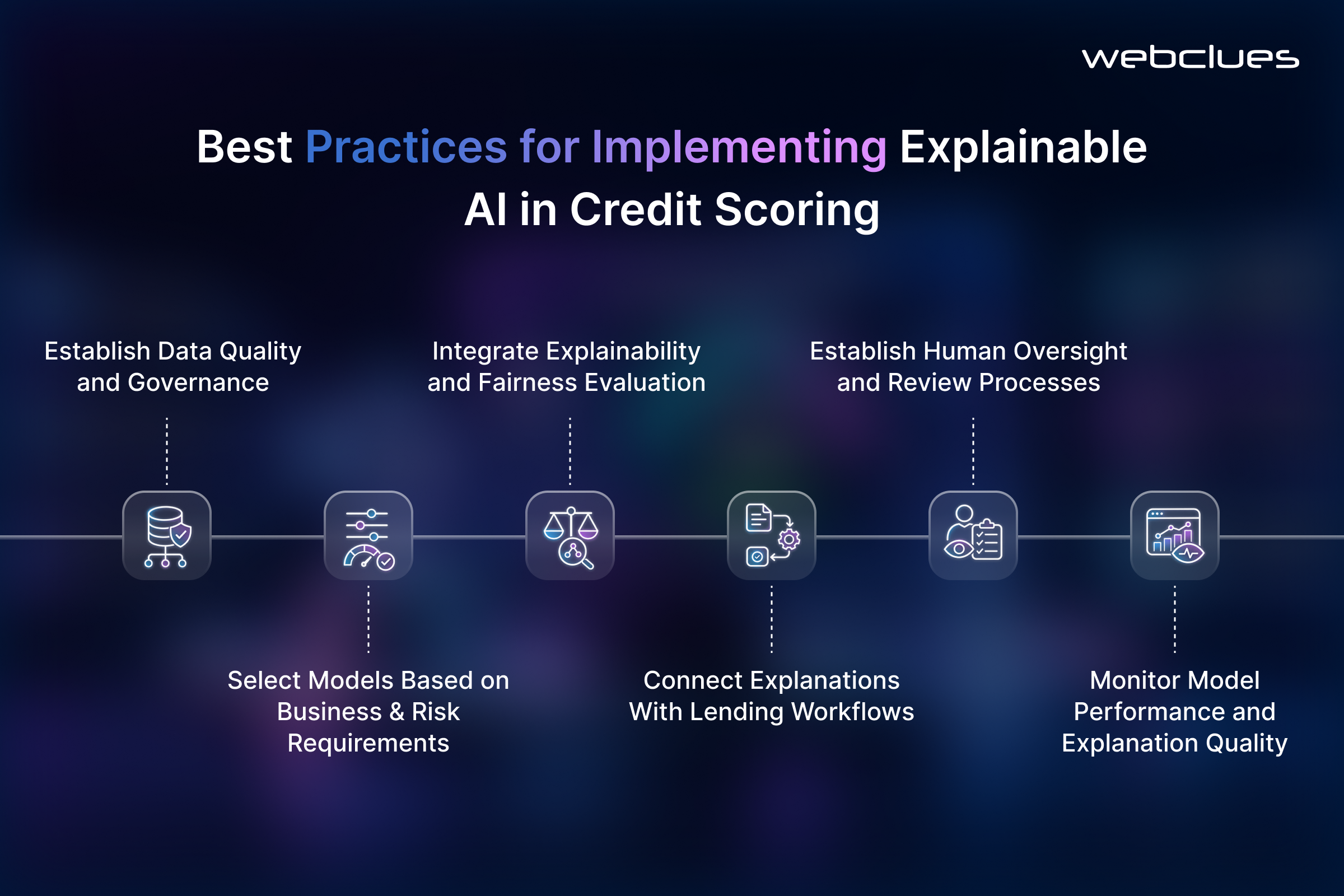
Implementing explainable AI requires more than adding an explanation tool to an existing machine learning model. Financial institutions need a structured approach that connects data quality, model development, fairness evaluation, compliance and ongoing monitoring.
1. Establish Data Quality and Governance
Begin by reviewing the accuracy, completeness, relevance and representativeness of the data used for credit scoring.
Identify missing values, inconsistent records, historical biases and variables that may introduce unfair or inappropriate outcomes. Evaluate potential proxy variables that could indirectly represent protected characteristics.
Maintain documentation of data sources, transformations, feature selection decisions and data access controls.
2. Select Models Based on Business and Risk Requirements
Evaluate candidate models using predictive performance, interpretability, operational complexity and regulatory considerations.
Compare statistical and machine learning approaches rather than selecting a model solely because it achieves a higher predictive score.
Consider performance metrics such as precision, recall, ROC-AUC and calibration alongside interpretability and model stability.
3. Integrate Explainability and Fairness Evaluation
Use techniques such as SHAP, LIME, PDP and ICE to examine individual predictions and overall model behavior.
Combine these explanations with fairness metrics, subgroup testing and human review. Validate whether explanations remain consistent and accurately represent the model's behavior.
Also examine whether the model relies on variables that may act as proxies for sensitive attributes.
4. Connect Explanations With Lending Workflows
Explanation outputs should be accessible to relevant teams, including credit officers, compliance professionals, risk managers and customer support.
For example, when a credit application is rejected, the system should capture the actual factors contributing to the decision and translate them into clear, accurate adverse action reasons where required.
Integrate explanation capabilities with loan origination systems, credit decision engines, reporting tools and audit workflows.
This helps connect technical model outputs with operational decision-making and customer communication.
5. Establish Human Oversight and Review Processes
Automated credit decisions should operate within clearly defined governance and review procedures.
Provide authorized reviewers with access to relevant decision factors, model outputs and supporting documentation. Establish escalation procedures for disputed decisions, unusual predictions and potential model errors.
Human oversight should involve meaningful review rather than simply approving automated recommendations.
6. Monitor Model Performance and Explanation Quality
Credit risk patterns can change as economic conditions, borrower behavior and lending portfolios evolve.
Monitor predictive performance, data drift, feature distributions, fairness indicators and explanation stability.
Establish processes for investigating unexpected changes, validating model updates, retraining when appropriate and documenting material changes.
Challenges Financial Institutions Should Consider
Explainable AI can improve model transparency, but implementation involves technical and operational challenges that financial institutions must address.
- Explanation Reliability: Post-hoc explanation methods may not always provide a complete or stable representation of complex model behavior. Organizations should validate explanation consistency and ensure that outputs accurately reflect the underlying model.
- Performance and Interpretability Trade-offs: Simpler models may be easier to interpret but may not capture every relationship in complex datasets. Model selection requires evaluating predictive performance alongside interpretability and operational requirements.
- Historical Data Bias: Explanation tools can reveal influential variables, but they cannot automatically remove bias from historical lending data or institutional practices. Dedicated fairness testing and data governance remain necessary.
- Regulatory Complexity: Requirements vary across jurisdictions, lending activities and institution types. Financial institutions must assess applicable laws and supervisory guidance rather than relying on a single compliance framework.
- Operational Integration: Explanation systems must work with existing lending platforms, credit decision engines, reporting processes and governance workflows. Poor integration can create gaps between technical explanations and actual lending decisions.
- Model Drift and Explanation Changes: Changes in economic conditions, applicant behavior and data distributions can affect both predictive performance and explanation outputs. Continuous monitoring and periodic validation are essential.
- Third-Party Model Transparency: Financial institutions using external AI models may have limited visibility into their architecture, training data, or decision logic. Vendor documentation, independent validation and appropriate contractual controls can help address these limitations.
Addressing these challenges requires coordination between data scientists, software engineers, lending specialists, risk teams and compliance professionals.

Choosing the Right AI Development Partner for Credit Scoring
Building an explainable credit scoring system requires expertise in machine learning, financial data processing, model interpretability, software engineering and system integration.
When evaluating an AI development company, financial institutions should consider the following capabilities:
- Machine Learning and Predictive Modeling: Experience developing classification models, credit risk prediction systems and data-driven decision engines.
- Explainability Implementation: Practical knowledge of SHAP, LIME, counterfactual explanations and other model interpretation techniques.
- Fairness and Model Validation: Ability to implement subgroup analysis, fairness testing, model calibration and explanation reliability assessments.
- Financial System Integration: Experience connecting AI models with loan origination systems, credit bureaus, banking platforms, APIs and existing enterprise infrastructure.
- Data Security and Governance: Appropriate experience with financial data protection, access controls, encryption, documentation and secure model deployment.
- Monitoring and Maintenance: Ability to implement model performance monitoring, data drift detection, explanation tracking and ongoing technical improvements.
A capable AI development partner should understand that explainability, fairness and compliance need to be considered during system design rather than added after deployment.
Conclusion
Explainable AI helps financial institutions understand how machine learning models influence credit decisions. By combining predictive modeling with techniques such as SHAP, LIME and counterfactual explanations, lenders can gain better visibility into model behavior and support more transparent decision-making.
However, explainability alone does not guarantee fair or compliant lending decisions. Effective implementation requires reliable data, dedicated fairness evaluation, regulatory alignment, human oversight and continuous model monitoring.
WebClues Infotech develops AI-powered solutions tailored to business requirements, including intelligent systems and data-driven applications. Whether you are building a new credit scoring platform or enhancing an existing lending system, our team can help you explore the right AI architecture and implementation approach.
Connect with us to explore our AI solutions for credit scoring and build transparent, data-driven lending systems aligned with your business requirements.
Post Author

Ayush Kanodia
As one of the esteemed Directors of WebClues Infotech. Ayush Kanodia is passionate about delivering innovative IT services & solutions and has spearheaded numerous successful projects, cementing the company's position as a leader in the field.


Build Your Agile Team
Hire Skilled Developer From Us
Build Transparent & Reliable Credit Scoring Solutions with WebClues
Our AI experts can help you develop intelligent credit risk assessment systems with predictive modeling, explainability and fairness evaluation capabilities. Contact WebClues Infotech to discuss your project and explore a tailored AI solution for your lending business.
Connect with usFrequently Asked Questions
Our Recent Blogs
Sharing knowledge helps us grow, stay motivated and stay on-track with frontier technological and design concepts. Developers and business innovators, customers and employees - our events are all about you.