

Connect with us


Corporate Video


How to Build HIPAA-Compliant Healthcare Software
Healthcare software development involves more than building useful features and connecting clinical systems. Applications that handle protected health information (PHI) must account for privacy obligations, security safeguards, vendor relationships and ongoing operational risks. For organizations serving the US healthcare market, choosing the right Software Development Services can help integrate security and compliance considerations into the development lifecycle, reducing avoidable security gaps and expensive architectural rework.
Building HIPAA-compliant healthcare software requires a structured approach that connects regulatory requirements with software architecture, development, testing, deployment and maintenance. In this blog, we will describe seven practical steps to help healthcare businesses and development teams plan that process, protect patient information and evaluate the technical and operational controls their applications need.
What Is HIPAA-Compliant Healthcare Software?
HIPAA-compliant healthcare software is software developed and operated within the applicable requirements of the Health Insurance Portability and Accountability Act (HIPAA). These requirements protect health information handled by regulated healthcare organizations and their business associates.
Protected health information includes individually identifiable information related to a person's health, healthcare services, or payment for healthcare. Electronic PHI (ePHI) is this information when created, received, maintained, or transmitted electronically.
HIPAA-covered entities include qualifying healthcare providers, health plans and healthcare clearinghouses. Business associates are individuals or organizations that perform certain functions or services involving PHI on behalf of covered entities. Depending on their contractual relationships and activities, software developers, hosting providers and other technology vendors may fall into this category.
Not every health or wellness application is automatically subject to HIPAA. Applicability depends on the organization's role, the services it provides and how it handles information. Developers should establish this scope before deciding which controls and agreements are required.
Key HIPAA Requirements to Address Before Development
Several HIPAA rules influence healthcare software design and operations:
- Privacy Rule: Governs permitted uses and disclosures of PHI and establishes privacy protections for individuals.
- Security Rule: Requires administrative, physical and technical safeguards to protect electronic PHI.
- Breach Notification Rule: Establishes notification obligations following breaches of unsecured PHI.
- Business associate requirements: Require appropriate contractual arrangements and safeguards when a business associate relationship exists.
The Security Rule focuses on protecting the confidentiality, integrity and availability of ePHI. Its requirements extend beyond application code to include risk analysis, workforce responsibilities, physical protections, access management and contingency planning.
A critical distinction is that HIPAA does not prescribe one universal technology stack. Organizations must assess their circumstances and implement appropriate safeguards. For example, encryption is an addressable implementation specification under the current Security Rule. Addressable does not mean optional without evaluation: the organization must determine and document the appropriate action based on its risk analysis and applicable requirements.
For the official requirements, consult the HHS HIPAA Security Rule guidance.
How to Build HIPAA-Compliant Healthcare Software: A 7-Step Process
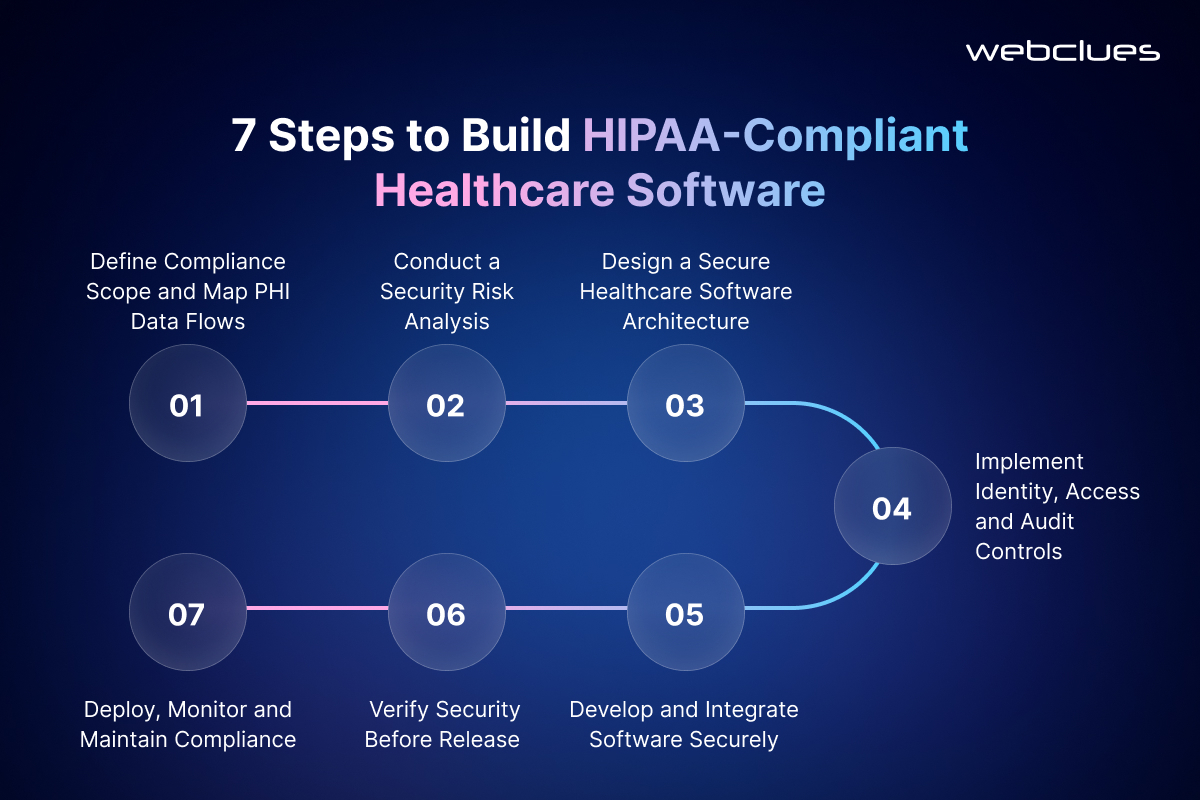
Follow these seven steps to protect patient health information, implement essential security safeguards, and build healthcare software that aligns with HIPAA requirements.
Step 1. Define the Compliance Scope and Map PHI Data Flows
Before development begins, establish what information the application handles, why it needs that information and which systems or organizations can access it.
Start by mapping the complete PHI lifecycle, including collection, processing, storage, transmission, archival and disposal. Identify the application components, databases, APIs, cloud services, external integrations and personnel that interact with the information.
For a telemedicine platform, for example, the data flow may include patient registration, appointment scheduling, video consultations, clinical notes, prescription workflows and payment processing. Each component may have different access requirements and introduce different risks.
Document the following:
- Categories of PHI collected and the purpose of each data field.
- Internal users and external parties that require access.
- Systems and vendors that create, receive, maintain, or transmit PHI.
- Applicable contractual requirements, including business associate agreements (BAAs).
- Data retention, archival and secure disposal requirements.
This inventory becomes the foundation for architecture decisions, risk analysis, access policies and testing.
Step 2. Conduct a Security Risk Analysis
A security risk analysis identifies threats and vulnerabilities that could compromise ePHI. It should inform the project's security requirements rather than remain a document prepared only for an audit.
Assess the likelihood and potential impact of risks involving unauthorized access, compromised credentials, insecure APIs, exposed cloud storage, ransomware, accidental disclosure and unavailable systems. Consider both technical vulnerabilities and operational weaknesses, such as excessive employee permissions or unclear incident escalation procedures.
Translate the findings into prioritized requirements. For instance, if a patient portal exposes clinical records through an API, testing should verify that changing a patient identifier cannot reveal another patient's information.
A useful risk register records the identified risk, affected asset, potential impact, existing safeguards, planned remediation, accountable owner and verification method.
HHS identifies risk analysis as foundational to Security Rule compliance. Organizations should revisit their assessments when significant changes occur, such as new integrations, changes in data use, infrastructure migrations, or newly identified vulnerabilities.
Step 3. Design a Secure Healthcare Software Architecture
Security requirements should influence the architecture before the application is implemented.
A healthcare application may use a web or mobile frontend, an application layer, APIs, databases, identity services, monitoring tools and cloud infrastructure. Each component should have clearly defined trust boundaries and permissions.
Key architecture considerations include:
- Encryption and key management: Protect ePHI at rest and in transit using appropriate cryptographic controls. Restrict access to encryption keys and define rotation and recovery procedures.
- Network segmentation: Separate sensitive workloads and administrative interfaces from components that do not need direct access to them.
- Secure APIs: Enforce authentication, authorization, input validation, rate limiting and appropriate error handling.
- Data isolation: Where a platform serves multiple healthcare organizations, design and test tenant boundaries to prevent cross-customer access.
- Resilience: Plan for encrypted backups, recovery objectives, redundancy and restoration testing.
Cloud hosting can support these requirements, but choosing a major cloud provider does not make an application automatically HIPAA-compliant. Organizations must select appropriate services, configure them securely, establish required BAAs and manage the application and operating environment correctly.
Architecture decisions should also reflect the clinical workflow. Excessive restrictions can obstruct legitimate care, while broad permissions can expose unnecessary information. The objective is to protect PHI without compromising essential functionality.
Step 4. Implement Identity, Access and Audit Controls
Authentication establishes who is accessing a system. Authorization determines what that person can do. Both must be designed around the application's actual workflows.
Use unique user identities, strong authentication and multifactor authentication where appropriate. Apply role-based or attribute-based access controls to limit permissions according to responsibilities and context.
For example, a billing employee may need access to insurance and payment details but not detailed clinical notes. A clinician may require broader access to relevant patient records for treatment. Emergency access should follow a documented procedure that supports legitimate clinical needs and enables subsequent review.
Implement controls such as:
- Least-privilege access and controlled administrative privileges.
- Timely removal or adjustment of access when roles change.
- Session expiration and reauthentication where appropriate.
- Audit records of relevant access and system activities.
- Monitoring and alerts for suspicious access patterns.
- Regular permission reviews and investigation of unusual activity.
Audit trails should capture useful information such as the user or service identity, timestamp, action, affected resource and outcome. Protect logs against unauthorized modification and restrict access to them.
Avoid placing unnecessary PHI in logs, error messages, URLs, analytics events, or monitoring dashboards. Auditability should improve security without creating another repository of sensitive information.
Step 5. Develop and Integrate the Software Securely
Secure development practices should be part of the software development lifecycle rather than a final review before launch.
Use peer code reviews, dependency management, secret scanning, vulnerability checks and secure configuration practices. Store credentials in an appropriate secrets-management system rather than embedding them in source code. Separate development, testing, staging and production environments, with tightly controlled access to production data.
Healthcare integrations require particular attention. Applications may connect to electronic health record (EHR) systems, laboratory platforms, pharmacy services, billing systems, or remote patient monitoring devices. Standards such as HL7 and FHIR may support interoperability, but using them does not eliminate the need for authentication, authorization, secure transmission and appropriate data validation.
Before enabling an integration, determine what information it receives, which party controls the information, how errors are handled and whether the vendor relationship requires a BAA.
Testing environments should generally use synthetic or appropriately de-identified data rather than unrestricted production PHI. If real PHI is necessary for a legitimate purpose, its use requires appropriate authorization, safeguards, access restrictions and compliance review.
Step 6. Verify Security Before Release
A successful build is not evidence that an application is secure. Verification should test whether the implemented controls work under expected and adverse conditions.
Combine automated testing with manual security reviews. Relevant activities include:
- Static application security testing (SAST) and dependency vulnerability scanning.
- Dynamic application security testing (DAST) and penetration testing.
- Authentication and authorization testing, including attempts to access another user's records.
- API validation, input handling and session-management testing.
- Checks for sensitive data exposure through logs, error responses, analytics and third-party services.
- Verification of backup restoration, access revocation and incident alerting.
For example, a patient portal should be tested against insecure direct object references: a user must not gain access to another patient's records simply by changing an identifier in a request.
Define release acceptance criteria before testing begins. Critical findings should be remediated and retested and unresolved risks should be documented and handled through an approved process. Keep evidence of test execution, remediation and approval so the organization can demonstrate how security decisions were made.
Security testing is not a one-time event. Repeat relevant checks when the application, dependencies, infrastructure, integrations, or threat environment changes.
Step 7. Deploy, Monitor and Maintain Compliance
HIPAA-related responsibilities continue after launch. New features, changing staff permissions, vendor updates and infrastructure changes can introduce risks even when the original release passed testing.
Establish an operational process that includes:
- Regular vulnerability remediation and dependency updates.
- Monitoring of authentication events, access anomalies and security alerts.
- Periodic access reviews and risk reassessments.
- Documented incident response procedures and escalation responsibilities.
- Encrypted backups, disaster recovery procedures and restoration exercises.
- Workforce training and appropriate policy reviews.
- Secure retention and disposal of PHI and associated media.
An incident response plan should explain how the team detects, contains, investigates, documents and resolves security incidents. It should also define who evaluates whether an incident constitutes a reportable breach and who communicates with affected parties.
Under the HIPAA Breach Notification Rule, a business associate must notify the covered entity of a breach of unsecured PHI without unreasonable delay and no later than 60 days after discovery. Contracts may require earlier reporting. The covered entity has separate notification obligations, including applicable deadlines for affected individuals and HHS.
Review the official HHS Breach Notification Rule when developing incident procedures.
HIPAA Compliance Checklist for Healthcare Software
Use this checklist to assess implementation readiness. It is a practical project aid, not a certification or substitute for a formal compliance assessment.
- Determine whether HIPAA applies and identify the relevant covered entities and business associates.
- Map PHI flows, data stores, APIs, integrations and vendors.
- Complete and document a security risk analysis.
- Define appropriate encryption, key-management and data-protection controls.
- Implement unique identities, access restrictions and suitable authentication.
- Maintain protected audit trails and monitor suspicious activity.
- Review third-party services and execute required BAAs.
- Use secure development practices and controlled test environments.
- Perform security testing and document remediation.
- Establish incident response, breach notification, backup and disaster recovery procedures.
- Review permissions, vulnerabilities, policies and risks throughout the application's lifecycle.
The checklist should be supported by documented ownership, evidence and recurring review. Merely checking off technical features does not establish that all applicable HIPAA obligations have been met.
Common Challenges in HIPAA-Compliant Software Development
Healthcare teams must balance data security, system interoperability, regulatory obligations and user experience while addressing evolving technical and operational risks.
Integrating Legacy Healthcare Systems
Older systems may use outdated protocols, limited authorization controls, or inconsistent data formats. Replacing them all at once can introduce operational disruption and migration risk.
A phased modernization strategy can help. Inventory existing interfaces, establish secure integration boundaries, validate data mapping and test access restrictions before migrating production workloads. Compatibility should not become a reason to leave known vulnerabilities unaddressed.
Balancing Security, Usability and Performance
Strong safeguards must work within real clinical workflows. Excessive authentication friction can slow legitimate tasks, while insufficient restrictions increase exposure.
Use role-specific permissions, appropriate session policies, carefully designed emergency access and targeted monitoring. Measure both security effectiveness and workflow impact during usability and acceptance testing.
Managing Third-Party Risk and Compliance Evidence
Healthcare applications often depend on cloud services, analytics tools, communication platforms and external APIs. Each integration introduces questions about data handling, contractual obligations, configuration and incident reporting.
Maintain a vendor inventory, assess which services handle PHI, verify required agreements and document control ownership. Automating security checks and collecting evidence throughout the development lifecycle can reduce manual work, but automated tools do not replace risk analysis or management decisions.
Modernizing an existing healthcare platform? Explore WebClues Infotech's healthcare software development insights to assess relevant architecture and security considerations for your project.
How to Choose a HIPAA-Aware Healthcare Software Development Partner
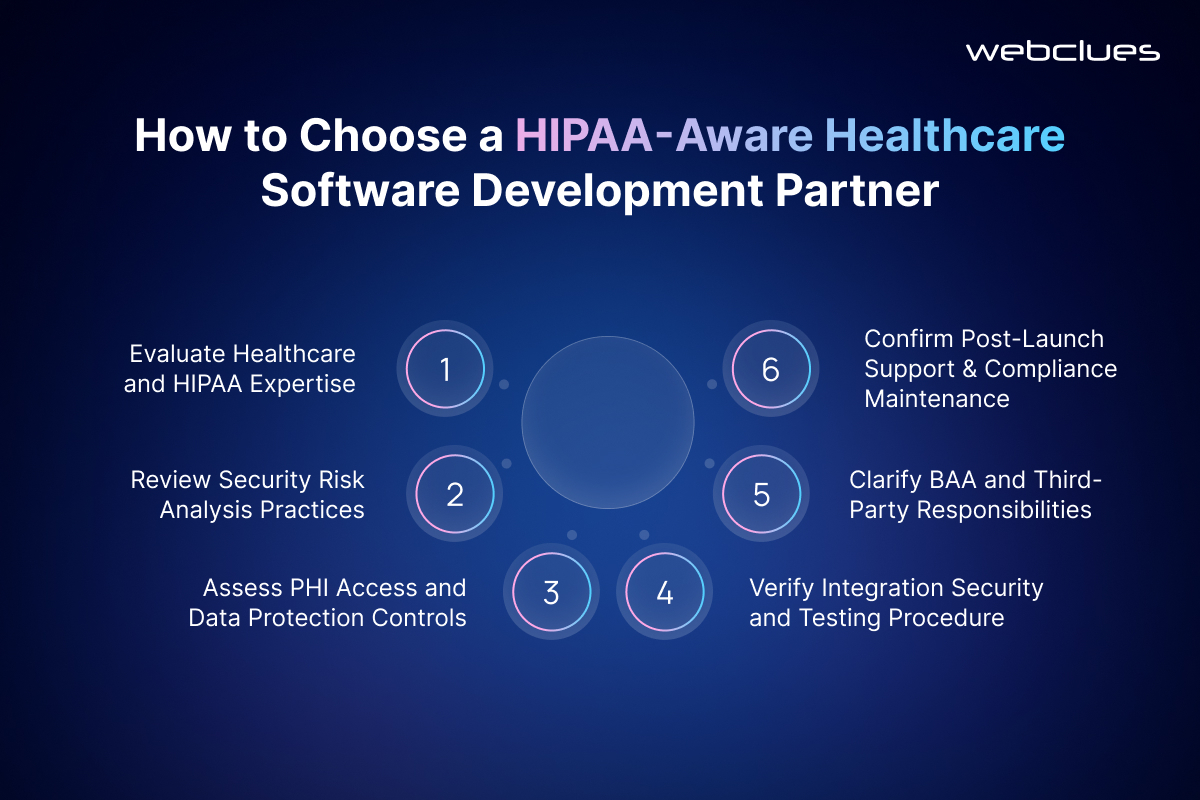
A suitable healthcare software development company should understand the relationship between software engineering, healthcare workflows, HIPAA requirements, security controls and contractual responsibilities.
Ask prospective vendors how they conduct risk analysis, restrict developer access to PHI, manage production credentials, secure integrations, test authorization boundaries, document vulnerabilities and support post-launch maintenance.
Clarify whether a BAA is required, which party will sign it, how subcontractors are managed and how quickly the vendor must report suspected incidents. Also establish who owns security policies, compliance evidence, incident decisions and ongoing remediation.
Review practical evidence such as documented development processes, sample security deliverables, testing procedures and support arrangements. Do not rely solely on claims that a particular technology stack or cloud provider is compliant.
The right healthcare AI development partner should be able to explain the safeguards it will implement, the responsibilities that remain with the healthcare organization and the evidence needed to verify the work.
Build Your Healthcare Software with Security in Mind
Developing healthcare software requires coordinated decisions about product functionality, data flows, architecture, access controls, testing, vendor relationships and ongoing operations.
Addressing these concerns early helps teams identify risks before they become costly to correct and establishes a stronger foundation for maintaining the application after launch.
WebClues Infotech is a trusted software development company that helps businesses build healthcare solutions tailored to their product requirements, integration needs, security priorities and long-term maintenance goals.
If you are building a patient portal, telemedicine platform, healthcare SaaS product, or clinical application or need product engineering services, discuss your project scope and security priorities with the team. Contact us to discuss your healthcare software project.
Post Author

Nikhil Patel
Nikhil Patel, a visionary Director at WebClues Infotech, specializes in leveraging emerging tech, particularly Generative AI, to improve corporate communications. Through his insightful blog posts, he empowers businesses to succeed digitally.


Build Your Agile Team
Hire Skilled Developer From Us
Build a Secure Healthcare Software with WebClues Infotech
Develop healthcare software tailored to your business needs with the right architecture, security controls and integration strategy. Contact WebClues Infotech to discuss your project requirements and development goals.
contact usFrequently Asked Questions
Our Recent Blogs
Sharing knowledge helps us grow, stay motivated and stay on-track with frontier technological and design concepts. Developers and business innovators, customers and employees - our events are all about you.