

Connect with us


Corporate Video


AI Agent Failure Recovery: How Production Agents Handle Errors
Summary: AI agents can fail because of unreliable APIs, invalid tool outputs, incorrect decisions, or interrupted workflows. Production-ready AI agent development services need more than error messages and automatic retries. They need a structured recovery strategy that detects failures, classifies their causes, contains their impact, restores valid state, verifies the outcome, and improves future performance.
What Is AI Agent Failure Recovery?
AI agent failure recovery is the process of detecting an unsuccessful or unsafe operation, determining its cause and restoring the workflow to a valid state without creating additional errors.
Unlike a conventional application that follows predefined execution paths, an AI agent can interpret instructions, select tools, retrieve information and dynamically determine its next action. Each decision introduces potential failure points.
Consider a customer support agent that retrieves an order, checks its delivery status and prepares a refund request. If the order management API times out, the agent must determine whether to retry, verify the request's status, or escalate the issue.
Simply repeating the operation could create a duplicate request if the original action succeeded but its response never arrived.
Reliable AI agent error handling therefore involves three distinct responsibilities:
- Detection: Identify an unsuccessful operation or unexpected result.
- Recovery: Apply an appropriate corrective action.
- Verification: Confirm that the intended outcome occurred before continuing.
The objective is not to eliminate every failure. It is to ensure that failures remain controlled, recoverable and visible.
Why AI Agents Fail in Production
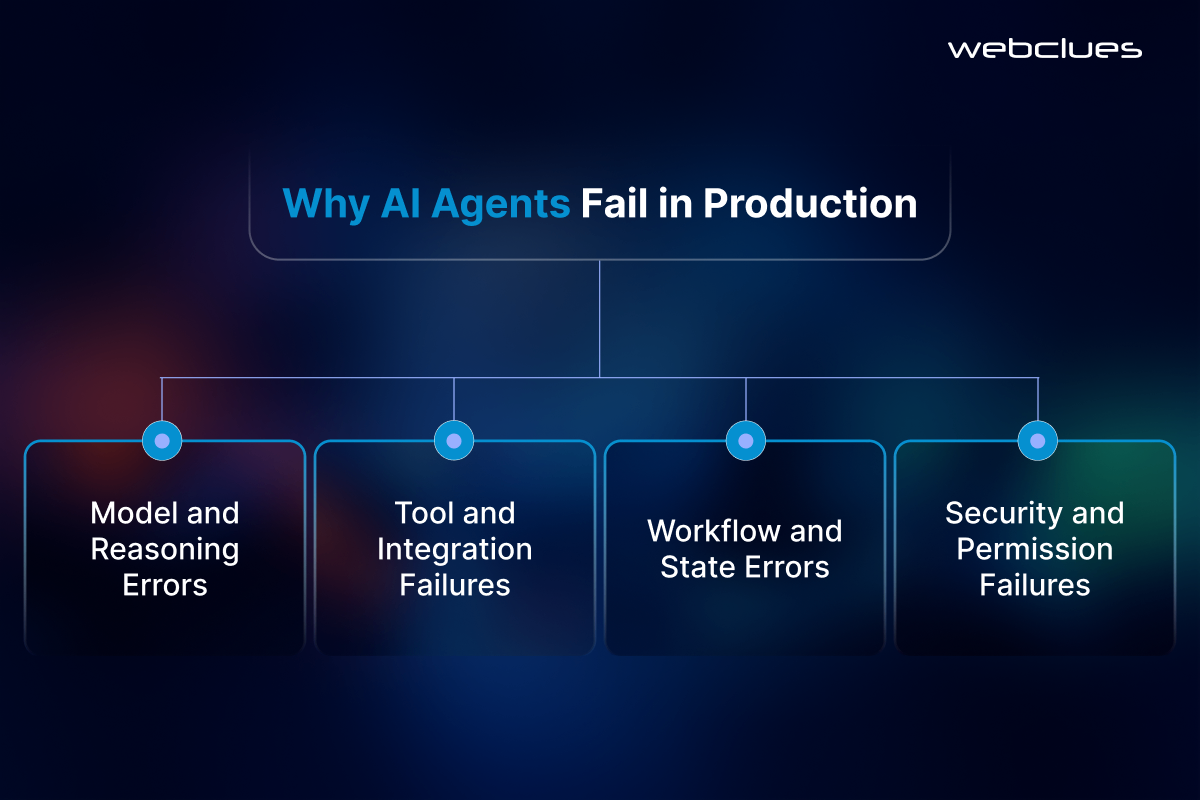
AI agents depend on several interconnected components. A failure in any component can interrupt the workflow or compromise its final result.
- Model and reasoning errors: An agent may misunderstand an instruction, select an inappropriate tool, or make a decision using incomplete information.
- Tool and integration failures: APIs, databases and enterprise applications can experience timeouts, rate limits, authentication errors and unexpected response formats.
- Workflow and state errors: Interrupted executions, repeated actions, stale information and incomplete transactions can leave the workflow in an inconsistent state.
- Security and permission failures: Prompt injection, unauthorized requests and excessive tool permissions can cause an agent to attempt unsafe actions.
These failures require different responses. A temporary network interruption may justify a retry, while an authorization failure requires a different intervention. An ambiguous instruction may require clarification rather than another model call.
This is why production reliability must be designed into the agent's runtime, orchestration and integrations instead of relying exclusively on prompts or model capabilities.
How Production AI Agents Recover From Errors
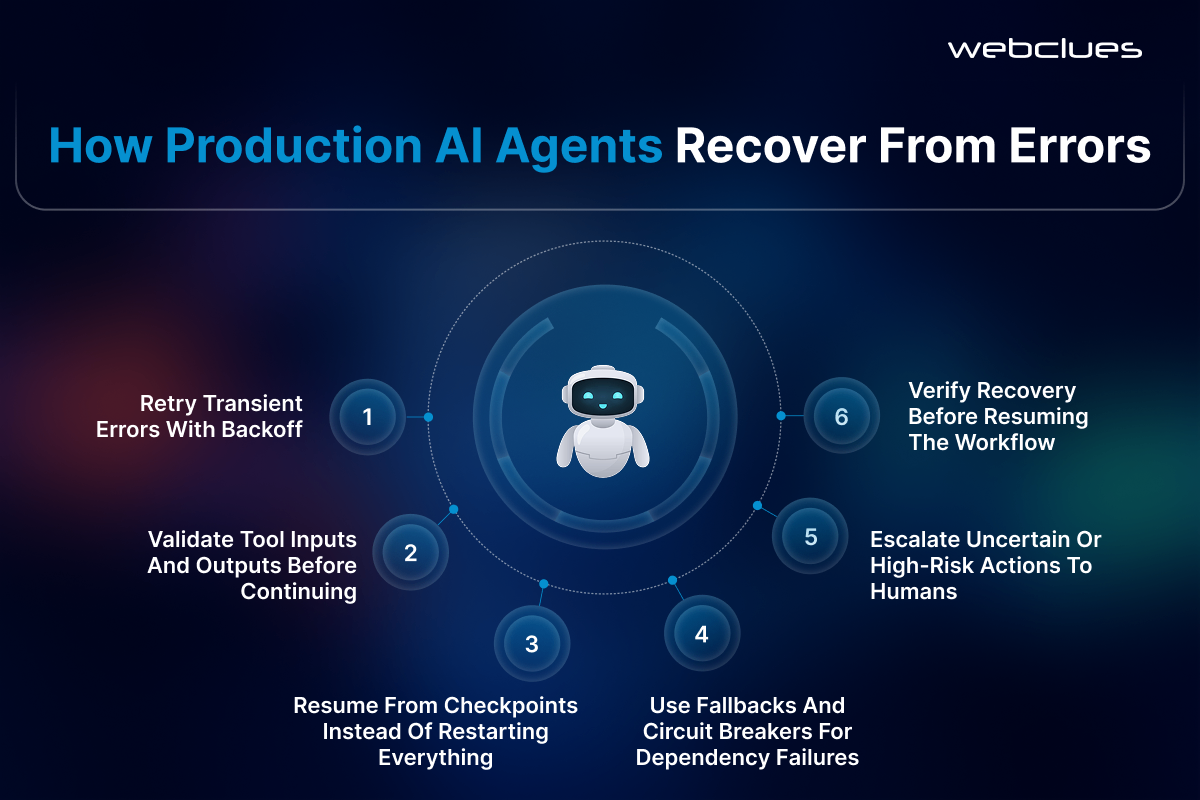
Effective AI agent failure recovery combines several mechanisms. The appropriate response depends on the error type, the operation's impact and whether the system can verify its current state.
1. Retry Transient Errors With Backoff
Some failures are temporary. A network interruption, service timeout, or API rate limit may prevent an operation from succeeding on its first attempt.
A bounded retry policy allows the system to try again without immediately abandoning the task.
A typical implementation includes:
- A maximum number of retry attempts.
- Request timeouts and an overall execution deadline.
- Exponential backoff, which increases the waiting period between attempts.
- Randomized jitter to reduce synchronized retry traffic.
- Error classification to distinguish retryable failures from permanent ones.
For example, an agent retrieving inventory information might retry after a temporary server error. If the service remains unavailable after the permitted attempts, the agent should stop retrying and use an approved fallback or escalate the task.
AWS documents the retry-with-backoff pattern for handling transient errors in distributed systems, while also warning that excessive retries can increase contention and worsen service degradation.
The trade-off: Retries improve resilience when failures are temporary, but they increase latency and resource consumption. They are also dangerous when repeated requests can produce duplicate side effects.
2. Validate Tool Inputs and Outputs Before Continuing
An AI agent may generate an incorrect parameter or receive an incomplete response from an external system.
Without validation, the agent can interpret the response as trustworthy and continue making decisions based on incorrect information.
Suppose an agent requests a customer's account status. The API returns a response without the required account identifier. The system should reject the incomplete result instead of allowing the agent to proceed with an uncertain record.
Useful safeguards include:
- Schema validation for tool arguments and responses.
- Type checks and required-field validation.
- Business-rule validation.
- Permission checks before state-changing operations.
- Verification that returned information corresponds to the intended record.
Structured outputs help ensure that responses conform to an expected format, but valid formatting does not guarantee factual correctness.
For example, a response can contain a valid customer ID that belongs to the wrong customer. The application must still verify the record's identity and authorization.
The principle is straightforward: validate an agent's proposed action and the result of that action before allowing dependent workflow steps to continue.
3. Resume From Checkpoints Instead of Restarting Everything
Long-running AI agent workflows may involve document retrieval, data analysis, several API calls and multiple decision stages.
If the final step fails, restarting the entire workflow can waste resources and repeat operations that already succeeded.
Checkpointing addresses this problem by preserving workflow state at defined stages.
A checkpoint may record:
- The original task and its constraints.
- Completed workflow steps.
- Validated intermediate results.
- The current execution stage.
- Pending operations and unresolved errors.
Consider a procurement agent that collects supplier quotations, validates their details and prepares a comparison. If a downstream reporting service becomes unavailable, the agent may resume from the validated quotation data rather than retrieving every quotation again.
However, restoring a checkpoint does not automatically make the workflow safe. The system must verify whether the underlying data has changed and whether any external operation completed before the interruption.
Checkpointing is particularly useful for long-running workflows, expensive model calls and processes with several independent stages.
4. Use Fallbacks and Circuit Breakers for Dependency Failures
Repeatedly calling an unavailable service can increase latency, consume resources and contribute to cascading failures.
A fallback provides an alternative response or execution path. A circuit breaker temporarily prevents calls to a dependency after its failure rate crosses a configured threshold.
Circuit breakers generally use three states:
- Closed: Requests proceed normally while failures are monitored.
- Open: Requests are blocked or redirected because the dependency is considered unhealthy.
- Half-open: A limited number of requests test whether the dependency has recovered.
For example, if an agent cannot retrieve information from a primary internal service, the application might use an approved secondary source or queue the task until the service recovers.
The fallback must preserve acceptable data quality and business rules. An alternative source containing outdated information may be worse than stopping the workflow.
AWS's circuit-breaker guidance explains how this pattern can prevent repeated calls to failing dependencies and help determine when normal operation can resume.
The trade-off: Fallbacks improve availability but add architectural complexity. Circuit breakers also require appropriate thresholds and recovery policies to avoid blocking healthy services unnecessarily.
5. Escalate Uncertain or High-Risk Actions to Humans
Not every failure should be resolved autonomously.
Some situations require human judgment because the agent lacks sufficient information, the consequences are significant, or the available recovery options cannot be verified safely.
Examples include:
- A financial transaction with an uncertain execution status.
- Conflicting customer records.
- A request that exceeds the agent's permissions.
- An irreversible account change.
- A security alert involving potentially malicious instructions.
A well-designed system can preserve the workflow state, record the failure and transfer the task to an authorized employee with the relevant context.
Human escalation should be based on risk, uncertainty and business rules—not merely on whether the model reports low confidence.
A model's self-reported confidence is not, by itself, a reliable guarantee of correctness.
For sensitive operations, deterministic authorization checks and explicit approval requirements provide stronger controls than asking the model whether it is confident.
6. Verify Recovery Before Resuming the Workflow
Recovery is incomplete until the system verifies what actually happened.
Consider an agent that submits a request to update a customer record. The operation times out before the agent receives confirmation.
Two outcomes are possible: the update failed, or the update succeeded but the response was lost.
Immediately repeating the request could produce duplicate side effects.
A safer recovery procedure is to:
- Check the operation's status using an available transaction identifier or equivalent mechanism.
- Retrieve the affected record or inspect the resulting state.
- Determine whether the intended change occurred.
- Retry only when the operation is known to be incomplete and retrying is safe.
- Escalate if the outcome cannot be established reliably.
Idempotency is especially important here. An operation is idempotent when repeating it produces the same intended state as executing it once. Where supported, idempotency keys or unique operation identifiers can help prevent duplicate execution.
For multi-step business processes, compensating actions may also be needed when a completed step cannot simply be rolled back.
The key distinction is that successful recovery means restoring a verified business state, not merely obtaining a successful API response.
AI Agent Recovery Strategies Compared
Different errors require different recovery mechanisms. Applying the wrong strategy can increase the original problem.
| Failure scenario | Preferred recovery strategy | When to stop or escalate |
| Temporary network timeout | Bounded retry with backoff | Retry limit or deadline exceeded |
| Invalid tool arguments | Validate and correct the input | Required information remains ambiguous |
| API rate limit | Respect the permitted retry interval | Execution deadline exceeded |
| Authentication failure | Use an authorized credential-refresh mechanism or escalate | Identity or permissions remain invalid |
| Uncertain write outcome | Verify operation status before retrying | Outcome cannot be established safely |
| Missing or conflicting data | Query an authoritative source or request clarification | No trustworthy source is available |
| Repeated execution loop | Apply iteration limits and stop conditions | The workflow cannot make meaningful progress |
| High-risk action | Require approval or transfer control | Required approval is unavailable |
This decision-based approach prevents agents from treating every error as a temporary interruption. It also helps engineering teams define recovery behavior at the workflow level, where business rules and consequences can be evaluated alongside technical error codes.
How to Build a Failure-Recovery Architecture
A reliable recovery strategy needs to be part of the application's architecture rather than an instruction embedded only in the model prompt.
Separate AI Decisions From Execution Controls
The model can propose an action, but deterministic application logic should validate its parameters, permissions and compliance with business rules before execution.
For example, an agent can recommend a refund, while application logic verifies the customer's eligibility, refund limits and approval requirements.
This separation limits the consequences of incorrect model decisions.
Define Recovery Policies at the Workflow Level
Each operation should have appropriate timeouts, retry limits, stopping conditions and escalation rules.
A read-only information lookup may tolerate a different recovery policy from a payment, database update, or account deletion.
Preserve State and Prevent Duplicate Actions
Use durable checkpoints where necessary, verify the status of uncertain operations and implement idempotency mechanisms where supported.
For workflows involving several systems, define how partial completion will be handled. A compensating action may be necessary when a completed operation cannot be reversed directly.
Design for Graceful Degradation
When a dependency becomes unavailable, the agent should be able to pause, queue the task, use a validated fallback, or provide an accurate partial result.
It should never report that a business action succeeded when the system cannot verify completion.
For organizations building interconnected agents, WebClues Infotech's multi-agent workflow automation is a relevant starting point for understanding how orchestration, permissions, validation and monitoring fit together.
How to Monitor and Improve Recovery Performance
An agent that recovers successfully today may encounter the same failure tomorrow. Production monitoring helps teams identify recurring problems and improve the system systematically.
Track the Right Reliability Metrics
Useful metrics include:
- Task success rate after recovery: How often does the workflow achieve its intended outcome?
- Failure rate by category: Which errors occur most frequently?
- Recovery success rate: How often does the selected recovery mechanism work?
- Time to recover: How long does the system take to restore normal execution?
- Retry frequency: Are retries increasing without improving task completion?
- Duplicate or inconsistent state changes: Are recovery attempts creating unwanted side effects?
- Human escalation rate: How often does the workflow require intervention?
- Cost and latency per completed task: Is recovery making the workflow unnecessarily expensive or slow?
These metrics should be interpreted together. A high recovery rate is not necessarily beneficial if the agent repeatedly retries expensive operations or produces incorrect outcomes.
Use Traces to Diagnose Failed Runs
Logs capture individual events, metrics reveal patterns and distributed traces show how a request moves through the workflow.
Tracing can help engineers identify whether a failure originated in a model call, retrieval operation, tool integration, or downstream service.
Google Cloud's agent observability documentation recommends collecting logs, metrics and traces to investigate agent behavior, diagnose failures and understand execution paths.
Sensitive prompts, tool arguments and returned data should be handled according to the organization's privacy, access-control and retention requirements.
Turn Production Failures Into Regression Tests
When a failure has been investigated, preserve an appropriate test case that reproduces it.
For example, an API timeout that previously caused duplicate requests should become a regression scenario that verifies the agent checks operation status before retrying.
Re-run relevant tests whenever the model, prompt, tool schema, retrieval system, or orchestration logic changes.
This creates a continuous improvement cycle:
Detect → Classify → Contain → Recover → Verify → Learn
The framework connects immediate error handling with long-term reliability. It helps teams contain incidents today while reducing the likelihood of similar failures in future deployments.
Build Reliable and Secure AI Agents With WebClues Infotech
Production AI agents need more than capable language models. They require carefully designed execution controls, reliable integrations, validated tool interactions, recoverable workflow state and monitoring that makes failures visible.
WebClues Infotech provides AI agent development services for businesses building AI-powered applications, agents, copilots and multi-step workflows. The right implementation depends on your business process, existing systems, risk requirements and expected operating conditions.
If you are moving an AI agent from proof of concept to production or improving an existing agent that struggles with errors, retries, or unreliable integrations, request a free consultation to discuss your requirements. Build an AI agent designed to recover safely, verify outcomes and operate within your business requirements.
Post Author

Vedansh Kanodia
Vedansh Kanodia, a dynamic Business Development Executive at WebClues Infotech, is a passionate technocrat who helps businesses embrace innovation, and unlock new possibilities with his valuable perspectives.


Build Your Agile Team
Hire Skilled Developer From Us
Build AI Agents That Recover, Not Just Respond
Production AI agents need more than intelligent responses. They need reliable recovery when APIs fail, tools return unexpected results, workflows break, or actions become uncertain. WebClues Infotech builds AI agents with validation, checkpoints, fault-tolerant workflows, human escalation, and production monitoring. Talk to our AI experts to design an agent built for real-world failures.
contact usFrequently Asked Questions
Our Recent Blogs
Sharing knowledge helps us grow, stay motivated and stay on-track with frontier technological and design concepts. Developers and business innovators, customers and employees - our events are all about you.