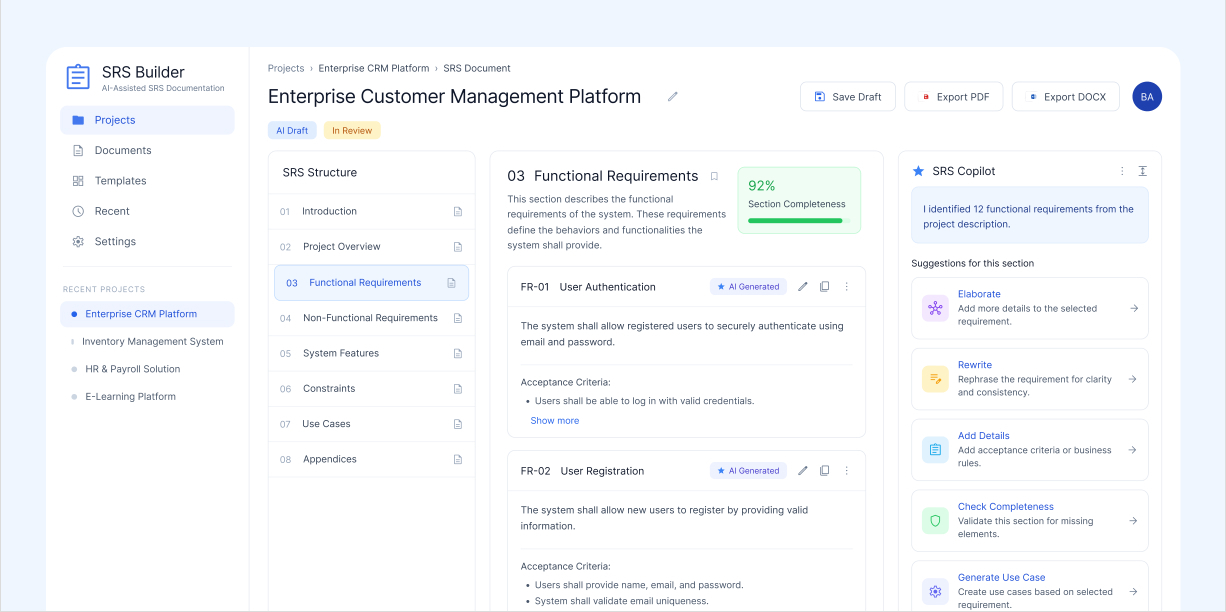
IEEE-Aligned SRS Templates:
Pre-built templates maintain a consistent documentation structure across projects.
Case Study
SRS Builder is an intelligent documentation platform developed by WebClues Infotech for a software development company operating in the enterprise software space. The client managed several projects at once, and each project required a detailed Software Requirements Specification before development could begin. Static Word templates made the process slow and inconsistent.
Using GPT-4 for content generation, Hugging Face Transformers for parsing and summarization, and modular templates for document structure, the platform turned high-level project information into structured, editable SRS drafts. Within weeks, preparation time was reduced by 70%, document consistency improved from 60% to 100%, and the SRS draft error rate fell from 15% to less than 3%.
Before SRS Builder, the client faced several issues that affected turnaround time and documentation quality:
Preparing each SRS manually often took three to four days
Analysts had to extract requirements from meetings, emails, notes
Static templates created inconsistent document structures
Missing sections and formatting issues were often identified late
Manual drafting limited analyst capacity across concurrent projects
The process was difficult to standardize and make more predictable
WebClues Infotech designed SRS Builder as a two-layer solution: an intelligent text-understanding layer and a structured document-generation layer.
GPT-4 turns high-level project descriptions into formal requirement statements, while Hugging Face Transformers handles parsing and summarization. Modular SRS templates organize the generated content into a defined document hierarchy, and a dialogue-based interface allows analysts to review sections, clarify ambiguities, and request revisions before final approval.
The system was built to reduce repetitive writing and formatting work while keeping analysts involved in the final documentation process.
Receives high-level project descriptions and the information prepared for the SRS documentation process.
Uses Hugging Face Transformers to parse and summarize inputs, identify intent, prioritize relevant information, and categorize details.
Uses GPT-4 to convert project context into formal requirement statements for the initial SRS draft.
Places the generated content into predefined sections, including introduction, functional requirements, non-functional requirements, system features, constraints, and use cases.
Allows analysts to review sections, ask the system to elaborate on specific details, and revise the document over multiple rounds.
Uses LaTeX and Markdown converters to generate presentation-ready SRS documentation in PDF or DOCX format.
Pre-built templates maintain a consistent documentation structure across projects.
Long textual inputs are summarized and categorized into relevant sections, such as functional requirements and system constraints.
High-level project descriptions are converted into formal SRS content.
Analysts can refine generated statements until final approval.
LaTeX and Markdown converters create formal PDF and DOCX documentation.
Unit and integration tests validate accuracy and section completeness, while Dockerized containers support rollout on the client’s internal infrastructure.
Enterprise software projects managed across multiple workstreams
Projects that require a detailed SRS before development begins
Documentation covering functional and non-functional requirements
System feature, constraint, and use-case documentation
Workflows that require human review and iterative refinement
Different project formats supported through modular templates
SRS Builder was shaped through a combined AI consulting, NLP development, and AI integration effort. Each area addressed a different part of the documentation workflow, from understanding the existing process to generating and refining structured SRS drafts.
70% faster SRS preparation
Average documentation time reduced from 3 to 4 days to less than 1 day
Document structure consistency improved from 60% to 100%
SRS draft error rate reduced from 15% to less than 3%
Analyst productivity increased by 2.5x
Initial SRS drafts could be generated in under one hour
"Their ability to start quickly and hit the ground running is outstanding. Internal stakeholders are quite pleased with the value WebClues Infotech delivers. They’ve earned a reputation for on-time deliveries that fulfill initial requirements. Their diverse skills and ability to dive into new projects are also noteworthy."

GPT-4 converts high-level project descriptions into formal requirement drafts
NLP parsing and summarization help organize long project inputs
IEEE-aligned templates create a consistent documentation structure
Dialogue-based refinement keeps analysts involved before approval
LaTeX and Markdown converters reduce manual formatting work
Dockerized deployment supports fast rollout within the client’s internal infrastructure
1007-1010, Signature-1,
S.G.Highway, Makarba,
Ahmedabad, Gujarat - 380051
1308 - The Spire, 150 Feet Ring Rd,
Manharpura 1, Madhapar,
Rajkot, Gujarat - 360007
Dubai Silicon Oasis, DDP,
Building A1, Dubai, UAE
6851 Roswell Rd 2nd Floor,
Atlanta, GA, USA 30328
513 Baldwin Ave, Jersey City,
NJ 07306, USA
4701 Patrick Henry Dr. Building
26 Santa Clara, California 95054
120 Highgate Street,
Coopers Plains,
Brisbane, Queensland 4108
85 Great Portland Street, First
Floor, London, W1W 7LT
5096 South Service Rd,
ON Burlington, L7l 4X4
Let’s Transform Your Idea into
Reality. Get in Touch