

Connect with us


Corporate Video


Custom AI Agent Development: How to Build AI Agents for Business Workflows
Custom AI agent development enables businesses to automate workflows that require more than predefined rules or simple conversational responses. An AI agent can interpret a request, retrieve relevant information, use approved tools, execute specific actions and escalate decisions when human judgment is required.
For example, a sales operations team could use an AI agent to review incoming leads, retrieve company information, check qualification criteria, update a CRM and route suitable opportunities to the right sales representative.
However, building a reliable business agent involves more than connecting a large language model (LLM) to a few APIs. It requires workflow analysis, system integration, access controls, evaluation and ongoing monitoring.
The practical approach is to identify a measurable business problem first, determine whether an AI agent is appropriate and develop a controlled solution around the existing workflow.
What Is Custom AI Agent Development?
Custom AI agent development is the process of designing and building AI-powered software agents for an organization's specific processes, business rules, data sources and technology environment.
Unlike generic assistants, custom agents can be configured to work with approved enterprise systems, follow defined procedures and perform authorized actions. Their capabilities depend on the underlying model, available tools, application architecture and operational controls.
How Does a Custom AI Agent Work?
A business AI agent typically combines several components:
- AI model: Interprets requests, reasons through tasks and determines which approved tools may be useful.
- Business knowledge: Supplies relevant information through document retrieval, retrieval-augmented generation (RAG), databases, or application queries.
- Tools and integrations: Connect the agent to systems such as CRM platforms, ERP software, ticketing applications and internal APIs.
- Workflow orchestration: Manages task sequences, state transitions, retries and handoffs.
- Security controls: Enforce permissions, validate inputs and outputs and restrict sensitive actions.
- Monitoring and evaluation: Track task completion, errors, latency, cost and compliance with business requirements.
The model may decide what to do next, but deterministic application logic should validate whether the action is permitted and whether the requested operation succeeds.
Custom AI Agents vs. Chatbots vs. Traditional Automation
These technologies solve different problems and businesses should select them according to the workflow.
| Capability | Chatbot | Traditional automation | Custom AI agent |
| Primary purpose | Answer questions or support conversations | Execute predefined rules and sequences | Handle tasks requiring interpretation and controlled actions |
| Decision logic | Conversation logic and model responses | Explicit rules and conditions | Model-guided decisions within defined boundaries |
| System access | Depends on integrations | Commonly available through APIs and connectors | Available through approved tools and integrations |
| Exception handling | May ask for clarification | Follows predefined exception paths | Can interpret some exceptions and escalate others |
| Best fit | FAQs and conversational support | Stable, predictable processes | Variable workflows involving multiple systems and decisions |
A business does not need an AI agent for every automation requirement. If a process follows fixed rules, conventional workflow automation may be simpler to maintain. An agent becomes more relevant when inputs vary, information must be interpreted, or the next action depends on context.
When Does a Business Need a Custom Agent?
Custom development is worth evaluating when a workflow involves organization-specific rules, multiple systems, proprietary information, complex permissions, or requirements that standard platforms cannot accommodate adequately.
It can also make sense when an organization needs control over its integration architecture, evaluation process, deployment environment and long-term maintenance.
How to Identify the Right Business Workflow to Automate
The first development decision should concern the workflow, not the AI model.
Start With a Measurable Operational Problem
Look for processes that involve repetitive information gathering, manual data entry, frequent context switching, structured decisions, or recurring delays between systems.
Examples include qualifying inbound sales leads, classifying support tickets, preparing internal reports, retrieving policy information and coordinating procurement requests.
Document the current process before selecting a solution. Identify who performs each task, which systems they use, where delays occur, what exceptions arise and which decisions require human approval.
A workflow that appears repetitive may still depend on judgment, incomplete data, or undocumented business rules. These dependencies need to be understood before automation begins.
Choose Between an AI Agent, Rules-Based Automation and a Hybrid
Use rules-based automation when the process is predictable and its conditions can be expressed explicitly. Consider an AI agent when the workflow requires contextual interpretation or flexible handling of unstructured inputs.
A hybrid approach is often appropriate for enterprise workflows. An LLM can interpret a request or extract information, while deterministic code validates the result, checks permissions and executes approved operations.
For instance, an agent could identify a purchase request's category and extract relevant details. A conventional approval workflow would then enforce spending limits and route the request to the authorized manager.
Define Success Before Development
Establish a baseline and agree on measurable acceptance criteria before implementation.
Useful measures include:
- Percentage of tasks completed correctly without intervention.
- Average handling time per task.
- Frequency of incorrect actions or data changes.
- Human review and escalation rates.
- Cost per successfully completed workflow.
- Processing latency and system availability.
These measures provide a basis for determining whether the agent creates operational value. A high-quality conversational response is insufficient if the agent fails to complete the underlying business task.
How to Build a Custom AI Agent
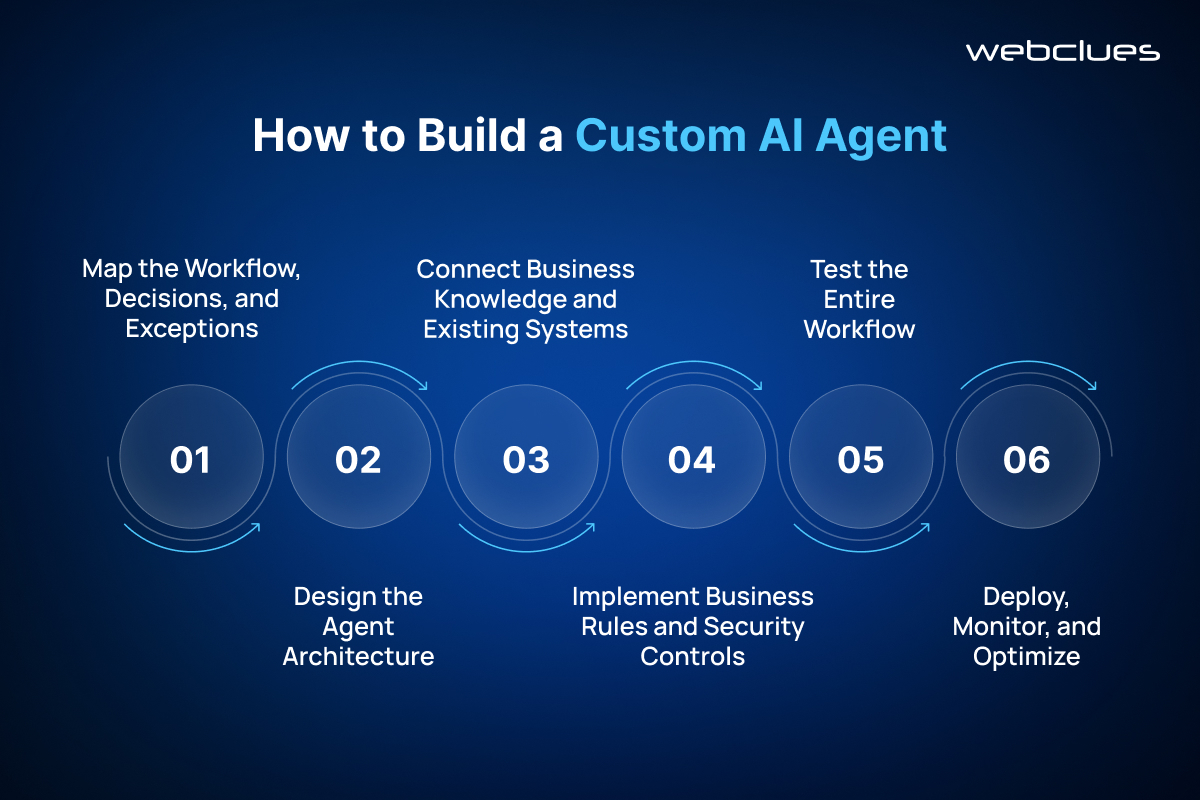
A structured implementation process reduces the risk of developing an agent that performs well in demonstrations but fails under real operating conditions.
Step 1: Map the Workflow, Decisions and Exceptions
Define the workflow's starting event, required inputs, expected outputs, decision points and completion conditions.
For each step, identify whether the agent must retrieve information, interpret unstructured data, select a tool, update a system, or request approval.
Also document exception paths. What happens if a required field is missing, an API is unavailable, two systems contain conflicting information, or the agent cannot confidently determine the next step?
The workflow specification should define when the agent can proceed independently and when it must stop and ask for human intervention.
Step 2: Design the Agent Architecture
Select the components needed to execute the workflow reliably.
A typical architecture may include an LLM, a tool-calling layer, a workflow orchestrator, a knowledge retrieval component, enterprise APIs and an evaluation and monitoring system.
Choose the model according to task complexity, accuracy requirements, latency, cost, data handling requirements and deployment constraints. A more expensive or complex model is not automatically the better choice.
Start with a single-agent design when one agent can manage the workflow and its tools effectively. Introduce multiple specialized agents only when distinct responsibilities, context boundaries, or independently managed tasks justify the additional coordination and failure modes.
The architecture should make it clear which component interprets a request, which component authorizes an action and which component verifies its completion.
Step 3: Connect Business Knowledge and Existing Systems
An agent's usefulness depends on access to the right information at the right time.
For internal documents, policies, product information and procedural guidance, retrieval-augmented generation (RAG) can help the agent retrieve relevant content and provide grounded responses.
For live operational information, such as current order status or account ownership, direct queries to the appropriate system may be more suitable. RAG should not replace authoritative transactional systems when current records are required.
Integrate systems through documented APIs, approved connectors and narrowly scoped tools. Examples include retrieving a CRM record, checking an order, creating a support ticket, or drafting an internal report.
Before connecting systems, define data ownership, authentication, authorization, error handling and the records the agent is allowed to access or modify.
Step 4: Implement Business Rules and Security Controls
AI-generated decisions should not bypass established business controls.
Apply least-privilege access so that the agent receives only the permissions needed for its assigned tasks. Validate inputs, constrain tool parameters, protect sensitive information and enforce authorization checks outside the model.
High-impact operations—such as approving payments, changing access permissions, or making consequential account changes—may require explicit human approval.
The system should also handle prompt injection, including malicious instructions embedded in user inputs or retrieved documents. Retrieved content must be treated as data, not as authority to override system policies.
For further implementation guidance, consult the OWASP AI Agent Security Cheat Sheet.
Step 5: Test the Entire Workflow
Testing should evaluate the complete process, including retrieval, tool selection, authorization, execution, error handling and final-state verification.
Build a representative evaluation dataset covering normal cases, incomplete requests, ambiguous instructions, conflicting information, unauthorized actions and unavailable services.
Test whether the agent completes the intended task—not merely whether its response sounds correct. For example, if an agent claims to have updated a CRM record, the application should verify that the record actually changed as intended.
Evaluate task success, factual accuracy, unauthorized action attempts, escalation quality, latency and cost. Include adversarial testing to assess whether untrusted inputs can manipulate the agent into exceeding its permissions.
Step 6: Deploy, Monitor and Optimize
Start with a limited deployment or controlled pilot. Define which users can access the agent, which actions it can execute and which operations require review.
Monitor execution traces, tool calls, errors, escalations, token consumption, latency and task outcomes. Maintain appropriate audit records for sensitive actions and protect the logs from exposing unnecessary personal or confidential information.
Review AI agent production failures and update evaluation datasets as new edge cases emerge. Model changes, prompt revisions, data updates and integration changes should be tested before release.
Production readiness is an ongoing process. An agent should remain subject to operational ownership, security reviews, regression testing and incident response procedures.
Example: Building an AI Sales Agent That Qualifies and Routes Leads
Consider a B2B company that receives leads through its website, marketing campaigns and partner referrals. Sales representatives spend time researching companies, checking qualification criteria, updating CRM records and deciding who should follow up.
A custom AI sales agent could coordinate these tasks within a controlled workflow.
Workflow and System Integrations
When a new lead arrives, the agent could:
- Retrieve the submitted form details and relevant CRM records.
- Check approved company information sources to enrich the lead.
- Extract relevant details, such as company size, industry and stated business need.
- Compare the available information against predefined qualification criteria.
- Update permitted CRM fields and recommend a routing category.
- Notify the appropriate sales representative or request review when information is incomplete.
The CRM remains the system of record. The agent supports the workflow rather than replacing the CRM's authorization and data validation mechanisms.
Permissions, Exceptions and Human Handoffs
The agent should not invent missing company information or treat an uncertain qualification score as a verified fact.
If company details conflict, the required fields are missing, or the lead falls outside established criteria, the workflow should route the record for review.
Its permissions might allow reading selected lead fields, updating approved enrichment fields and creating a follow-up task. Deleting records, changing access controls, or sending unapproved external communications should remain restricted.
How to Measure Workflow Success
Evaluate the workflow against its previous performance. Relevant measures include time from lead submission to routing, completeness of CRM records, qualification agreement with sales reviewers, correction rates and the proportion of leads requiring manual intervention.
The purpose is to improve the lead management process without introducing inaccurate records or unreviewed decisions. The same design principle applies to support operations, procurement, finance and internal knowledge workflows.
How to Evaluate Custom AI Agent Performance and Security
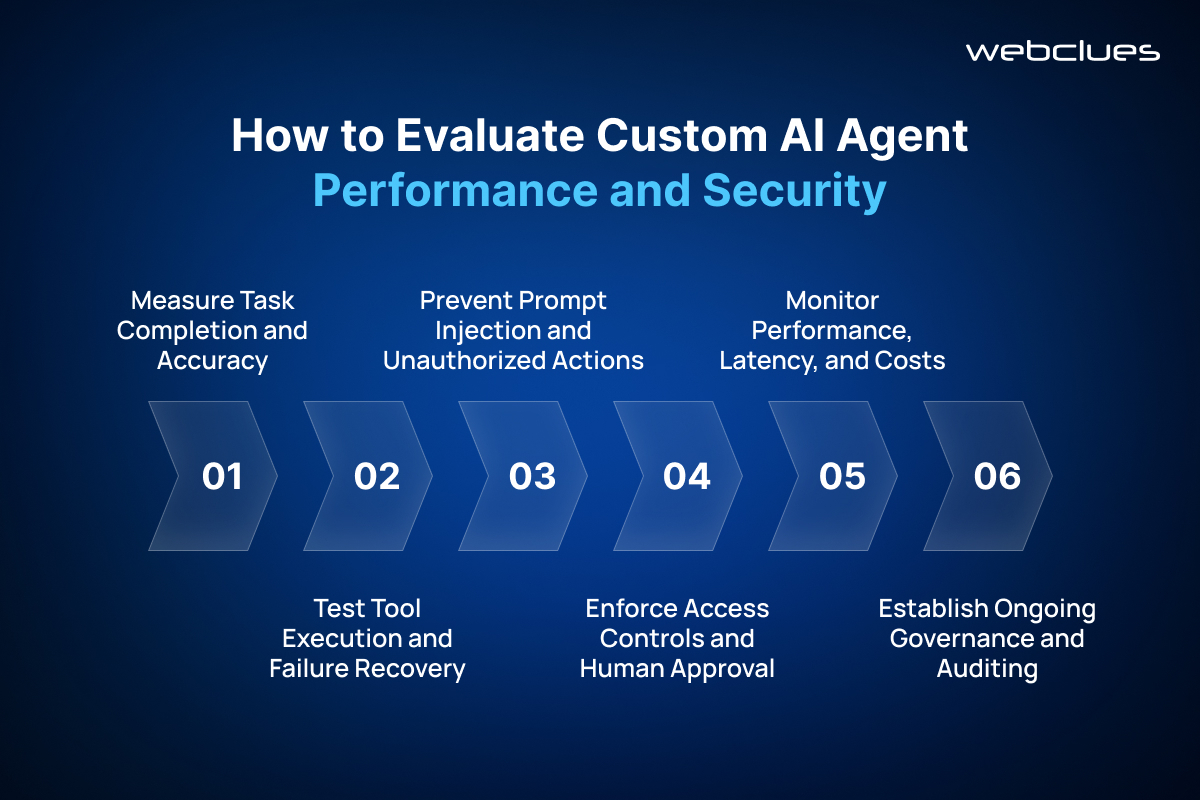
An enterprise agent needs explicit performance and governance criteria before it can be trusted with operational work.
Measure Task Completion, Not Just Response Accuracy
A response can be factually correct while the workflow remains incomplete. Evaluation should therefore cover the entire chain from the initial request to the verified business outcome.
Track successful task completion, incorrect or duplicate actions, tool failures, recovery behavior, escalation rates, response latency and cost per completed task. Compare results against a baseline and test across representative business scenarios.
OpenAI's A Practical Guide to Building Agents provides additional guidance on agent design, tool use and guardrails.
Control Prompt Injection and Excessive Agency
Security should be enforced at the application and integration layers, not entrusted to the model alone.
Use scoped credentials, server-side authorization, input validation, output constraints and approval gates for consequential actions. Treat external documents, emails and retrieved web content as untrusted inputs.
Where possible, make actions idempotent, implement bounded retries and verify system state after execution. These controls help reduce duplicate operations and make failures easier to investigate.
Establish Ongoing Monitoring and Governance
Assign clear ownership for the agent's business purpose, technical operation, access permissions and incident handling.
Define acceptable performance thresholds, escalation rules, data retention requirements and release procedures. Review access when business responsibilities change and reassess the agent when its tools, model, or workflow are modified.
Custom AI Agent Development vs. Off-the-Shelf Platforms
Custom development is not the default answer for every organization. The decision depends on workflow complexity, integration needs, control requirements and the total cost of ownership.
When a Configurable Platform Is Enough
An off-the-shelf agent platform or low-code builder may be sufficient when the workflow is common, the required connectors already exist and the platform meets the organization's security and governance requirements.
This approach can reduce initial engineering effort and help teams validate a use case before committing to a more tailored implementation.
When Custom Development Is Worth Considering
Custom development becomes more relevant when the workflow relies on proprietary business logic, specialized integrations, complex permissions, nonstandard data flows, or deployment constraints that a configurable platform cannot meet.
It can also provide greater control over evaluation, application behavior, infrastructure and future changes. Those benefits must be weighed against the engineering and maintenance responsibilities involved.
Compare Total Cost and Operational Ownership
Compare solutions using more than the initial development quote. Consider model and infrastructure usage, integration work, licensing, data preparation, testing, monitoring, security reviews, human oversight and ongoing maintenance.
A sensible business case compares the expected operational value with the full cost of running and governing the workflow. It should account for review effort, error correction and failure recovery—not only the number of tasks automated.
What Determines the Cost of Custom AI Agent Development?
The cost of custom AI agent development varies with the workflow's complexity and the level of production readiness required. A narrowly scoped internal assistant is materially different from an AI agent use that updates multiple enterprise systems or executes sensitive transactions.
Key cost drivers include:
- Workflow complexity: The number of decision points, exceptions and handoffs.
- Integration requirements: The availability, quality and complexity of APIs and data sources.
- Knowledge preparation: Document processing, retrieval design, data permissions and content quality.
- Model selection and usage: Model capability, request volume, context size and inference costs.
- Security and compliance: Identity management, authorization, auditability and approval requirements.
- Testing and deployment: Evaluation datasets, load testing, monitoring, infrastructure and release processes.
- Ongoing operations: Maintenance, model updates, incident response and performance optimization.
The most reliable estimate follows workflow discovery and technical assessment. A proof of concept can help validate feasibility and expose integration or data constraints before a broader production investment.
WebClues Infotech offers an 80-hour AI proof-of-concept engagement focused on use-case validation, data assessment, prototyping, performance testing, value validation and production planning. The scope should be agreed in advance; validating a use case is not the same as completing a production-ready enterprise deployment.
How to Choose a Custom AI Agent Development Company
An AI agent development partner should demonstrate an understanding of both AI engineering and the business process the agent is expected to improve.
Assess Workflow Discovery and Integration Expertise
Ask how the team evaluates workflow suitability, identifies exceptions, selects models and determines whether RAG, direct system queries, conventional automation, or a hybrid architecture is appropriate.
Review its approach to integrating existing CRM, ERP, support and internal data systems. The partner should explain how permissions, data quality and system ownership affect the proposed design.
Request Evidence of Testing, Security and Monitoring
Ask how the team measures task completion, tests failure scenarios, prevents unauthorized actions and verifies that tool calls produce the intended outcome.
The proposal should address prompt injection, access controls, audit records, production monitoring and regression testing not just model selection and a demonstration.
Define Deliverables, Acceptance Criteria and Post-Launch Support
Before signing a contract, document the workflow scope, integration requirements, deliverables, acceptance tests, source-code ownership, deployment responsibilities and support arrangements.
Agree on measurable success criteria and define what happens when the agent fails, escalates a case, or encounters an unsupported request. These details reduce ambiguity during implementation and handover.
Build a Custom AI Agent Around Your Business Workflow
A successful AI agent begins with a clearly defined operational problem. The model matters, but so do the systems it can access, the rules it must follow, the exceptions it can handle and the evidence used to verify its results.
For enterprise teams, the practical route is to validate one suitable workflow, establish measurable acceptance criteria, test the integration and security boundaries and expand only when the evidence supports it.
WebClues Infotech, your leading AI agent development company, helps businesses evaluate and implement custom AI solutions around their workflows, data and existing systems.
Discuss your enterprise AI project with WebClues Infotech to explore a suitable use case, integration requirements and a scoped proof of concept.
Post Author

Nikhil Patel
Nikhil Patel, a visionary Director at WebClues Infotech, specializes in leveraging emerging tech, particularly Generative AI, to improve corporate communications. Through his insightful blog posts, he empowers businesses to succeed digitally.


Build Your Agile Team
Hire Skilled Developer From Us
Looking to automate complex business workflows?
WebClues Infotech builds custom AI agents tailored to your processes, data, and existing systems. From workflow automation to enterprise integrations, we help turn AI opportunities into practical solutions. Discuss your AI agent development project with our team.
Connect with usFrequently Asked Questions
Our Recent Blogs
Sharing knowledge helps us grow, stay motivated and stay on-track with frontier technological and design concepts. Developers and business innovators, customers and employees - our events are all about you.