
Connect with us


Corporate Video

Top 15 AI Integration Companies in the UK [2026]
Summary: Choosing the right AI integration company requires more than comparing AI development portfolios. Businesses need a partner that can connect artificial intelligence with existing ERP, CRM, supply chain management (SCM), databases, APIs and operational workflows. This guide compares 15 AI integration companies serving the UK market, explains their potential strengths and outlines how to evaluate technical capabilities, security, implementation requirements and long-term support.
What Are AI Integration Services?
AI integration services connect artificial intelligence capabilities with an organisation's existing applications, data sources and business processes. The objective is to make AI useful within real workflows rather than leaving it isolated in a standalone application or proof of concept.
For example, an AI assistant might retrieve customer information from a CRM, check order status through an ERP and prepare a response within a customer service platform. A supply chain solution might combine historical sales, inventory and supplier information to support forecasting and purchasing decisions.
Typical AI integration services include:
- Enterprise application integration: Connecting AI with ERP, CRM, SCM, HR and finance platforms.
- API and middleware development: Establishing controlled communication between AI models and business applications.
- Data integration: Preparing structured and unstructured information for AI applications.
- Generative AI and RAG integration: Connecting language models with approved company knowledge and documents.
- AI workflow automation: Incorporating AI into existing approval, service and operational processes.
- Legacy system integration: Introducing AI capabilities without necessarily replacing established software.
- Deployment and monitoring: Testing, securing and maintaining integrations in production.
The distinction matters because a capable AI model does not automatically produce a dependable business application. Data access, permissions, application compatibility, validation and error handling all influence the outcome.
The UK government's UK Business Data Survey 2026 found that 41% of surveyed businesses handling digitised data used AI for at least one purpose. Among businesses using AI, 21% reported that their AI tools were integrated into existing business systems. The survey also found higher integration rates among large businesses. These findings suggest that AI adoption and operational integration are different stages of implementation.
How We Evaluated These AI Integration Companies
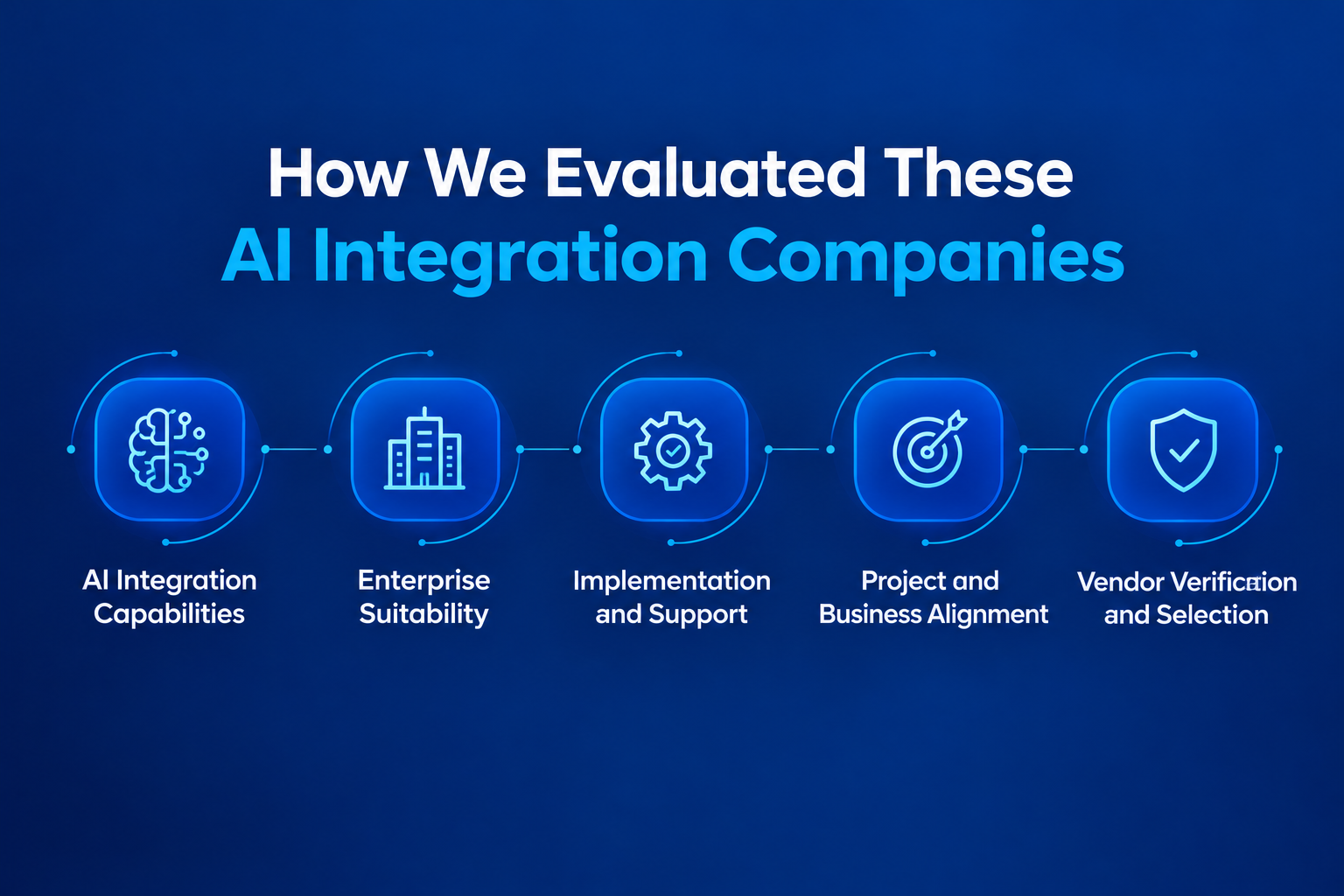
This editorial shortlist considers the relevance of each company's publicly described AI, software engineering, enterprise technology or integration services. It also considers the kinds of projects a buyer might evaluate the provider for.
The comparison uses five practical criteria:
- Integration capabilities: Evidence of work involving enterprise applications, APIs, data platforms, AI systems or custom software.
- Enterprise fit: Potential suitability for complex technology environments and established business processes.
- Implementation approach: Relevance to architecture, engineering, deployment and ongoing operations.
- Project alignment: Whether the provider appears better suited to large transformation programmes, bespoke development or applied AI projects.
- Buyer considerations: The questions a prospective customer should resolve before selecting a provider.
The order is an editorial shortlist, not an independently audited ranking by revenue, customer satisfaction or project performance. Capabilities and delivery arrangements should be confirmed directly with each company before procurement.
Leading AI Integration Companies in the UK 2026
The top AI integration companies in the UK in 2026 include WebClues Infotech, IBM Consulting, Accenture, Capgemini and other leading technology providers. They help businesses integrate AI with existing applications, enterprise systems, data platforms and workflows. The best choice depends on your integration needs, budget, security requirements and business goals.
1. WebClues Infotech: Best for Custom AI Integration and Enterprise Workflows
WebClues Infotech provides AI development and integration services for businesses looking to introduce AI into existing technology environments. Its published service offering includes CRM and ERP integration, AI API integration, SaaS integration, database integration and legacy system modernisation.
The company's approach is relevant to organisations that need AI to work with existing applications instead of replacing their established technology stack. Potential project areas include internal knowledge assistants, document processing, workflow automation and AI-enabled business applications.
WebClues also publishes guidance on enterprise AI integration, covering the role of ERP, CRM and SCM systems in connected business processes.
Best suited for: Businesses evaluating custom AI solutions that must interact with existing software, data and operational workflows.
What to verify: Ask for an architecture proposal covering the exact systems involved, supported integration methods, data permissions, testing strategy and post-deployment support. Confirm relevant delivery experience against your specific use case.
2. IBM Consulting: Best for Enterprise AI Orchestration
IBM Consulting offers AI integration services focused on coordinated AI-powered workflows, enterprise platforms, orchestration and governance.
This is relevant to large organisations adopting AI across multiple departments or platforms. Where different applications and AI agents operate independently, an integration strategy must establish how they exchange information, respect permissions and coordinate actions.
IBM's published offering, Enterprise Advantage, addresses the design of enterprise AI platforms and coordinated workflows.
Best suited for: Organisations with complex enterprise environments, multiple AI initiatives and formal governance requirements.
What to verify: Clarify platform dependencies, implementation scope, integration with existing systems and the operating model required after deployment.
3. Accenture: Best for Large-Scale AI Transformation
Accenture is a global consulting and technology services provider that organisations can evaluate when AI integration forms part of a wider business transformation.
Large transformation programmes may require coordinated changes to enterprise applications, data architecture, operating processes and employee workflows. The integration work can therefore extend beyond developing an AI component.
Accenture may be relevant when an organisation needs to assess AI implementation alongside a broader technology change programme.
Best suited for: Large enterprises planning multi-function AI adoption or enterprise-wide technology transformation.
What to verify: Establish whether the proposed engagement includes hands-on integration engineering, which platforms are covered, how delivery will be phased and what resources your internal teams must provide.
4. Capgemini: Best for Application Integration and Modernisation
Capgemini UK explicitly offers application integration, API services and AI-powered integration capabilities.
Its published services include integration strategy, platform modernisation, enterprise systems integration and the use of APIs and integration frameworks to connect systems such as CRM, ERP and supply chain platforms.
This makes Capgemini relevant to organisations that need to modernise how applications communicate while introducing AI into existing workflows.
Best suited for: Businesses combining AI integration with application modernisation, API management or enterprise integration programmes.
What to verify: Assess how the proposed architecture will work with your existing integration platforms, how dependencies will be managed and how the organisation will maintain the resulting interfaces.
5. Deloitte: Best for AI Strategy and Enterprise Engineering
Deloitte UK offers engineering, AI and data services that cover technology transformation, platform modernisation and AI-enabled business processes.
Deloitte may be worth evaluating when AI integration requires coordination between business strategy, data engineering, application development and operational change.
For example, a business may need to redesign a customer service workflow before integrating a generative AI assistant into its CRM and support platform.
Best suited for: Organisations requiring strategic consulting alongside engineering, data and operational transformation.
What to verify: Separate advisory deliverables from implementation deliverables. Confirm who will build the integrations, who owns production support and how success will be measured.
6. Cognizant: Best for Enterprise Technology Integration
Cognizant UK provides technology modernisation and transformation services, including AI-focused offerings.
For businesses with established application estates, AI integration may involve connecting new capabilities to existing systems, improving data flows and adapting operational processes. Cognizant is a potential candidate when these activities form part of a wider enterprise technology programme.
Best suited for: Enterprises evaluating AI alongside application modernisation and business process transformation.
What to verify: Request examples relevant to your industry and application environment. Confirm the delivery team's experience with your required systems, integration architecture and operational constraints.
7. EPAM Systems: Best for Custom Software and AI Engineering
EPAM offers AI services spanning enterprise transformation, AI-native engineering and custom product development.
This engineering-led orientation can be relevant when AI must become part of an existing digital product or a specialised business application. The work may involve application architecture, data access, model integration and changes to the software development lifecycle.
Best suited for: Businesses integrating AI into custom applications, software products or complex digital platforms.
What to verify: Establish how the proposed solution will fit the existing codebase, deployment environment, security controls and software maintenance process.
8. HCLTech: Best for Enterprise IT Modernisation
HCLTech is a global technology services provider that organisations can evaluate for enterprise technology transformation and AI-related programmes.
Where legacy infrastructure, cloud services and established business applications coexist, AI implementation must account for compatibility, access controls, operational reliability and system dependencies.
Best suited for: Large organisations considering AI as part of broader IT modernisation.
What to verify: Ask which components will be reused, replaced or connected and whether the proposed architecture can support the required performance, availability and data governance.
9. Tata Consultancy Services (TCS): Best for Large Enterprise Programmes
TCS provides enterprise technology and transformation services across business and IT environments.
For organisations with multiple business units, AI integration can involve coordinating applications, data sources and operational processes across different locations. Such projects require clear ownership, standardised interfaces and a realistic migration or rollout plan.
Best suited for: Enterprises evaluating AI integration within a large technology transformation programme.
What to verify: Define the first implementation scope carefully. Confirm the project team, system responsibilities, delivery milestones and approach to coordinating dependencies across business units.
10. Infosys: Best for Enterprise AI and Cloud Integration
Infosys provides enterprise technology services spanning AI, cloud and application-related transformation.
Organisations considering AI integration alongside cloud modernisation or enterprise application changes may find this combination relevant. However, the right engagement depends on the existing platforms and the degree of custom development required.
Best suited for: Businesses connecting AI initiatives with cloud, data and enterprise application programmes.
What to verify: Confirm the integration patterns, cloud and model dependencies, data movement requirements and ongoing operating costs for the proposed solution.
11. Thoughtworks: Best for Modern Software and Data Architecture
Thoughtworks is a technology consultancy with an engineering-led approach to software, data and digital transformation.
AI integration projects benefit from sound software architecture because model endpoints, data services and business applications must work together reliably. Architecture decisions also affect maintainability, testing and the ability to change components later.
Best suited for: Organisations prioritising software architecture, engineering quality and maintainable AI-enabled applications.
What to verify: Ask how the proposed integration will be tested, documented and maintained and how the team will avoid creating unnecessary dependencies between systems.
12. BJSS: Best for Technology Consulting and Software Delivery
BJSS provides technology consulting and software delivery services that businesses can evaluate when implementing AI within broader digital programmes.
An AI feature may require changes to application interfaces, data services, identity management and deployment pipelines. Engineering-led delivery is particularly relevant when these changes need to fit an established product or platform.
Best suited for: Organisations looking for technology consulting and custom software delivery around AI-enabled applications.
What to verify: Determine whether the proposed team covers the full integration lifecycle, including production deployment, monitoring, documentation and support.
13. AND Digital: Best for Digital Product Engineering
AND Digital works with organisations on digital products, technology capabilities and software delivery.
For businesses adding AI to an existing product, integration is not only a model-selection exercise. It may require changes to user journeys, application services, data access and employee workflows.
Best suited for: Organisations embedding AI into digital products or improving existing software experiences.
What to verify: Ask how the integration will fit the product roadmap, how user adoption will be assessed and which components the internal team will be able to maintain.
14. Softwire: Best for Bespoke Software Integration
Softwire is a software engineering consultancy that can be considered for custom application development and complex software delivery requirements.
Bespoke integration can be important when a business uses proprietary software, specialised workflows or applications that do not fit a standard connector-based approach.
Best suited for: Businesses requiring custom engineering to connect AI capabilities with existing applications or specialised workflows.
What to verify: Request a technical design explaining how the solution will connect to current systems, handle failures and remain maintainable as those systems evolve.
15. Faculty: Best for Applied AI Projects
Faculty is an applied AI company that organisations can evaluate when a project requires specialist AI expertise and implementation planning.
Some business problems depend heavily on model selection, data analysis, decision support or domain-specific AI methods. These projects still require integration with the applications and processes where recommendations or outputs will be used.
Best suited for: Organisations with complex applied AI problems that need a close connection between AI capability and business decisions.
What to verify: Confirm the team's experience with your specific use case and establish whether the engagement includes enterprise application integration, production deployment and ongoing operational support.
How to Choose an AI Integration Partner
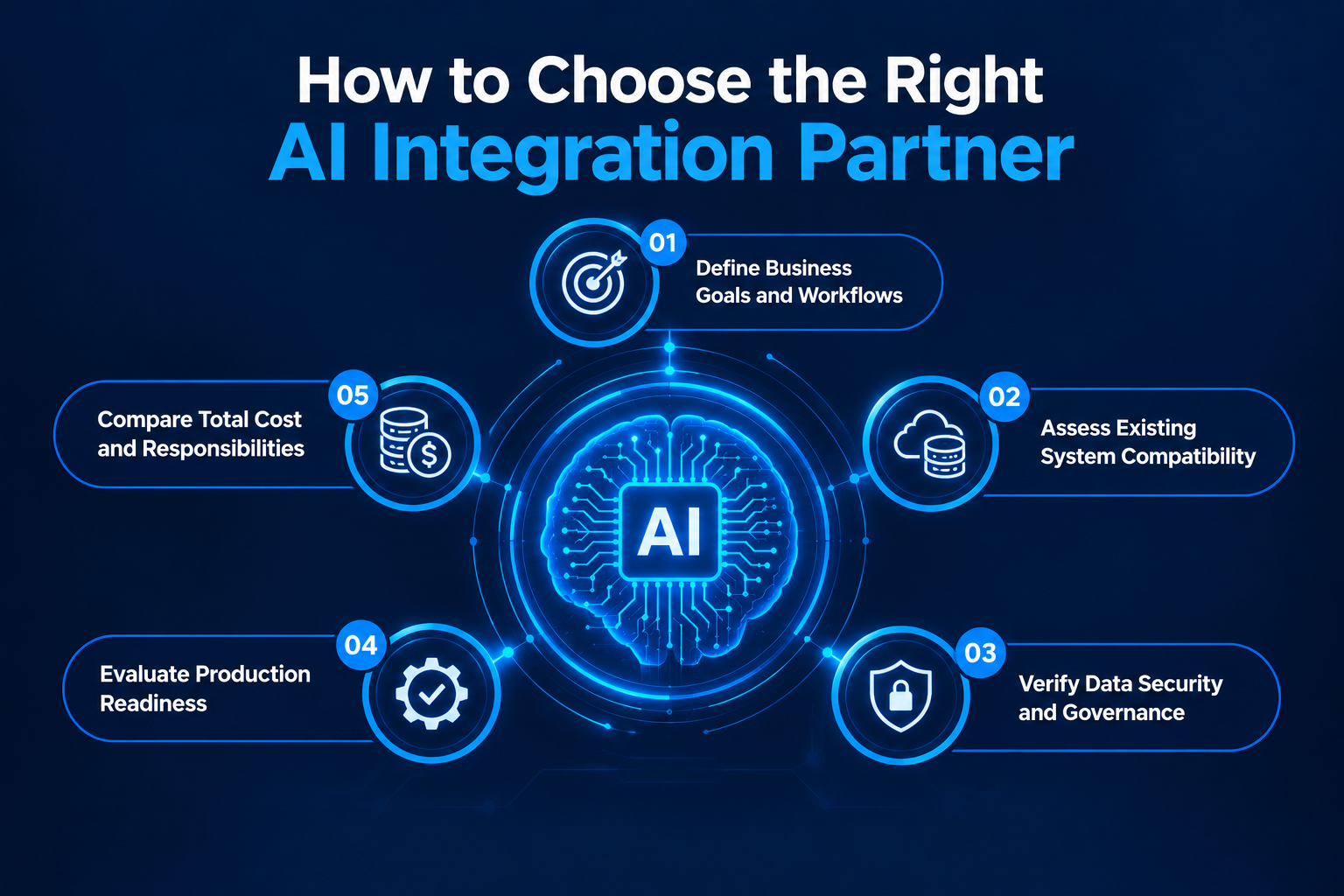
The right AI integration company is the one that can solve your business problem within your technical, security and operational constraints. Use the following criteria to compare proposals.
1. Start With the Business Workflow
Define the process you want to improve before selecting a model or platform.
For example, a customer service team might need to reduce manual case research. The integration scope could involve retrieving account history from a CRM, searching approved support documents and preparing a response for an employee to review.
Define the current baseline and the intended result. Depending on the use case, relevant measures could include handling time, error rates, manual effort, resolution time or cost per completed task.
2. Check Experience With Your Existing Systems
Ask potential vendors how they will connect to your actual applications.
Important considerations include API availability, authentication, data formats, rate limits, update frequency and write permissions. Older applications may require middleware, controlled file exchanges or custom connectors.
An AI integration service provider should explain why its proposed integration method fits your environment rather than recommending a platform without considering existing constraints.
3. Evaluate Data Security and Governance
Determine what data the AI system will access, where processing will occur and which parties can access the information.
Review identity management, least-privilege permissions, logging, retention, encryption, data residency requirements and third-party model terms. For UK organisations processing personal data, assess applicable data protection obligations and consult the Information Commissioner's Office guidance.
Ask how the system prevents users from retrieving information they are not authorised to see. For AI agents, also define which actions require human approval and how errors can be reversed.
4. Confirm Production Readiness
A successful demonstration does not prove that an integration will remain reliable under real workloads.
The vendor should explain its approach to integration testing, access control, failure recovery, monitoring, model evaluation, version changes and incident handling.
For systems that update business records, define validation rules and approval requirements before allowing automated write-back.
5. Compare Total Cost and Delivery Responsibilities
Compare proposals on more than initial development fees. Consider integration development, cloud infrastructure, model usage, third-party software, testing, security reviews, monitoring, maintenance and future changes.
Also clarify who owns the code, integration documentation, deployment configuration and operational knowledge. The commercial proposal should identify assumptions, exclusions, acceptance criteria and responsibilities for ongoing support.
Common AI Integration Challenges
AI integration projects often face data quality issues, legacy-system compatibility problems, unreliable outputs and ongoing maintenance challenges that require careful planning and monitoring.
Inconsistent Data and Restricted Access
AI output depends on the information available to the system. Conflicting records, outdated documents and incomplete data can undermine otherwise capable models.
Start by identifying authoritative data sources, defining access rules and establishing how information will be refreshed. Where possible, validate outputs against source records before using them in operational decisions.
Legacy-System Compatibility
Older software may lack modern APIs or reliable documentation. Replacing it can be expensive and disruptive, but connecting to it without a clear interface can introduce maintenance risks.
Possible approaches include API wrappers, middleware, scheduled data exchanges and controlled robotic process automation. The right method depends on system stability, transaction requirements and the need for current data.
WebClues explains this approach in its guide to AI implementation with legacy systems.
Unreliable Outputs and Excessive Automation
Generative AI can return incorrect or incomplete answers. An AI agent can also take an unsuitable action if its instructions, context or tool permissions are poorly defined.
Use output validation, constrained tool access, human review for consequential decisions and clear escalation paths. Start with a limited scope, evaluate performance against representative cases and expand autonomy only when the evidence supports it.
Monitoring and Ongoing Maintenance
Integration requirements change when APIs, models, data structures or business processes change.
Production systems therefore need monitoring for failed requests, latency, permission errors, data quality issues and unexpected model behaviour. Assign clear ownership for incident response, updates and performance review.
Choose the Right AI Integration Partner
The most suitable AI integration company is not necessarily the largest provider or the one with the broadest AI portfolio. It is the partner that understands your systems, can design a secure, maintainable integration, and can show how the implementation will improve a defined business process.
For UK businesses, the next step is to identify the workflow, map the relevant data and applications and evaluate vendors against clear technical and operational requirements. Contact us to discuss custom AI integration, enterprise application connectivity and AI implementation aligned with your existing technology environment.
Post Author

Nikhil Patel
Nikhil Patel, a visionary Director at WebClues Infotech, specializes in leveraging emerging tech, particularly Generative AI, to improve corporate communications. Through his insightful blog posts, he empowers businesses to succeed digitally.


Build Your Agile Team
Hire Skilled Developer From Us
Ready to Integrate AI Into Your Business Systems?
Connect your ERP, CRM, databases and business workflows with custom AI solutions built around your operational needs. Talk to WebClues Infotech to explore your integration requirements, technical feasibility and implementation roadmap.
Connect with usFrequently Asked Questions
Our Recent Blogs
Sharing knowledge helps us grow, stay motivated and stay on-track with frontier technological and design concepts. Developers and business innovators, customers and employees - our events are all about you.